-
-
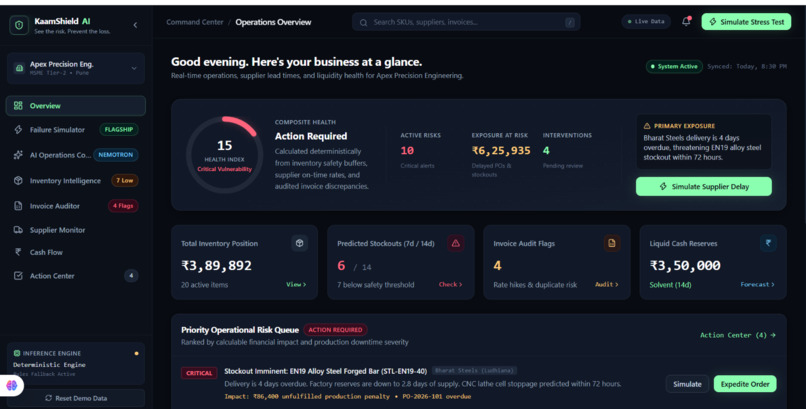
AI-powered platform helping MSMEs predict stockouts, monitor suppliers, detect invoice risks, forecast cash flow, and prevent losses.
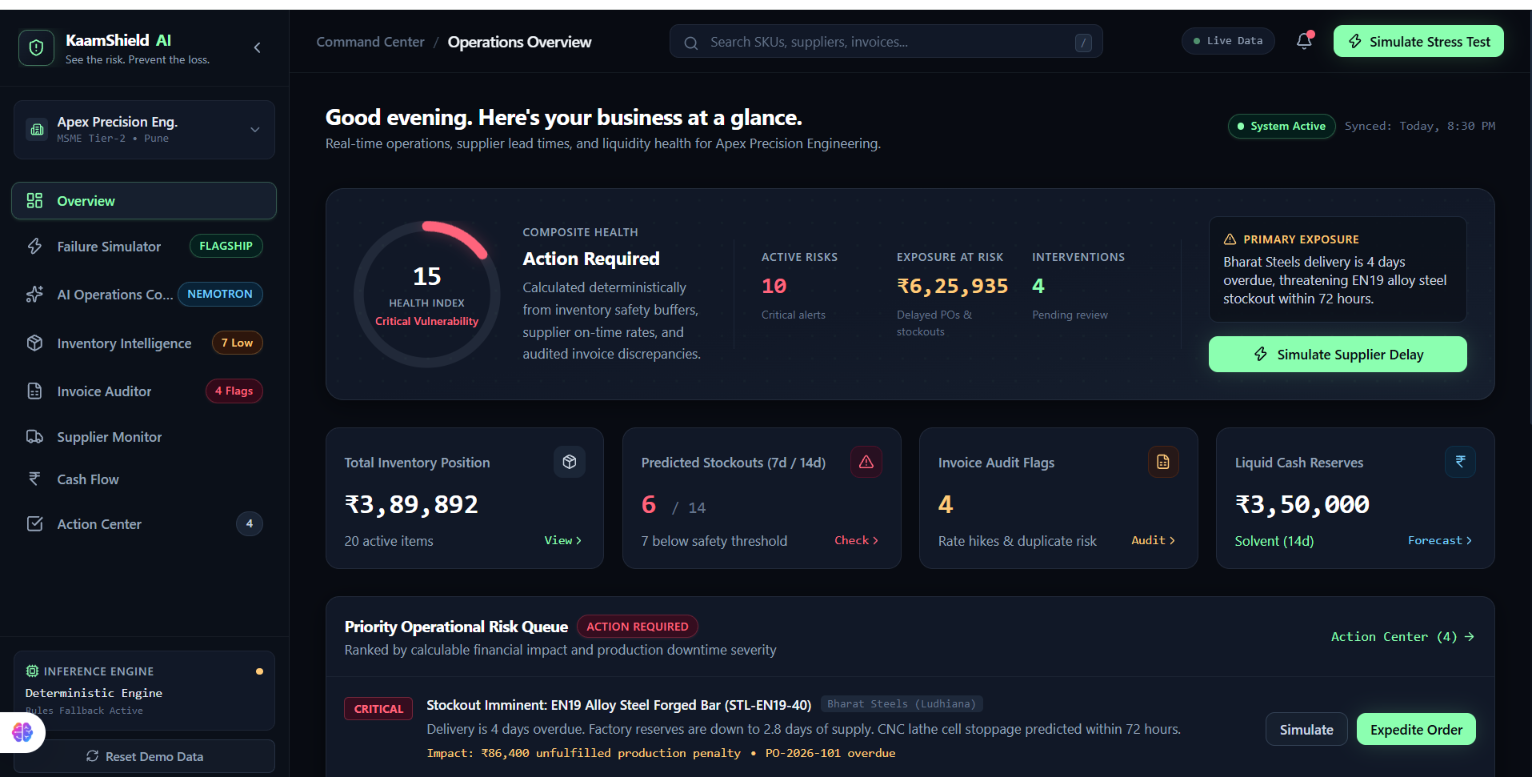
KaamShield AI — See the Risk. Prevent the Loss.
Inspiration
Small manufacturers and micro, small, and medium enterprises (MSMEs) often operate with limited resources, tight cash flow, and complex supplier relationships. A delayed shipment, an unexpected inventory shortage, a duplicate invoice, or a late customer payment can quickly turn into a major business problem.
We were inspired by a simple question: What if a business could identify a problem before it causes a loss?
Many businesses rely on spreadsheets, manual tracking, and experience to make critical decisions. We envisioned an AI-powered business co-pilot that helps them move from reacting to problems toward predicting and preventing them.
What We Built
KaamShield AI is an AI-powered operations intelligence platform designed to help small manufacturers make smarter, data-driven decisions.
The platform brings several important business functions into one dashboard:
- Inventory Intelligence: Identify potential stockouts and highlight products that need replenishment.
- Supplier Monitor: Track supplier reliability and flag potential delivery delays.
- Invoice Auditor: Identify invoice discrepancies and potential duplicate invoices for review.
- Cash-Flow Forecast: Help businesses anticipate cash shortages and upcoming payment pressure.
- Business Failure Simulator: Explore what-if scenarios, such as delayed suppliers, sudden demand increases, and late customer payments.
- AI Operations Copilot: Turn operational information into understandable insights and recommended next steps.
- Action Center: Prioritize risks so businesses can focus on the most urgent issues first.
Our goal is to make operational intelligence accessible to businesses that may not have dedicated data science or risk management teams.
How We Are Building It
We designed KaamShield AI around a practical, modular architecture. The proposed frontend uses Next.js, TypeScript, and Tailwind CSS to deliver a responsive business dashboard, while Python and FastAPI support backend logic and data processing. PostgreSQL or SQLite can store structured operational data, with Pandas and NumPy supporting analysis and forecasting.
For the AI layer, we plan to integrate NVIDIA Nemotron through Nebius infrastructure to interpret business context, explain detected risks, and generate actionable recommendations. This integration is an important part of the implementation and will be validated as the prototype develops.
A key design principle is that AI recommendations should be grounded in available business data. Financial calculations, inventory thresholds, and scenario assumptions should be handled transparently, rather than relying on AI-generated guesses.
What Makes It Different?
KaamShield AI is not intended to be just another dashboard displaying historical numbers. Its central idea is to help users understand what could go wrong, why it matters, and what they can do next.
The Business Failure Simulator is especially important to this vision. A business owner could explore questions such as:
- What happens if a critical supplier is delayed by seven days?
- Can we handle a sudden 25% increase in demand?
- What if a major customer pays two weeks late?
- How would an increase in supplier prices affect our working capital?
By comparing scenarios and their potential consequences, businesses can make better-informed decisions before committing resources.
Challenges We Anticipated
One of the main challenges is turning incomplete, inconsistent business records into useful insights. Real-world operational data may contain missing values, inconsistent product names, incorrect invoices, and unpredictable supplier lead times.
Another challenge is balancing AI flexibility with numerical accuracy. A language model can explain a risk, but financial totals, forecast calculations, and scenario comparisons must be validated using deterministic logic and reliable input data.
We also need to make recommendations understandable and actionable for users who may not have technical expertise. This means presenting clear explanations, prioritizing risks, and avoiding unsupported claims or false certainty.
What We Learned
This project reinforced the importance of designing AI around real user problems rather than adding AI simply for the sake of it.
We learned to think about data quality, transparent calculations, uncertainty, and the difference between identifying a possible risk and proving that a loss will occur. We also recognized that a useful AI product needs more than a model: it needs a reliable data pipeline, an understandable interface, and a clear path from insight to action.
Future Vision
Our vision is to make KaamShield AI a practical digital co-pilot for MSMEs, helping them protect working capital, manage suppliers, reduce operational surprises, and build more resilient businesses.
Over time, we aim to improve forecasting with historical data, add stronger anomaly detection, support integrations with accounting and inventory systems, and evaluate recommendations against real business outcomes.
KaamShield AI turns operational data into early warnings and better decisions—because preventing a business problem is often better than solving it after the damage is done.
Built With
- fastapi
- nebius-ai-cloud
- next.js
- numpy
- nvidia-nemotron
- pandas
- postgresql
- python
- recharts
- tailwind-css
- typescript

Log in or sign up for Devpost to join the conversation.