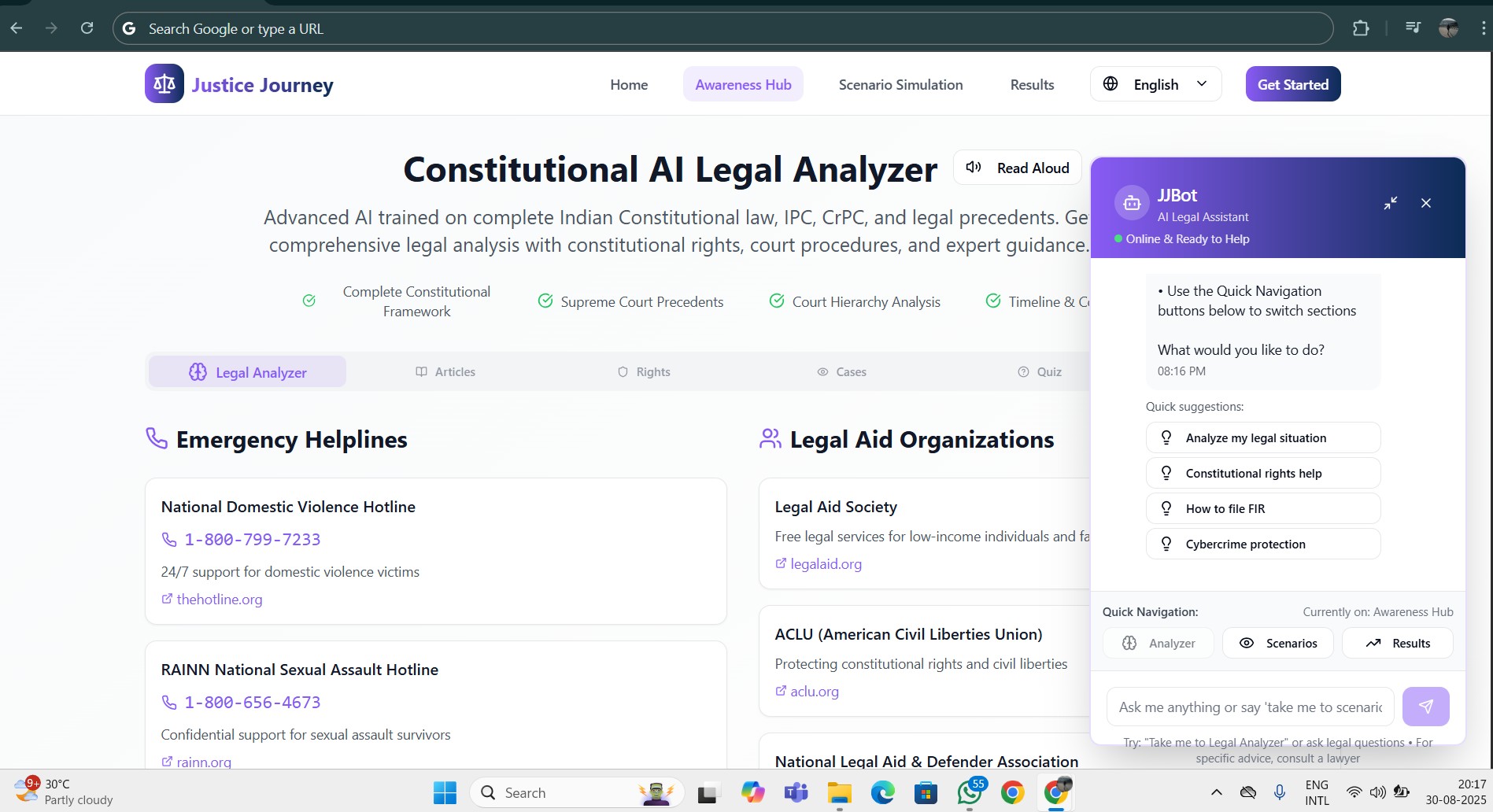
Inspiration Justice Journey was created with the thought about how many people, activists, and particularly young individuals from marginalized groups do not have any knowledge about the laws and legal rights which they have or the illegal acts which they may commit. The lack of legal astuteness awareness programs is evident and can be supported through the real life examples of people paying fines of petty offenses without knowledge of the legal framework, and the youth facing cyber bullying without any legal help. The aim was to create a platform that not only informs people about laws, but also allows them to experience laws through real-world scenario simulations which help make the learning experience immersive.
What We Learned While focusing on this specific project, we explored several concepts relevant to both technology and law: Legal knowledge simplification – Converting legal terms and expressions into everyday language so they can be understood and appreciated by ordinary people. AI and NLP integration – Implementation of Large Language Models (LLMs) and OpenAI Whisper for voice input and conversational legal learning. Design thinking – Emphasis on usability with scenario-based role play, where users act as victims, offenders, or law enforcers to better understand their rights and responsibilities. Tech stack skills – Using React.js for the web platform, Flutter for mobile applications, and Node.js + Supabase for backend and database management. SDG alignment – Ensuring our project aligns with Agenda 2030 and specifically Sustainable Development Goal 16: Peace, Justice, and Strong Institutions. We also worked on conditional logic and probability for decision trees, where the outcomes of a scenario depend on both the user’s role and their chosen action:
Outcome=f(Role,Action) Here, Role ∈ {Victim, Offender, Law Enforcer}, and each action within that role leads to a different legal explanation and consequence.
How We Built It Research & Case Studies – Identified common real-life legal issues (cyberbullying, petty theft, traffic violations). Content Simplification – Broke down law sections into plain language explanations with examples. Frontend Development – Built a cross-platform interface using React.js (web) and Flutter (mobile). Backend Development – Used Node.js and Supabase for user data, scenario storage, and role-based management. AI Integration – Integrated LLMs for natural conversation and Whisper for accurate voice recognition. Scenario Flow – Designed the flow: Select scenario → Choose role → Take action → Experience consequences → Receive AI explanation.
Challenges We Faced Complexity of laws – Making legal texts both simple and accurate without losing meaning. AI reliability – Preventing misleading or biased legal responses. Scalability – Balancing between free-tier services and system performance for a large user base. User engagement – Designing interactive scenarios that are realistic and not overly complicated. Multilingual support – Adapting content for regional languages without misinterpretation.
Conclusion Justice Journey is not just a tool but a movement for accessible justice. By combining AI, real-time simulations, and storytelling, we transformed legal learning into an immersive, interactive experience. It bridges the gap between abstract legal theory and real-world application, empowering individuals to understand their rights and responsibilities.
In the long run, we envision this platform as a scalable, low-cost solution to spread legal awareness widely, thereby contributing to a more informed, fair, and just society.


Log in or sign up for Devpost to join the conversation.