-
-
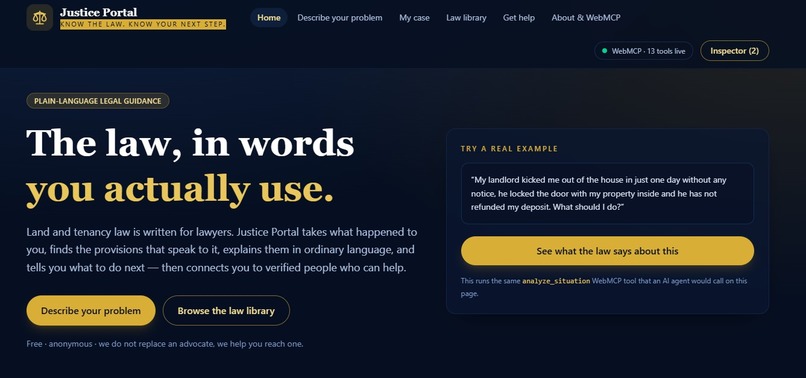
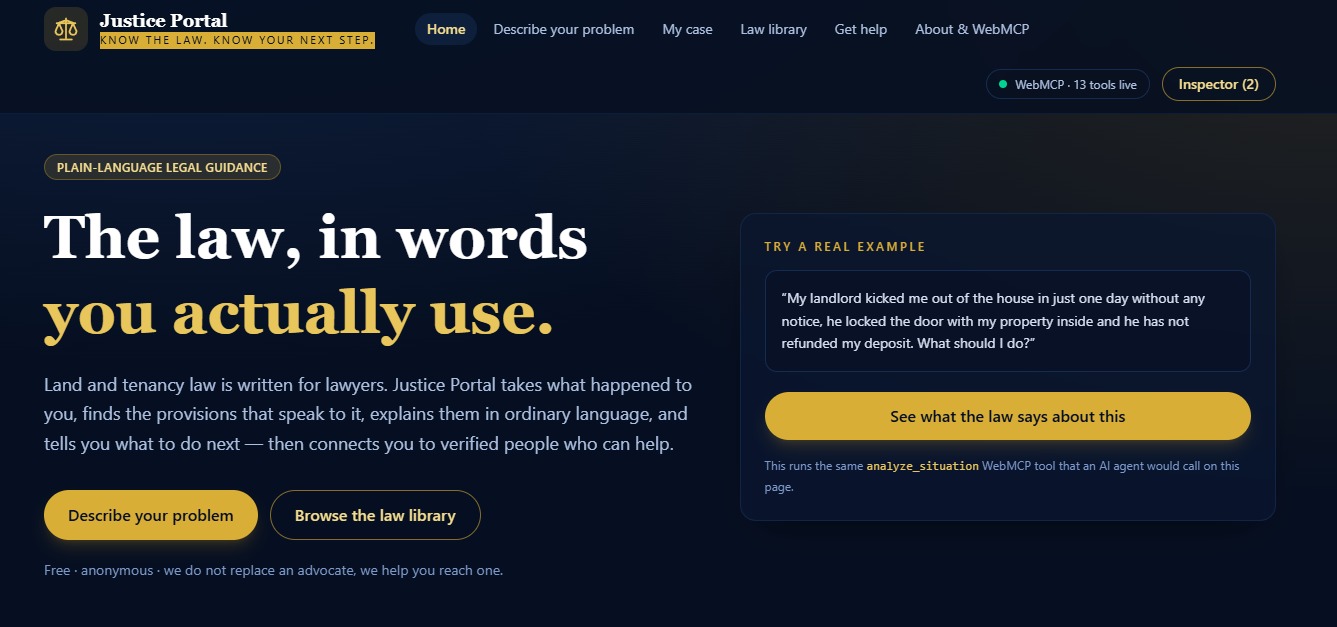
welcome page
-
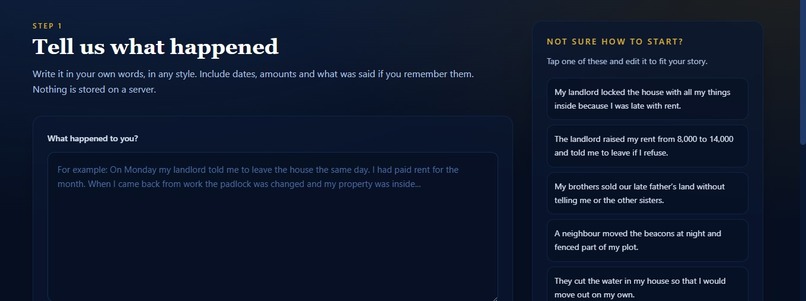
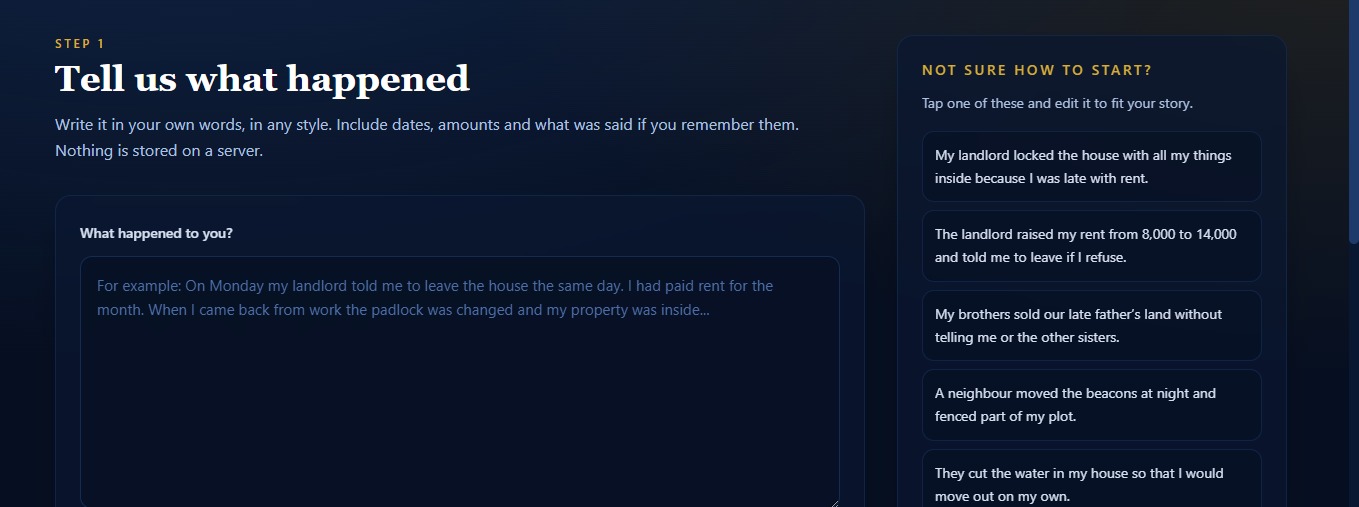
Describe your problem page
-
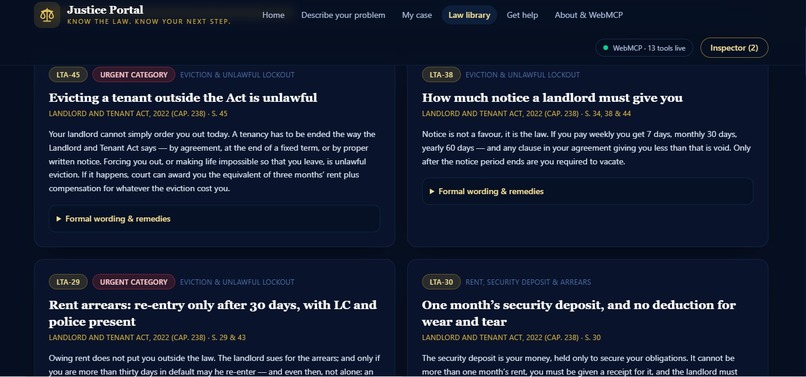
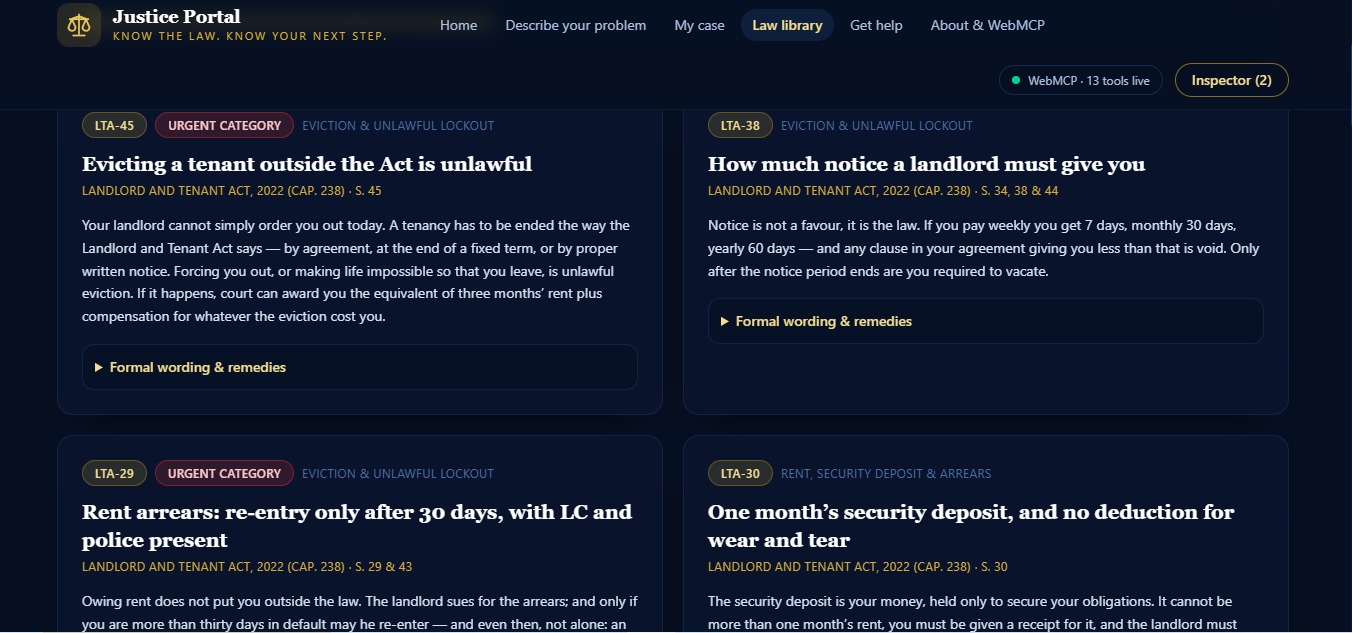
Law Library
-
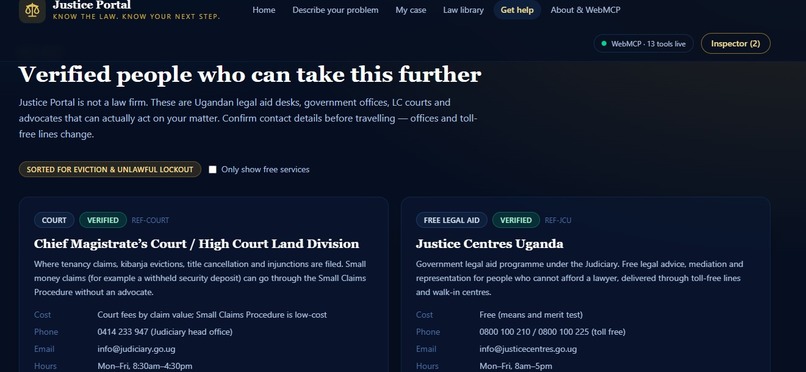
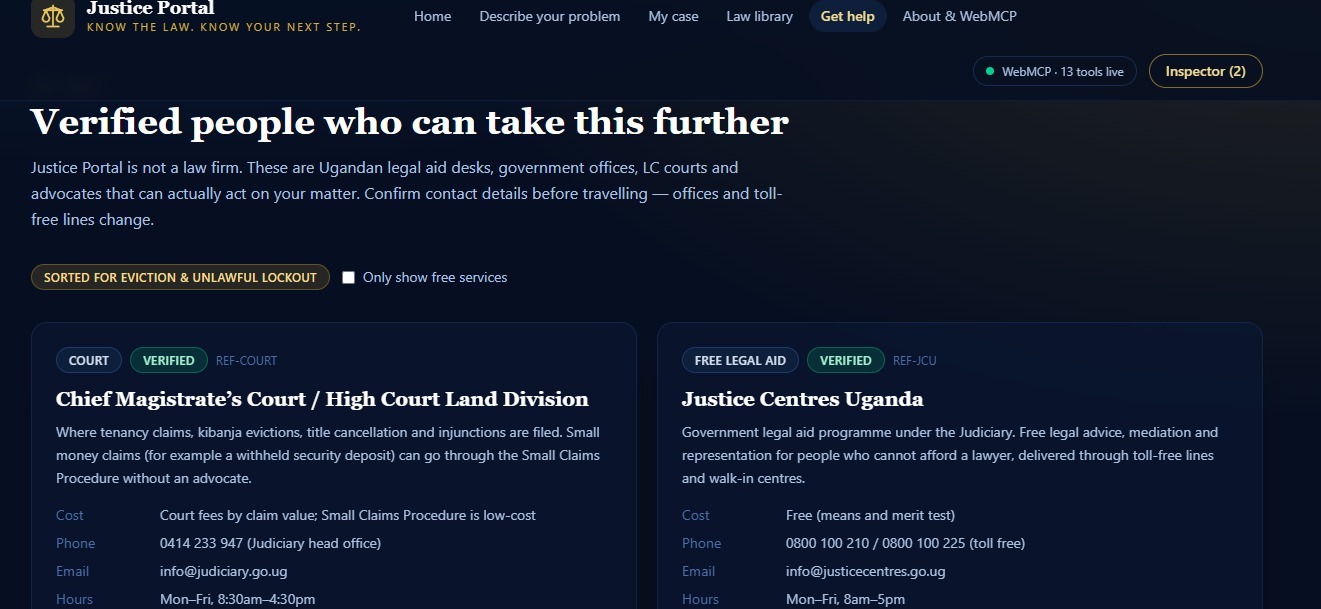
Help Page
Inspiration
The inspiration behind Justice Portal came from two things: my desire to learn and work with emerging technologies, and a problem I have observed in my own country, Uganda. As a developer, I wanted to challenge myself by learning something new and understanding how technologies such as WebMCP could change the way people interact with web applications and AI agents. At the same time, I kept thinking about how many people have legal rights but do not necessarily act on them when they face everyday disputes. The problem is often not that there is no law or that there is no possible action to take. Instead, people may not know what the law says, whether their situation is covered, what information they need, or what they can actually do next. Legal language can also be difficult for an ordinary person to understand. Someone may be able to describe their problem very clearly in everyday language, but struggle to translate that problem into legal terminology or determine which legal information is relevant.
That led me to the idea for Justice Portal.
What it does
Instead of expecting people to already understand legal terminology, Justice Compass allows a person to describe their situation naturally. The system can then help them structure the problem, identify relevant information, organize the facts and evidence, and prepare possible next steps.
The goal is not to replace lawyers or provide definitive legal representation. It is to help people move from:
"I have a problem, but I don't know if anything can be done."
to:
"I understand my situation better, I know what information is relevant, and I have a clearer idea of what I can do next."
Why Legal Help is a strong fit for WEBMCP
Legal help is a strong fit for WebMCP because users provide real-world facts, while the website provides structured legal knowledge to interpret those facts. WebMCP connects the two by allowing an AI agent to directly use tools such as analyze_situation, search_laws, get_next_steps, draft_demand_letter, and find_help through the live website without requiring separate APIs or integrations. Since legal accuracy is important, these tools can ground the agent in curated Ugandan laws, legal sections, and forums rather than relying only on generated assumptions.
WebMCP also makes Justice Portal interactive by allowing an agent to analyze situations, populate forms, navigate the site, identify relevant laws, determine missing information, create action plans and evidence checklists, draft demand letters, and connect users with appropriate legal-help organizations. Multiple tools can be combined to address issues such as eviction procedures, deposit limits, and notice requirements. In this way, Justice Portal transforms from a passive legal information website into an interactive legal assistant where people and AI agents work together to understand, organize, and respond to everyday legal problems while keeping the user involved and in control.
How we built it
Justice Portal is a frontend-only React 19 + TypeScript application built with Vite and Tailwind CSS. It has no backend, database, or API keys, so the legal data, case analysis, and generated documents run entirely in the user's browser, keeping sensitive information local and making the system easy to audit.
The application is built around a single tool layer that powers both the user interface and AI agents. It contains a structured Ugandan legal dataset, a referral directory, and a deterministic matching engine that analyzes a user's problem, identifies relevant laws, rights, remedies, evidence, next steps, and legal-help services. Because the engine is rule-based, users can see why particular laws were matched instead of relying on a black-box model.
WebMCP exposes these capabilities through 13 tools, including analyzing situations, searching laws, retrieving cases, generating action plans and demand letters, finding legal help, filling forms, and navigating the application. Both the UI and AI agents use the same tool handlers, meaning agent actions immediately update what the user sees.
A built-in WebMCP Inspector allows developers to view tool schemas, test tools, inspect results and errors, measure execution time, and view the history of UI and agent calls. This makes Justice Portal both an accessible legal-information platform and a practical demonstration of how WebMCP enables AI agents to interact directly with web applications.
Challenges we ran into
One of our biggest challenges was understanding WebMCP and how it actually fits into the interaction between a website and an AI agent. At first, it was difficult to understand why WebMCP was necessary when an agent could already interact with a website through its normal user interface. We gradually learned that the real value is in allowing a website to expose meaningful, structured capabilities that an agent can directly use instead of relying only on visual interaction. Another challenge was ideation. We wanted to build something where WebMCP was genuinely useful rather than simply adding it to an unrelated application. We therefore had to think carefully about problems that involve multiple steps and where an AI agent could meaningfully collaborate with a human. Finally, designing the application around a frontend-only architecture with mock data required us to focus on the core experience and demonstrate the concept without spending too much time building infrastructure that was not essential to the WebMCP demonstration.
Accomplishments that we're proud of
We are proud of turning an initial idea into a working concept that demonstrates how AI agents and web applications can work together through WebMCP.
One of our biggest accomplishments was understanding and implementing the idea of exposing application capabilities as WebMCP tools. Instead of treating WebMCP as another interface element, we designed tools around meaningful actions that an agent could perform within Justice Portal. Another accomplishment is keeping the human in the loop. Justice Compass is designed to assist users rather than make consequential legal decisions on their behalf. Important outputs remain reviewable and editable before the user decides what to do. Most importantly, we are proud that the project allowed us to explore a new technology while applying it to a problem that has real-world relevance.
What we learned
We learned that WebMCP is more than a mechanism for an AI agent to search or navigate a website.
We learned how a website can expose structured tools that allow an AI agent to interact with the application's capabilities directly. This helped us understand the difference between an agent simply navigating a user interface and an agent being able to use meaningful application-level operations.
We also learned how multiple WebMCP tools can be combined into a larger workflow. For example, an agent can search for relevant information, identify missing facts, create or update a case, organize evidence, and prepare a document as part of one broader task.
The project also taught us the importance of designing around the actual problem being solved rather than simply choosing a technology and trying to find somewhere to use it.
What's next for Justice Portal
The current version of Justice Portal is a starting point. We want to expand it from a prototype into a more complete platform for helping people navigate everyday legal and public-service problems.
Some of our next goals include:
- Expanding beyond landlord–tenant disputes into areas such as family, employment, consumer, and public-service issues.
- Adding more reliable and comprehensive legal information from authoritative sources.
- Improving the agent's ability to identify missing information and ask useful follow-up questions.
- Expanding the number of WebMCP tools available to agents.
- Improving evidence organization and document preparation.
- Adding stronger privacy and security protections.
- Exploring how Justice Portal could support different jurisdictions beyond Uganda.
- Continuing to improve the collaboration between humans and AI agents so that the agent handles repetitive and complex organizational tasks while the human remains in control of important decisions.
Our long-term vision is for Justice Portal to become a trusted bridge between everyday people, legal information, and AI agents, helping people move from simply knowing that they have a problem to understanding their possible options and taking informed next steps.
Built With
- react
- tailwind
- typescript
- vite
- webmcp

Log in or sign up for Devpost to join the conversation.