Just Standup
Tagline: No device. No place. No coach. Just no excuse.
Inspiration
"Hey bro, let's go to the gym!" "Deadline." "LeetCode first." "Maybe tomorrow."
Every CS friend I have says the same thing. Push a little and it always comes down to three excuses:
- I don't have the device.
- I don't have a place.
- I don't know what to do.
I'm Max. I research human motion at Dartmouth, and I box. Brian builds motion models. We didn't want to build another fitness app for people who already go to the gym. We wanted to punch through those three excuses one at a time, starting with the one thing every CS person already holds all day: their phone.
What it does
Just Standup has three modes, and each one breaks one excuse. Each mode is more real than the last: first you play, then you go outside, then you actually train. It all starts from a QR code, with no app to install.
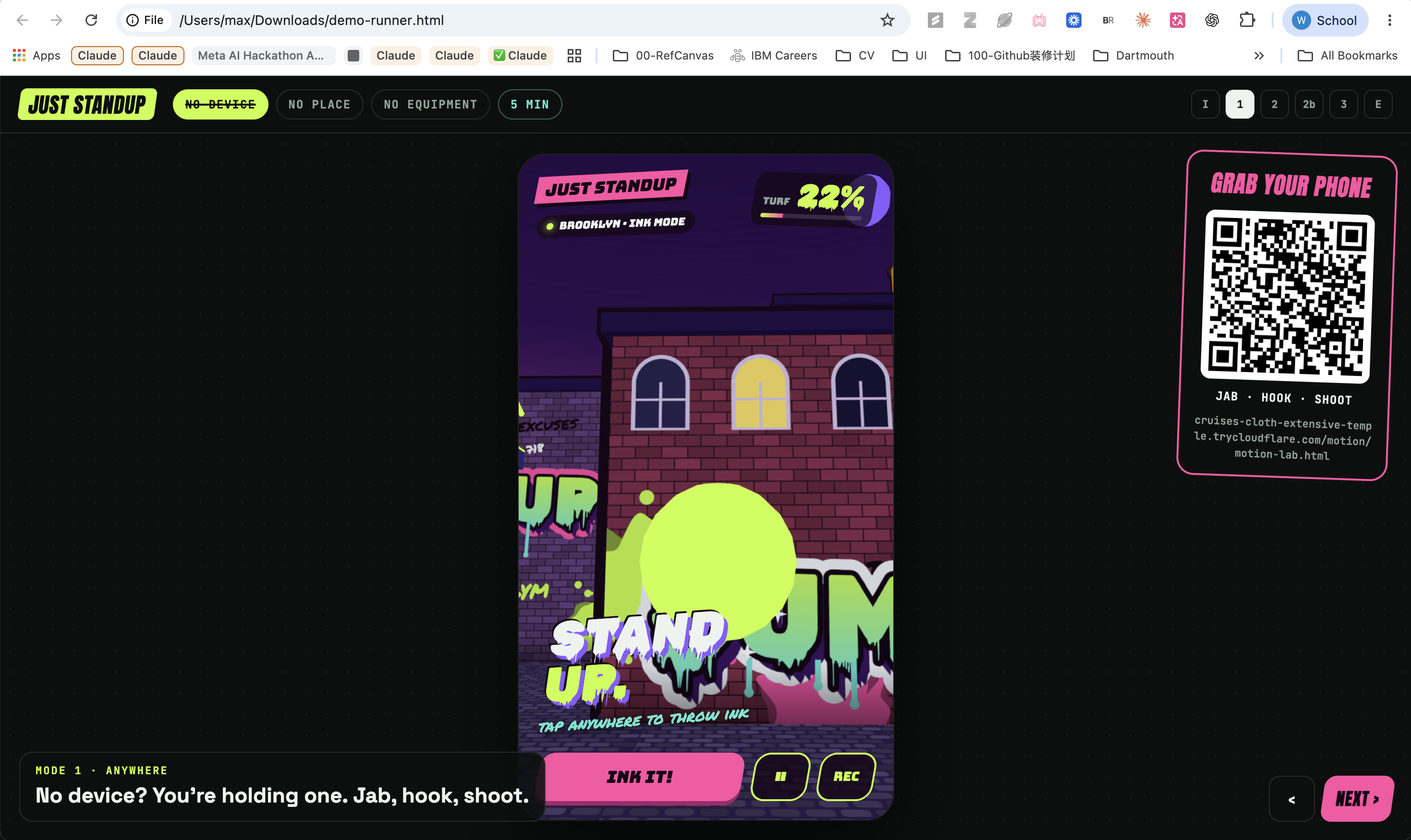
1. No Device? No problem. You don't need an Apple Watch. You're already holding one. Scan the QR code, hold your phone, and punch. The phone's motion sensors can tell a jab from a hook from an uppercut, and every punch throws paint on a wall in Brooklyn. No watch, no camera, no setup.
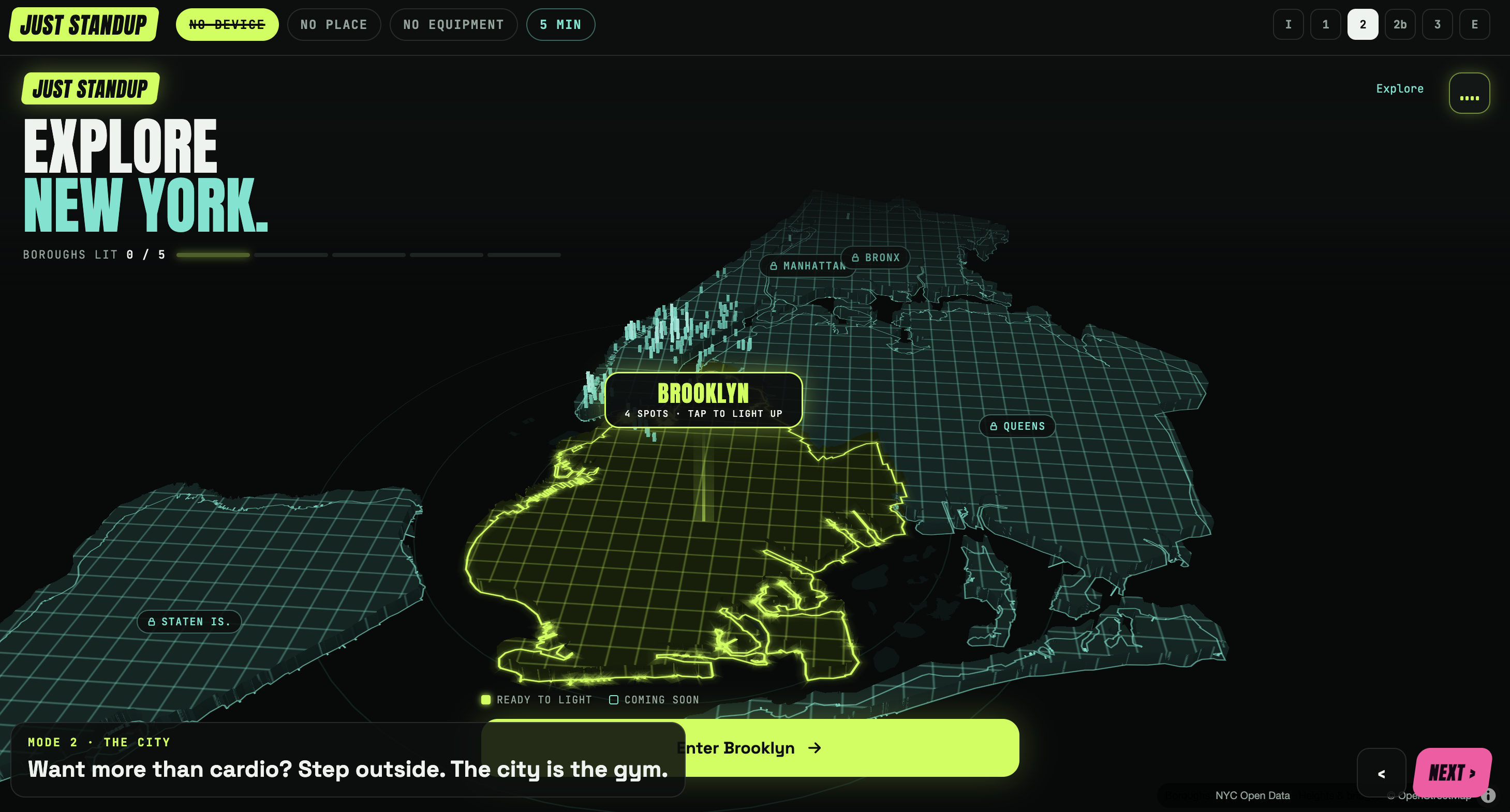
2. No Place? New York is the gym. Dive from the New York skyline into the city. Our agent explores it for you and finds real spots: a railing in Brooklyn Bridge Park, a set of steps, an open court. Tap a spot and it tells you exactly what to do there, like a jump shot on the court.
3. No Coach? Now you have a coach. Film your room once. The agent reads the room in three steps. Rendering rebuilds the space. Identify finds usable objects like a chair, a desk, and a wall. Generation turns them into real strength training: split squats on the chair, desk push-ups, wall sits. Every move gets a safety check before you see it, so you never get told to stand on a rolling chair.
How we built it
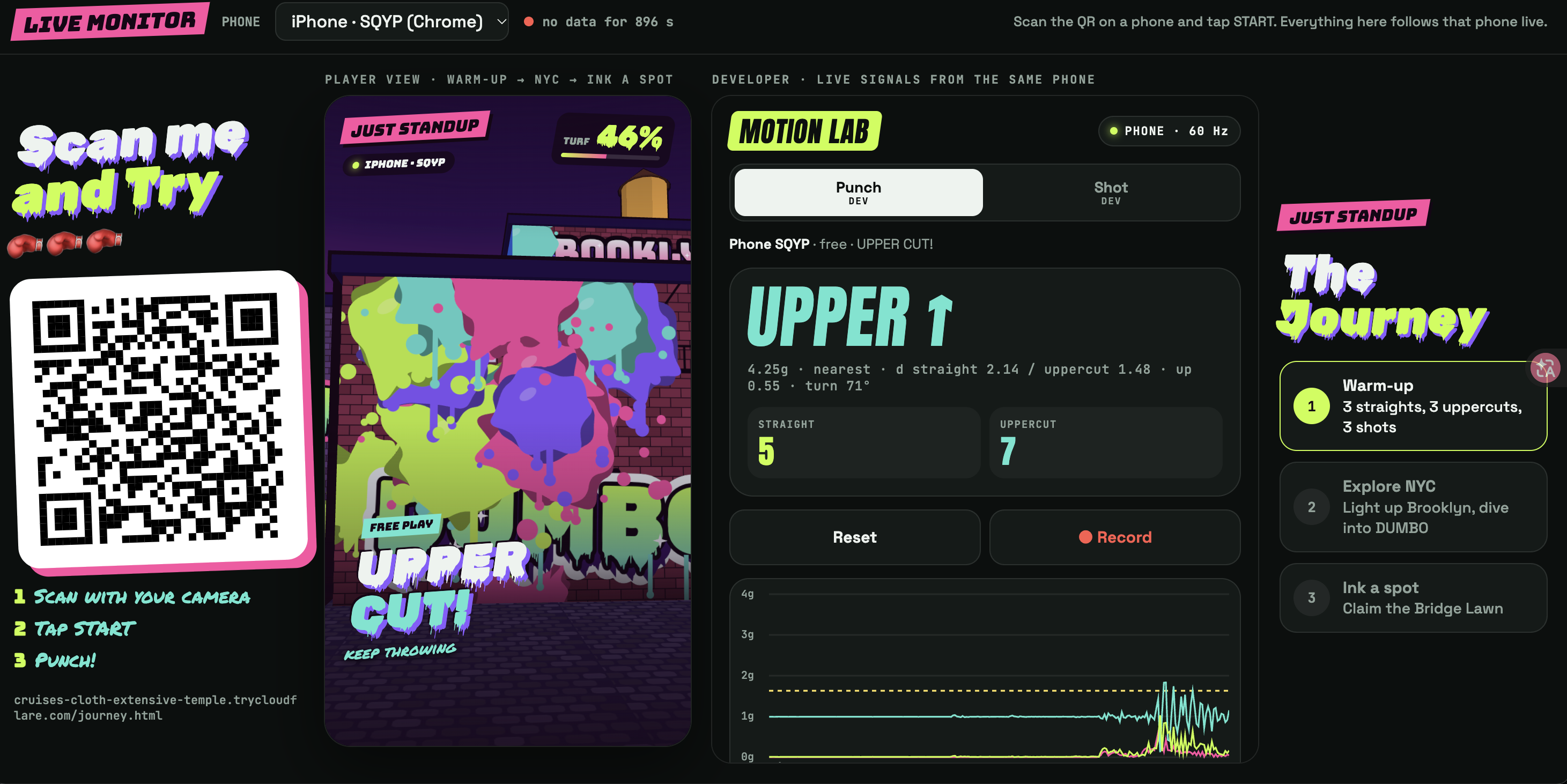
Mode 1: Punch detection. A phone-side IMU pipeline runs at 60 Hz. It uses a threshold trigger with a refractory window, a 7-D feature (onset direction plus integrated rotation), and few-shot 1-nearest-neighbor templates captured during a short warm-up. Sound is synthesized locally with Web Audio, and the laptop mirrors the phone live through a zero-dependency Node relay.
Mode 2: City as a gym.
- Anchor Browser: The agent browses the web to find real outdoor spots and the moves that fit each one.
- SurrealDB: Stores spots, moves, and training records, so the agent can query and reason over them quickly.
Mode 3: AI room coach. Claude Opus 5.5 (served through AWS) reads the room video, identifies objects and layout, queries our exercise database, and reasons about which moves are safe in that space. Each suggestion comes with a demo video.
- Daytona: Each user gets a throwaway sandbox that runs the full pipeline. Room videos are sensitive personal data, so the sandbox destroys itself when the user is done.
- Arize AI: Traces every step the agent takes and evaluates whether each recommendation is safe, so we can see exactly why a move was approved or rejected.
- SurrealDB: The exercise database. Each entry has a name, a description, the target body part, and a demo video link.
Challenges we ran into
- Hand-tuned punch rules failed. Everyone's wrist twists differently, so no single rule worked for everyone. We flipped the design and made the warm-up the training. After a few punches the system knows how you punch, with no dataset and no training time.
- Scraping was blocked. Most exercise sites block scrapers, so we pulled archived pages from the Wayback Machine and built the exercise database live in SurrealDB.
- Unsafe recommendations. Early on, the agent suggested things like push-ups in the middle of a road. We added a dedicated safety-check layer that judges each move against the detected space, and used Arize traces to debug its decisions.
Accomplishments that we're proud of
- It runs live. A real iPhone streams 60 sensor samples per second to the big screen. Recognition happens on the phone, so there's no network lag between your punch and the sound.
- Personalized punch recognition with zero training time. It works instantly for the next person who picks up the phone.
- One path from play to real training. Punching paint, finding real spots in the city, and strength training in your own room, all from one QR code.
- Privacy-first. Room videos only live inside a sandbox that destroys itself.
What we learned
- For noisy, wearable-style sensor data, calibrating per user beats hand-tuned rules.
- Browsers can now read motion sensors, render 3D, and synthesize sound, so "no install" is realistic.
- LLM agents need an explicit safety layer, plus observability so you can understand and trust their judgments.
What's next for Just Standup
- Make the room coach fully live: real-time 3D room rebuild, plus a coach that walks you through each move in your own space.
- More punch types, multiplayer paint walls, and real city spots beyond New York.
- A bigger exercise database and longer-term training plans built from your training records.
Built With
- amazon-web-services
- arize
- claude
- daytona
- python
- surrealdb


Log in or sign up for Devpost to join the conversation.