-
-
Home
Inspiration
AI coding assistants are making software development faster, but regulatory compliance is still often considered late in the development process. A feature involving personal data, AI-driven hiring, or health information can trigger different requirements across countries.
I wanted to explore a simple question: What if developers could identify potential compliance requirements before committing to an architecture?
That idea led to JuriSync, a development-time compliance orchestration tool that connects regulatory knowledge with AI-assisted software engineering.
What it does
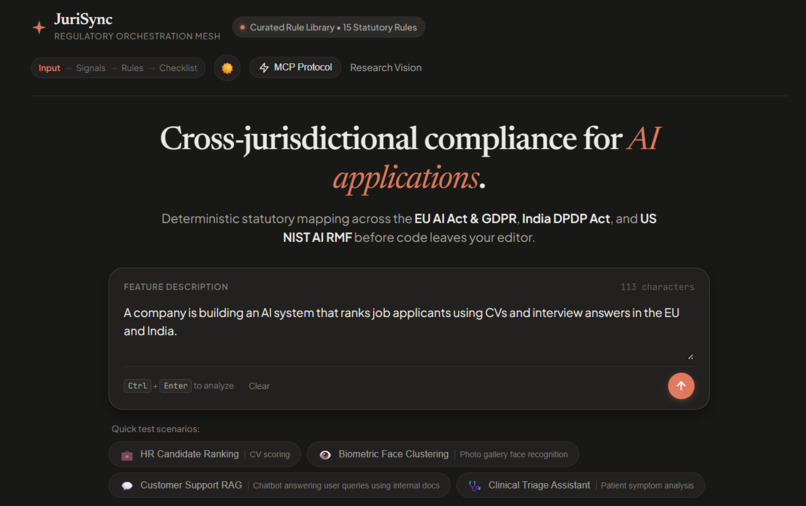
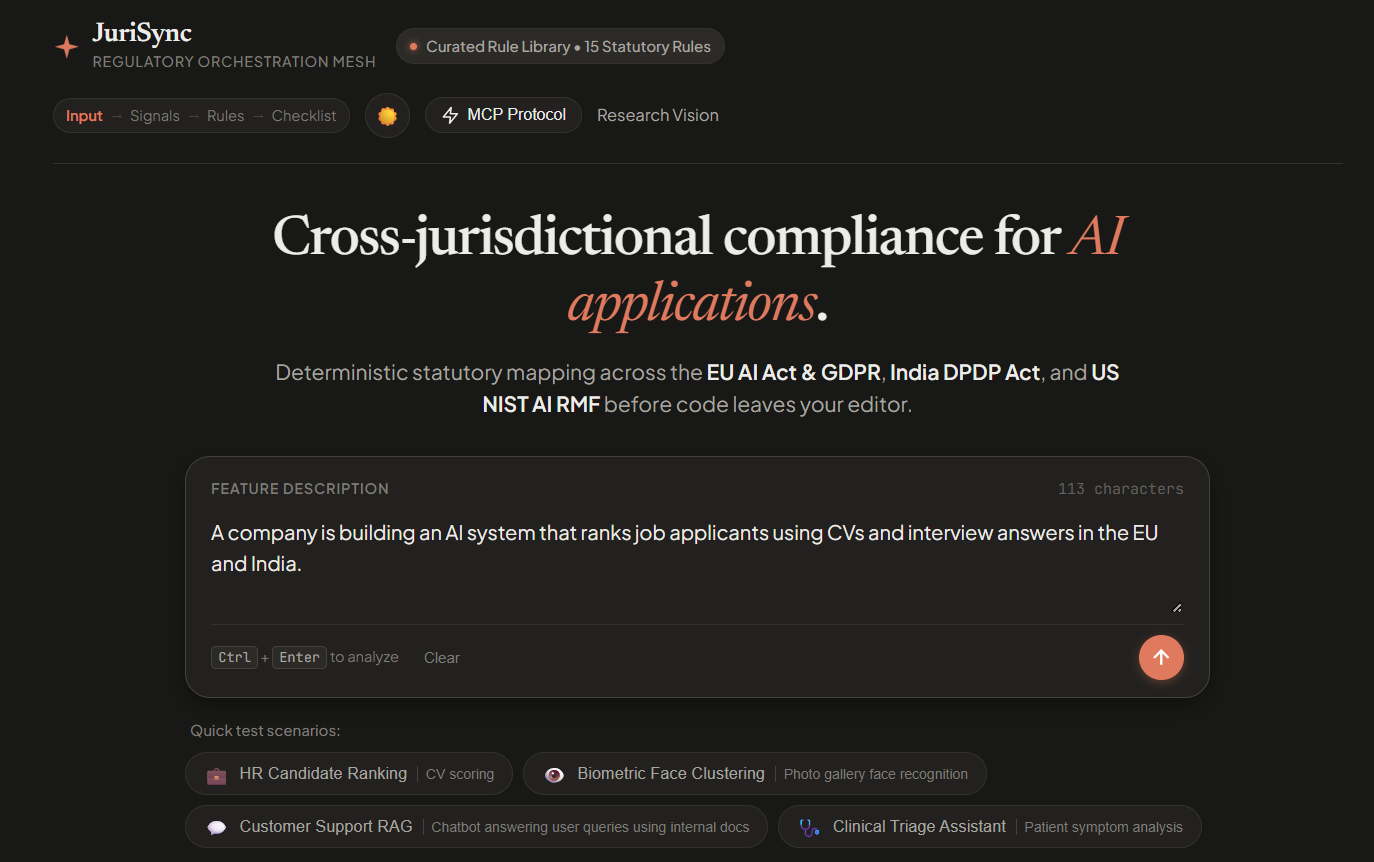
JuriSync analyzes plain-language software feature descriptions and identifies potential regulatory considerations across the European Union, India, and the United States.
Its key capabilities include:
- Risk Signal Radar: Detects signals related to AI systems, personal data, biometrics, employment, healthcare, and other sensitive domains.
- Multi-Jurisdiction Analysis: Evaluates detected signals against a curated library of regulatory rules and guidance.
- Cross-Border Tension Detection: Highlights potential conflicts between obligations across jurisdictions.
- Traceable Findings: Connects findings to rule identifiers, legal references, and supporting sources.
- Developer Checklists: Generates actionable Markdown tasks to help developers consider compliance during implementation.
- MCP Integration: Exposes compliance analysis through a local Model Context Protocol server, allowing compatible AI coding assistants to query JuriSync.
JuriSync is a technical decision-support tool, not a substitute for qualified legal advice.
How we built it
JuriSync is built with JavaScript and a modular architecture that separates signal extraction, regulatory evaluation, cross-border tension detection, and output generation.
The main components are:
- Signal extraction engine: Uses token matching, regular expressions, and domain heuristics to convert natural-language descriptions into structured signals.
- Curated rule engine: Maps detected signals to regulatory rules maintained in the project's knowledge base.
- Knowledge base: Organizes jurisdiction-specific findings, risk classifications, citations, and developer actions.
- Tension engine: Evaluates findings across jurisdictions to identify potential regulatory friction.
- Web interface: Provides an interactive console for analyzing feature descriptions and reviewing results.
- MCP server: Implements a local JSON-RPC 2.0 stdio server that exposes tools for compliance analysis, retrieving individual rules, and listing supported regulations.
The web interface is deployed on Vercel, and the MCP server can run locally using Node.js. The project also includes automated verification suites covering signal extraction, regulatory mapping, tension detection, and MCP tool invocation.
Challenges we ran into
One of the biggest challenges was turning ambiguous natural-language descriptions into useful, structured compliance signals without relying entirely on free-form AI-generated legal interpretations.
Another challenge was representing regulatory differences across jurisdictions. A requirement that appears straightforward in one country may interact with different obligations elsewhere. Identifying these potential tensions requires more than simply listing regulations.
We also needed to distinguish binding legal requirements from voluntary frameworks and make findings traceable to their underlying rules.
We addressed these challenges through deterministic signal extraction, a curated rule library, explicit legal-status classifications, and a separate cross-jurisdiction tension engine. The current implementation is rule-based, so its coverage depends on the signals and regulations represented in the knowledge base.
Accomplishments that we're proud of
- Built a working, interactive compliance analysis application.
- Connected natural-language feature descriptions to structured regulatory findings and developer checklists.
- Implemented a cross-jurisdiction tension detection component.
- Created a local MCP server so compatible AI coding assistants can access compliance tools.
- Added automated verification suites for the core analysis pipeline and MCP integration.
- Designed the project around traceability, privacy-conscious local processing, and human review.
Most importantly, JuriSync brings regulatory considerations closer to the point where software architecture decisions are made.
What we learned
We learned that useful compliance tooling requires more than an AI interface. The quality of the output depends on structured knowledge, traceable sources, clear distinctions between legal obligations and voluntary guidance, and transparent limitations.
We also learned how MCP can connect a specialized developer tool to AI assistants without requiring every assistant to implement the underlying compliance logic independently.
Building JuriSync helped us explore how deterministic software components and AI-assisted development workflows can work together to make complex information more actionable.
What's next for JuriSync
The next step is to expand JuriSync from feature-description analysis toward deeper integration with real development workflows.
Our planned improvements include:
- Static code and abstract syntax tree analysis for detecting potential compliance issues in source code.
- More formal modeling of conflicts between regulatory constraints.
- Expanded regulatory coverage across additional jurisdictions.
- CI/CD integration for checking pull requests and surfacing compliance considerations.
- More comprehensive rule validation, testing, and expert review.
These are future directions rather than claims about the current implementation. Our long-term goal is to make compliance checks a practical part of everyday AI-assisted software engineering.
Built With
- ai
- compliance
- javascript
- json-rpc
- model-context-protocol-(mcp)
- node.js
- vercel
- vite
