-
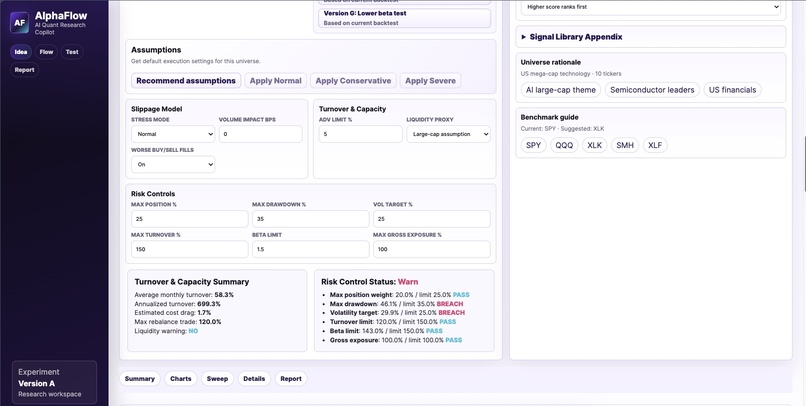
Website function display
-
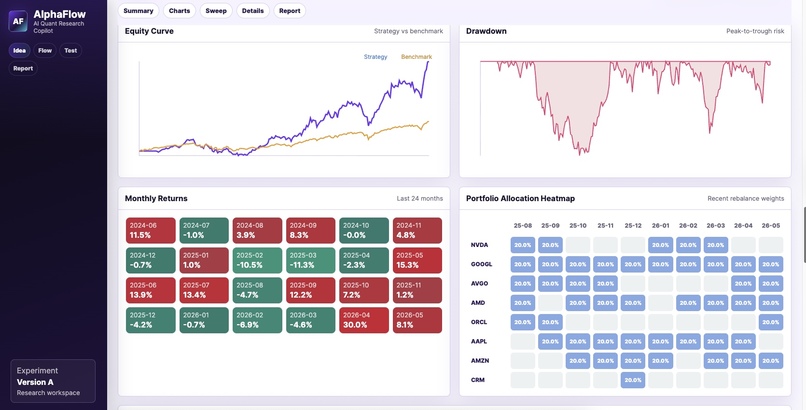
Website function display
-
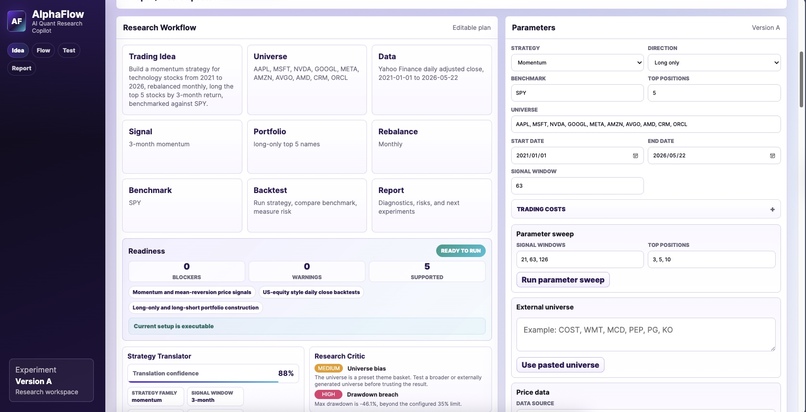
Website function display
-
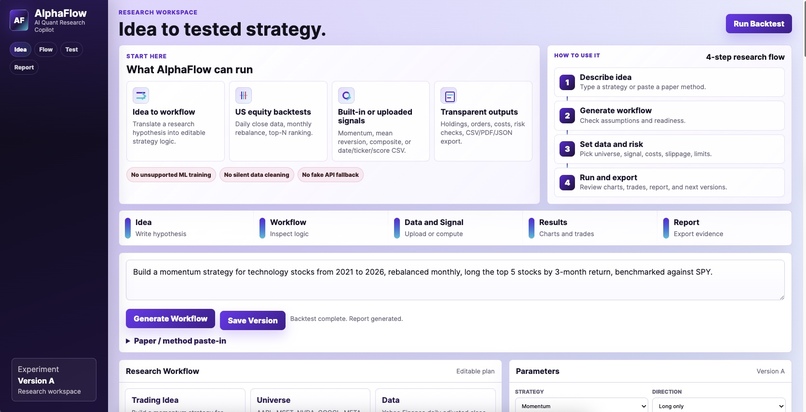
Website function display
Inspiration
Many AI finance tools can generate confident strategy ideas, but they often hide the most important part of quant research: whether the idea is actually testable under clear assumptions.
I wanted to build a tool that does more than simply draw a backtest chart. AlphaFlow is designed to help users move from a trading hypothesis to a structured research workflow, check whether the required data and signal logic are valid, run the strategy under explicit constraints, and understand the result through transparent holdings, trades, costs, and risk checks.
What it does
AlphaFlow is an AI-assisted quant research workspace for transparent, constraint-aware backtesting.
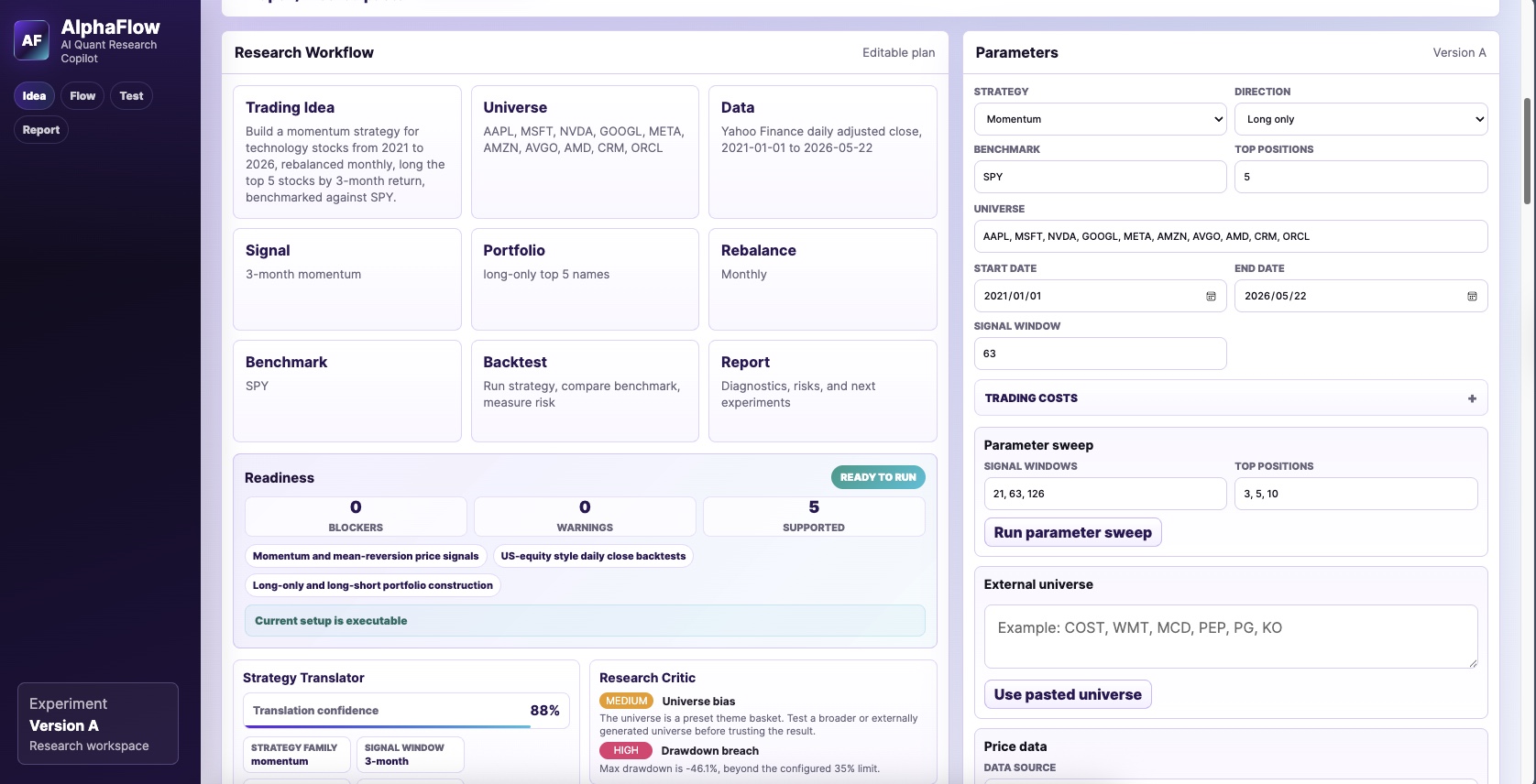
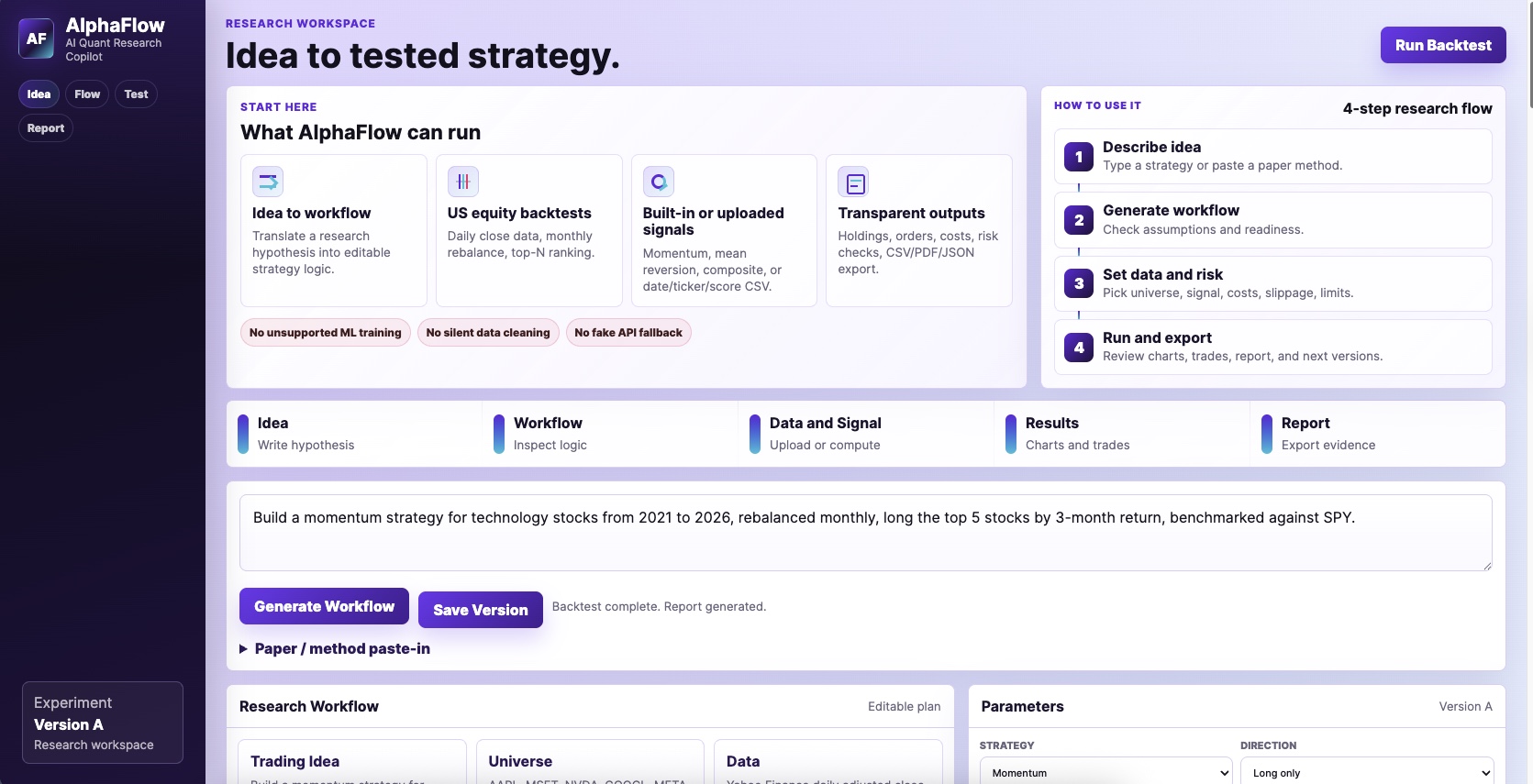
Users can type a plain-English strategy idea, such as a momentum strategy for large-cap AI stocks, and AlphaFlow turns it into an editable workflow with key assumptions like universe, signal, benchmark, rebalance frequency, position count, transaction costs, slippage, and risk controls.
The platform supports:
- US equity-style daily close backtests
- Momentum, mean reversion, and composite signals
- Uploaded external model scores using a strict
date,ticker,scoreCSV format - Uploaded price data in CSV format
- Long-only and long-short portfolios
- Parameter sweeps across signal windows and top-N portfolio sizes
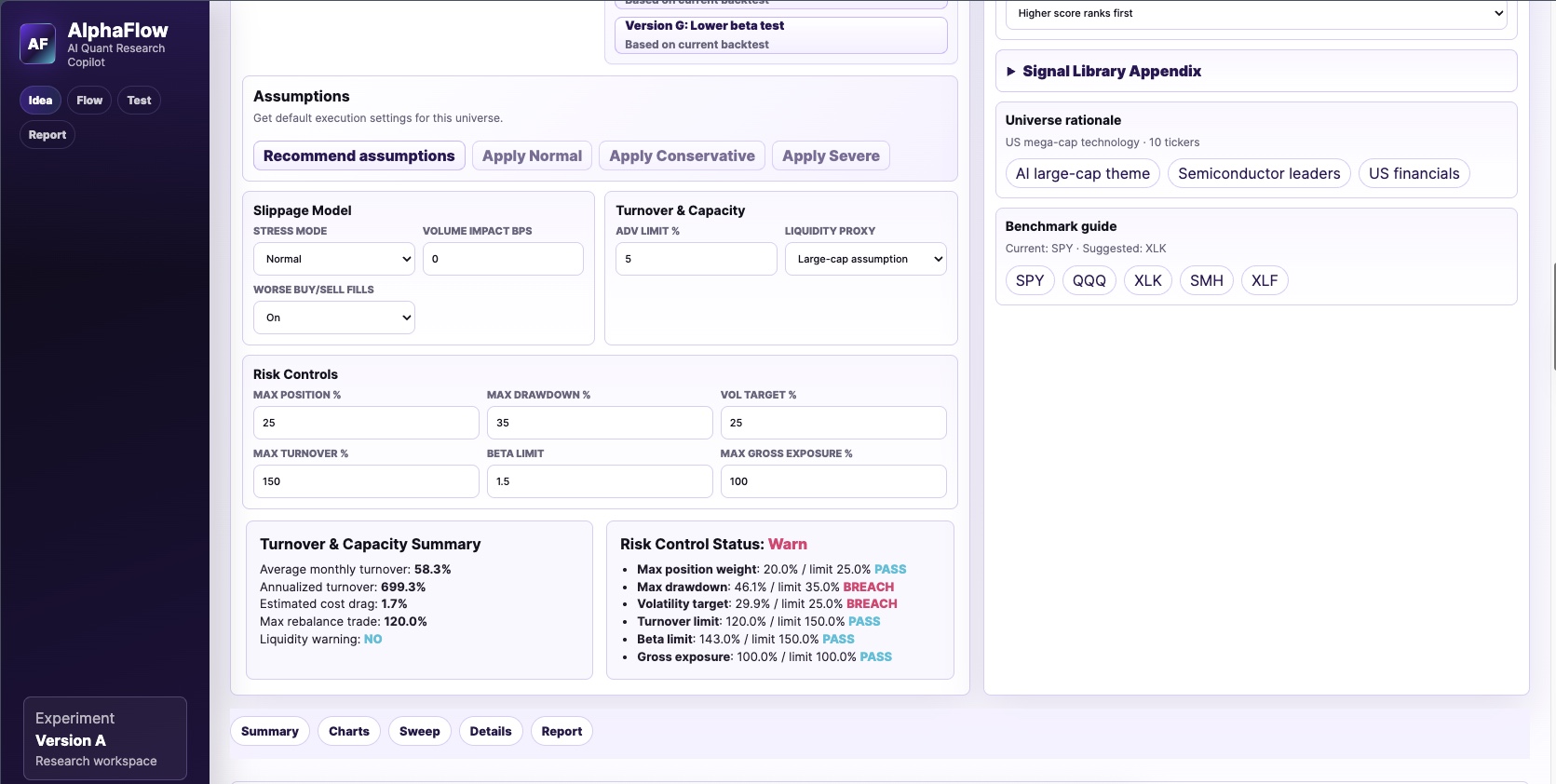
- Transaction costs, slippage, turnover, capacity, and risk control settings
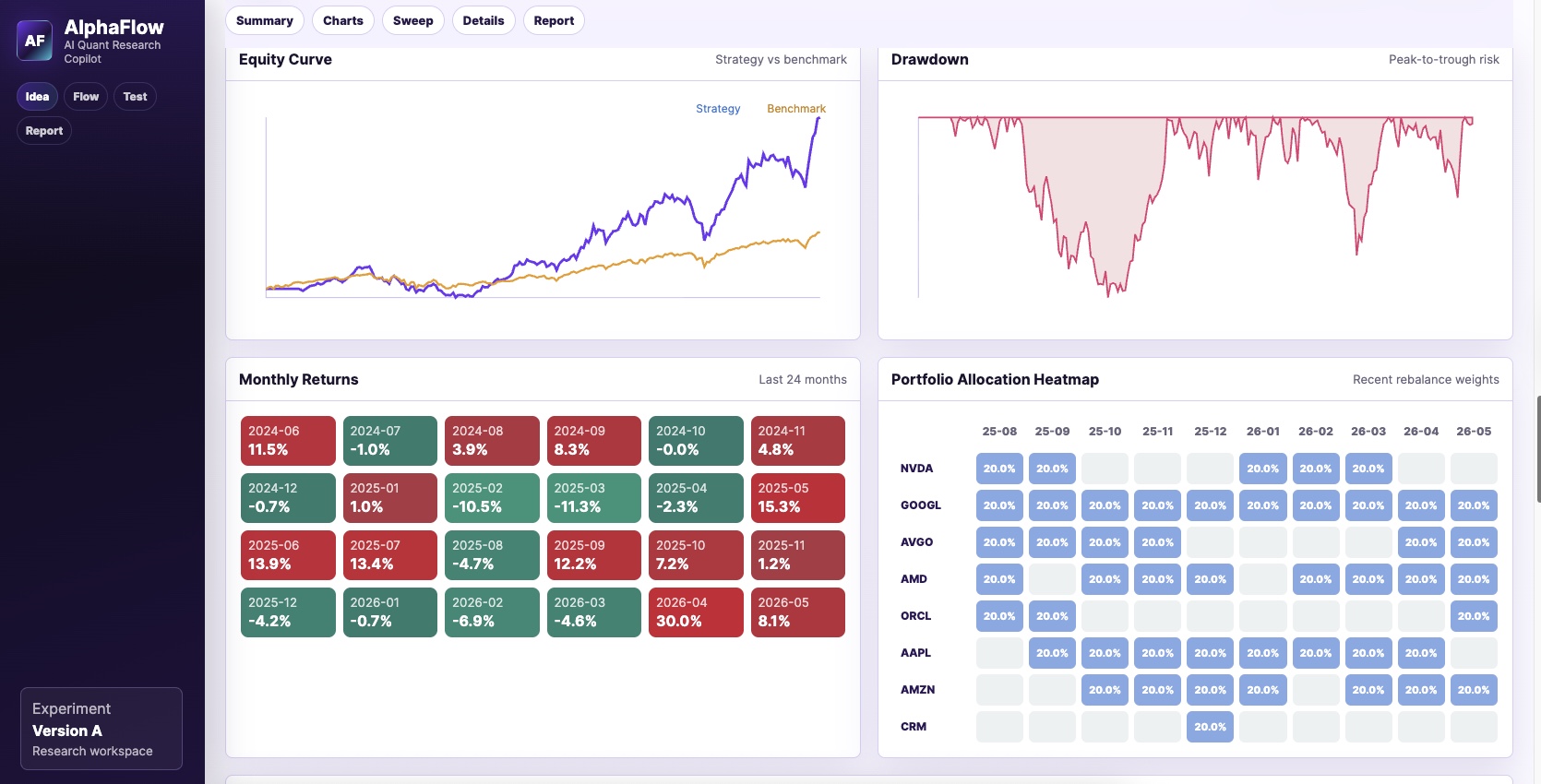
- Holdings, rebalance orders, equity curves, drawdowns, allocation views, trade exports, and PDF/JSON reports
A key feature is that AlphaFlow does not try to run every idea. If a strategy, paper, dataset, or uploaded signal does not satisfy the current engine requirements, AlphaFlow blocks the run instead of producing a misleading result.
How we built it
AlphaFlow is built as a local Flask web application with a Python backtesting engine and an interactive JavaScript frontend.
The backend handles strategy parsing, readiness checks, price and signal validation, backtest execution, parameter sweeps, metric calculation, transaction cost modeling, and report export. The frontend provides the research workspace: idea input, workflow visualization, parameter controls, data upload, risk settings, charts, tables, and downloadable outputs.
The product logic follows this flow:
- User enters a trading idea or strategy method.
- AlphaFlow translates it into a structured workflow.
- The app checks whether the idea, data, signal, and parameters are executable.
- The user edits assumptions such as signal window, benchmark, universe, costs, and risk limits.
- AlphaFlow runs the backtest and parameter sweeps.
- The user reviews metrics, charts, holdings, trades, costs, risk checks, and exports the research report.
Challenges we ran into
The biggest challenge was defining the product boundary. At first, it was tempting to make AlphaFlow support every possible quant strategy, paper, machine learning model, and data source. But that would create a dangerous black-box system where the app might appear to backtest strategies that it cannot actually execute correctly.
So I narrowed the product scope around correctness and transparency. AlphaFlow currently supports strategies only when the signal, data, and portfolio construction can be represented by the current engine. Unsupported machine learning papers, missing alternative data, malformed CSV files, non-overlapping signal dates, and unconnected API sources are blocked by design.
Another challenge was making the tool useful for more serious strategy research. I added uploaded external signal scores so users can bring outputs from their own machine learning models or factor screens, while AlphaFlow focuses on validation, portfolio construction, backtesting, and reporting.
Accomplishments that we're proud of
I am proud that AlphaFlow is not just a chart generator. It includes a transparent research workflow, strict data validation, external signal support, transaction cost and slippage assumptions, turnover and capacity checks, risk controls, parameter sweeps, trade detail exports, and report generation.
The most important accomplishment is the readiness gate: AlphaFlow refuses to run when the input is outside the supported scope. This makes the tool more honest and more useful for quant research, because a blocked result is better than a polished but misleading backtest.
What we learned
I learned that the hardest part of building an AI finance tool is not only generating ideas, but deciding what the system is allowed to do safely and correctly.
For quant research, transparency matters as much as automation. Users need to know what universe was selected, how the signal was calculated, what assumptions were used, which stocks were held each month, how much turnover occurred, and how costs and risk limits affected the result.
I also learned that a useful AI product should guide the user, but not hide uncertainty. AlphaFlow is designed to make assumptions visible and editable instead of silently making decisions for the user.
What's next for AlphaFlow
Next, I want to improve AlphaFlow in three directions.
First, I want to make the strategy translator more accurate, especially for complex factor strategies and paper-based strategy descriptions.
Second, I want to expand the external data layer so users can connect additional data providers or upload larger cleaned datasets while keeping the validation process transparent.
Third, I want to deepen the AI research assistant layer, so AlphaFlow can critique weak strategies, suggest better parameter ranges, recommend next experiments, and help users compare different strategy versions more intelligently.
The long-term goal is to make AlphaFlow a focused research workspace for strategy validation, not a black-box trading platform.

Log in or sign up for Devpost to join the conversation.