Inspiration
Imagine needing to visit a government office—whether for a license, citizenship, or a replacement document—and having no idea what steps or paperwork are required. We’ve all been there: waiting in long lines, running from one room to another, only to leave frustrated because no one told us we’d need something like our dad’s original citizenship. It’s a situation that feels unnecessarily complicated and avoidable.
For our team, this problem wasn’t just an idea—it was personal. Each of us had faced similar struggles: confusion, wasted time, and incomplete tasks. Determined to dig deeper, we conducted a survey and visited the District Administration Office (DAO) in Bhaktapur. This gave us valuable insight into the challenges faced by both citizens and government officers. What we discovered was clear: a significant communication gap exists, leaving citizens under informed and officials overwhelmed with repetitive questions.
It became evident that a solution was needed to bridge this gap—a reliable medium to flow accurate, consistent information from government offices to citizens. That’s when the idea of JUNU, a voice assistant, was born. JUNU can provide step-by-step guidance anytime, anywhere, and unlike office workers, it never tires of answering the same questions again and again. By bridging this communication gap, JUNU not only saves time but also restores trust in the efficiency of government services.
What it does
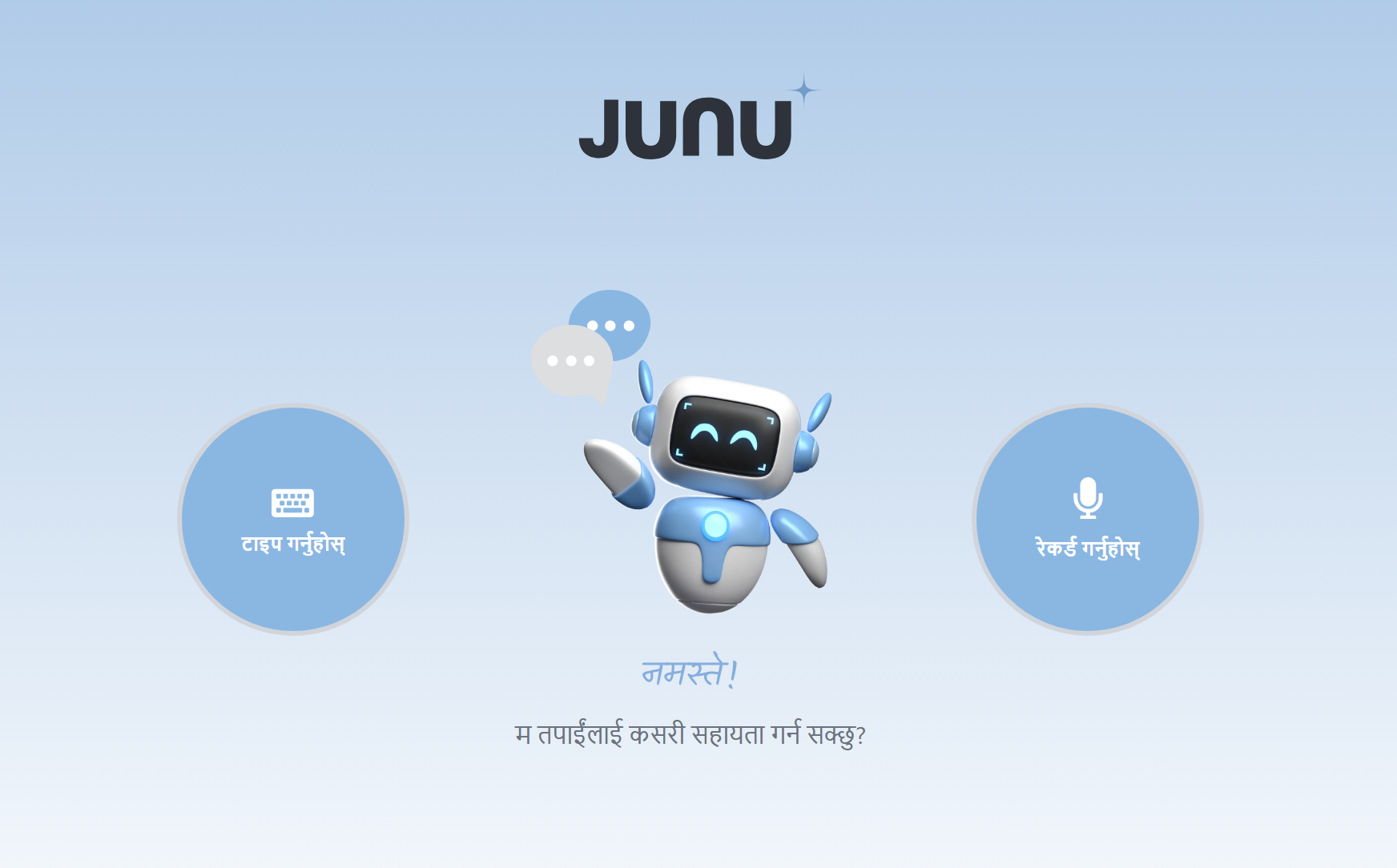
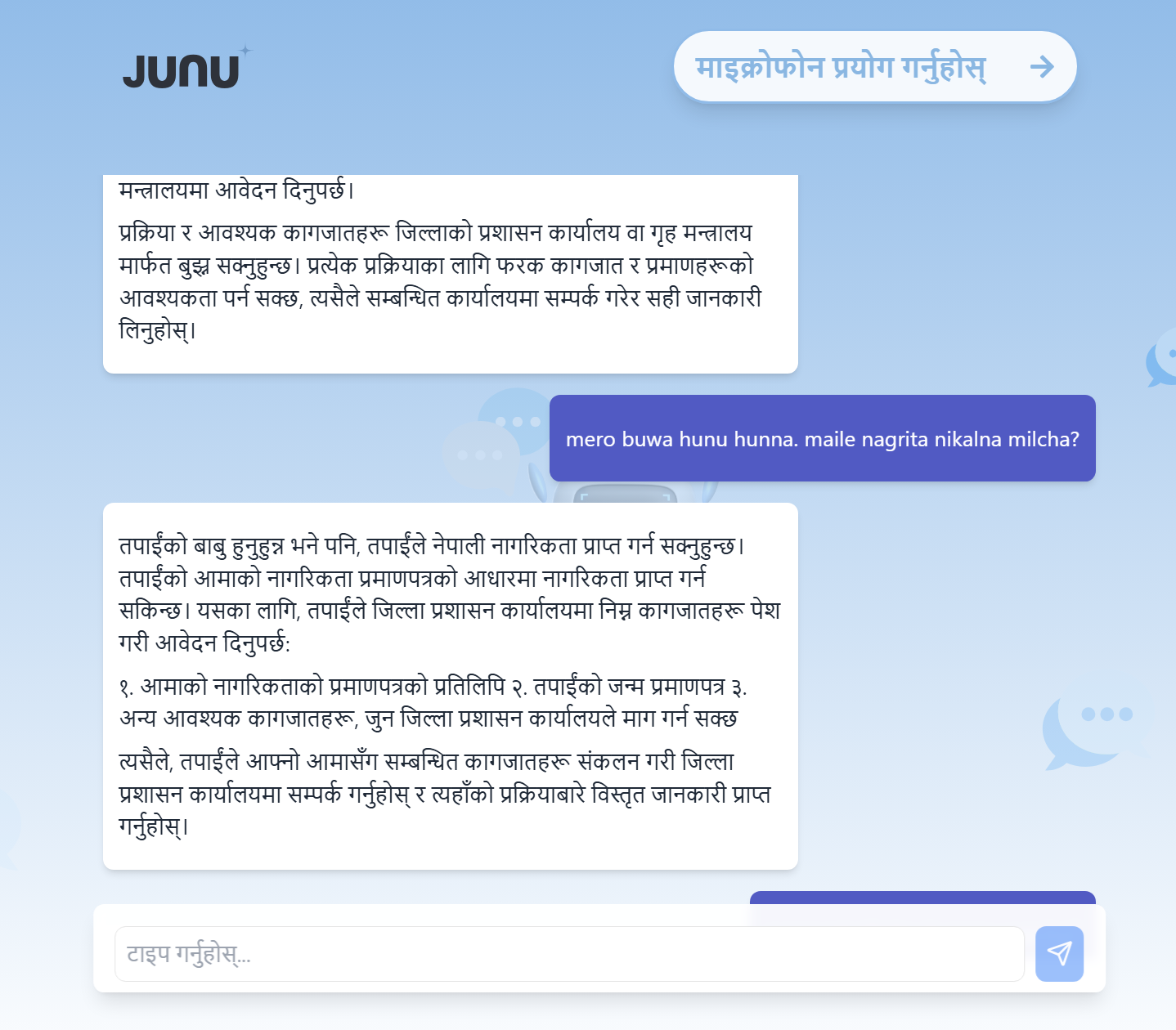
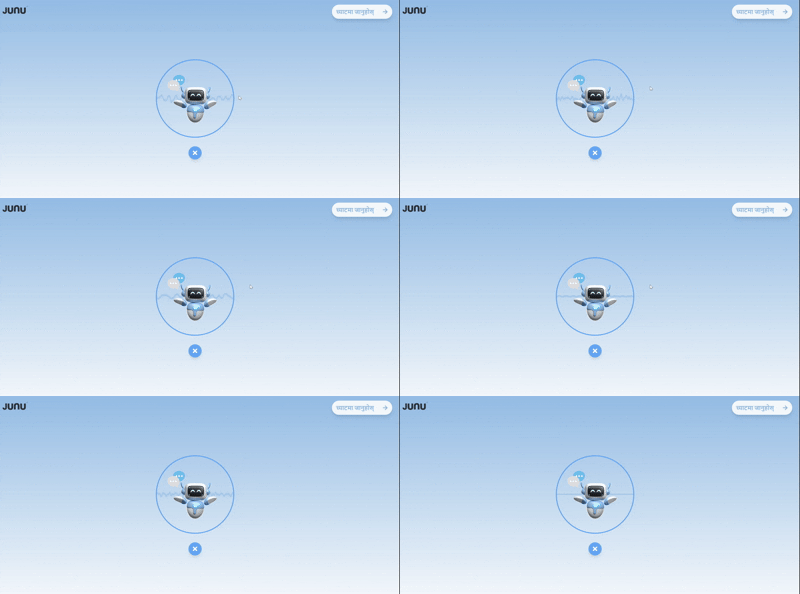
JUNU is a government office voice assistant designed to help citizens navigate complex government processes with ease. It offers both voice and chat options in Nepali and English, providing clear, step-by-step guidance on various services offered by the respective government offices. JUNU answers questions about required documents, fees, office locations, and processes, ensuring that users have all the information they need before visiting a government office. Its intuitive interface is built for ease of use, making it accessible to all users, whether they’re tech-savvy or not. JUNU reduces confusion, saves time, and helps citizens avoid unnecessary trips to the office, providing them with seamless, efficient, and frustration-free experiences.
How we built it
JUNU was built using a combination of advanced technologies and user-centric design to ensure a seamless experience for all users. The core of JUNU is its ability to provide clear and accessible information by repackaging publicly available government data into a more consumable format. Rather than gathering new data, we focused on making existing information—about processes, required documents, fees, and office locations—easy for users to understand and access.
To ensure JUNU always provides the most up-to-date information, we took the approach of a Retrieval-Augmented Generation (RAG) model. This allows JUNU to pull relevant data from trusted public sources, even if the information changes over time. With this model, JUNU can generate accurate and current responses, ensuring citizens get the right information when they need it.
We utilized state-of-the-art large language models (LLMs), like GPT-4o, for inference. This allows JUNU to understand and respond to user queries in a natural, conversational manner, both in Nepali and English. JUNU uses advanced technology to comprehend spoken and written language, providing accurate responses with the help of speech recognition for converting speech into text and text-to-speech (TTS) for verbal responses.
The user interface was developed using React.js and Tailwind CSS, creating a responsive and intuitive experience across all devices. JUNU ensures that citizens can easily navigate government processes with ease and confidence.
Challenges we ran into
Building JUNU came with its fair share of challenges, but each obstacle presented an opportunity for learning.
1. Lack of proper Nepali speech models for TTS and STT One of the first challenges we faced was the lack of robust Nepali speech models for Text-to-Speech (TTS) and Speech-to-Text (STT). Nepali language support in these technologies is still developing, and finding high-quality models was a challenge. Fortunately, we had Azure credits that gave us access to Azure’s TTS and STT models, both of which worked great for our needs. This allowed us to ensure smooth and accurate voice interactions for users in Nepali.
2. Data restructuring from source to input for the model Another hurdle was the need to restructure the existing government data. Publicly available data often comes in inconsistent formats, which makes it difficult to feed it into the model. We had to organize and standardize the data from various sources so that it could be easily understood and processed by JUNU. This step was crucial to ensuring that the information provided by the assistant was both relevant and accurate.
3. Fine-tuning the prompts for sensible responses Finally, we ran into the challenge of fine-tuning the prompts used by the GPT-4o model to ensure the responses were sensible and directly addressed user queries. We spent significant time adjusting the prompts to make sure JUNU’s responses were not only correct but also easy to understand and relevant. This required iterating through various approaches until we found the right balance between accurate information and natural conversation.
Accomplishments that we're proud of
One of the accomplishments we’re most proud of is how we were able to build a functional and usable product, despite not being familiar with all the technologies involved at the outset. As a team, we learned and adapted quickly, tackling challenges like integrating Nepali speech models, restructuring government data, and fine-tuning the GPT-4o prompts. By collaborating and pushing ourselves, we were able to create a voice assistant that genuinely serves a real-world need, helping citizens navigate government services with ease. It’s fulfilling to see a project we built from the ground up actually being useful to people, and knowing that it can make their lives easier and save them time.
What we learned
One of the most important lessons we learned during this project is that availability doesn't guarantee accessibility. Just because information or technology is available doesn't mean it is easily accessible or usable by everyone. We discovered that to truly make an impact, the design of a product must be centered around the needs of the user. This lesson highlighted the critical importance of user-centric design. It's not enough to simply make data available; it must be presented in a way that is intuitive, easy to understand, and suited to diverse user needs. This insight guided us in making JUNU a truly accessible tool, ensuring that all citizens, regardless of their tech-savviness, can easily navigate government processes.
What's next for Junu: Your Government Office Voice Assistant
Our major goal is to establish a collaboration with government entities to expand JUNU’s offerings by seamlessly integrating additional services related to education, health, and local governance. By partnering with these entities, we aim to create a framework that automates the integration of publicly available data, ensuring that new services can be added with little to no manual intervention.
The framework will leverage automated data extraction from trusted government sources, allowing JUNU to continuously update and present new information in a user-friendly format. This collaboration will enable JUNU to quickly expand its services and maintain up-to-date content, making it a comprehensive one-stop solution for all citizens. As a result, JUNU will remain an effective, efficient, and accessible tool for navigating government processes.


Log in or sign up for Devpost to join the conversation.