-
-
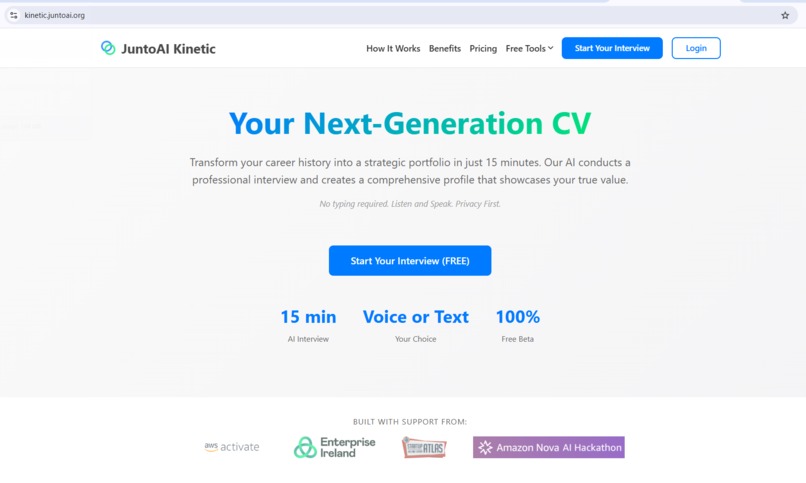
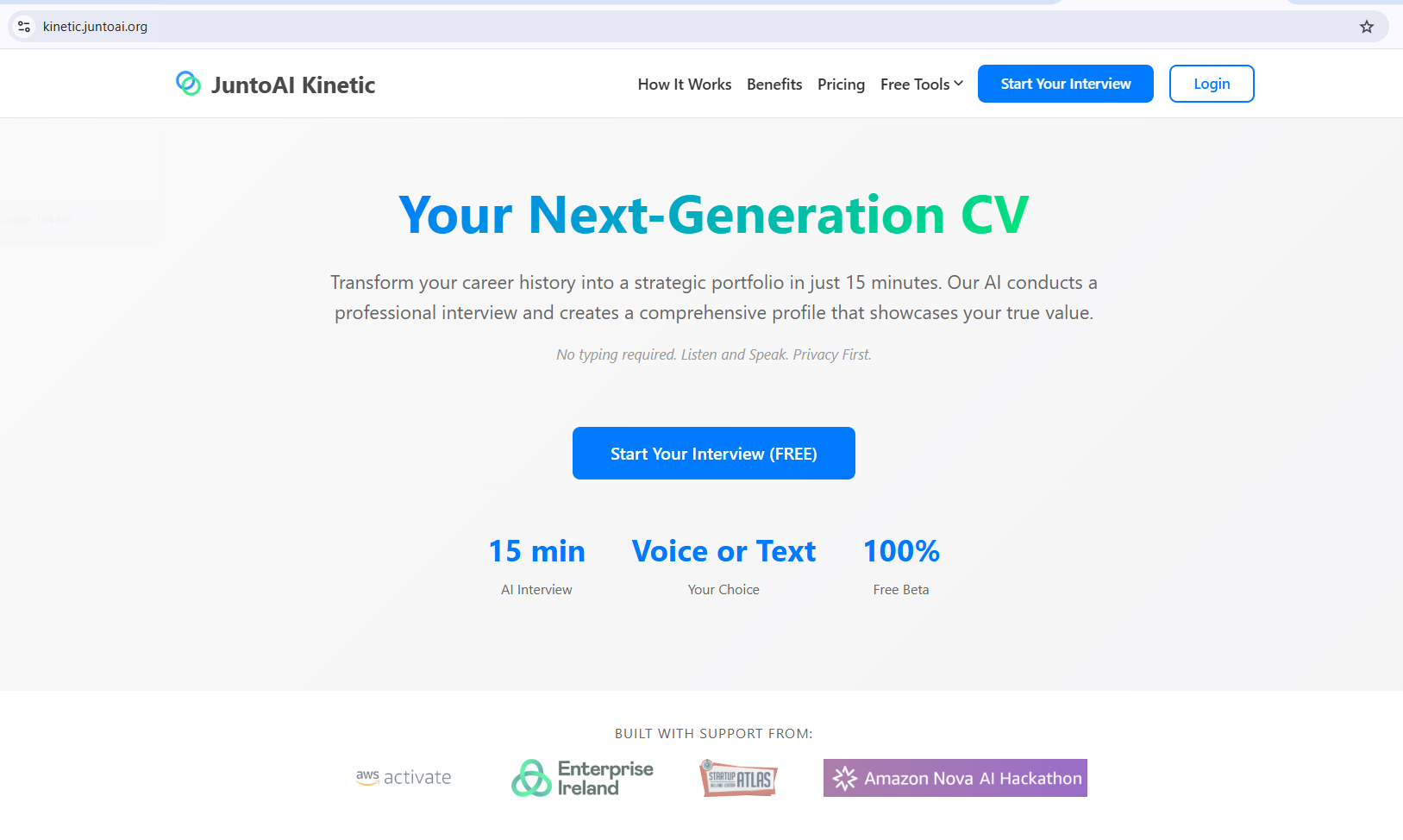
Landingpage
-
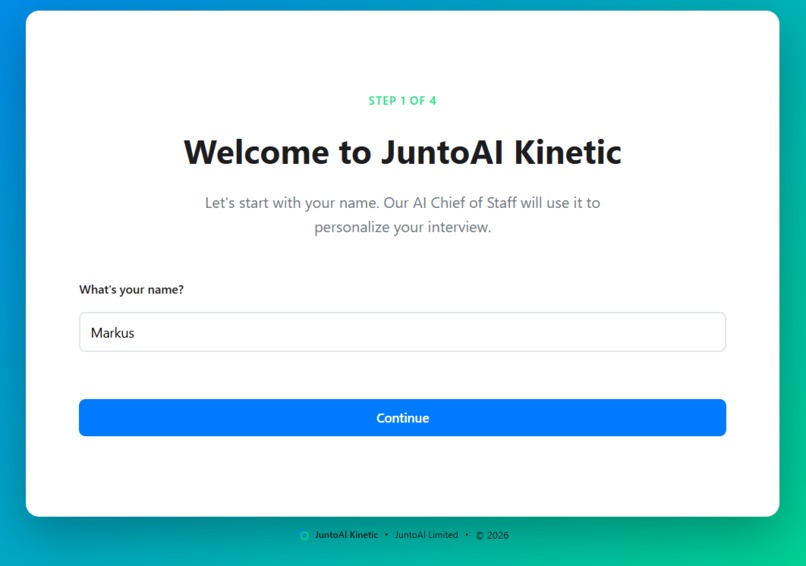
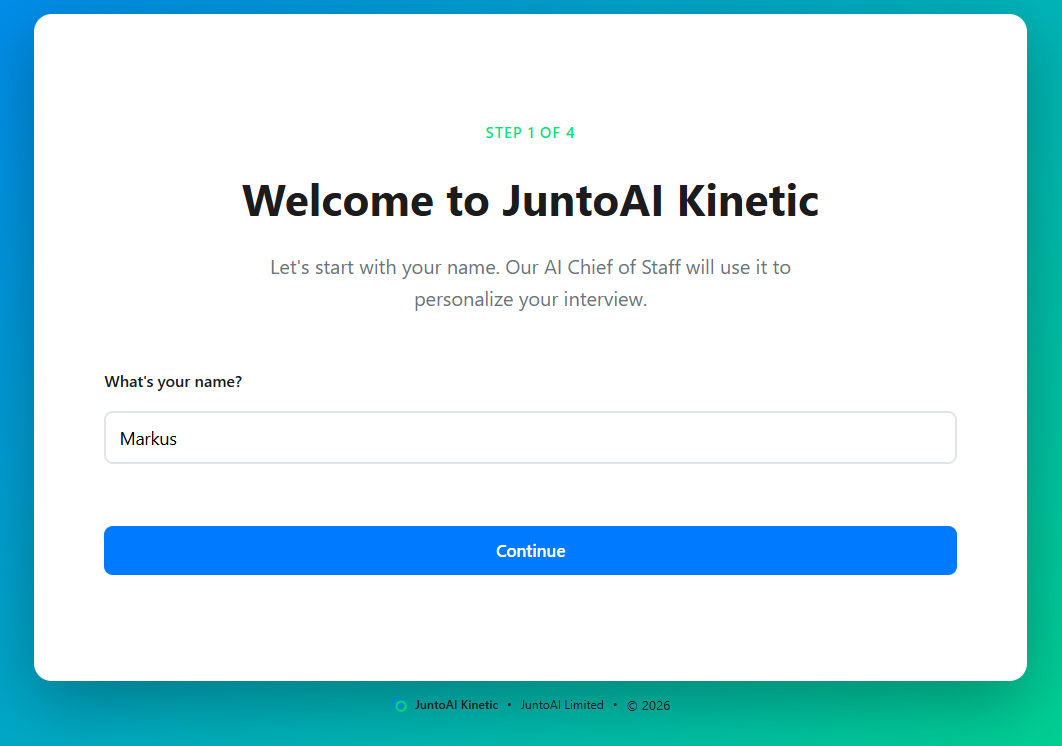
Onboarding into Interview 1/4
-
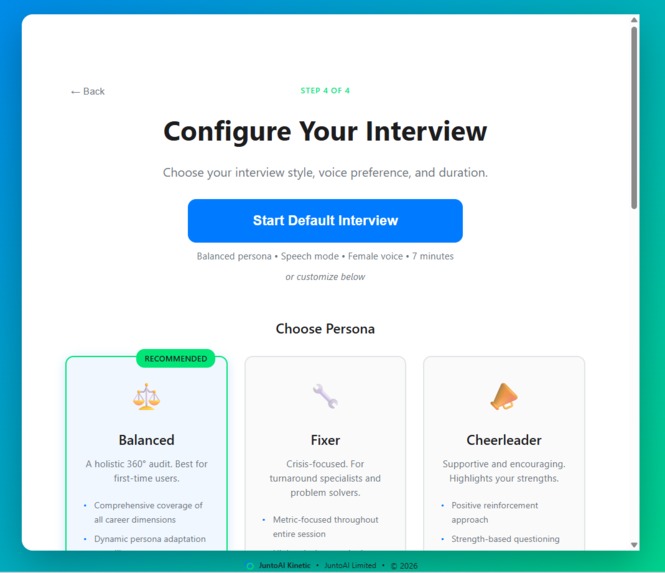
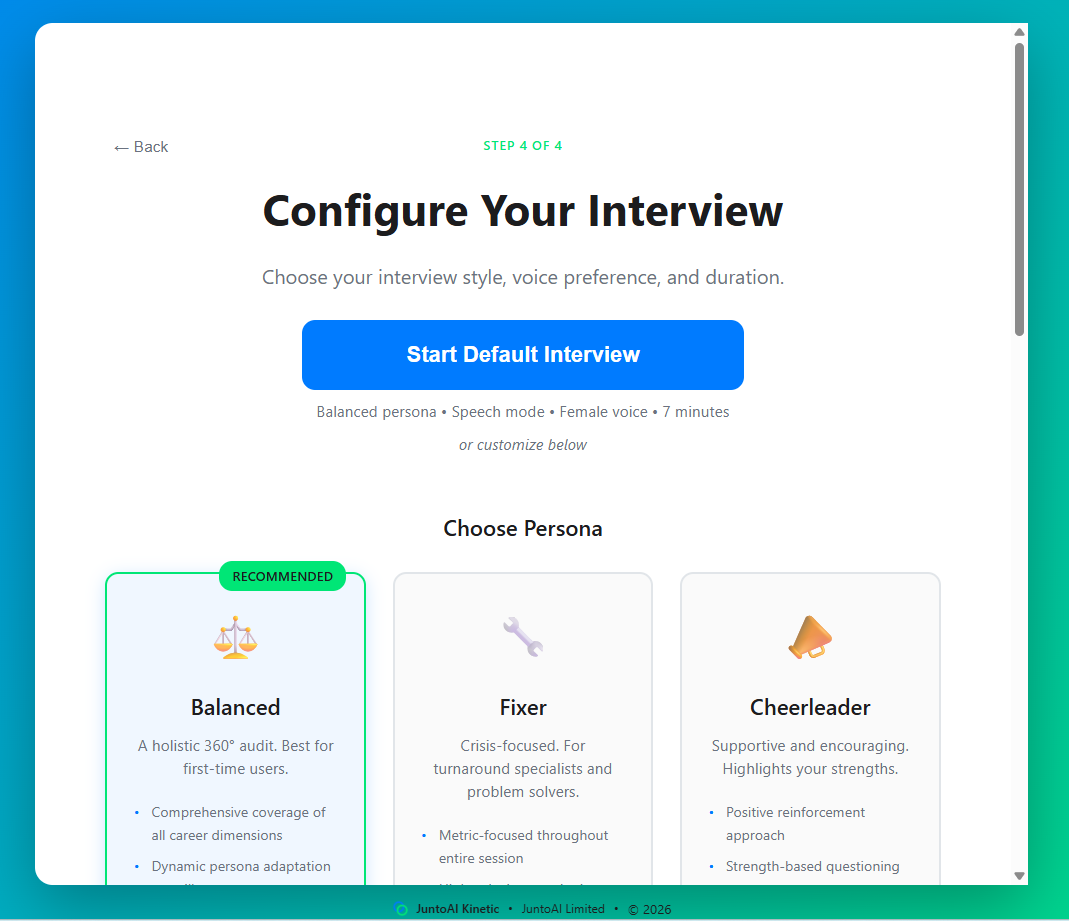
Onboarding into Interview 4/4
-
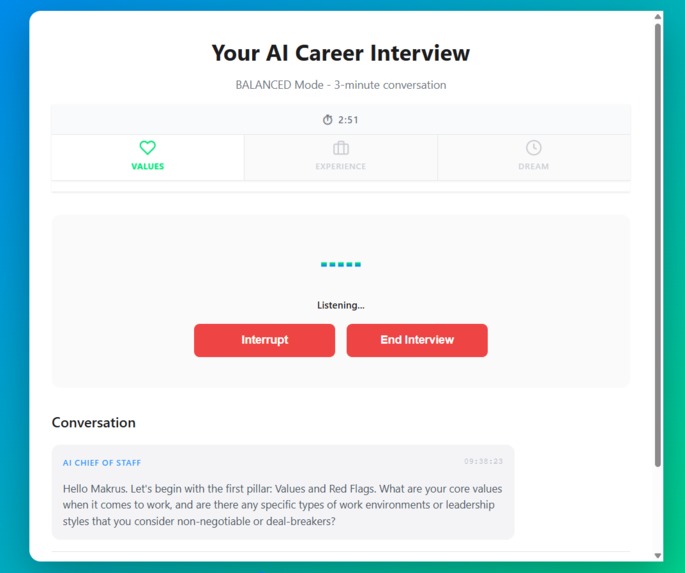
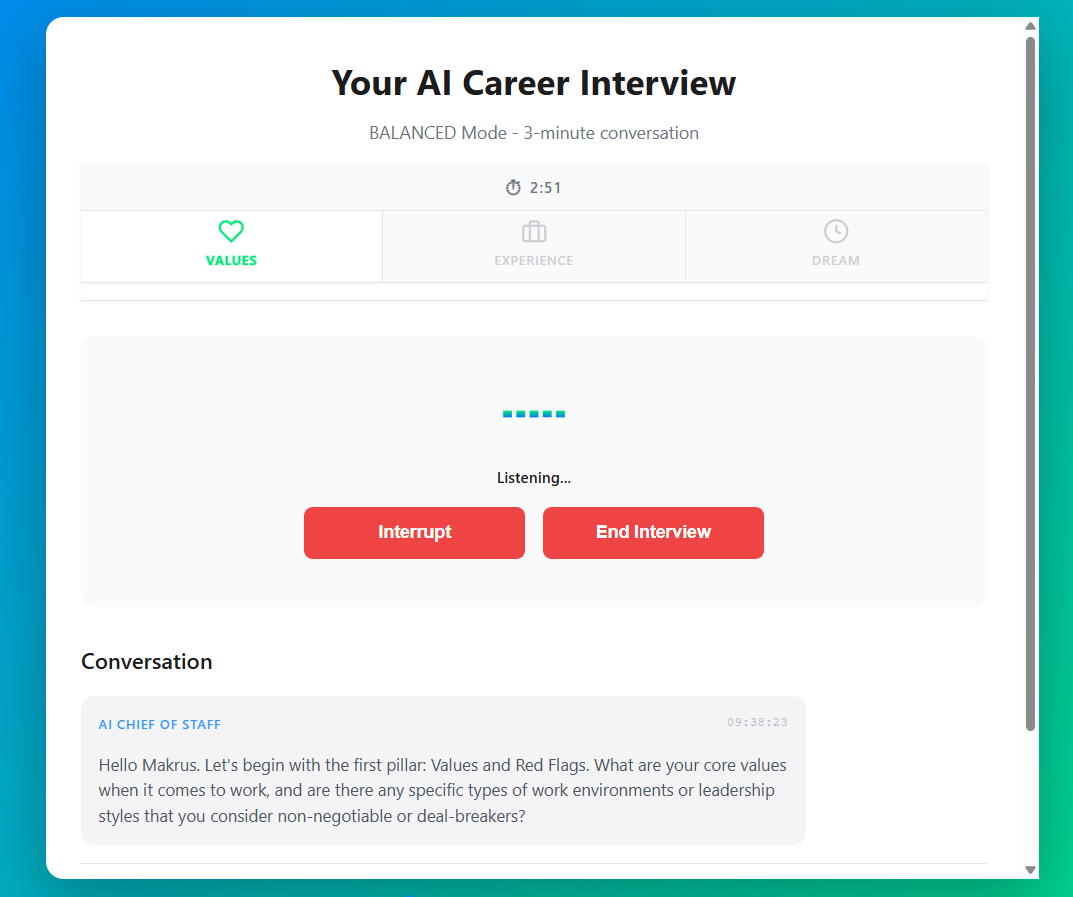
Voice Interview using Nova 2 Sonic
Inspiration
Senior professionals have "CV Exhaustion". They have 15-20 years of real impact but struggle to translate it into a strategic narrative. Traditional resume tools just match keywords to job descriptions. In 2026, that's table stakes.
We asked: what if an AI could interview you like a sharp Chief of Staff, push back on vague answers, and extract the war stories, metrics, and values that actually define your career?
That's JuntoAI Kinetic.
What it does
Kinetic is a voice-first career profiling tool. You sit down for a 15-minute AI voice interview. The AI doesn't autocomplete your resume. It challenges you.
Say "I managed a team" and it fires back: "How many people? What was the budget? What happened when it went wrong?"
The output is a structured Career Graph: your strategic archetype (The Fixer, The Builder, or The Scaler), metric-backed skill evidence, core values, and red flags. Not a prettier PDF. A machine-readable professional identity.
We also built two free evaluator tools (CV Readiness and LinkedIn Profile) that score your existing documents against 2026 hiring standards across 10 dimensions, giving users immediate value before they ever start an interview.
How we built it
The entire interview engine runs on Amazon Nova 2 models via AWS Bedrock:
Amazon Nova Sonic powers the real-time speech-to-speech interview. No STT-to-LLM-to-TTS pipeline. Native voice-to-voice with barge-in support, so users can interrupt naturally. The AI handles Voice Activity Detection, turn-taking, and emotion detection natively.
Amazon Nova Lite handles CV parsing (multimodal OCR on uploaded PDFs), post-interview analysis, and Career Graph JSON generation. We use the ConverseCommand API for structured output with low temperature for reliable JSON.
The Pushback Loop is where it gets interesting. During the interview, Nova Sonic detects low-signal answers in real-time and demands specifics. "I improved sales" gets rejected. "I increased revenue by 20% in Q3 by restructuring the channel partner program" gets accepted.
The backend runs on Node.js (ECS Fargate) with persistent WebSocket connections to maintain the Bedrock streaming session throughout the full 15-minute interview. DynamoDB for session metadata, S3 for transcripts and generated profiles. The frontend is React with an AudioWorklet-based playback pipeline for glitch-free audio.
We developed the entire project using Kiro IDE, which accelerated iteration significantly through its spec-driven development workflow and agent-powered coding.
Challenges we faced
Nova Sonic's event protocol. This isn't a simple streaming API. It requires a specific event sequence (sessionStart → promptStart → contentStart → textInput → audioInput → audioOutput). Getting the bidirectional streaming right with RxJS Subject-based async queues took real effort. Messages arrive as Buffer objects that can be either JSON events or binary audio, and you have to handle both in the same stream.
The 8-minute stream limit. Bedrock enforces an approximately 8-minute limit on bidirectional stream connections. For a 15-minute interview, we had to implement proactive stream recreation with conversation history replay. We recreate the stream at pillar transitions, replay the full transcript as structured USER/ASSISTANT messages, and trigger the AI to continue naturally. The user never notices.
Making AI professionally disagreeable. It's easy to make an AI agreeable. Making it push back without being rude is a prompt engineering challenge. We followed AWS's own Nova 2 prompting best practices: single system prompt, one-shot examples instead of phrase lists, and natural pause instructions. The result is an AI that feels like a demanding but supportive partner.
Audio format asymmetry. Nova Sonic accepts 16kHz PCM input but outputs 24kHz PCM. Different sample rates in the same session. The frontend AudioWorklet handles the resampling transparently.
Cost control. Each 15-minute session costs approximately $0.10 for Nova Sonic and $0.05 for Nova Lite analysis. We enforce a hard 15-minute timeout and use tiered S3 storage with automatic TTL cleanup to keep per-session costs under $0.15.
What's next
Kinetic is live at kinetic.juntoai.org. The interview engine, CV evaluator, and LinkedIn evaluator are all in production.
Now we need real users. Our immediate focus is getting Kinetic into the hands of senior professionals, career coaches, and recruiters, learning how they actually use it, and iterating fast on what we hear. The free evaluator tools are our growth lever: they deliver instant value with zero commitment, and every score becomes a natural entry point into the full voice interview.
The bigger vision is the Digital Twin. Once we have enough structured Career Graph data from real professionals, each profile becomes a living, queryable representation of someone's career. Not a static document, but an AI-native professional identity that can answer questions, surface relevant experience on demand, and evolve as the person's career does. That's where Kinetic stops being a tool and becomes infrastructure.
Built With
- amazon-dynamodb
- amazon-web-services
- bedrock
- codepipeline
- fragate
- kiro
- node.js
- nova
- react
- sonic
- terrafrom
- vite


Log in or sign up for Devpost to join the conversation.