-
-
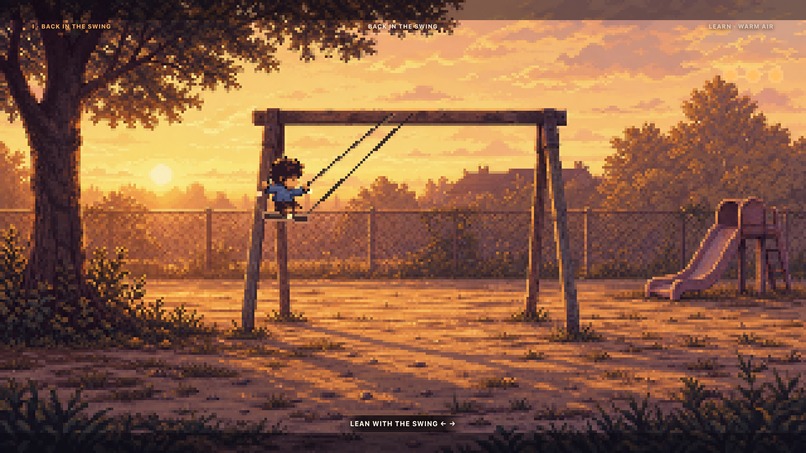
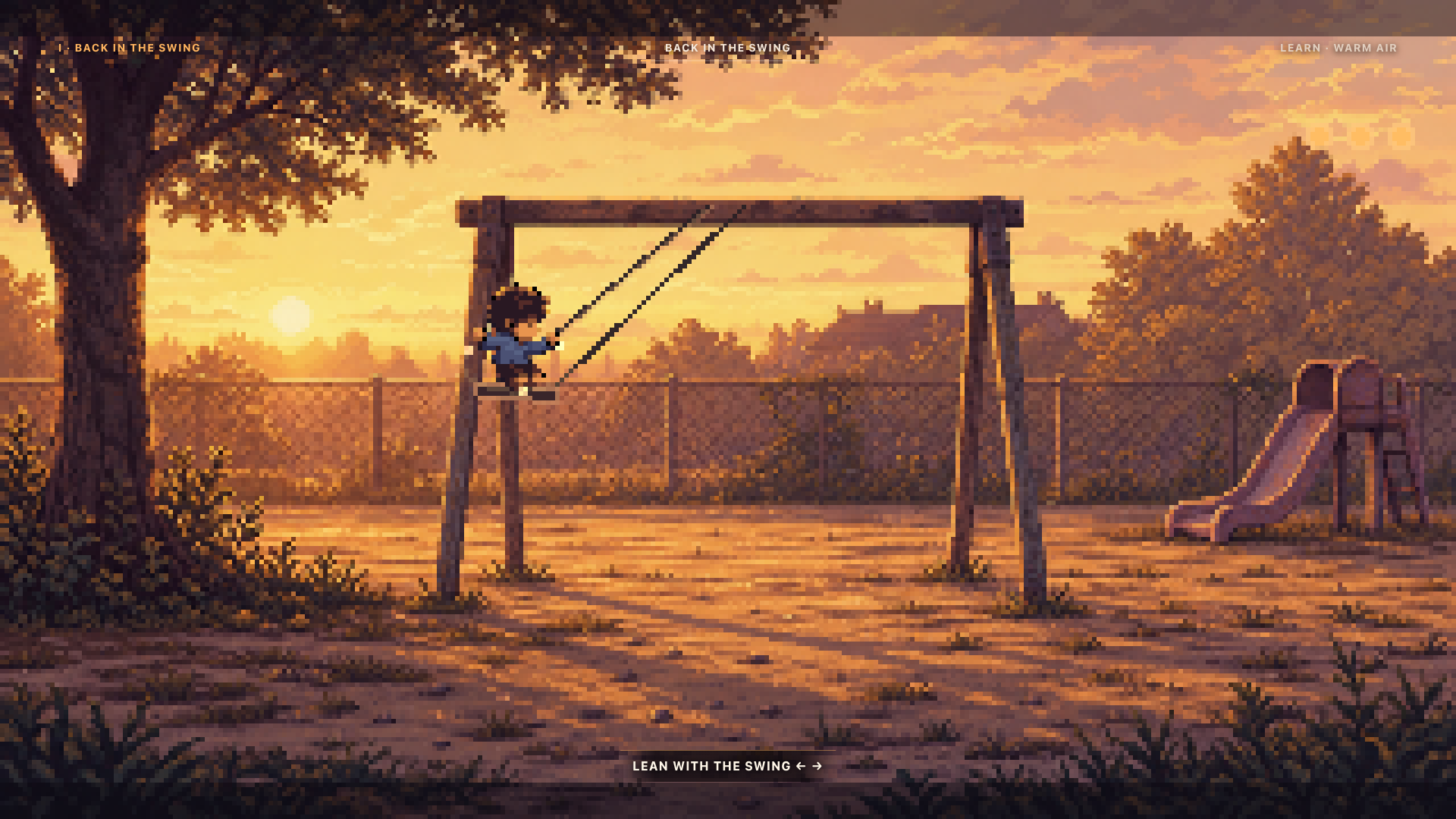
Back in the Swing — building momentum at golden hour.
-
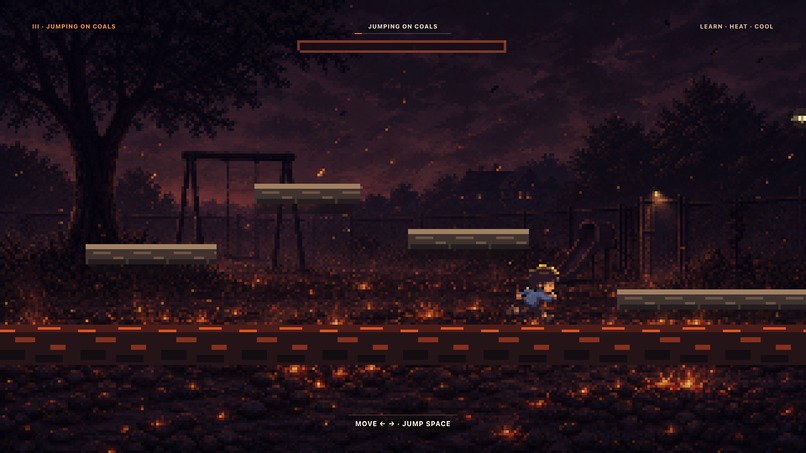
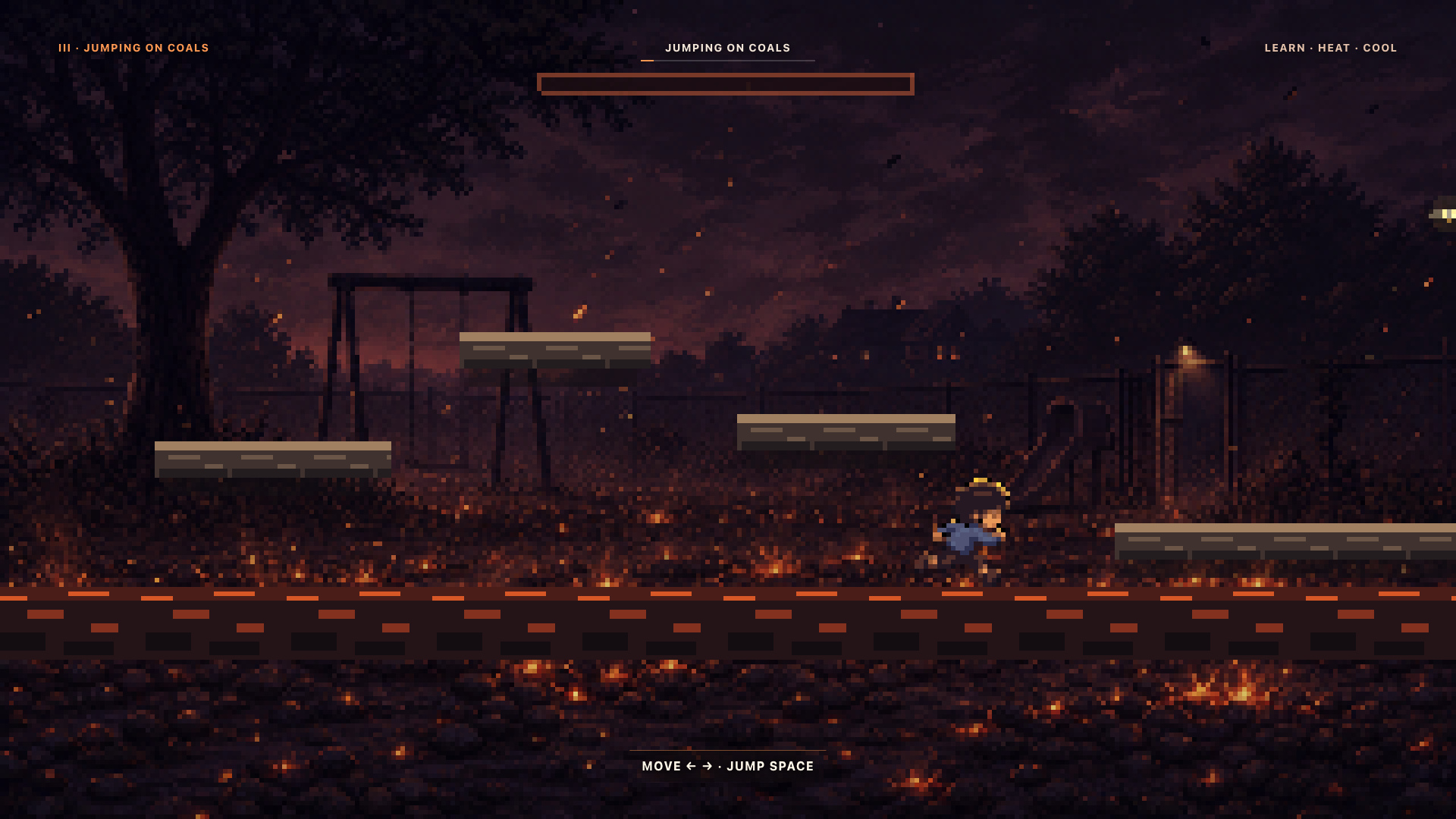
Jumping on Coals — manage Heat and Flow while the fire closes in.
-
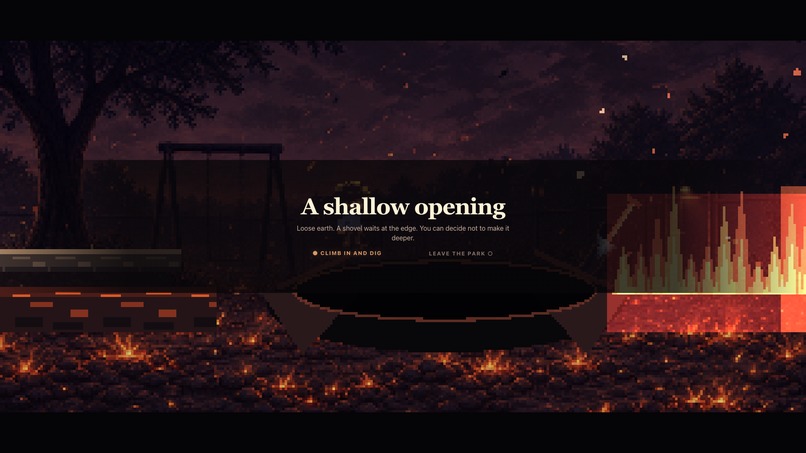
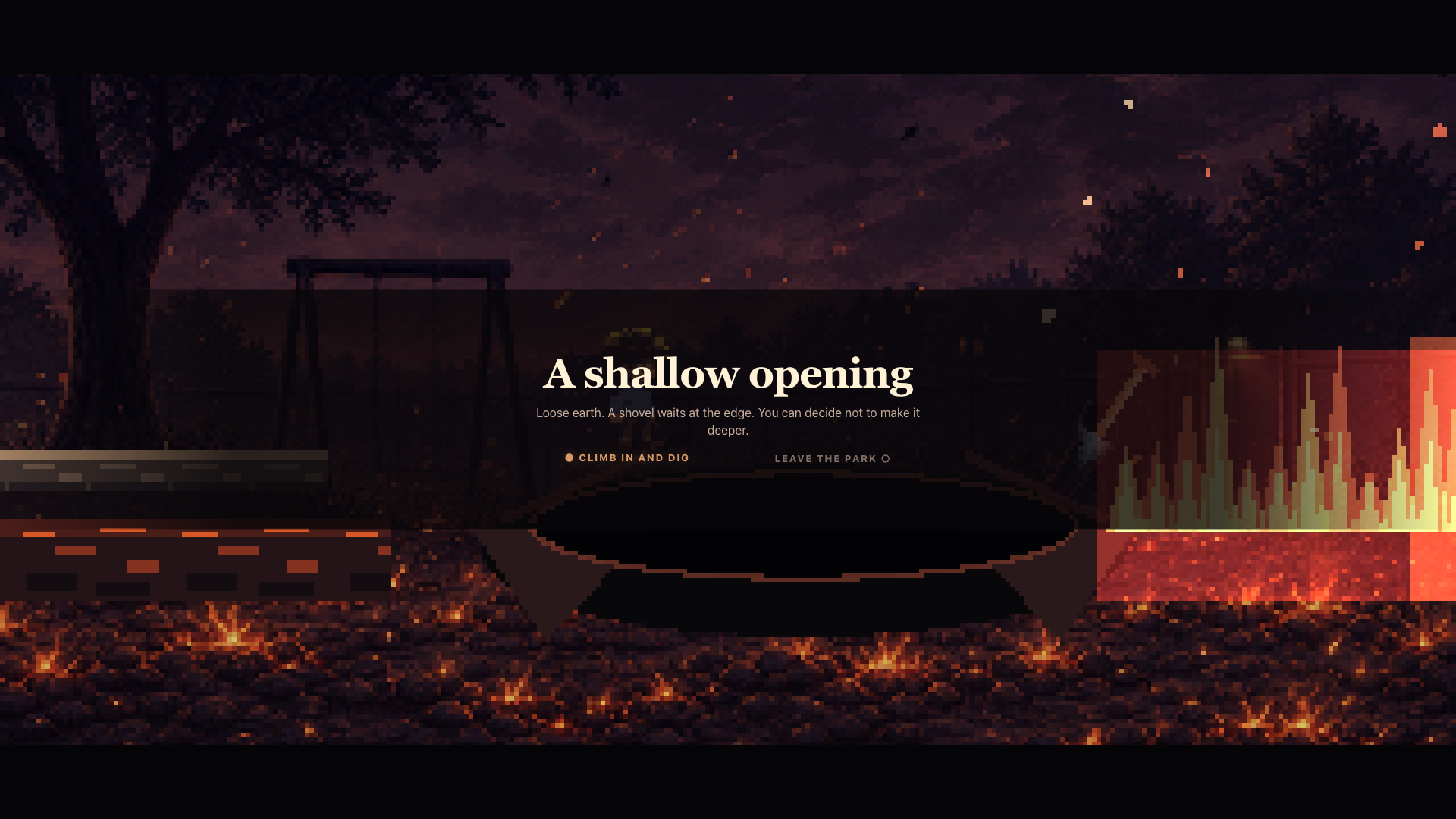
A shallow opening — choose whether to dig beneath the coals or leave the park.
-
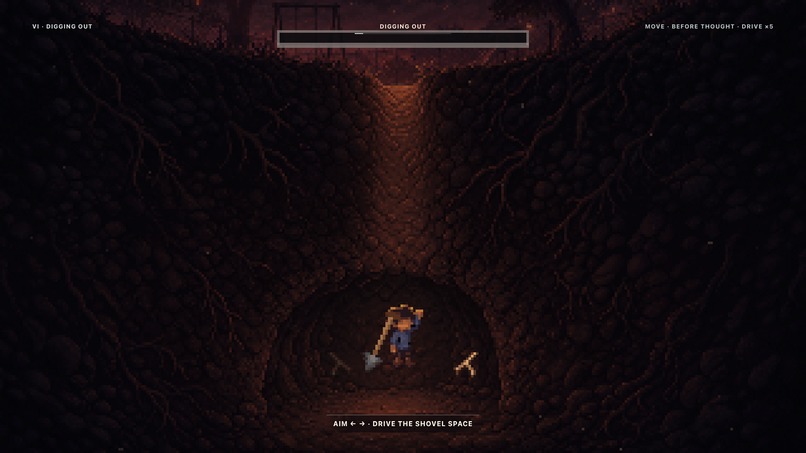
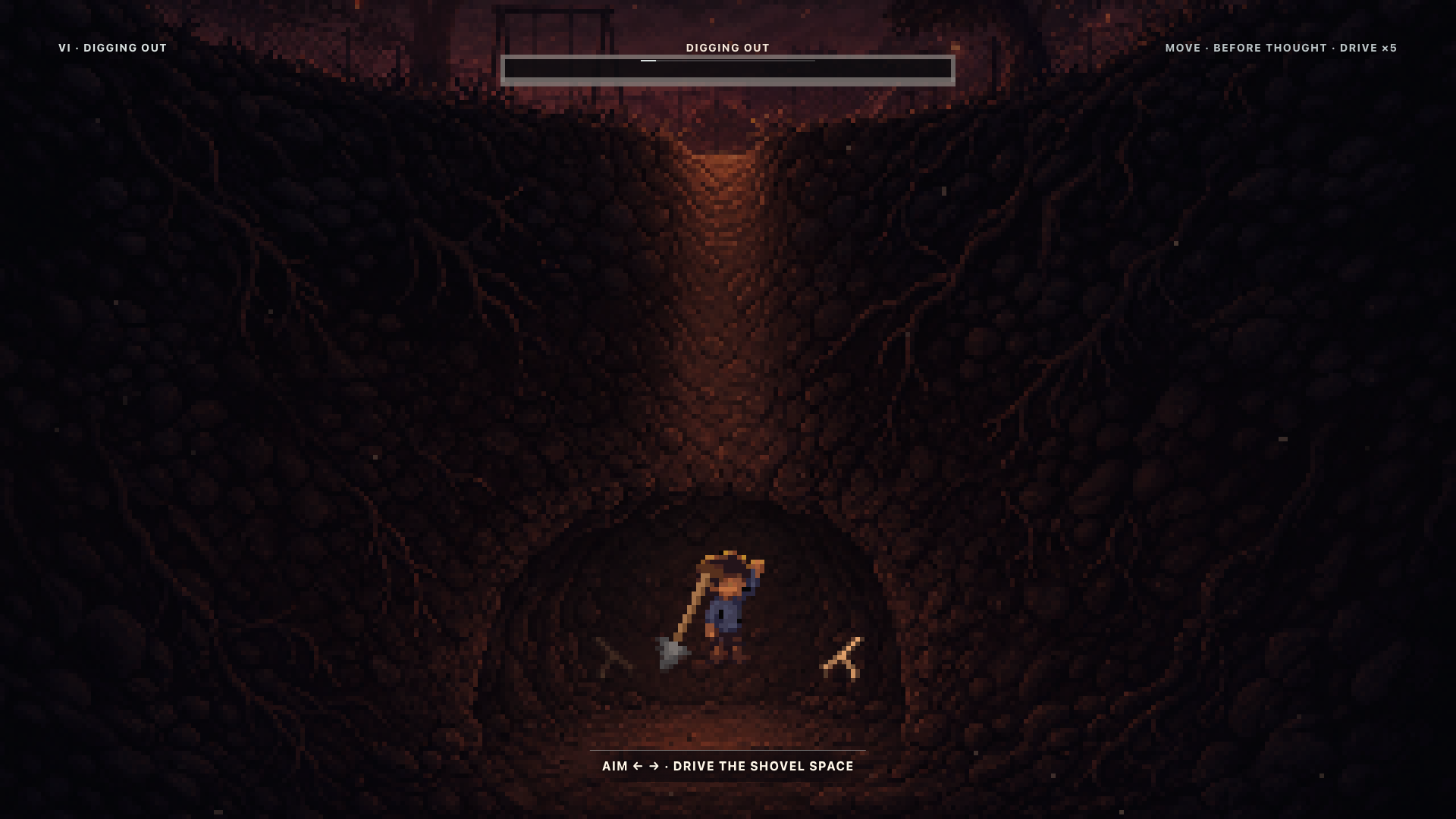
Digging Out — alternating shovel strikes turn recovery into a difficult ascent.
-
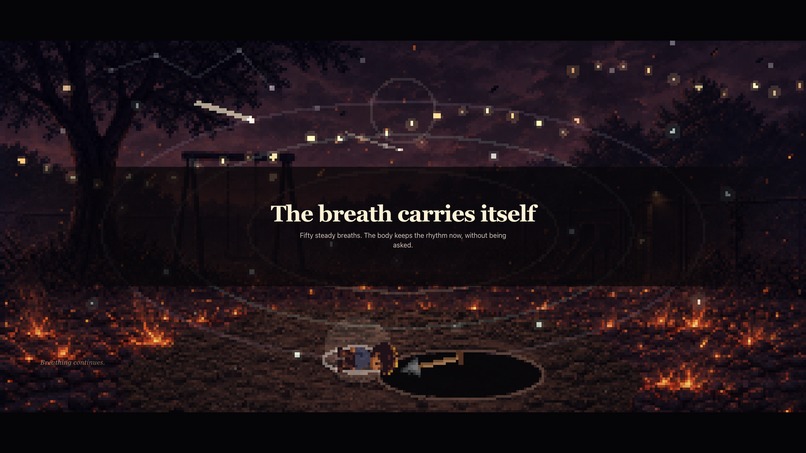
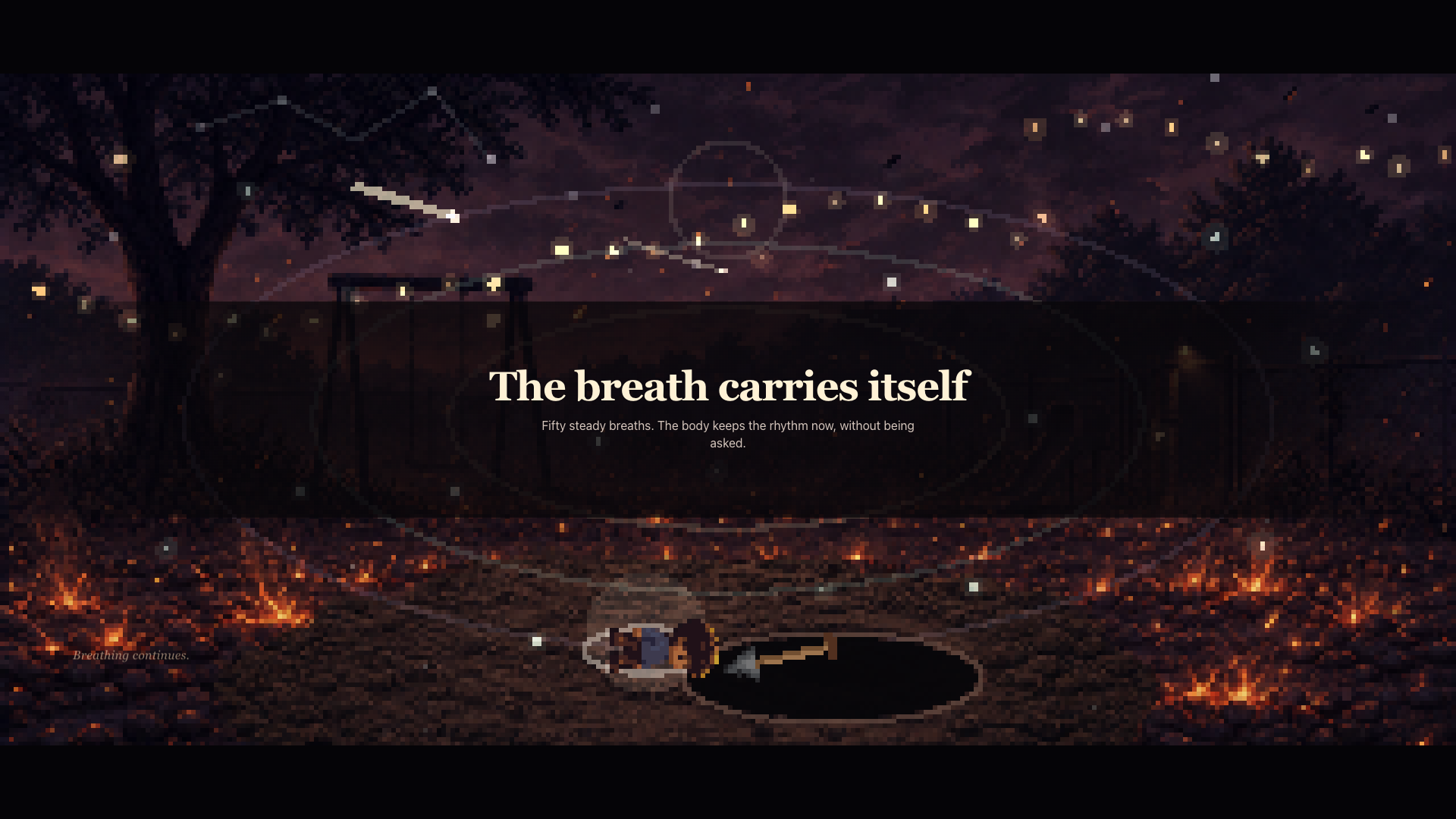
By the Shovel — recovery becomes a slower practice of breathing, focus, and memory.
-
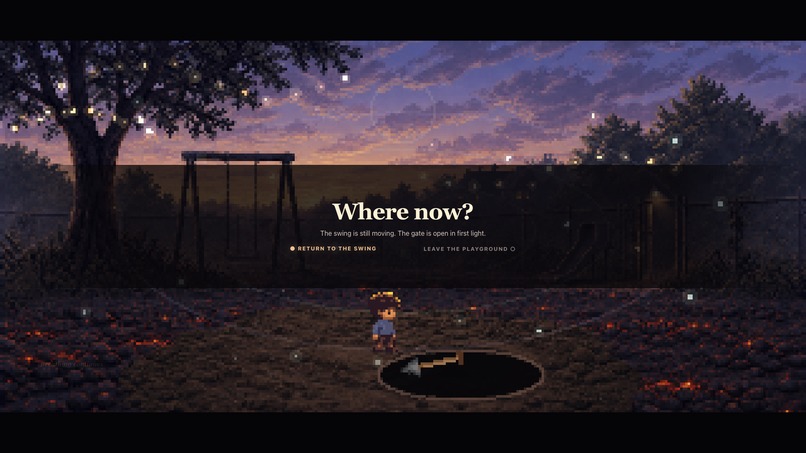
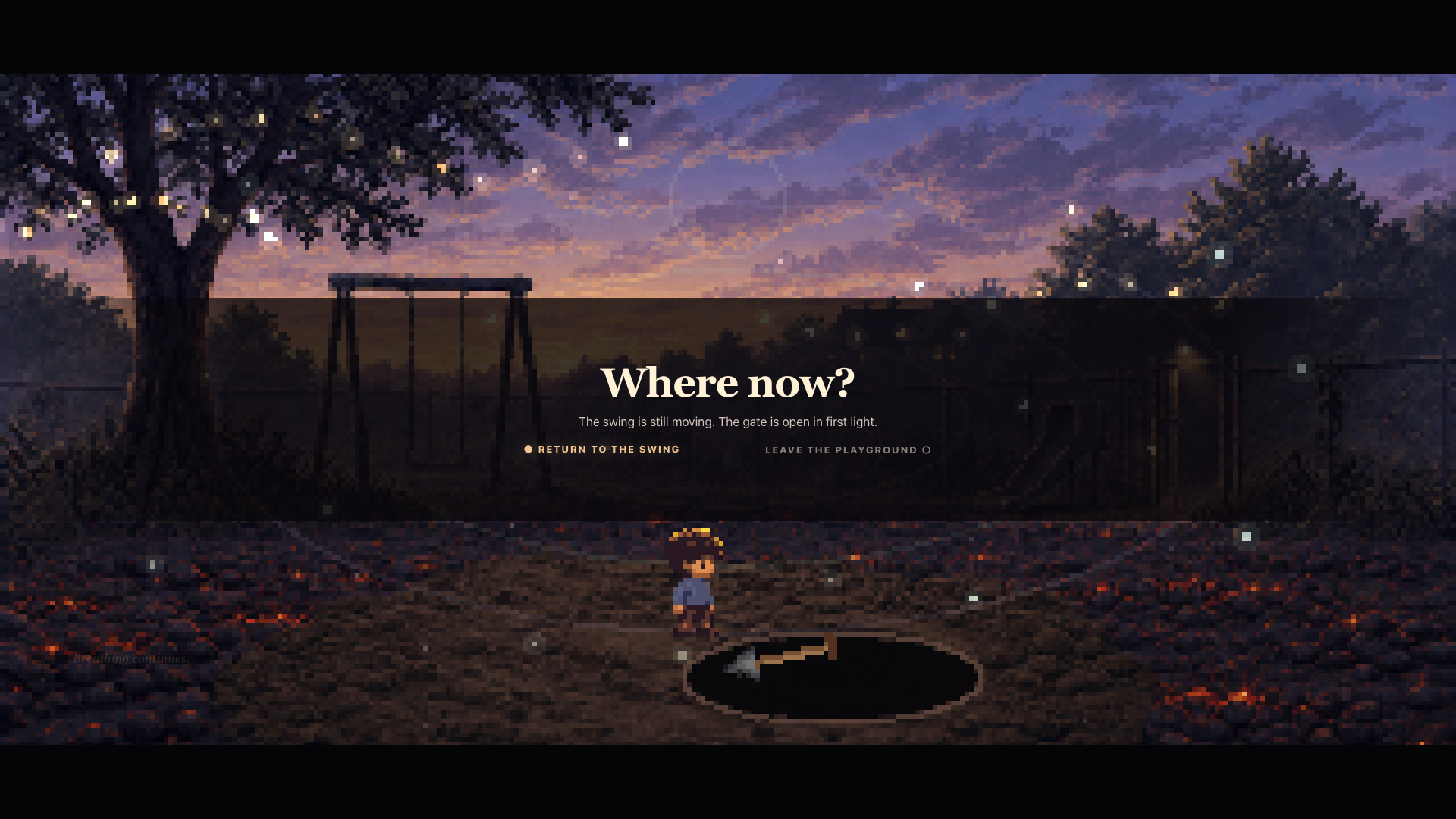
Where now? — return to the moving swing or leave the playground.
Jumping on Coals
An original album about burnout, transformed into a tactile eight-chapter game.
Inspiration
Years ago, I was putting nearly all of my energy into work. I wanted to grow quickly, accomplish something meaningful, and leave a legacy. The work succeeded, but I was becoming angry, isolated, and creatively empty.
Then I took my first paid PTO day. It was a Friday. Over that weekend, I wrote the entire Jumping on Coals album.
As I composed, a visual story appeared. It begins with a child on a swing: repetitive, comfortable motion that keeps you safely above the ground. The moment you leave that familiar cycle, you land on hot coals. You have to keep moving because stopping means burning. Eventually you dig beneath the coals for relief, only to find yourself exhausted at the bottom of a hole. You recover, dig back out, and face one final question: do you leave, or climb onto the swing again?
The whole album was made from one cello pizzicato sound transformed by different effects. To me, that represents one person moving through different circumstances and emotional states. I wanted the game to do the same thing: let the player inhabit the cycle rather than simply hear me explain it.
The album, concept, creative direction, and an earlier three-chapter Phaser prototype all existed before OpenAI Build Week. The Build Week story is not that AI invented Jumping on Coals. It is that Codex and GPT-5.6 helped me finally realize a cross-disciplinary work I had been unable to complete.
What it does
Jumping on Coals is a 37–42 minute pixel-art web game structured by the eight songs of the original album. It is not a conventional game with background music, and it is not a rhythm game. Each song owns a chapter, sets its dramatic duration, and changes what the player sees and does:
- Back in the Swing — build momentum, collect fireflies, and finally jump off.
- Losing Balance — read the environment while crossing a narrow beam.
- Jumping on Coals — manage Heat and Flow across a 26,400-pixel route while fire pursues you.
- Digging In — keep working as productive effort becomes compulsion and exhaustion.
- At the Bottom — use breathing, focus, and memory to recover the ability to stand.
- Digging Out — turn alternating shovel strikes into a difficult ascent.
- By the Shovel — rest beneath an opening sky and choose whether to leave or return.
- Back in the Swing (Again) — return to a satisfying familiar motion and decide when to step away.
Music shapes the environment, pacing, and available activity, but silence never takes control away from the player. A track ending does not automatically advance the game. The player must release, step forward, pick up the shovel, or make a choice.
Several apparent exits also surface the kinds of thoughts that make burnout cycles hard to leave: sunk effort, comparison, reputation, and identity. Leaving is always possible, but the player has to choose it deliberately. The final return to the swing is mechanically satisfying and accompanied by a scored variation on the original “Back in the Swing” theme, leaving the player to decide whether the return feels like recovery, repetition, or both.
How I built it
I had imagined an interactive version of this album for years, but I did not have the game-development experience or budget to build it. During the GPT-5.2 era, I created a game design document with ChatGPT and attempted a first prototype with Codex. After a great deal of iteration, I had a useful Phaser foundation and rough versions of the first three chapters—but the physics, visuals, mechanics, and remaining album arc were not coming together. I stopped working on it.
About five months later, during Build Week, I returned with Codex, GPT-5.6, Goal Mode, and Sol. My first request was essentially: evaluate what is here, decide whether it should be rebuilt or continued, and make it work. Codex concluded that the earlier prototype was a good foundation. It kept that foundation, improved the first three chapters, connected the intended visuals and mechanics, and gave me the first version that actually felt like the game I had imagined.
That changed the project. The swing could not remain engaging for the length of an entire song, so GPT-5.6 and Codex helped develop the firefly mechanic and its evolving visual orbit. Then, using the existing design document and Goal Mode, I asked Codex to carry the experience through the rest of the album. It implemented the missing chapters and gave each one a distinct physical and emotional verb. Within the first Build Week evening, the project crossed a line from “a prototype I was fighting” to “a game that was genuinely fun to make.”
The implementation uses Phaser 3, TypeScript, Vite, HTML/CSS, Arcade Physics, and Web Audio. During Build Week, Codex helped me:
- analyze the repository and turn the creative objective into staged acceptance criteria;
- rebuild the swing and balance systems around readable player goals;
- replace a short, flat coal test with a chapter-length route containing Heat, Flow, checkpoints, memory sparks, recovery decisions, and a pursuing fire;
- implement and connect the later chapters for collapse, recovery, escape, reflection, and return;
- coordinate music timing, silence gates, state, input, UI, transitions, and narrative choices across eight scenes;
- reduce runtime audio from roughly 397 MB of WAV masters to roughly 36 MB of browser-ready MP3s without altering the originals;
- add responsive presentation, touch controls, and deterministic judge shortcuts;
- debug TypeScript and browser behavior, validate the production build, and create an evidence-backed before-and-after record.
GPT-5.6 was especially valuable because this was not one isolated coding problem. The mechanics had to express the music, the scenes had to share state without losing player agency, recovery had to feel different from achievement, and the ambiguous ending had to work as an action rather than an explanation. GPT-5.6 sustained that larger context while Codex moved between physics, audio, visuals, state, narrative, and validation.
I worked with Codex conversationally—like a collaborator I wanted to play the game with. I could describe how a mechanic felt, what emotional purpose it was failing to serve, or why a visual beat did not match the music, and then inspect and refine a working implementation instead of translating every idea into a discipline I had not yet mastered.
Challenges
The hardest design problem was letting full-length songs drive the experience without producing either a passive music visualizer or a beat-mapped rhythm game. The solution was to use song progress for broad dramatic phases while reserving every meaningful transition for the player.
The second half created a different challenge: recovery should be interactive, but it should not become another optimization loop. Breathing, focus, posture, restrained feedback, and slower physical verbs let those chapters remain playable without treating wellness as a score.
Finally, the real experience lasts more than half an hour. I added development-only chapter navigation, audio seeking, scene-aware outro preparation, and direct access to key decisions so judges can inspect the actual game state without waiting through every full-length track.
Accomplishments that I'm proud of
- Expanded a preexisting three-chapter vertical slice into a complete eight-chapter playable cycle.
- Made the album the game's structure rather than decoration.
- Turned burnout, collapse, recovery, escape, and relapse into distinct player actions.
- Preserved player agency at every song boundary and every leave-or-return decision.
- Built a technically coordinated experience across physics, audio, state, visuals, input, narrative, and responsive presentation.
- Finished an artistic idea that I had previously tried to express through concepts, video ideas, and writing—but could never make people inhabit.
What I learned
I learned that an album can function as a game clock without becoming a beat chart, provided the player retains control at every meaningful boundary. I also learned that ambiguity becomes more powerful when the player performs it repeatedly instead of reading about it.
Most importantly, I learned what AI-assisted creation can mean for an independent artist working across disciplines. I had taken coding courses and imagined this project for years, but I could not have built this particular combination of composition, visual storytelling, interaction design, and game engineering alone. Codex and GPT-5.6 did not replace the artistic point of view; they made it possible for me to carry that point of view into a medium that had previously been out of reach.
What's next
The game is now publicly playable. Next I want to observe how players interpret the ambiguous ending, refine accessibility and touch behavior from real-device feedback, complete more natural-duration playthrough testing, and continue polishing the experience around the album's eventual public presentation.
I am especially interested in the conversations after people finish: Did returning to the swing feel comforting, compulsive, or both? Where did the cycle become recognizable? And when, if ever, did they decide to leave?
Built With
- gpt-5.6
- html5
- openai-codex
- phaser.js
- typescript
- vite
- web-audio-api

Log in or sign up for Devpost to join the conversation.