Inspiration
Our team was inspired to create something truly entertaining and unique. We wanted to mix the formal setting of a courtroom with totally outrageous and funny situations. The idea for "Judgement Day: Ridiculous Cases" came from imagining a place where users could become the judge for the funniest, most absurd legal battles. It was about creating a lighthearted game that brought a smile to people's faces, while also pushing the boundaries of what a courtroom simulation could be with intelligent AI interactions.
What it does
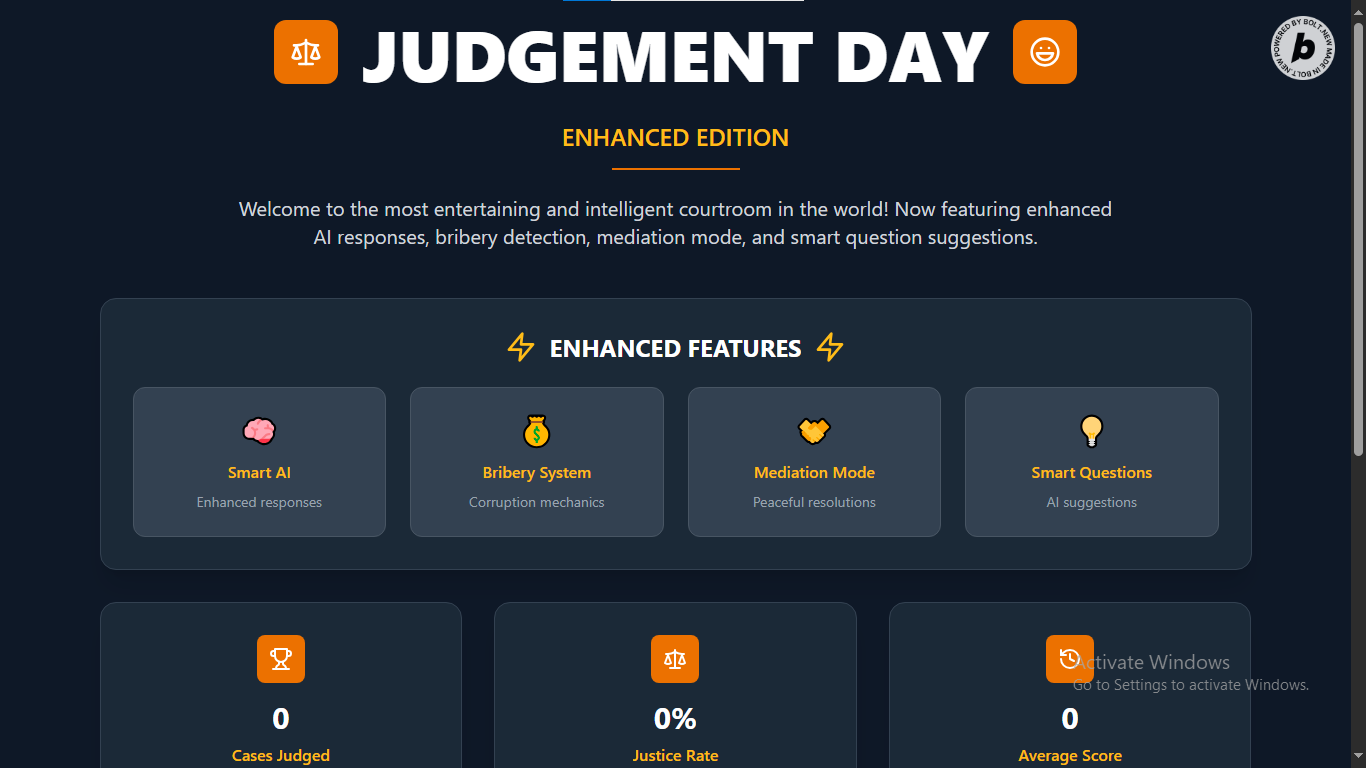
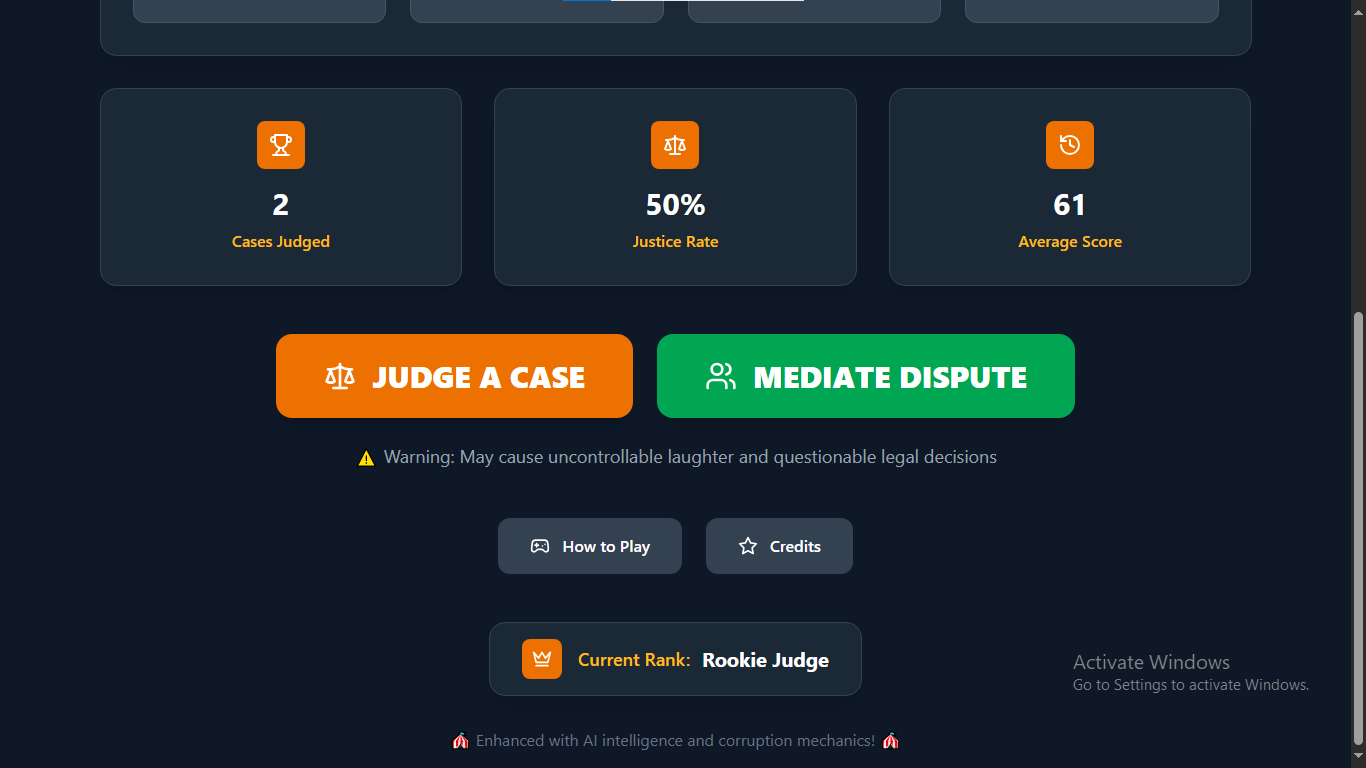
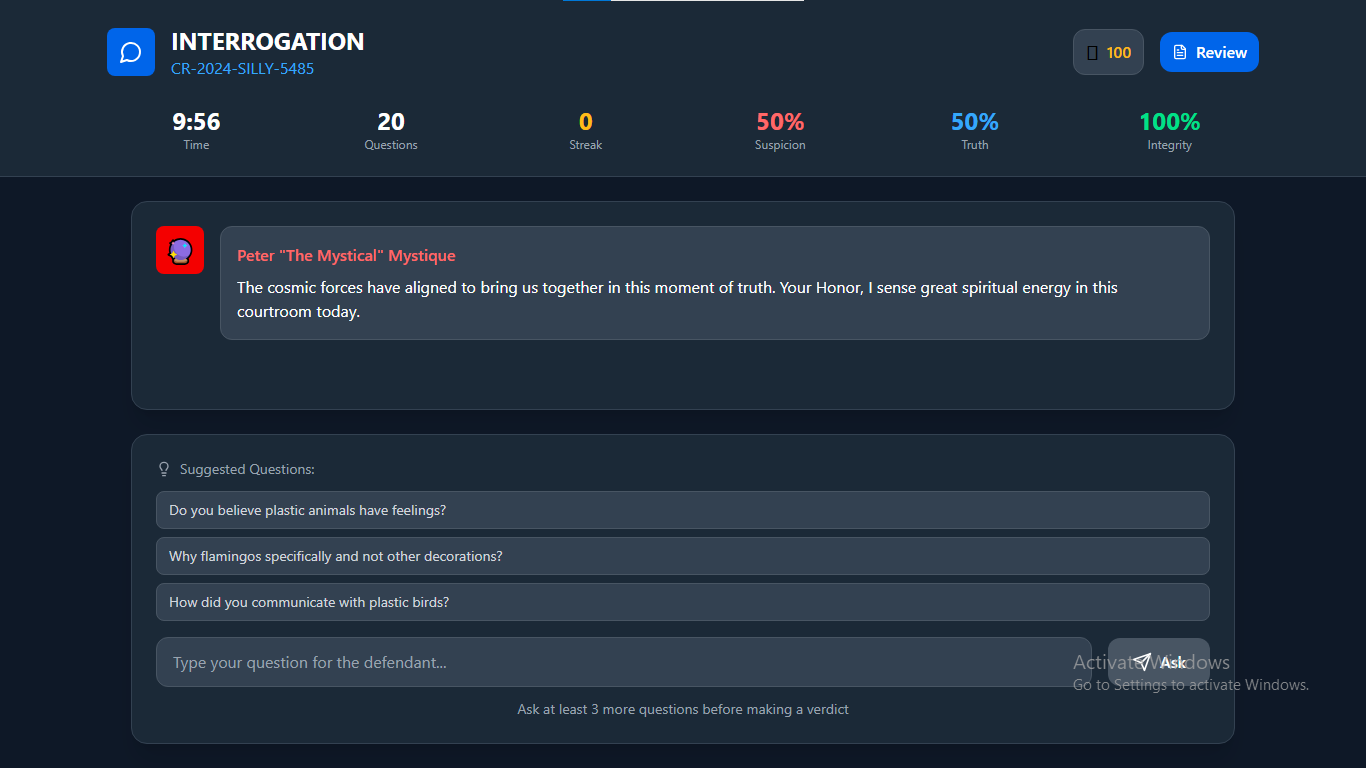
"Judgement Day: Ridiculous Cases" stands as the most entertaining and intelligent courtroom in the world! This web application puts you in the role of a judge or a mediator, challenging you with a series of utterly ridiculous legal cases.
Here's a breakdown of its key features:
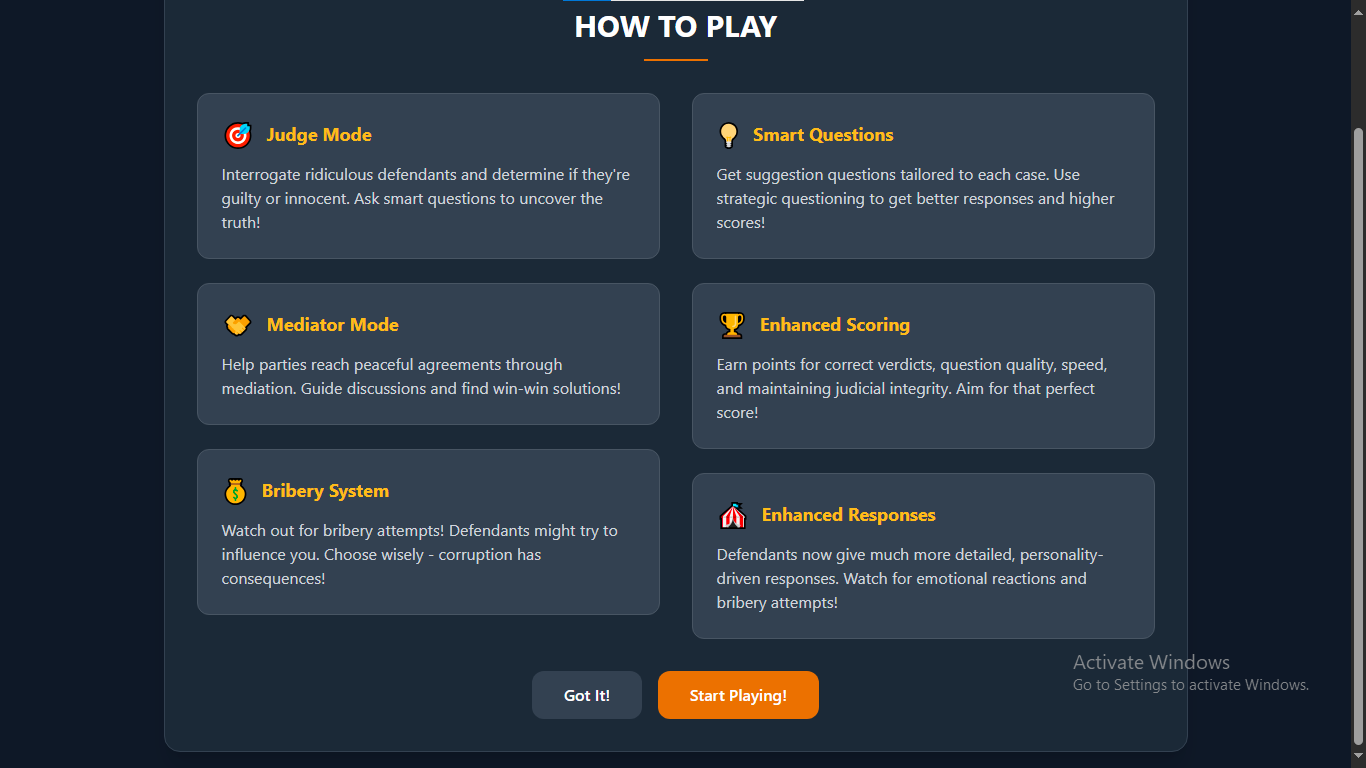
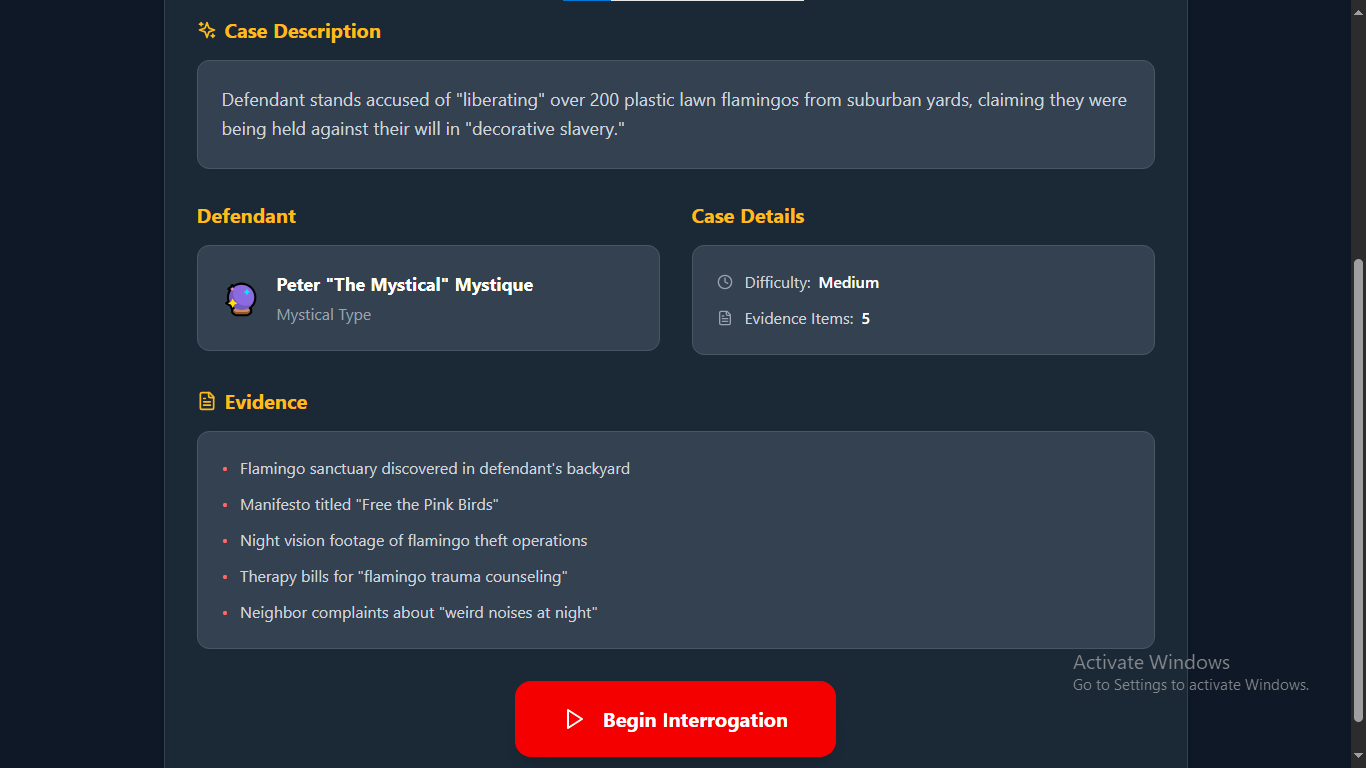
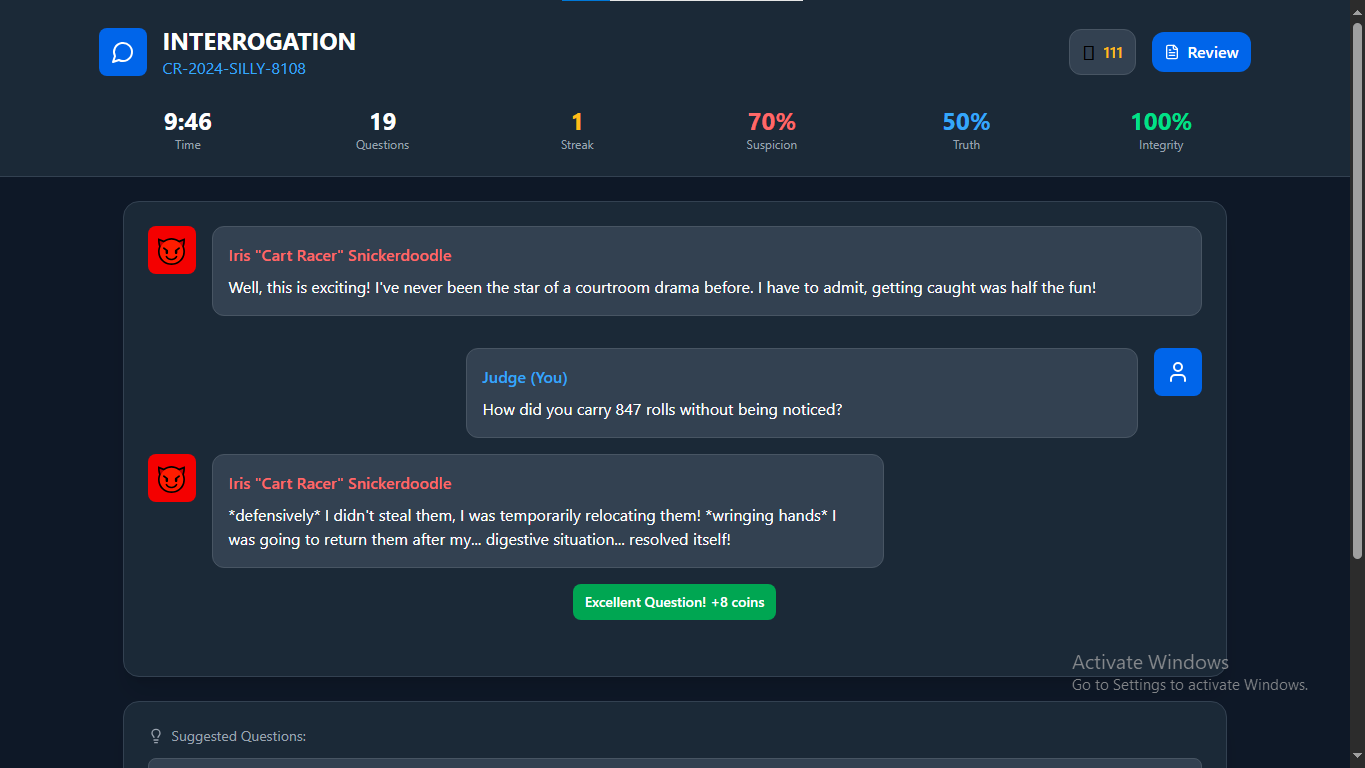
- Judge Mode: Interrogate hilarious defendants and determine their guilt or innocence. Use Smart Questions tailored to each case to uncover the truth and get better responses.
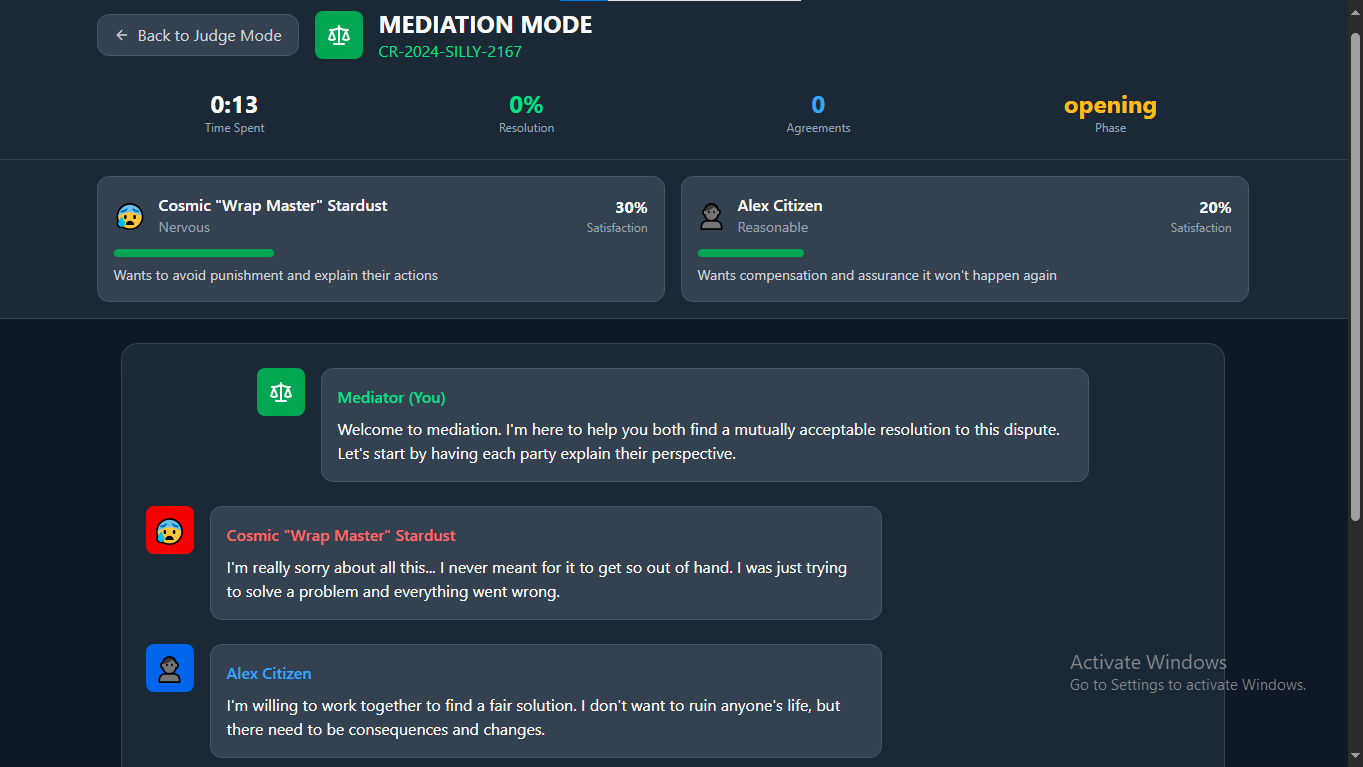
- Mediator Mode: Shift roles to help conflicting parties reach peaceful, win-win agreements through guided discussions.
- Bribery System: Be vigilant! Defendants might attempt to influence your verdict with bribes. Your choices have consequences, impacting your judicial integrity.
- Smart Questions: Receive intelligent suggestion questions that adapt to the unfolding case, allowing you to strategically question and achieve higher scores.
- Enhanced Scoring: Earn points not just for correct verdicts, but also for the quality of your questions, your speed in making decisions, and maintaining your judicial integrity against bribery attempts. Aim for that perfect score!
- Enhanced AI Responses: Defendants now provide incredibly detailed, personality-driven responses. Watch closely for their emotional reactions and detect any subtle bribery attempts, making each case uniquely dynamic.
How we built it
We built "Judgement Day: Ridiculous Cases" primarily using Bolt AI, an incredible AI-powered app builder. This allowed our team to bring our vision to life much faster than traditional coding, especially for integrating the complex AI-driven features.
Here’s our process:
- AI-Powered Foundation: We started by telling Bolt AI about our project – the idea of a courtroom simulation with funny cases and advanced AI interactions. Bolt AI then generated the core structure of our web application, including setting up the frontend using React and laying the groundwork for the intelligent features.
- Modern Tech Stack: Bolt AI automatically set up our project with modern development tools like Vite for fast development, ESLint for clean code, and Tailwind CSS for easy styling. This gave us a robust and up-to-date base, allowing us to focus on the unique game mechanics.
- Collaborative Refinement: After Bolt AI provided the initial code, our team worked together to refine it. We adjusted layouts, added specific design elements using Tailwind CSS's utility classes, and deeply integrated the interactive components for Judge Mode, Mediator Mode, the Bribery System, and Smart Questions. Bolt AI handled the complex code generation, allowing us to focus on crafting the intricate "ridiculous cases" and making the user experience truly engaging and intelligent.
Challenges we ran into
Even with the power of Bolt AI, we faced some interesting challenges as a team, especially when pushing the boundaries of its AI capabilities:
- Guiding the AI for Complex Logic: Learning how to give Bolt AI the clearest and most effective instructions to generate sophisticated features like bribery detection and nuanced AI responses took significant practice. It was a new way of thinking about building complex game logic.
- Customizing AI Output for Game Mechanics: While Bolt AI generated a solid foundation, fine-tuning the unique design choices and intricate game mechanics, such as the scoring system and question suggestions, often required us to manually refine or add to the generated code.
- Integrating Advanced Features: Ensuring the seamless integration of features like Mediator Mode and the Bribery System into the core courtroom flow, while maintaining a smooth user experience, presented its own set of design and coding challenges.
- Team Coordination with AI: Integrating the AI-generated code with our manual customizations and ensuring smooth collaboration within the team was an initial learning curve, particularly with the iterative nature of AI development.
Accomplishments that we're proud of
We are really proud of several accomplishments with this project:
- Revolutionary AI Integration: We successfully implemented an AI system that delivers enhanced responses, smart question suggestions, and even bribery detection, making "Judgement Day" an intelligent and highly interactive experience.
- Rapid Development: Using Bolt AI, we were able to create a functional, feature-rich, and fun application in a significantly shorter amount of time, demonstrating the power of AI in accelerating complex game development.
- Engaging and Diverse Gameplay: The successful implementation of both Judge Mode and Mediator Mode, along with a unique Bribery System, offers diverse and highly entertaining gameplay experiences.
- Mastering New Tools: Our team gained valuable hands-on experience with cutting-edge tools like Bolt AI, React, Vite, and Tailwind CSS, pushing our skills in modern web development to new heights.
- Successful Team Collaboration: Despite integrating a new AI-driven workflow and complex game mechanics, we effectively collaborated as a team to bring this ambitious project to completion.
What we learned
Working on "Judgement Day: Ridiculous Cases" taught our team a lot, particularly about developing intelligent, interactive applications:
- The Power of AI in Game Development: We deeply understood how AI tools like Bolt AI can revolutionize the app-building process for intricate game mechanics, making it faster and enabling more sophisticated features.
- Designing Interactive AI: We learned the nuances of designing prompts and refining AI output to create personality-driven responses and intelligent game interactions (like smart questions and bribery attempts).
- Efficient Workflow with AI: We learned how to set up and manage a modern web development workflow, from package management to code quality with ESLint, efficient styling with Tailwind CSS, and integrating AI-generated components.
- Problem-Solving with New Paradigms: We developed advanced skills in debugging and refining complex code that was partly AI-generated, which is a valuable skill in the evolving tech landscape of AI-assisted development.
- Focus on Creative Gameplay: By leveraging AI for much of the foundational coding, our team was able to devote significantly more time to the creative content – designing the "ridiculous cases," defining character personalities, and refining the game's core loop.
What's next for JUDGEMENT DAY- RIDICULOUS CASES EDITION
For the future of "Judgement Day: Ridiculous Cases Edition," we have several exciting ideas to further enhance the world's most entertaining courtroom:
- Expanded Case Library: Continuously add a much larger and even more diverse library of truly ridiculous and challenging cases for judges and mediators to tackle.
- Community Case Submissions: Implement a feature allowing users to submit their own "ridiculous cases" for others to judge, fostering a community-driven content stream.
- Advanced AI Personalities: Further develop the AI responses to include even more distinct personalities, character arcs, and dynamic reactions throughout a trial.
- Multiplayer / Competitive Mode: Explore a mode where players can judge or mediate cases against friends or other players, possibly with real-time interaction.
- Visual Enhancements: Invest in more detailed character art, courtroom backgrounds, and visual effects to bring the cases to life even more vividly.
- Story Arcs: Develop interconnected cases that form longer story arcs, allowing players to follow characters through multiple ridiculous legal encounters.
Built With
- boltai
- css3
- eslint
- html5
- javascript
- node.js
- npm
- postcss
- react
- tailwindcss
- typescript
- vite

Log in or sign up for Devpost to join the conversation.