-
-
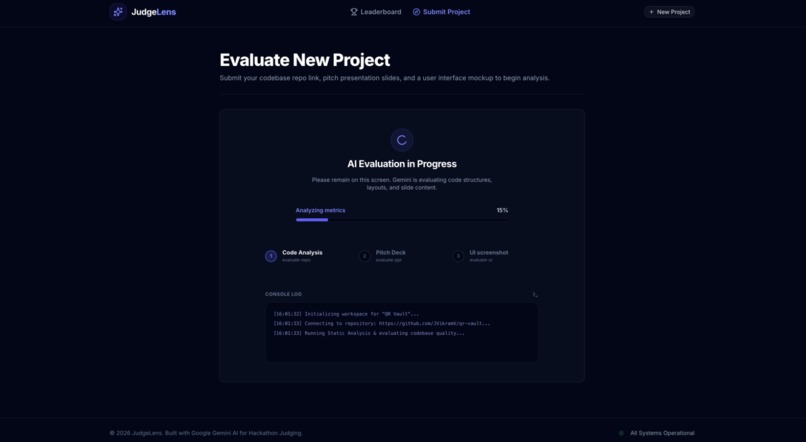
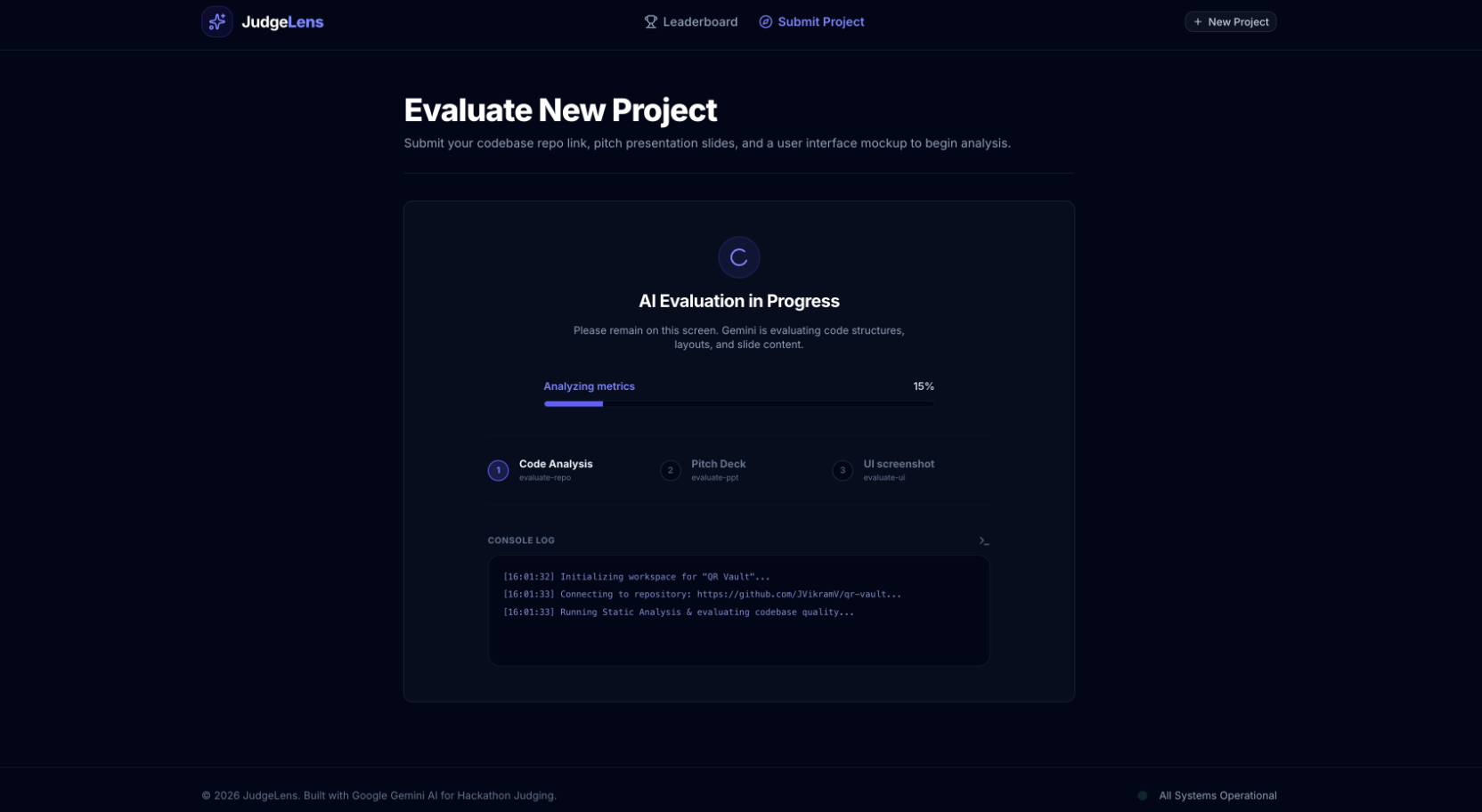
Evaluating project
-
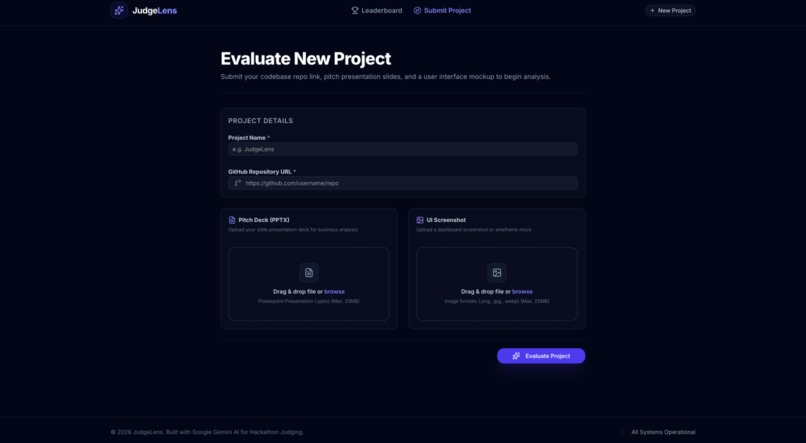
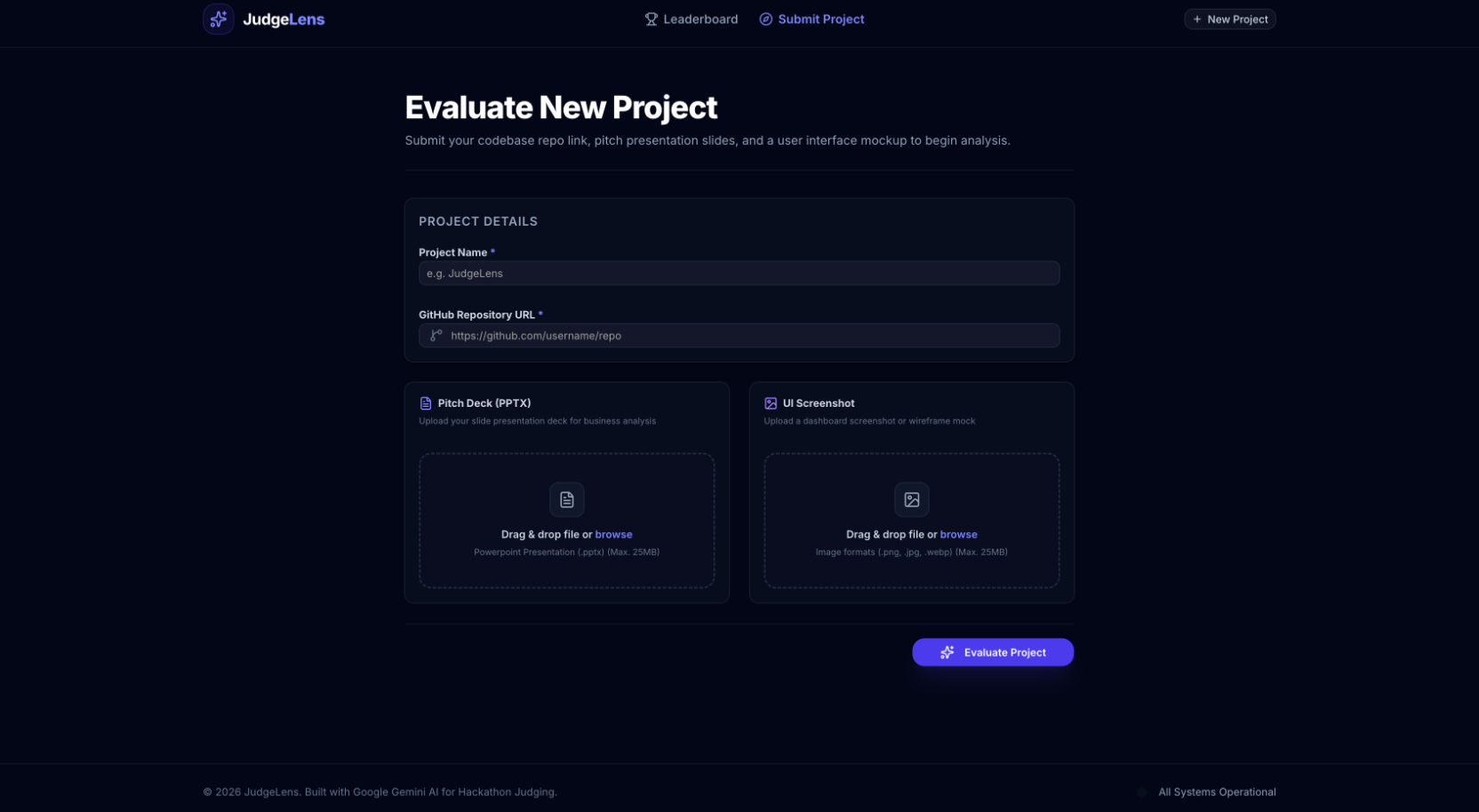
New project submission
-
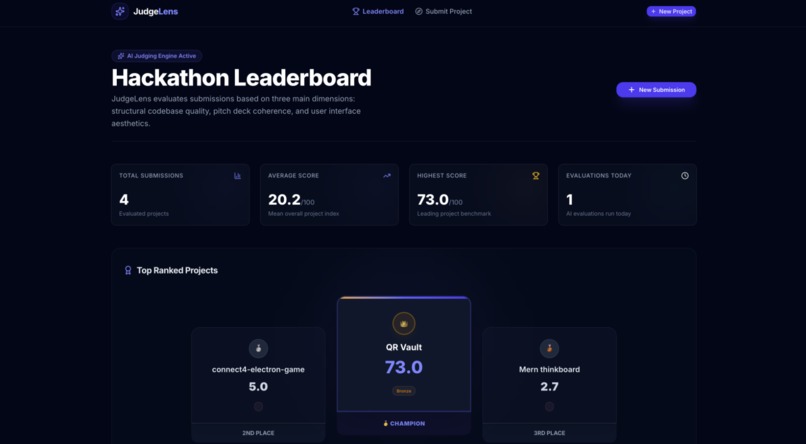
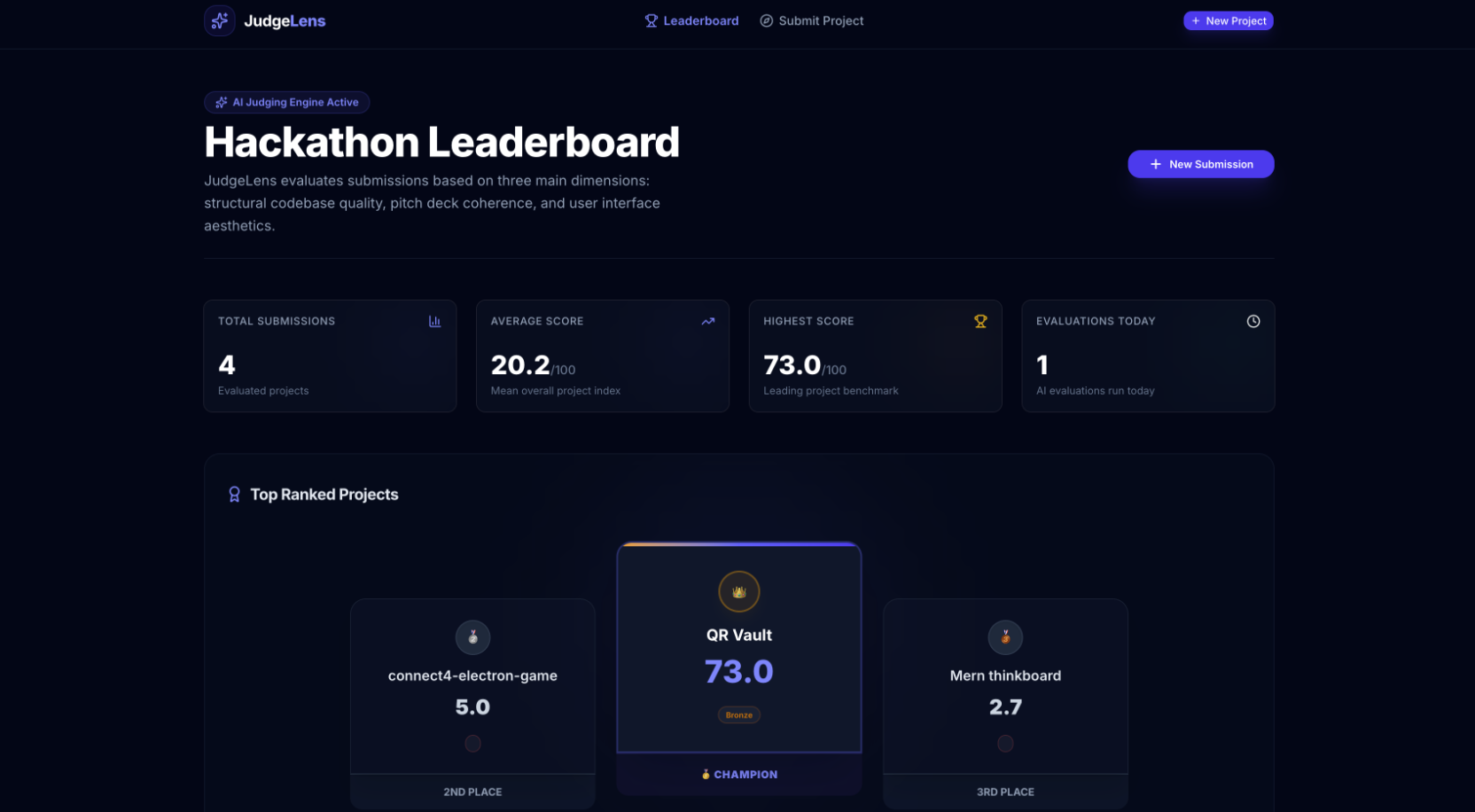
Leaderboard
-
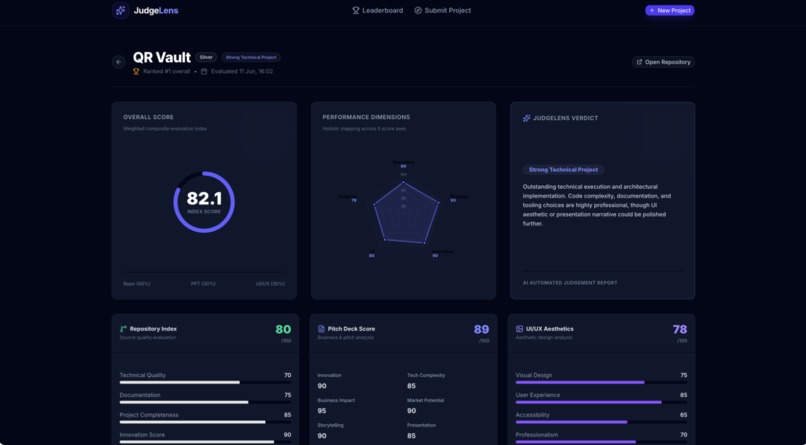
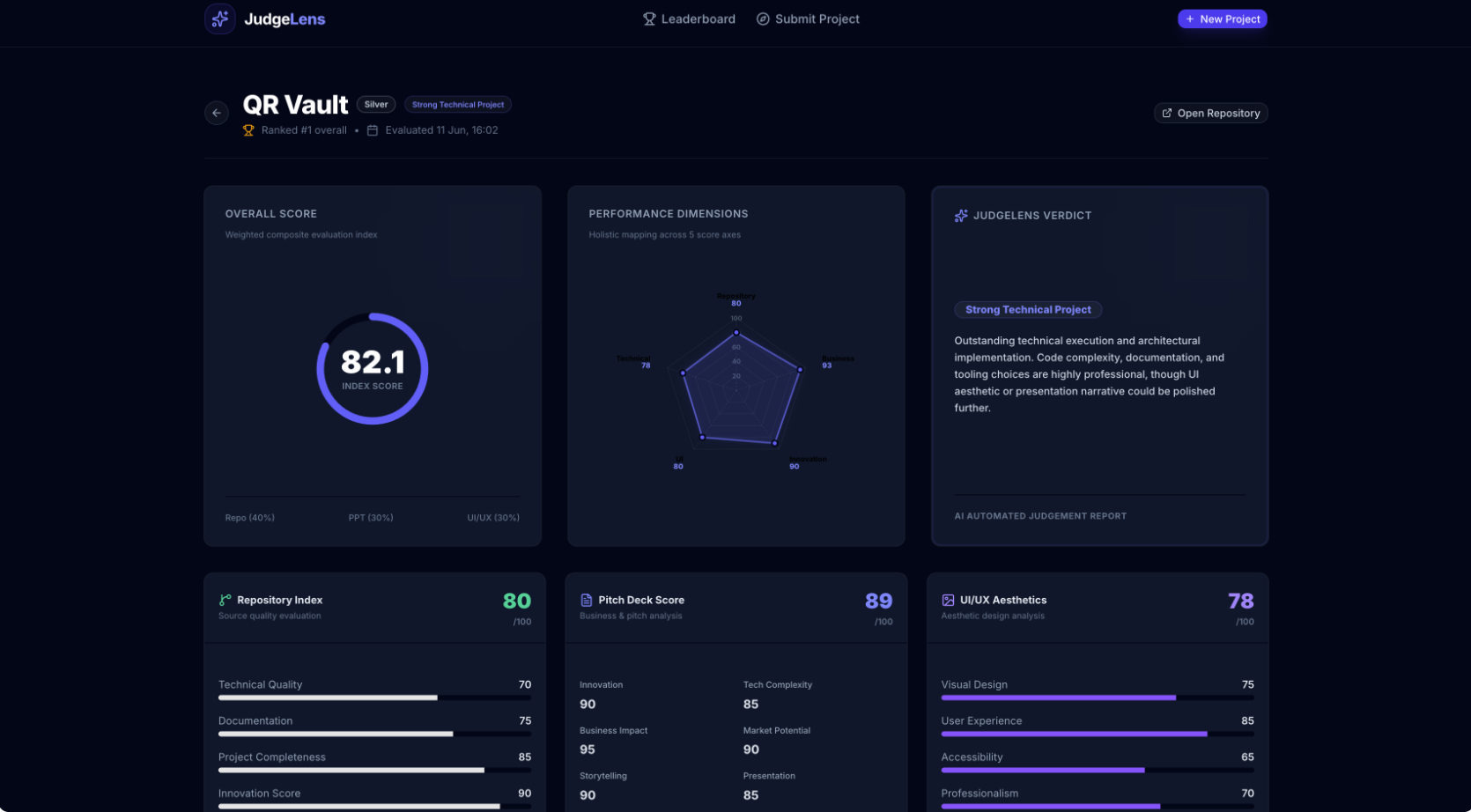
Deatiled Analysis
🚀 The Story Behind JudgeLens
🎯 Inspiration
The idea for JudgeLens came from my own experience participating in hackathons.
One thing I noticed repeatedly was that judges often have to evaluate a large number of submissions within a very limited amount of time. They need to review repositories, pitch decks, demos, and user interfaces, all while trying to remain fair and consistent.
This made me wonder:
What if there was an AI-powered system that could act as an intelligent first-level judge and provide structured feedback for every submission?
That question became the foundation of JudgeLens.
Instead of replacing judges, the goal was to help them make faster and more informed decisions while ensuring every participant receives meaningful feedback.
💡 What JudgeLens Does
JudgeLens is an AI-powered hackathon evaluation platform that analyzes three critical components of a project:
- GitHub Repository
- Pitch Deck (PPT)
- UI/UX Screenshots
Using AI, the platform generates:
- Project scores
- Strengths
- Weaknesses
- Improvement suggestions
- Leaderboard rankings
This helps organizers scale judging while helping participants understand how their projects can improve.
🛠️ How I Built It
Frontend
- React
- Vite
- Tailwind CSS
- shadcn/ui
Backend
- FastAPI
- Python
AI Layer
- Google Gemini 2.5 Flash
- Vertex AI
Database
- MongoDB Atlas
The platform uses dedicated AI evaluation pipelines for:
- Repository Analysis
- Pitch Deck Analysis
- UI/UX Analysis
All evaluation results are stored and aggregated to generate project rankings and detailed judging reports.
📊 Scoring Logic
JudgeLens combines multiple evaluation engines into a single final score.
The weighted formula is:
$$ Final\ Score = (0.4 \times Repository) + (0.3 \times PitchDeck) + (0.3 \times UI/UX) $$
This ensures that technical quality, presentation quality, and user experience all contribute to the final ranking.
🚧 Challenges I Faced
One of the biggest challenges was designing a scoring system that felt fair.
Every hackathon project is different. Some have excellent engineering but weak presentations, while others have strong business ideas but simpler technical implementations.
Another challenge was ensuring that AI responses remained structured and predictable. Since JudgeLens relies on AI-generated evaluations, I spent significant time refining prompts and validating outputs before storing them in the database.
Building a complete workflow that connected repository analysis, PPT evaluation, UI analysis, scoring, storage, and leaderboard ranking was also more complex than expected.
📚 What I Learned
This project taught me:
- Prompt Engineering
- FastAPI Backend Development
- MongoDB Data Modeling
- React Dashboard Development
- AI Workflow Design
- Full-Stack System Architecture
- Building AI-Assisted Decision Systems
Most importantly, I learned that AI is most effective when it augments human decision-making rather than replacing it entirely.
🔮 Future Plans
Future versions of JudgeLens could include:
- 🎥 Demo Video Evaluation
- 🤖 Multi-Agent AI Judging
- 🏆 Automated Finalist Selection
- 🔍 Fraud Detection
- 📈 Real-Time Judging Analytics
- 💰 Investor Readiness Scoring
The long-term goal is to create a platform that helps hackathons scale without sacrificing judging quality.
❤️ Final Thoughts
As a student developer and frequent hackathon participant, I built JudgeLens because I wanted to solve a problem I had personally observed.
The goal was never to replace judges.
The goal was to empower them with better tools.
JudgeLens represents my attempt to combine Artificial Intelligence, Software Engineering, and User Experience Design into a product that can make hackathons more efficient, fair, and insightful for everyone involved.
"Great ideas deserve great evaluation. JudgeLens helps make that possible."
Built With
- fastapi
- git
- github-api
- google-cloud
- google-gemini-2.5-flash
- mongodb-atlas
- pymongo
- python
- react
- recharts
- shadcn/ui
- tailwind-css
- vertex-ai
- vite

Log in or sign up for Devpost to join the conversation.