-
-
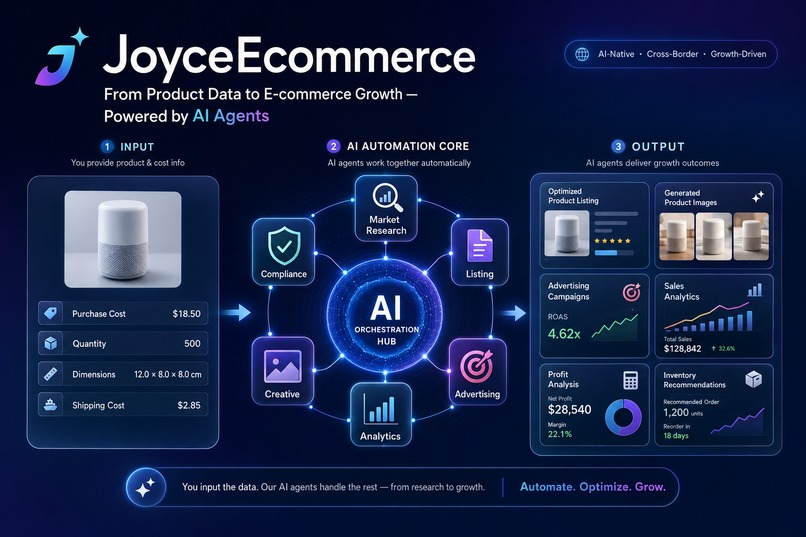
JoyceEcommerce turns product and cost data into AI-powered research, listings, creatives, ads, and profit insights.
Inspiration
Running a cross-border e-commerce business requires sellers to manage a long and fragmented workflow: product research, compliance checks, pricing, listing creation, image production, advertising, inventory tracking, and financial analysis. These tasks are usually handled through different tools, spreadsheets, and service providers.
We were inspired by a simple question: What if a small business owner could operate with the capabilities of a full e-commerce team?
JoyceEcommerce was created to turn product procurement data into an automated business workflow. The seller only needs to enter basic information—such as the product, purchase price, quantity, specifications, and shipping costs—and the system coordinates specialized AI agents to complete the remaining work.
What it does
JoyceEcommerce is an AI-native automation pipeline for cross-border e-commerce.
After the seller enters the product and cost information, the system can:
- Research the market, competitors, customer needs, keywords, and pricing.
- Identify potential intellectual property, product safety, and platform compliance risks.
- Calculate landed cost, platform fees, estimated profit, and break-even price.
- Recommend whether the product is commercially viable.
- Generate optimized product titles, bullet points, descriptions, search terms, and listing attributes.
- Create product-image briefs and generate listing images and advertising creatives.
- Develop launch plans, advertising structures, keyword strategies, and initial budgets.
- Monitor sales, traffic, conversion rates, advertising performance, inventory, and profitability.
- Produce actionable recommendations for pricing, advertising, replenishment, and product optimization.
- Maintain a review process so that important decisions can be approved by a human before execution.
The goal is to transform a collection of repetitive tasks into one continuous workflow—from product sourcing to ongoing operations.
How we built it
We designed JoyceEcommerce as a multi-agent system rather than a single general-purpose chatbot.
Each AI agent has a specialized role, including:
- Market Research Agent
- Product and Compliance Agent
- Cost and Pricing Agent
- Listing Content Agent
- Creative and Image Agent
- Advertising Agent
- Inventory and Operations Agent
- Data Analysis Agent
- Quality Review Agent
A central orchestration layer receives the seller’s product data, breaks the work into tasks, assigns those tasks to the appropriate agents, and passes the results from one stage to the next.
We combined large language models, structured workflows, reusable prompts, product and financial databases, marketplace reports, and image-generation tools. Human approval checkpoints were added for high-impact actions such as publishing listings, changing prices, launching advertising campaigns, and making compliance-related decisions.
Challenges we ran into
One of our biggest challenges was turning incomplete supplier information into reliable, structured product data. Product descriptions from suppliers are often inconsistent, and important details such as materials, dimensions, certifications, and packaging information may be missing.
Another challenge was connecting different parts of the workflow. Market research affects positioning; positioning affects listing copy and images; costs affect pricing and advertising limits; and advertising results affect future optimization. The system therefore needed shared data and context across all agents.
We also had to address:
- Marketplace and advertising data coming from different reports and formats.
- The risk of AI-generated information being inaccurate or unsupported.
- Intellectual property and regulatory risks across different product categories.
- The need to distinguish revenue from actual profit.
- The difficulty of automating decisions without removing necessary human oversight.
- Maintaining consistent brand positioning across listings, images, and advertising.
Accomplishments that we're proud of
We are proud to have transformed a complex e-commerce operating process into a clear and scalable AI workflow.
Instead of using AI only to generate product descriptions, JoyceEcommerce connects research, compliance, content, creative production, advertising, operations, and financial analysis within one system.
We are especially proud that the project is based on real operational needs from an active cross-border e-commerce business. It is designed around the daily challenges faced by small sellers—not around a hypothetical workflow.
Our most important accomplishment is demonstrating how an individual founder or a small team can use AI agents to gain capabilities that would traditionally require multiple specialized employees.
What we learned
We learned that effective e-commerce automation is not simply about generating more content or completing tasks faster. The real value comes from connecting decisions across the entire business.
For example, an advertising budget should be based on product margin and break-even ACoS—not an arbitrary number. Listing content should be based on customer research and competitive positioning—not generic keywords. Replenishment decisions should consider sales velocity, lead time, available cash, and profitability together.
We also learned that successful AI automation requires:
- Structured and reliable input data.
- Clearly defined roles and responsibilities for each agent.
- Shared business context across the system.
- Traceable sources and calculations.
- Quality-control mechanisms.
- Human approval for high-risk or irreversible actions.
AI works best as an operational team that supports the founder, while the founder remains responsible for strategy and final decisions.
What's next for JoyceEcommerce
The next step is to develop JoyceEcommerce from a working automation framework into a complete AI-native operating platform.
Our roadmap includes:
- Direct integration with Amazon, Shopee, Shopify, advertising platforms, and supplier data.
- Automated ingestion and normalization of marketplace reports.
- Real-time profitability dashboards at the SKU and order levels.
- Automated advertising monitoring and budget recommendations.
- Inventory forecasting and replenishment alerts.
- A centralized product knowledge base that improves with every product launch.
- Brand-specific content and visual guidelines.
- Stronger compliance and intellectual-property screening.
- Scenario planning for pricing, advertising, logistics, and cash flow.
- Expansion from internal use to a platform for other cross-border sellers.
Our long-term vision is to enable one founder or a small team to operate with the research, creative, analytical, and execution capabilities of a much larger e-commerce organization.
Built With
- agents
- ai
- analysis
- automation
- codex
- data
- engineering
- generation
- generative
- image
- language
- large
- minimax
- models
- multi-agent
- openai
- openclaw
- prompt
- systems
- workflow


Log in or sign up for Devpost to join the conversation.