-
-
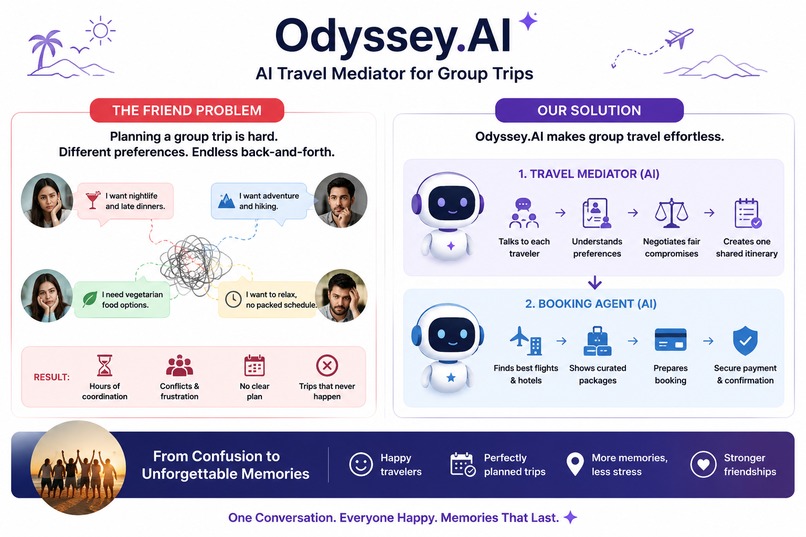
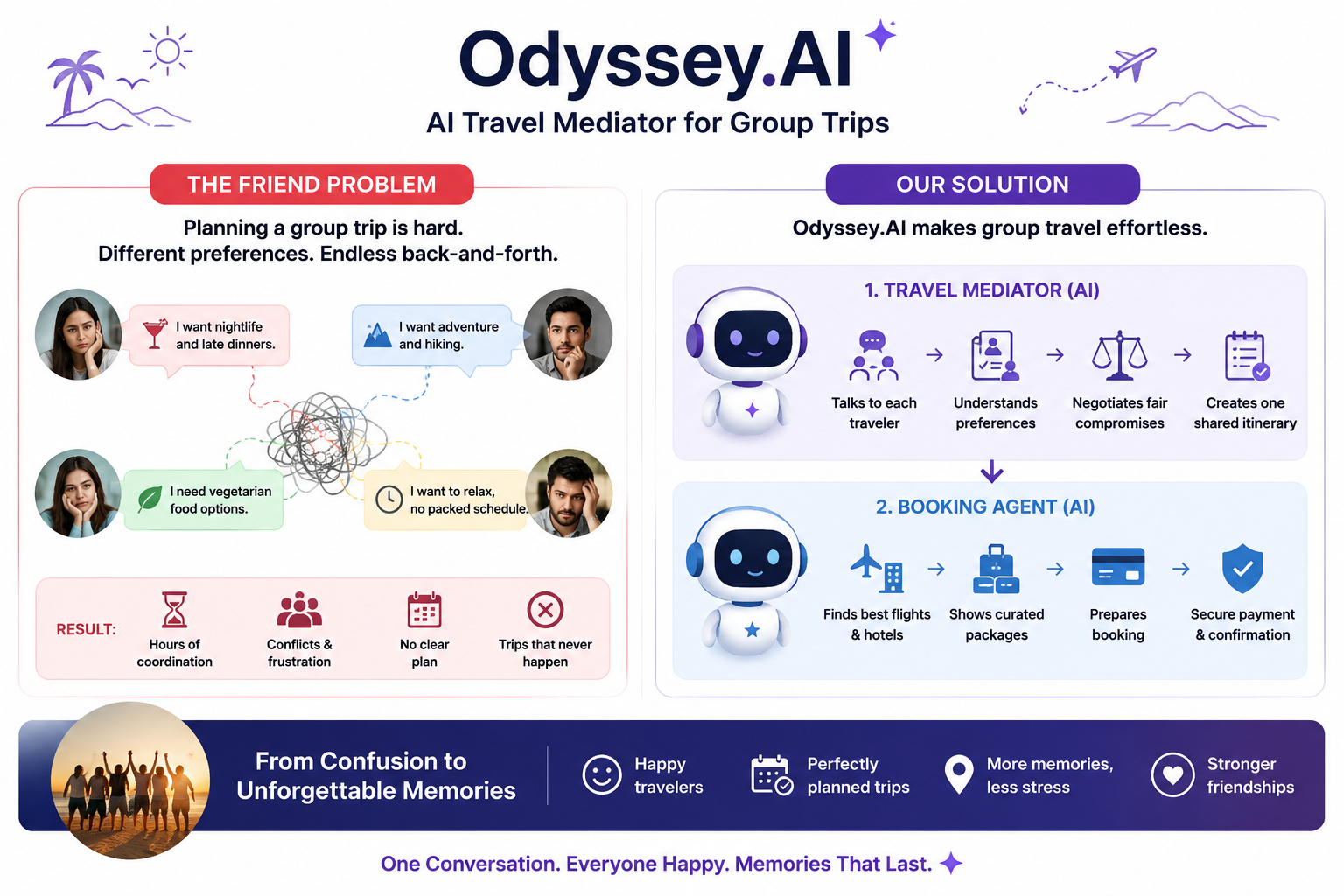
Problem and Solution in one slide
-
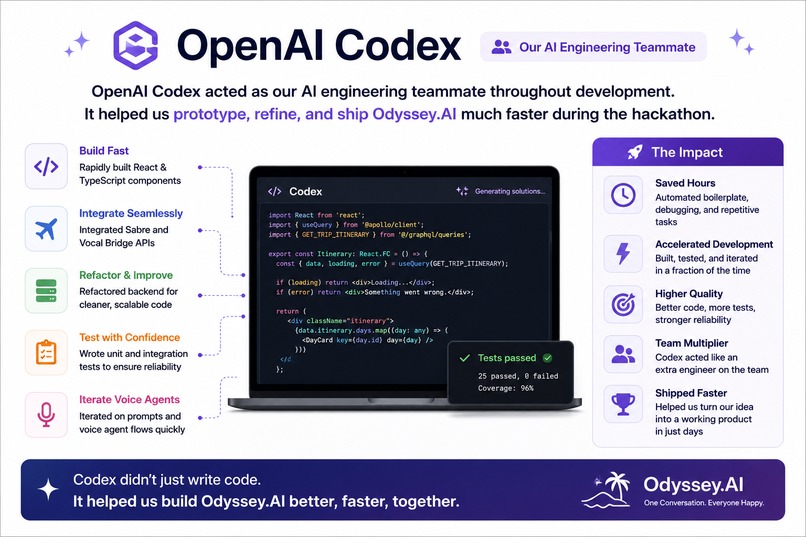
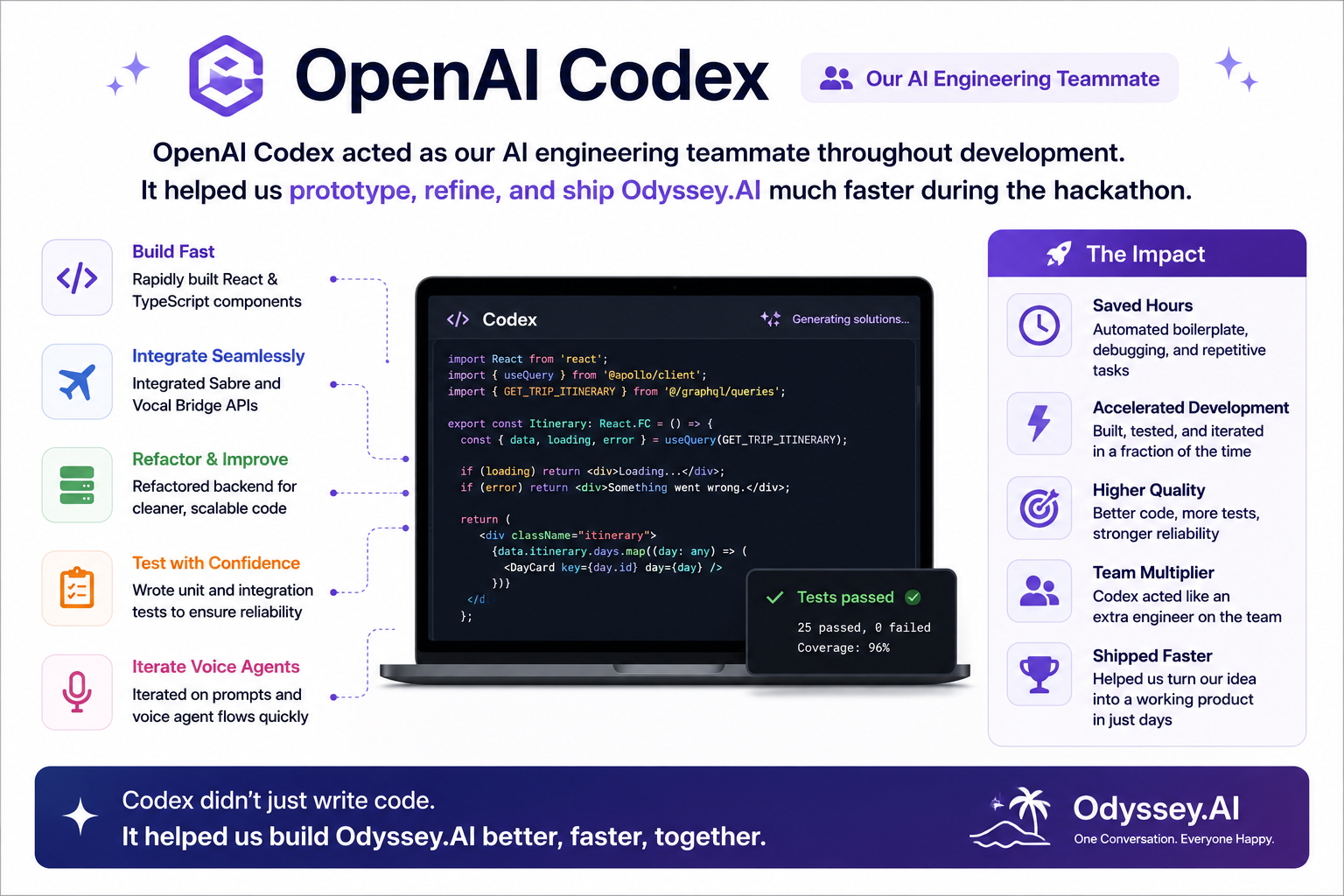
Codex
-
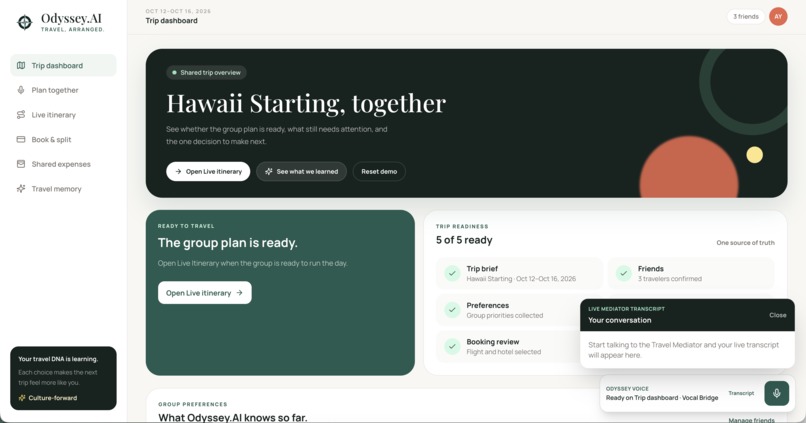
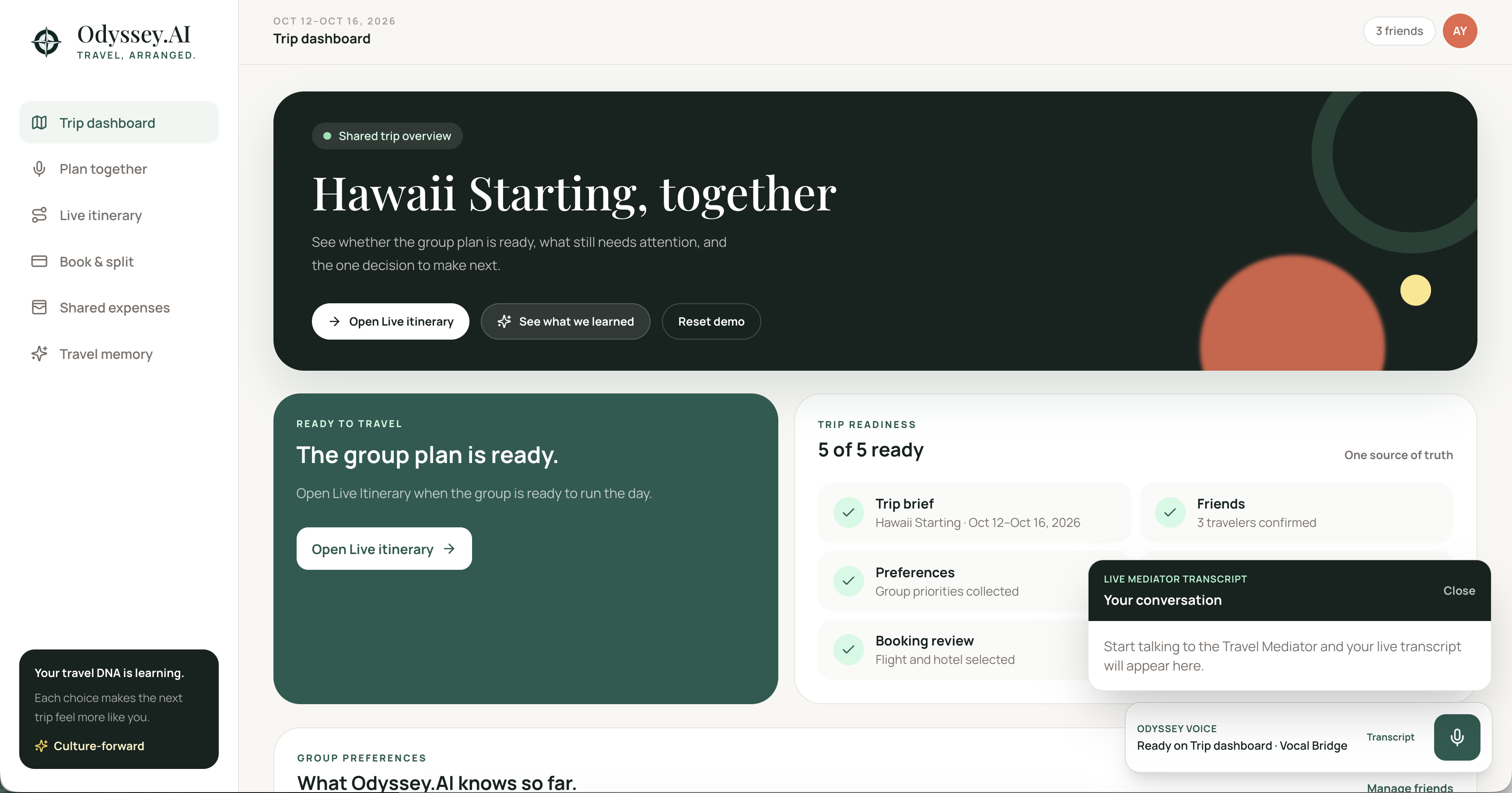
Landing Page
-
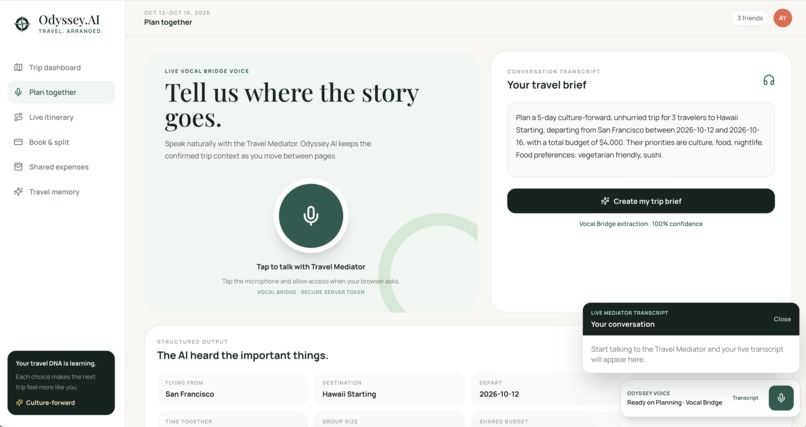
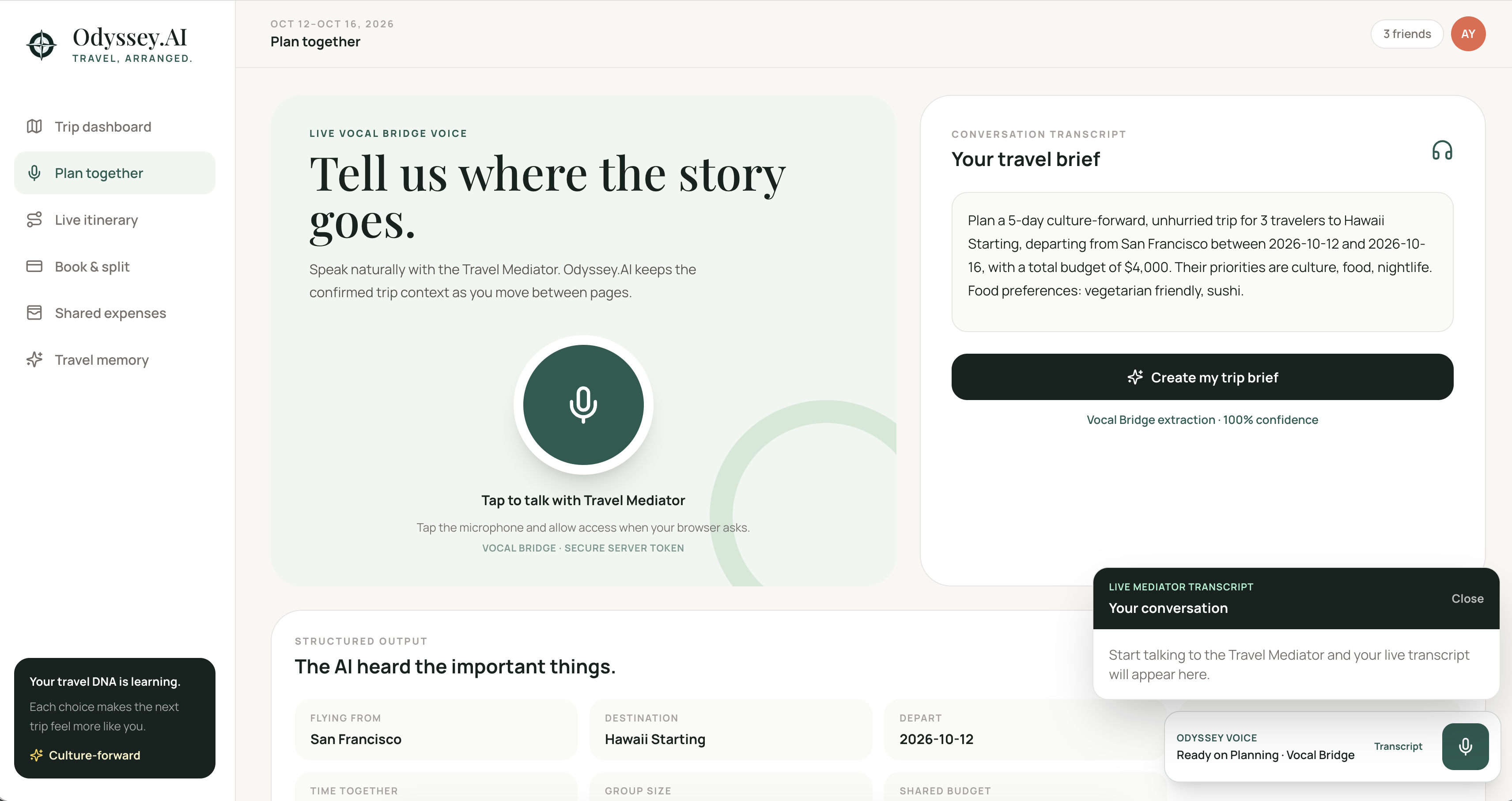
Talking to Planner Agent
-
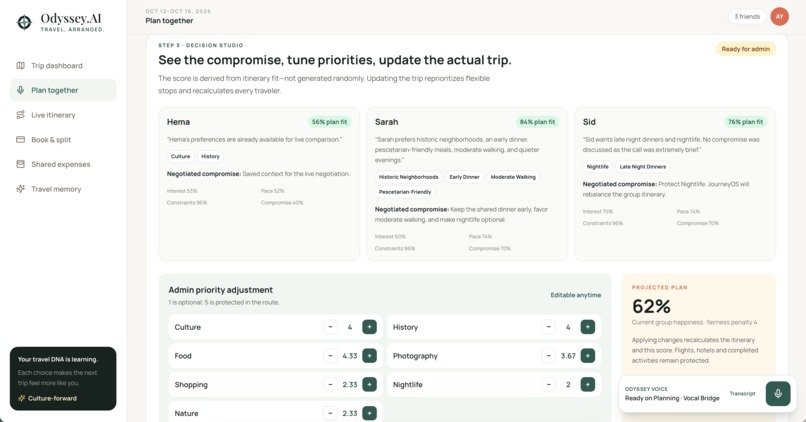
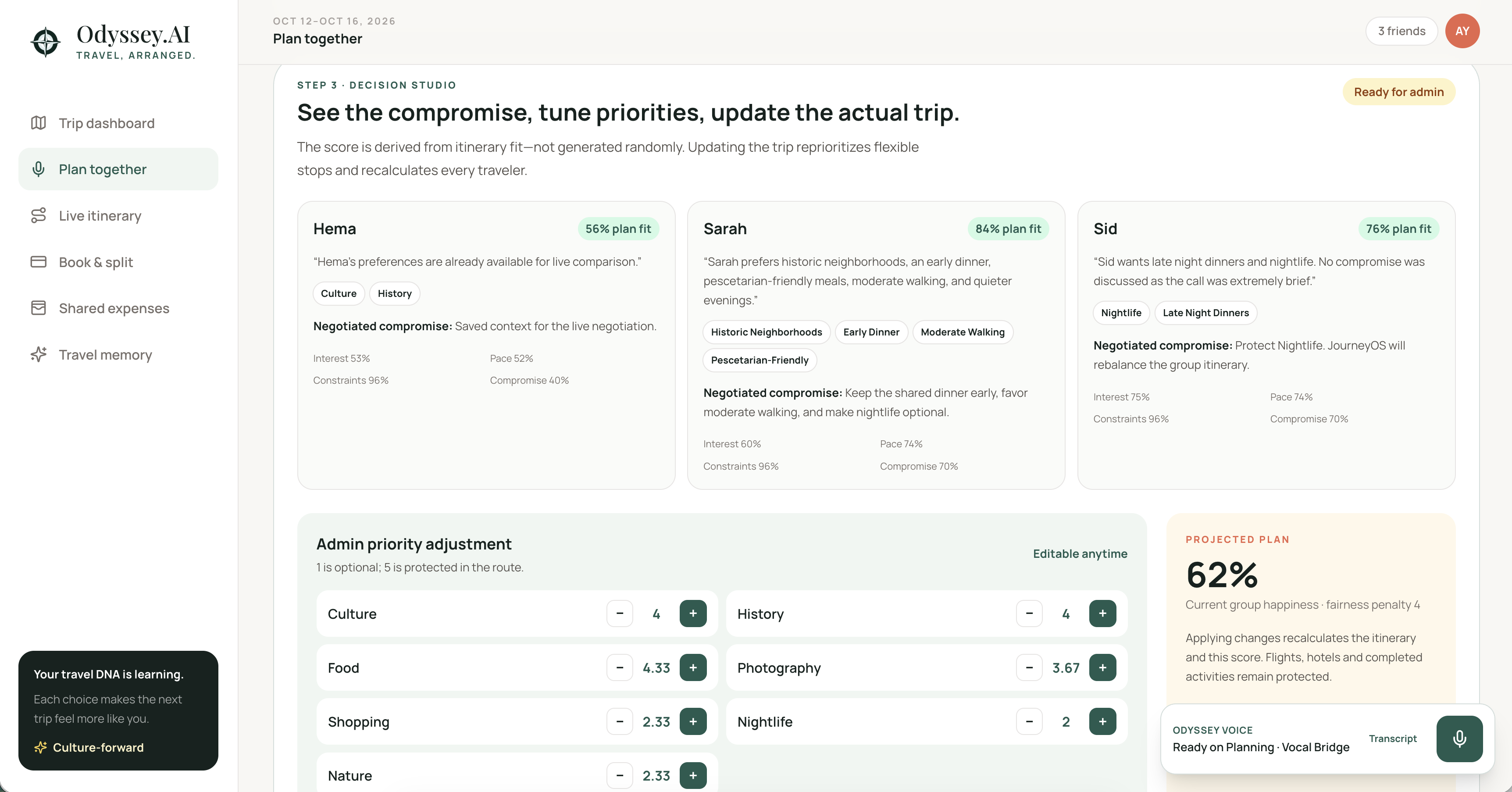
Preference Collected
-
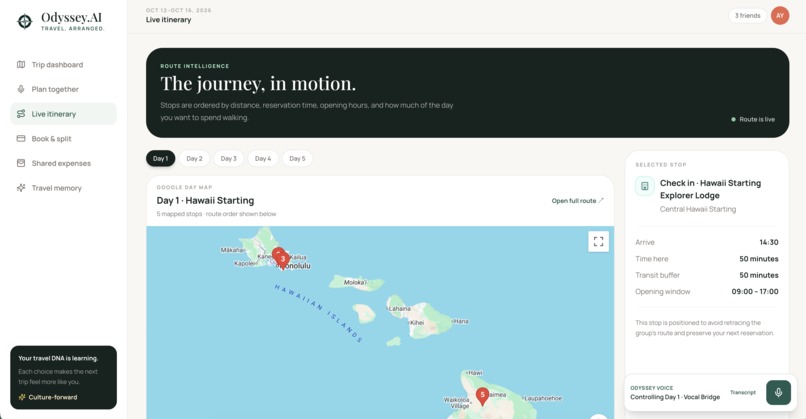
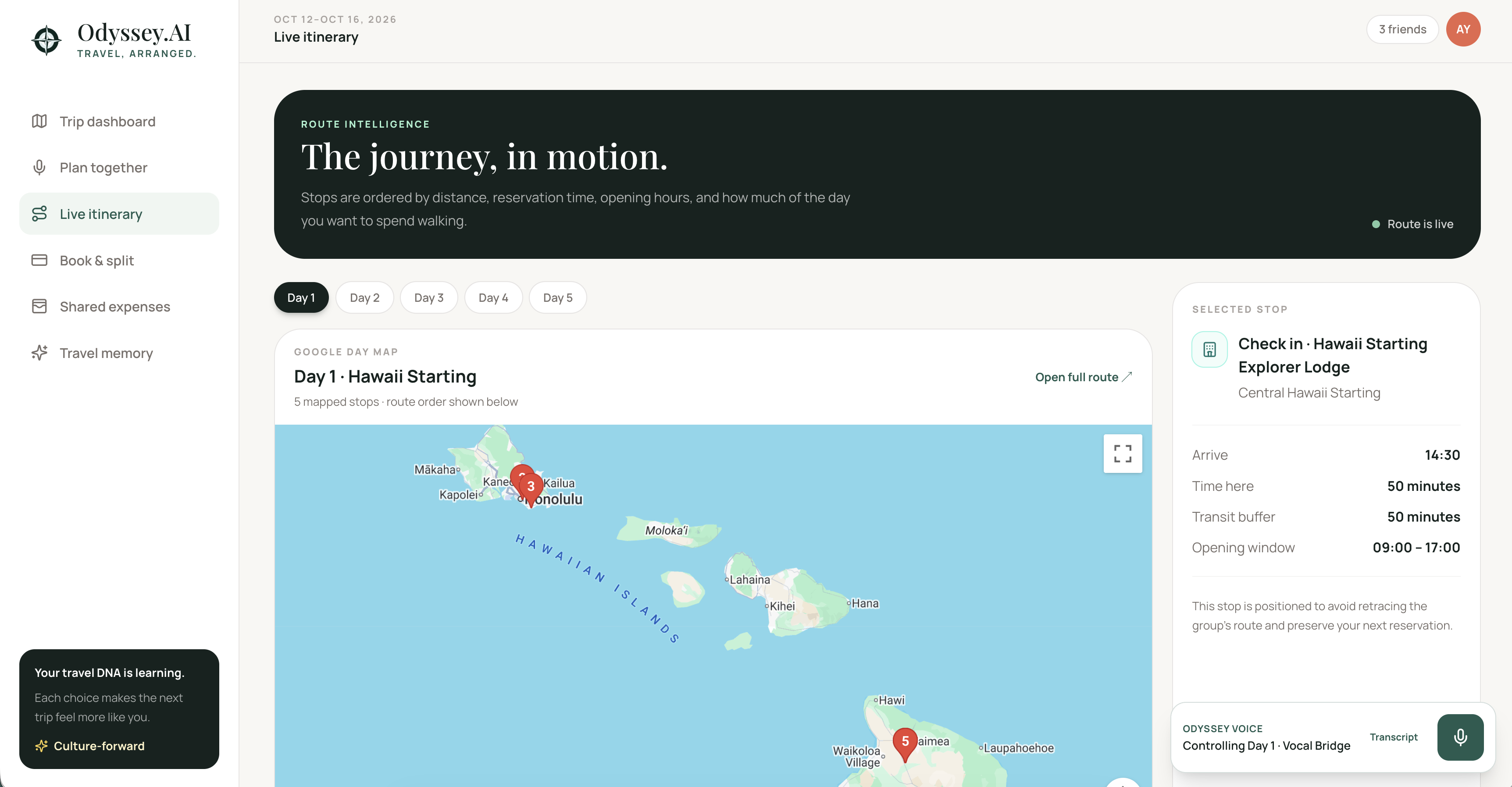
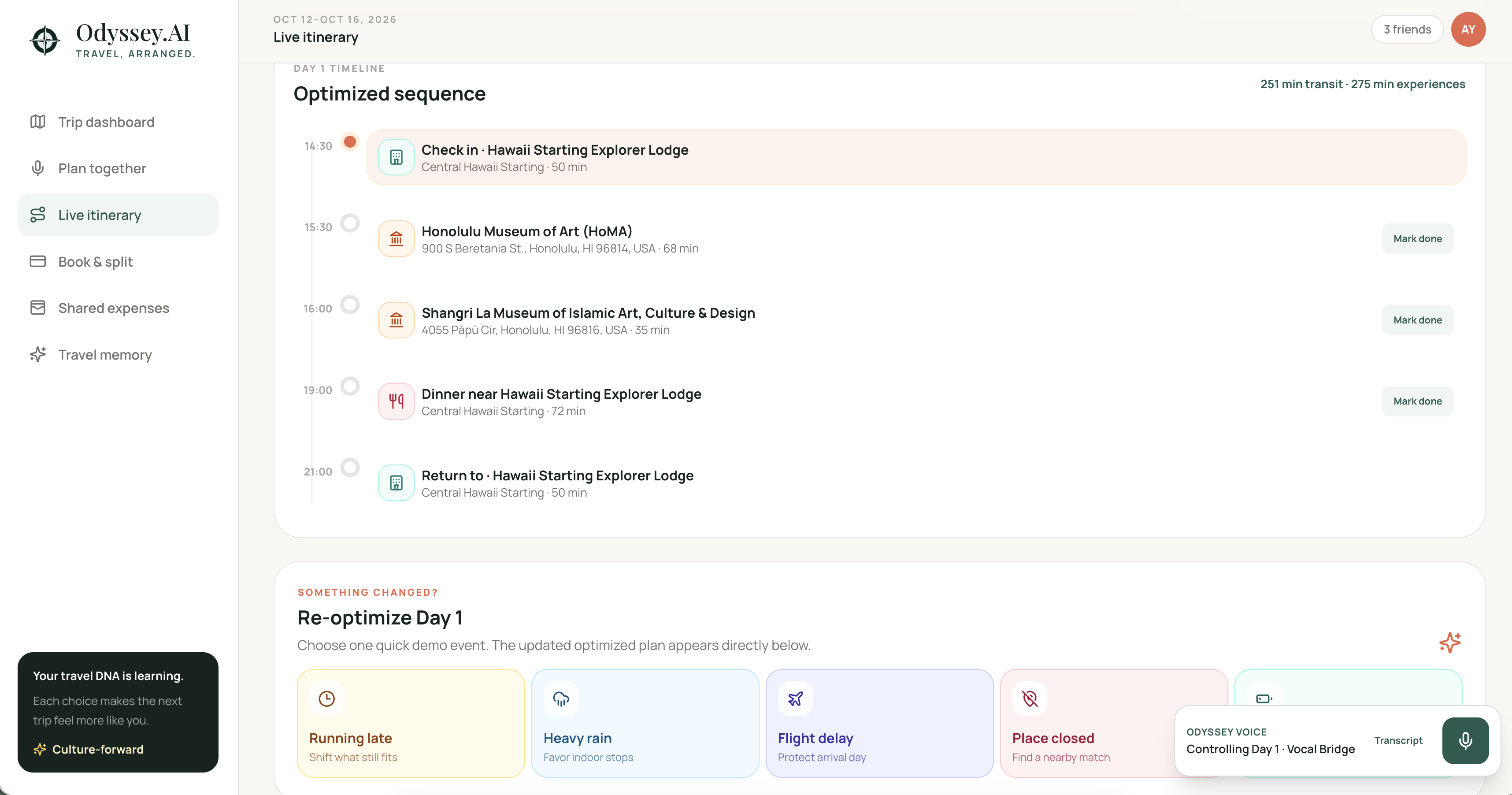
Live Itinerary mapped on Google Maps with Disruptions
-
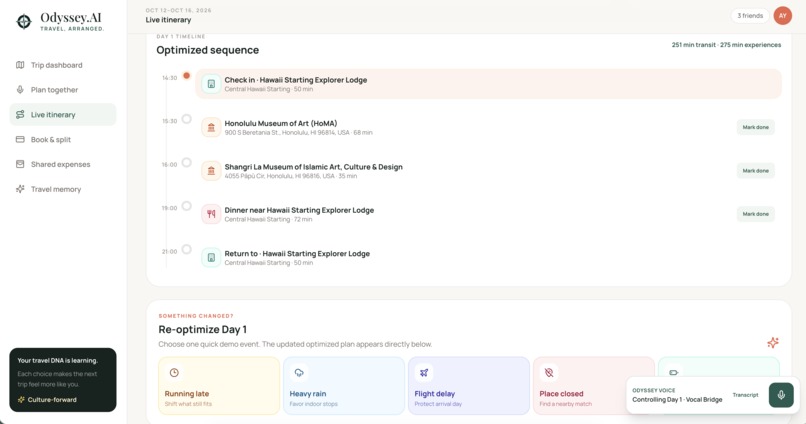
Itinerary mapped on Google Maps with Disruptions
-
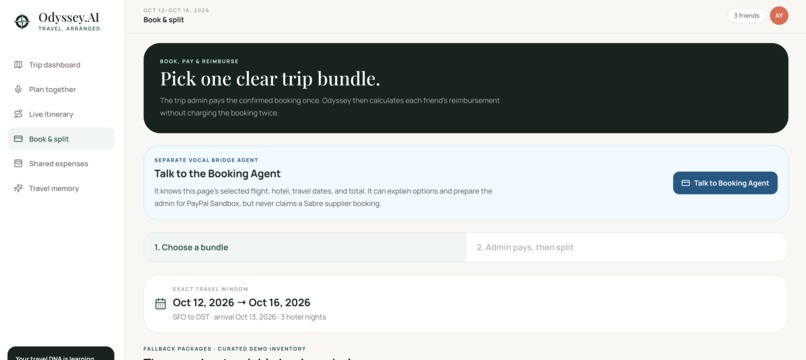
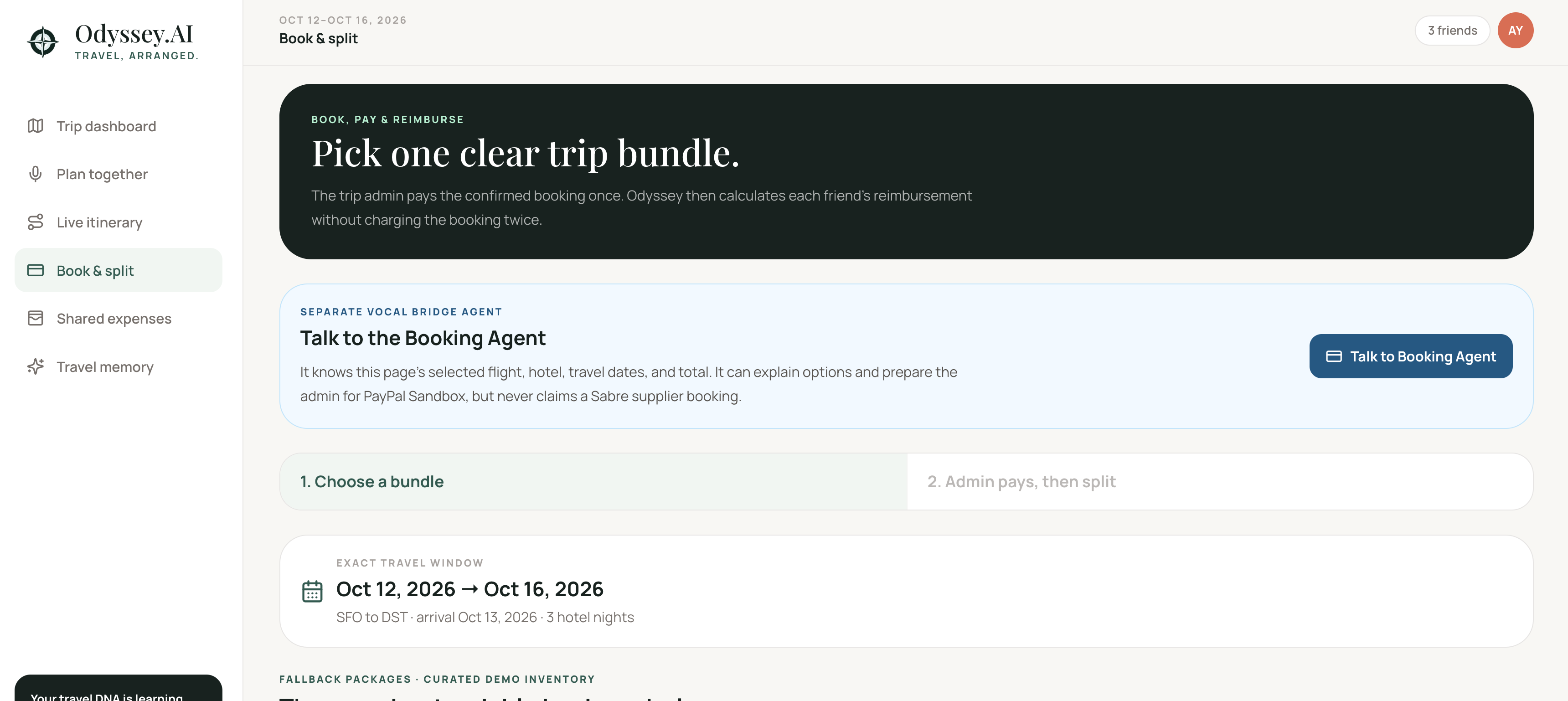
Booking and Payement
-
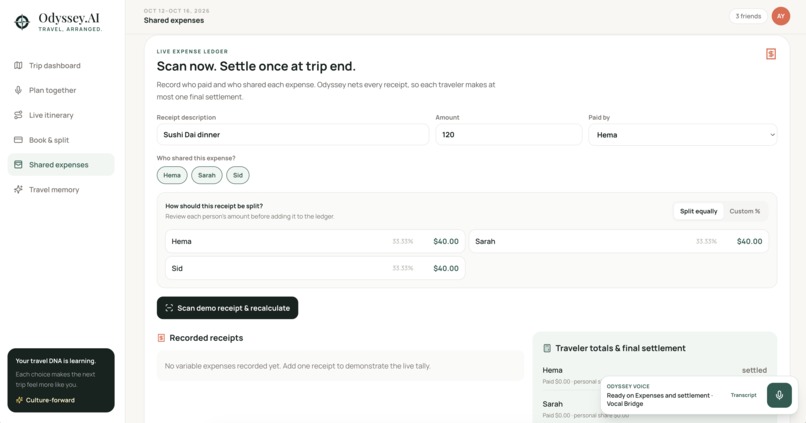
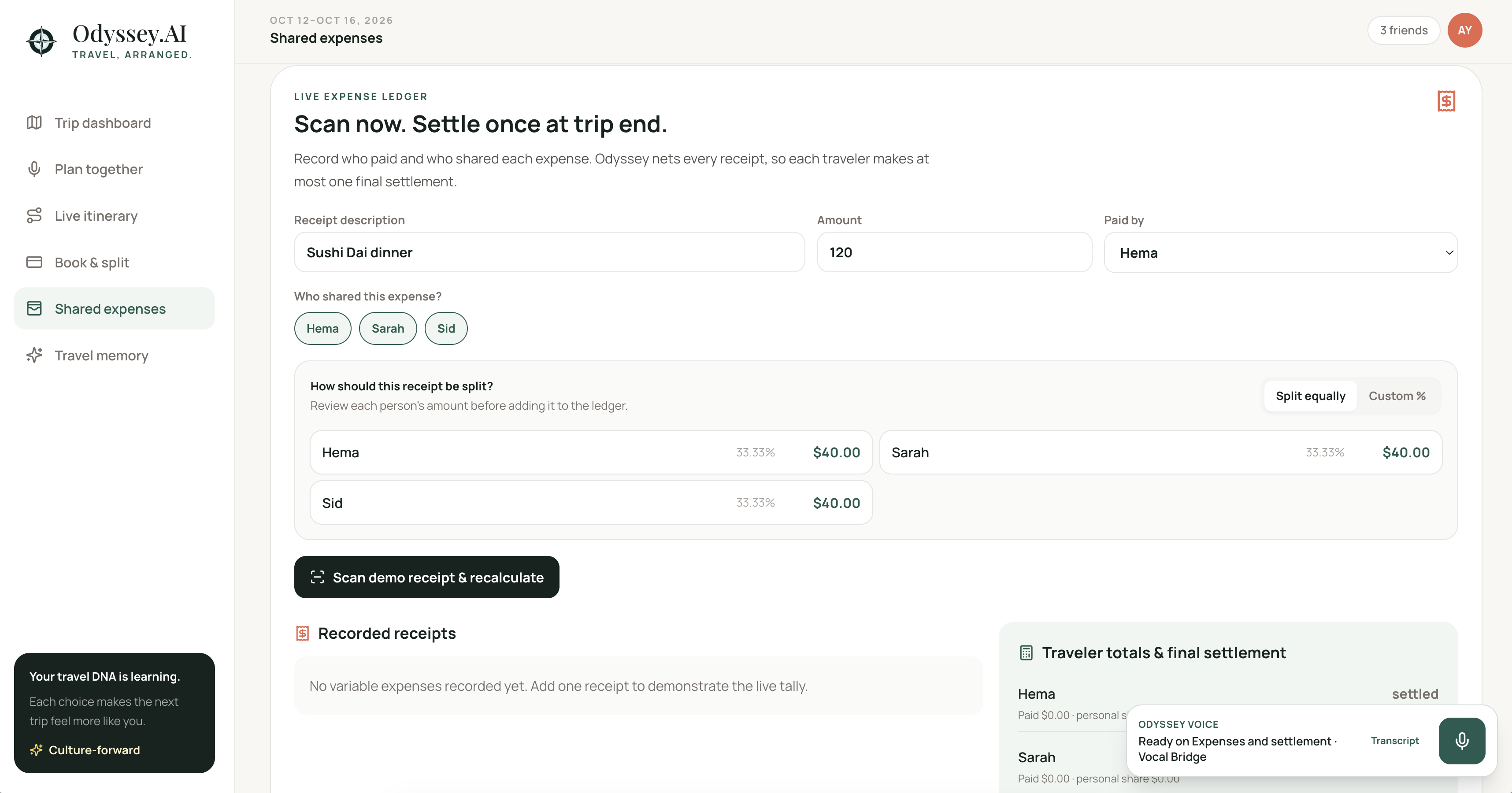
Share expenses among friends from the trip
-
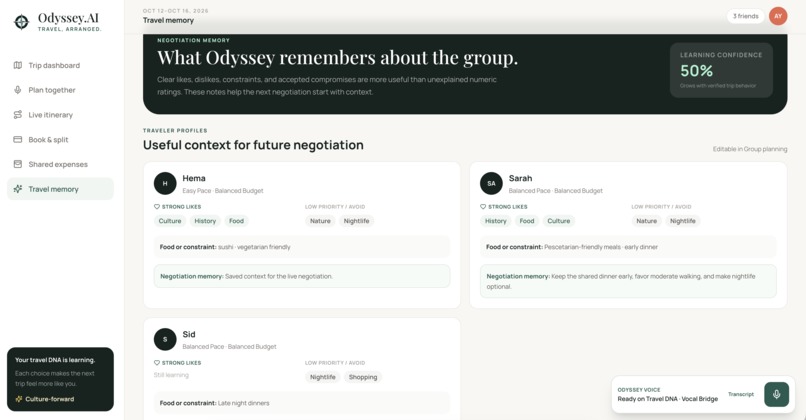
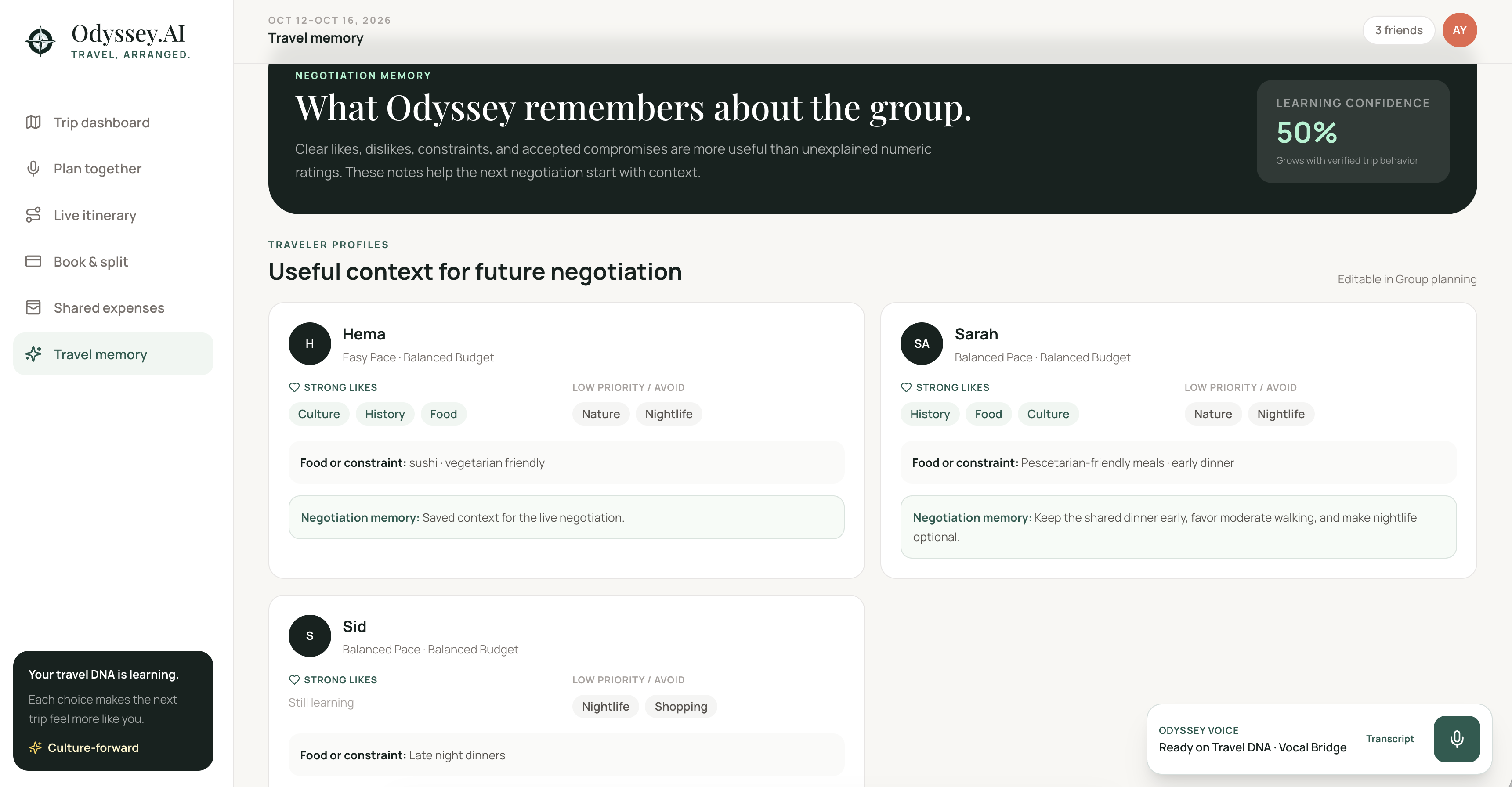
Memories and Preference captured for future
Inspiration
Planning a group trip shouldn't require hundreds of messages, endless polls, or one person becoming the unofficial travel coordinator.
Yet that's exactly what happens today. Every traveler has different budgets, schedules, interests, and priorities, turning what should be an exciting experience into hours of back-and-forth negotiation.
We built 🧭 Odyssey.AI to solve the real problem behind travel planning—not finding flights or hotels, but helping people reach a decision together.
Instead of filling out forms or switching between travel apps, travelers simply talk. Odyssey.AI listens, understands each person's preferences, mediates disagreements, and creates a trip everyone can get behind.
What it does
🧭 Odyssey.AI — The World's First AI Travel Mediator
One conversation. Every traveler heard. Every trip optimized.
🧭 Odyssey.AI is a voice-first AI Travel Operating System for collaborative travel planning.
Rather than acting as another itinerary generator, Odyssey.AI coordinates people. Through natural voice conversations, it understands what every traveler wants, negotiates conflicts, explains trade-offs, and continuously keeps the group aligned.
Using natural voice conversations, it can:
- 🎙️ Capture an entire trip brief from a single conversation
- 👥 Call friends or family individually to collect their preferences
- 🤝 Detect conflicting priorities and negotiate transparent compromises
- 🗺️ Generate optimized itineraries with live route visualization
- ✈️ Search flights and hotels using Sabre APIs
- 💳 Review bookings and demonstrate checkout using PayPal Sandbox
- 🔄 Adapt itineraries as plans change
Every conversation updates a shared trip state, allowing the entire group to stay synchronized from the first idea to the journey itself.
How we built it
🧭 Odyssey.AI is built as a voice-first, multi-agent AI platform using GPT-5.6 for conversational intelligence and OpenAI Codex as our AI engineering partner.
Our application is built with React, TypeScript, Vite, Node.js, and Express, with every AI agent operating on a synchronized shared trip state that keeps conversations, itineraries, bookings, and traveler views continuously in sync.
Multi-Agent Architecture
Instead of relying on a single assistant, Odyssey.AI coordinates specialized AI agents that collaborate throughout the travel lifecycle.
- Travel Mediator — captures the group's trip brief
- Preference Collector — interviews each traveler through live voice conversations
- Negotiation Agent — identifies conflicting priorities and recommends transparent compromises
- Booking Agent — reviews flights, hotels, and checkout before booking
- Trip Assistant — adapts itineraries during the journey
GPT-5.6 & OpenAI Codex
GPT-5.6 powers Odyssey.AI's natural conversations, traveler preference understanding, travel reasoning, conflict negotiation, itinerary generation, and contextual responses.
OpenAI Codex served as our AI engineering partner throughout the hackathon.
Rather than using Codex only for code generation, we used it to accelerate engineering across the entire application. Codex helped us:
- Design and evolve our multi-agent architecture
- Build React components and Express APIs
- Integrate Sabre CERT APIs and Sabre MCP workflows
- Connect Vocal Bridge voice events with synchronized application state
- Build Google Maps itinerary visualization
- Integrate PayPal Sandbox booking and payment flows
- Debug shared state synchronization across multiple pages
- Refactor frontend and backend code as the product evolved
- Improve prompts, negotiation workflows, and end-to-end user journeys
By helping us reason across the codebase—not just generate code—Codex enabled us to spend more time designing the product experience and less time on repetitive engineering work.
Platform Integrations
- 🎤 Vocal Bridge — live voice conversations and outbound traveler calls
- ✈️ Sabre CERT APIs & Sabre MCP — flight and hotel inventory
- 🗺️ Google Maps Platform — routing, visualization, and itinerary mapping
- 💳 PayPal Sandbox — booking review and payment demonstration
Challenges we ran into
The biggest challenge wasn't integrating travel APIs—it was maintaining a consistent shared state across multiple AI agents, voice conversations, and user interfaces.
A single traveler preference collected during one conversation could immediately affect negotiation outcomes, itineraries, bookings, maps, and every other traveler's experience.
To make that work, we had to solve challenges including:
- Synchronizing live voice conversations with the UI
- Preserving conversational context across navigation
- Translating natural language into structured travel searches
- Negotiating conflicting traveler preferences fairly
- Coordinating multiple AI agents without losing context
- Avoiding brittle demo flows while maintaining a realistic user experience
Building a conversational travel operating system required orchestrating people, conversations, AI agents, and application state—not simply connecting APIs.
Accomplishments that we're proud of
We're proud that Odyssey.AI feels like a cohesive product rather than a collection of disconnected demos.
The complete experience flows naturally:
Voice Brief → Traveler Calls → AI Negotiation → Shared Itinerary → Booking Review → Payment → Live Trip Adaptation
We're especially proud of:
- Building a true multi-agent travel platform
- Creating a voice-first experience for collaborative travel planning
- Delivering transparent AI negotiation with explainable trade-offs
- Keeping conversations, itineraries, and bookings synchronized in real time
- Integrating Sabre, Vocal Bridge, Google Maps, and PayPal into one seamless workflow
- Leveraging GPT-5.6 for intelligent travel reasoning and OpenAI Codex to accelerate architecture, implementation, debugging, and integration throughout the hackathon
What we learned
We learned that the hardest part of travel isn't finding flights or hotels.
It's helping people agree.
Travel planning is fundamentally a coordination problem—not simply a search problem.
We also learned that users trust AI more when recommendations are transparent, trade-offs are explained, and conversations remain synchronized with the interface.
Finally, we discovered how powerful GPT-5.6 and OpenAI Codex are together. GPT-5.6 enabled rich, context-aware travel conversations and negotiation, while Codex accelerated engineering across the codebase, helping us rapidly iterate on architecture, integrations, debugging, and complex multi-agent workflows.
What's next for Odyssey.AI
We're just getting started.
Next, we plan to expand Odyssey.AI with:
- Deeper Sabre booking capabilities
- More advanced AI negotiation using traveler history
- Real-time disruption handling for delays and cancellations
- Personalized traveler memory
- Collaborative expense tracking and reimbursements
- Additional specialized AI agents for flights, hotels, transportation, and shared expenses
- Richer mobile-first voice experiences
- Live trip optimization using weather, delays, pricing, and availability
Our long-term vision is to build an AI Travel Operating System that doesn't just plan trips—it coordinates people, books travel, adapts in real time, and becomes a trusted travel companion from the first conversation to the journey home.
Built With
- aiagents
- codex
- conversationalai
- express.js
- googlemapsplatform
- gpt-5.6
- grouptravel
- itinerary
- llm
- mcp
- multiagent
- node.js
- openai
- paypal
- react
- sabre
- sabremcp
- travelai
- traveltech
- tripplanning
- typescript
- vite
- vocalbridge
- voiceai

Log in or sign up for Devpost to join the conversation.