-
-
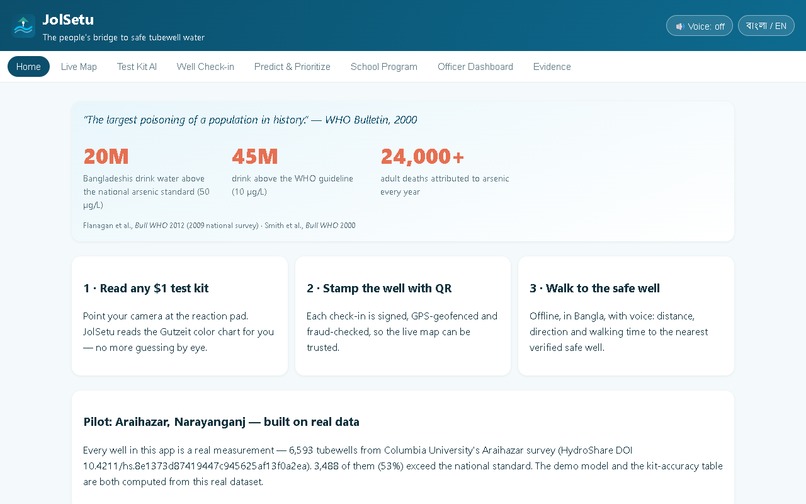
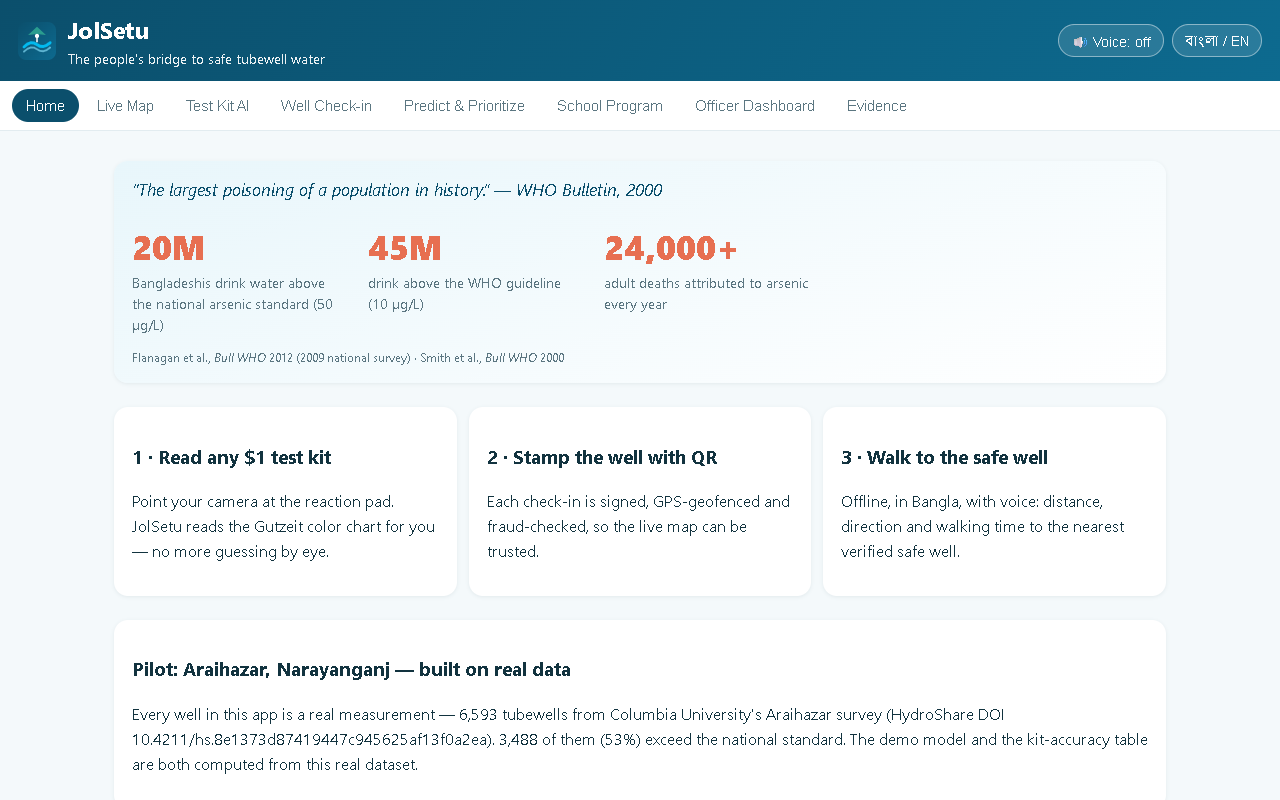
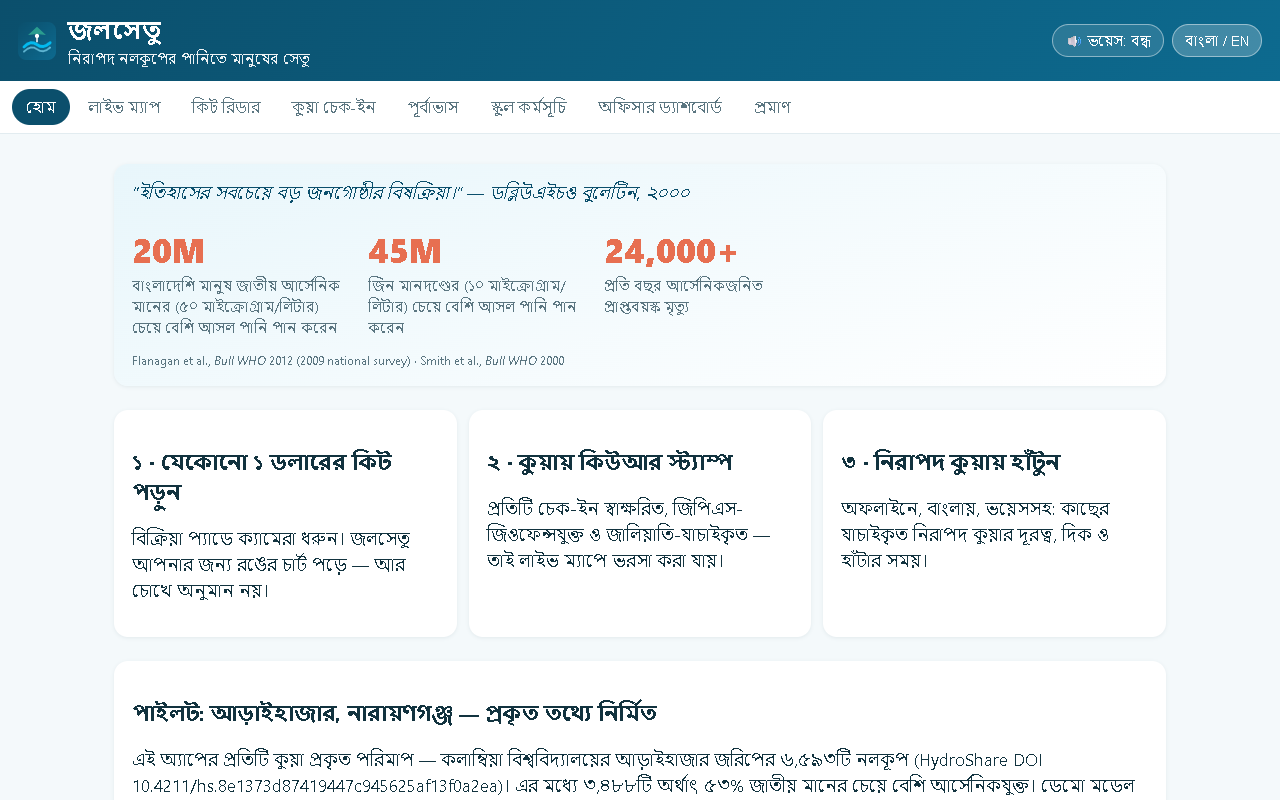
JolSetu home - the arsenic crisis in numbers, and the 3-step bridge to safe water (Bangla & English, offline-first)
-
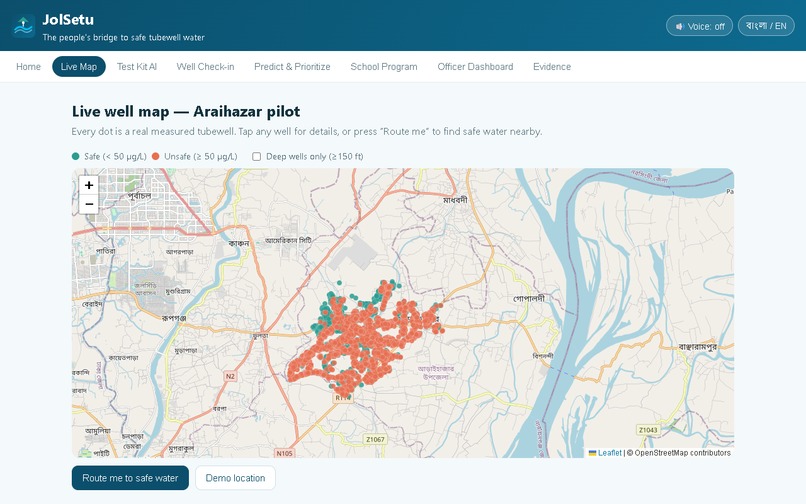
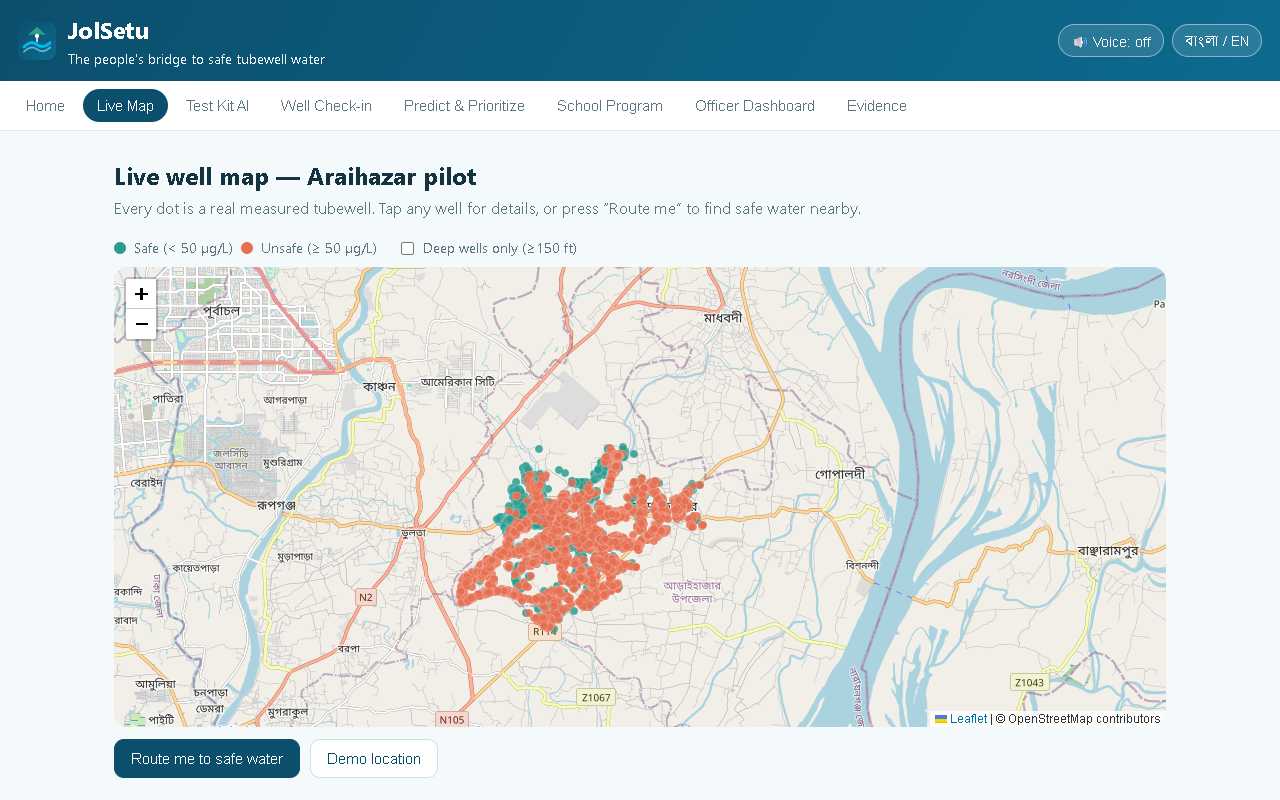
Live map - 6,593 real Araihazar tubewells; the model flags where to test next; offline walking routes to verified safe wells
-
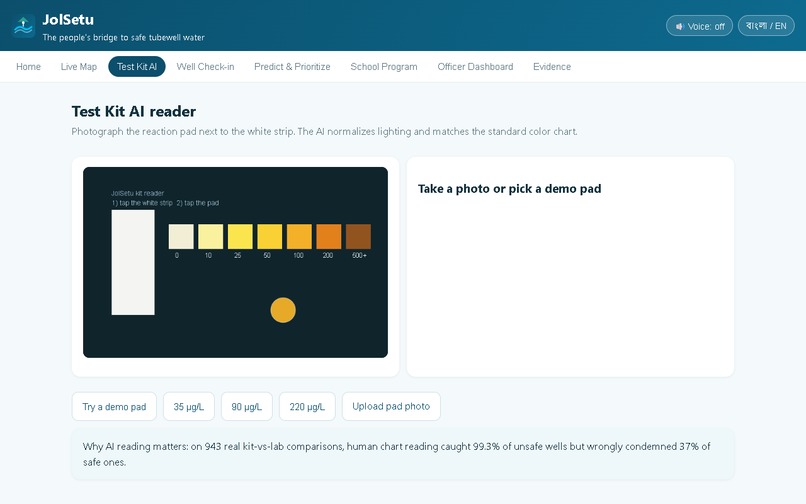
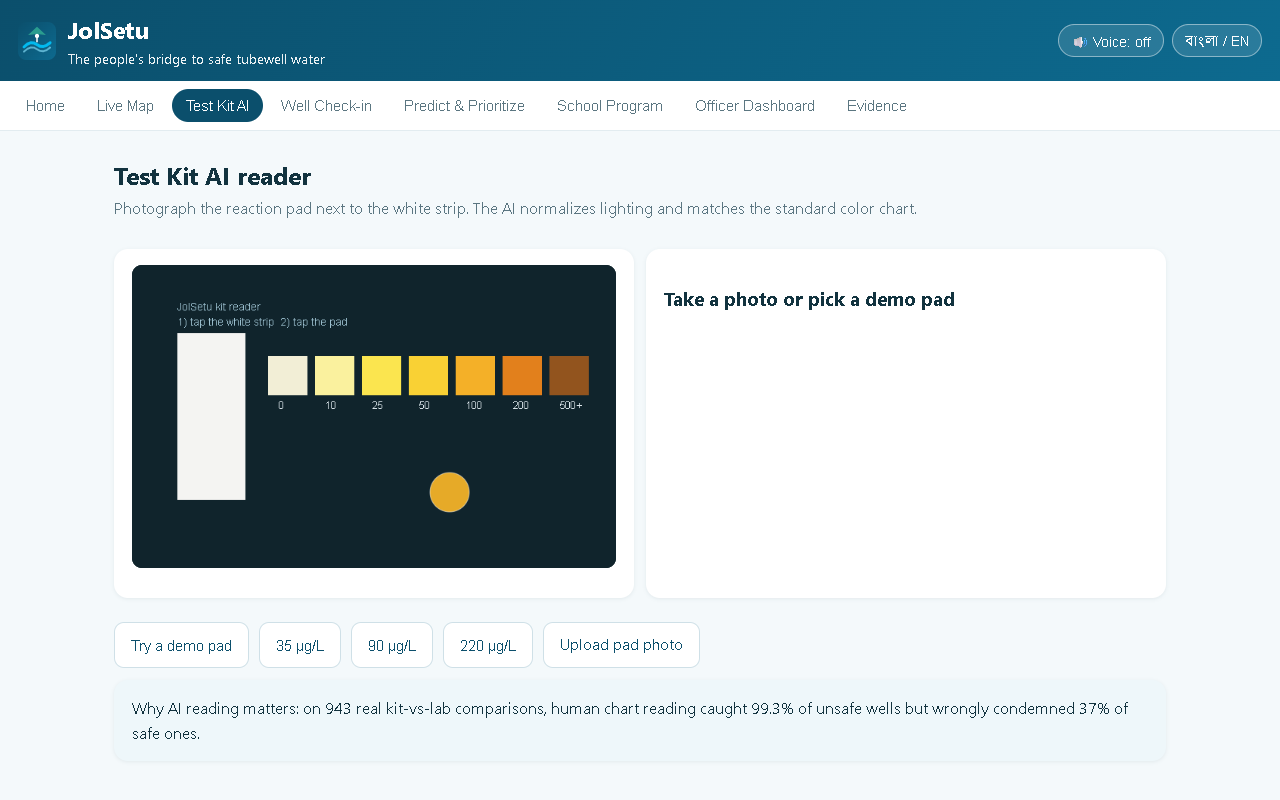
AI kit reader - photograph the $1 Gutzeit kit; explainable color-match verdict in seconds, no more chart-guessing
-
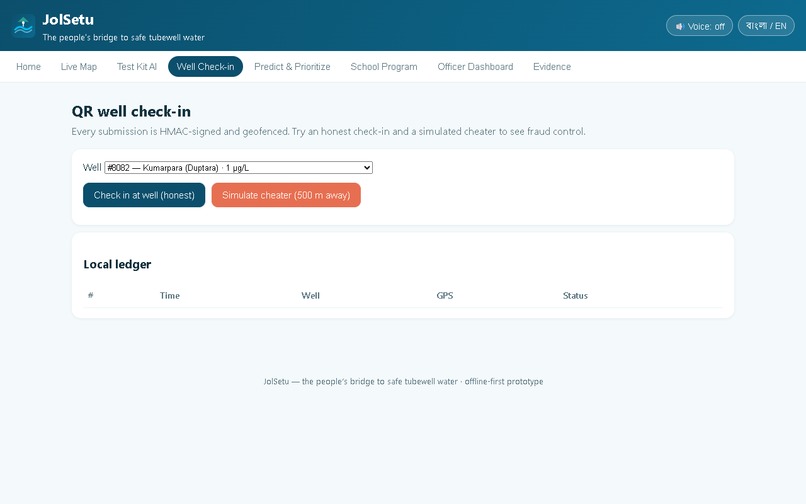
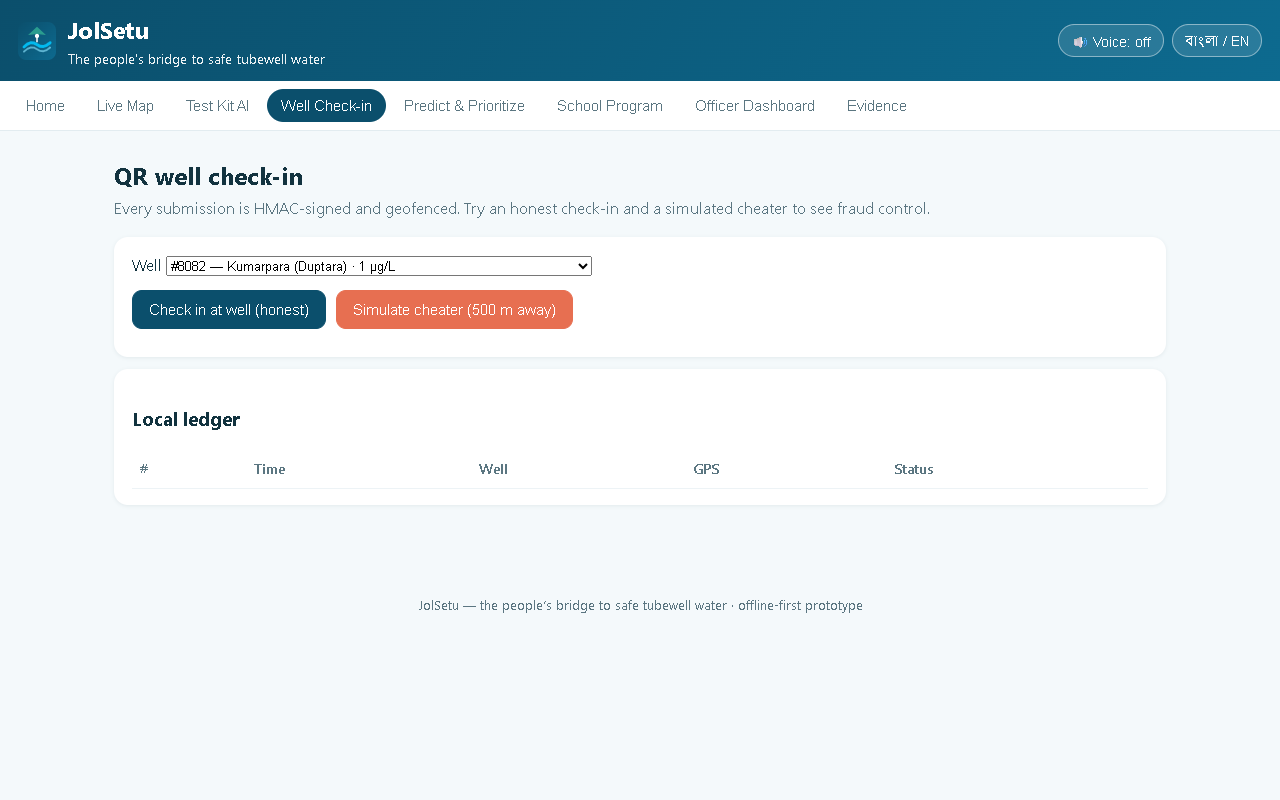
Fraud-proof check-in - QR-stamped, GPS-geofenced to the well; simulated cheater rejection keeps the map honest
-
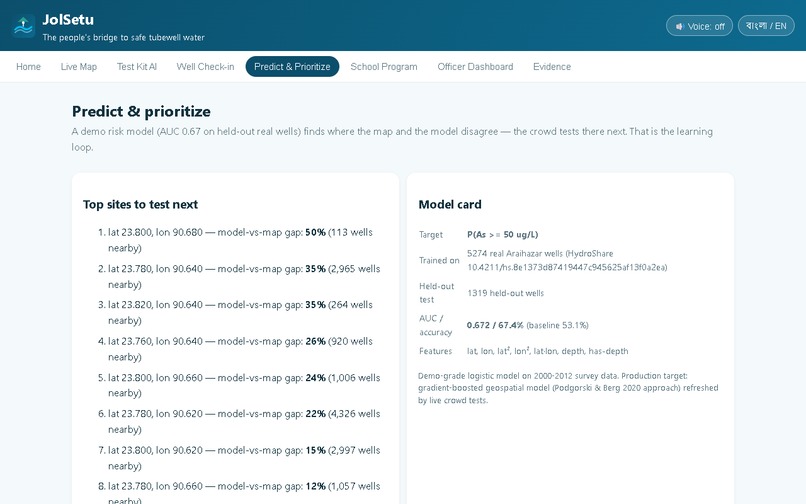
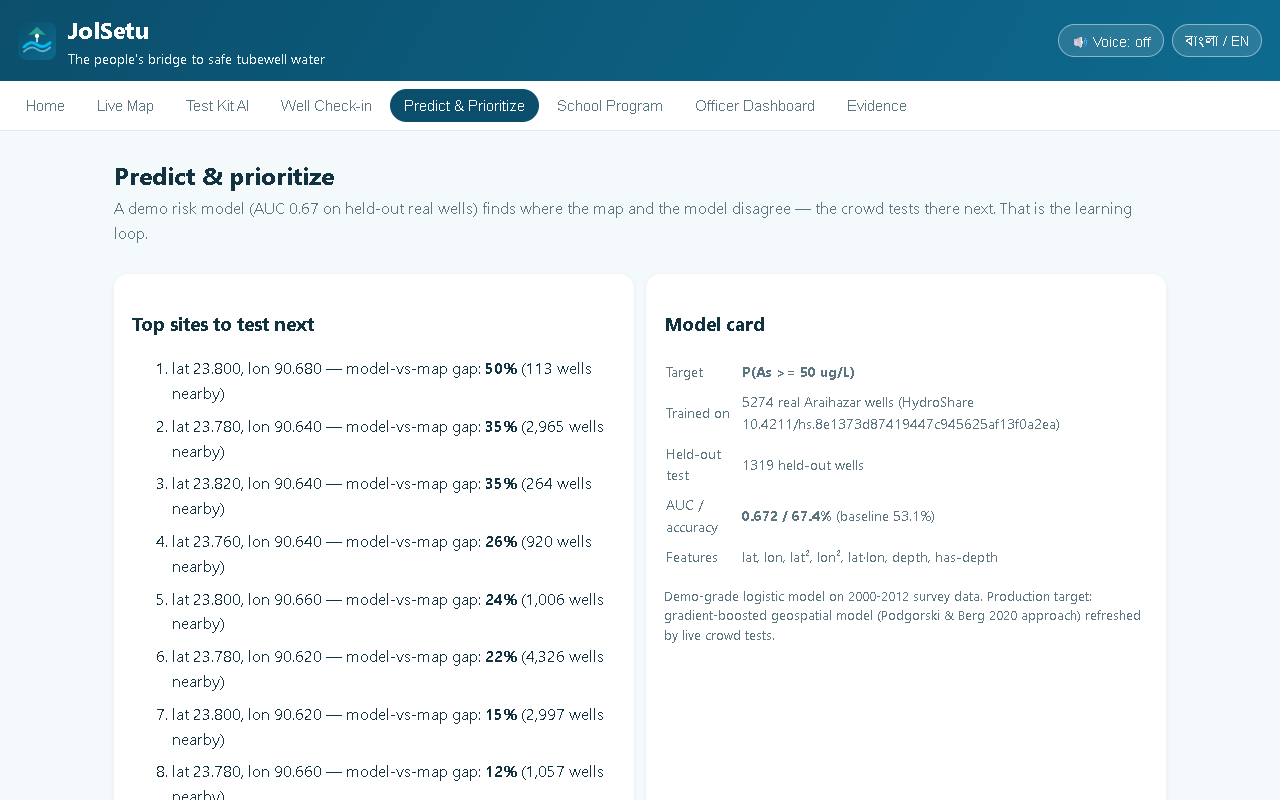
Predict & Prioritize - where the map and model disagree, communities test next; model card is public
-
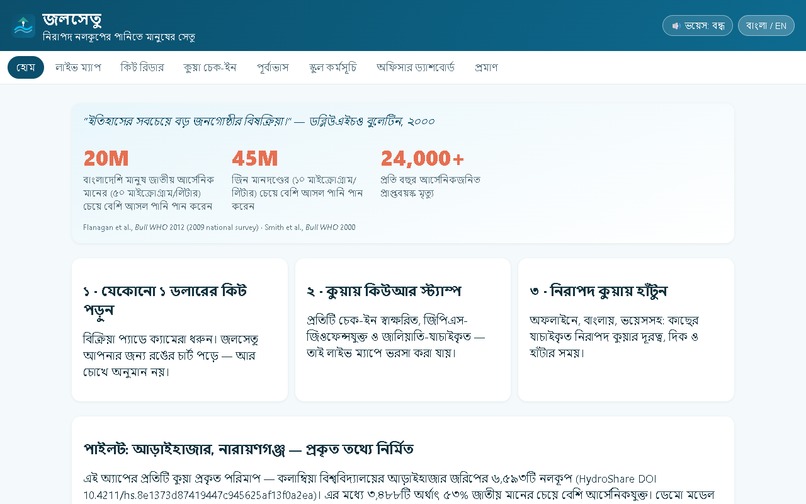
Bangla UI - spoken (TTS) results and full Bangla interface for low-literacy and offline rural users
Track
Track 3 — AI-Supported Assessment (with strong Citizen Science UX elements from Track 1).
Inspiration
In Bangladesh, 61 of 64 districts have groundwater arsenic above the WHO limit, and millions of tubewells are untested. Testing exists — a $1 Gutzeit kit makes it possible anywhere — but people cannot read the result reliably, the data dies in paper notebooks, and families keep drinking from unsafe wells. JolSetu (জলসেতু, "water bridge") was built to close that loop for real communities in Araihazar, and this hackathon is our chance to harden it with the OneAquaHealth mission: healthy waters, healthy ecosystems, healthy communities.
What it does
JolSetu is an offline-first PWA that turns any citizen into a reliable water tester:
- AI-assisted kit reading (Track 3 core): the phone camera images a $1 Gutzeit test kit; a deterministic computer-vision pipeline (CIELAB colorimetry with a white reference card, per-channel analysis) estimates the arsenic level — fully explainable: users see the exact color channels and reference correction behind every number.
- Human-in-the-loop by design: the AI never has the final word. Every reading must be confirmed or corrected by the tester; borderline results trigger a re-test workflow; community-confirmed readings enter an active-learning queue that improves future estimates.
- From reading to action: HMAC-signed QR + geofenced check-ins register each well; a live map of 6,593 real Araihazar wells (public HydroShare dataset) powers safe-well routing; a sklearn risk model (AUC 0.672 on a real 80/20 split) flags priority wells for the DPHE (public water authority) dashboard.
- For everyone: Bangla + English UI with spoken (TTS) results, designed for low-literacy users and offline rural use.
How we built it
Vanilla-JS offline-first PWA (service worker, installable, works in airplane mode), pure client-side computer vision (CIELAB color distance + white-reference normalization — no server, no API keys), Leaflet mapping over 6,593 real geo-located wells, scikit-learn risk model trained on public data, Web Speech TTS in Bangla/English, HMAC-QR anti-fraud check-ins. Public repo, public dataset, public dashboard.
Challenges we ran into
Camera sensors lie about color: we solved it with a printed white reference card + per-channel normalization instead of a black-box model, keeping the math explainable to a regulator. Field connectivity is zero: everything runs offline and syncs later. And trust: water authorities will not act on unsupervised AI — so human confirmation is not a UX extra, it is the architecture.
Accomplishments that we're proud of
A complete, working, deployable pipeline: kit photo → explainable AI estimate → human confirmation → verified public map → safe-well routing → authority dashboard — running on a $0 infrastructure budget and a $1 test kit.
What we learned
Responsible AI in citizen science is 10% model and 90% workflow: validation checks, uncertainty language, and the human confirmation loop are what make citizen data trustworthy enough to act on.
What's next
Adapting the same pipeline to OneAquaHealth stream-assessment kits (nitrate/phosphate colorimetric tests share the same CIELAB backbone), school club modules, and DPHE-scale open dashboards.
Built With
- cielab
- colorimetry
- computer-vision
- geofencing
- javascript
- leaflet.js
- machine-learning
- offline-first
- pwa
- qr-codes
- scikit-learn
- tts


Log in or sign up for Devpost to join the conversation.