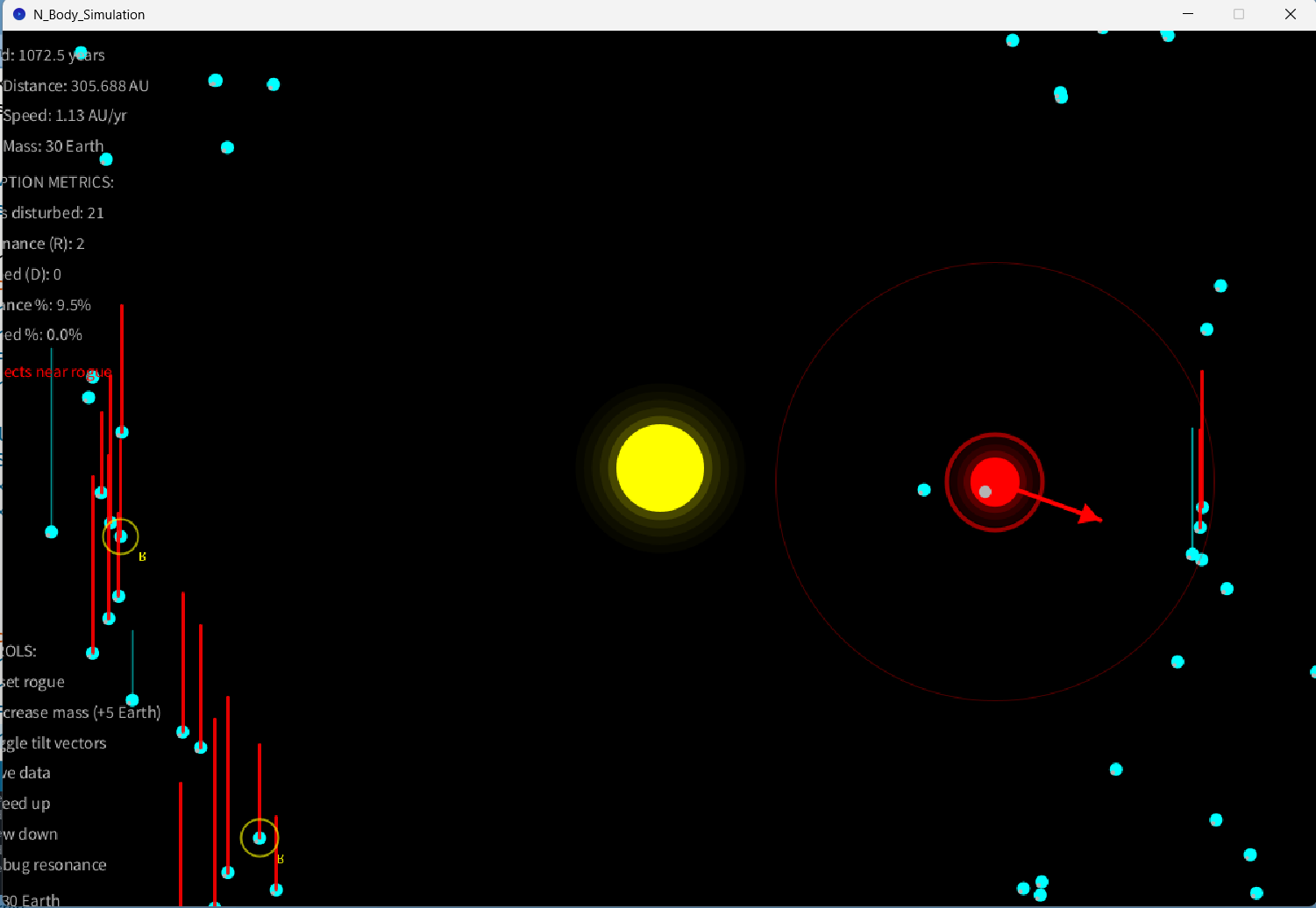
I first came up with this project when doing research in school. My topic was on rogue planets, and I was fascinated by their characteristics. However, I realized that rogue planets are far more important than I had believed, as they can influence resonance, detachment, and orbital tilts. However, I soon began to think: Why is Canada not a frontrunner in research on topics like these? What if Canada had an advantage in understanding the mysteries of the cosmos, and that’s where my project comes in. I built an N-Body Simulation, modelling the same phenomenon I researched in class. This project was built with Java, specifically the Processing IDE. I made this decision based on Processing’s superb simulation capabilities. A large challenge I ran into was understanding the physics behind the project. The physics was very high-level and often required prerequisite skills I also had to learn. When it came to coding, one of the biggest issues I ran into was that it was just too damn slow. I asked around and, using AI, they recommended some advanced efficiency algorithms. The actual problem-solving of figuring out a strategy to optimize the program was difficult. With all things considered, I’m very proud of how my program looks and its functionality. The math is mostly accurate, and I love that I can take this project in many versatile directions. Whether presenting this at a hackathon, a science fair, or a school club, I believe this will help future astronomers research the universe.
Join Aerospace Club
When we think about Canadian innovation, we often think about computing. But what about space research?
Updates

Leave feedback in the comments!
Log in or sign up for Devpost to join the conversation.