Inspiration
John CEO is a private AI coworker: each customer gets a dedicated workspace where conversations, files, and connections never mix with anyone else's. John helps on Slack (for teams) and Telegram (for solo operators) - drafting replies, checking calendars, and closing loops in the apps you already use.
The hard part is not the chat. It is memory: John should remember that you prefer bullet-point updates, that your Q3 priority is the Berlin launch, and what you decided in last Tuesday's thread - without you repeating yourself every session.
Most agent memory demos use in-process maps or a separate vector database that drifts from operational state. We built John CEO Agentic Memory to prove that durable, queryable, transactionally consistent memory belongs in the database layer: CockroachDB native VECTOR columns, distributed vector indexes, and serverless AWS execution - not a bolt-on sidecar.
This project is our CockroachDB x AWS hackathon entry and an open-source slice of the memory architecture we are building for John CEO.
What it does
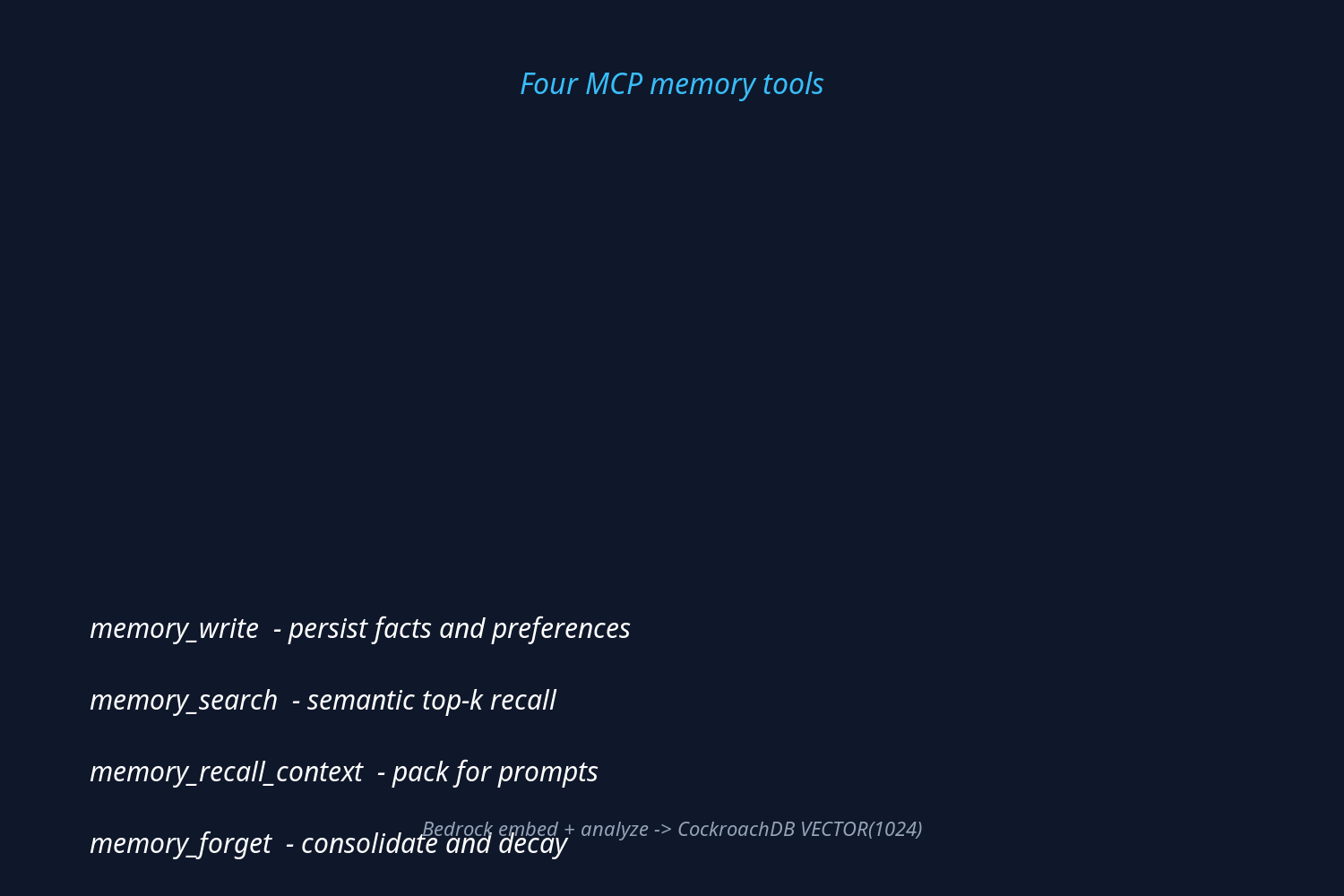
John CEO Agentic Memory is an open-source Model Context Protocol server that gives agents (including John) four memory tools:
| Tool | Purpose |
|---|---|
memory_write |
Persist a preference, fact, event, or task with Bedrock-derived summary, tags, salience, and a 1024-d embedding |
memory_search |
Semantic top-k recall through CockroachDB's vector index |
memory_recall_context |
Pack the most important memories into a token budget for prompt injection |
memory_forget |
Consolidate near-duplicates and decay stale low-salience memories |
Every write runs in one transaction: memory row + session state stay in sync. Multi-tenant deployments filter by user_id with token-bound ACL - the same isolation model John CEO needs when every customer has their own private workspace.
Live MCP demo: https://l4ohjmgz52.execute-api.eu-central-1.amazonaws.com/
Product: https://john.ceo
How we built it
We extracted the memory layer as a standalone MIT module so judges can run it without our proprietary app - while the story stays anchored to a real product need.
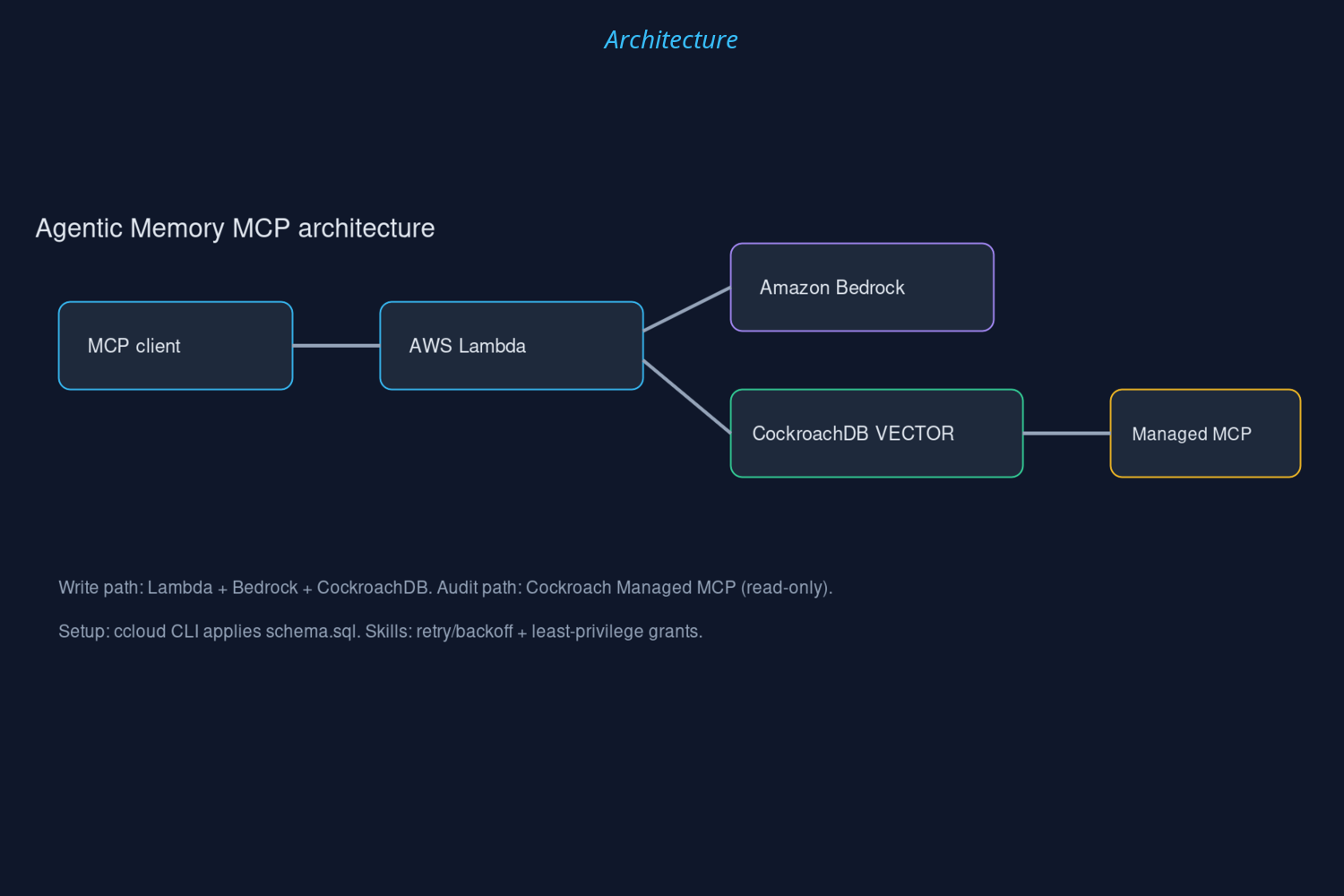
Write path (agents like John):
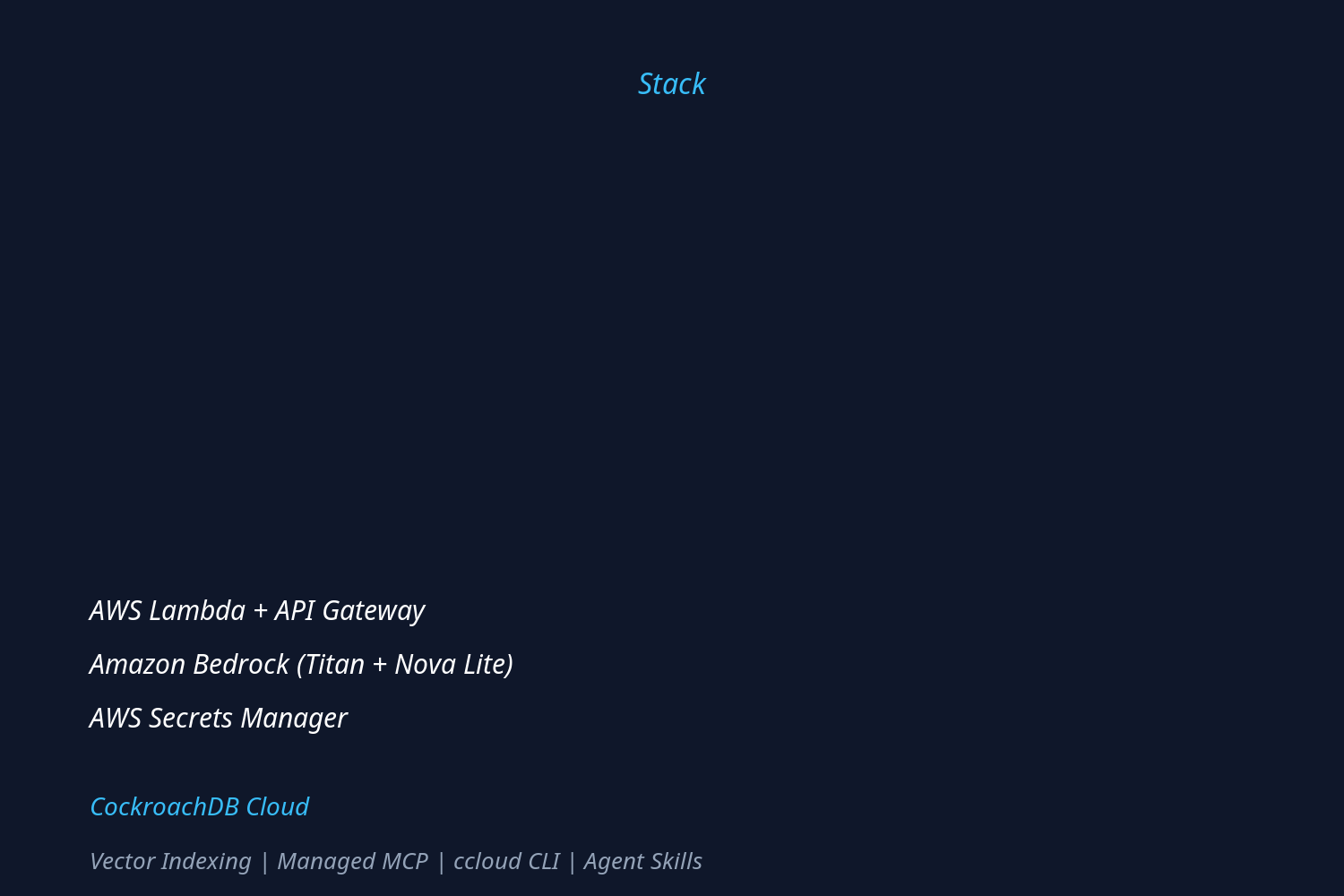
- MCP client -> API Gateway -> AWS Lambda (Node 20)
- Amazon Bedrock: Titan Text Embeddings V2 (1024-d) + Amazon Nova Lite (analyze/consolidate)
- CockroachDB Cloud:
memoriestable withVECTOR(1024)andVECTOR INDEX (user_id, status, embedding vector_cosine_ops) - Auth via AWS Secrets Manager (Bearer token + bound
userId)
Audit path (operators):
- Cursor / Claude Code -> CockroachDB Cloud Managed MCP (
https://cockroachlabs.cloud/mcp) read-only - Inspect schema, sample rows, and query plans without the application write token
Provisioning: scripts/ccloud-bootstrap.sh uses the ccloud CLI to create the database, apply schema.sql, and grant least-privilege DML to the app user.
CockroachDB Agent Skills from cockroachlabs/cockroachdb-skills directly shaped the code: retry backoff/jitter, idempotent session counters, statistics-aware index validation, and privilege hardening ([docs/skills-used.md](https://github.com/John-CEO-HQ/cockroachdb-x-aws-hackathon/blob/main/docs/skills-used.md)).
Evidence and benchmarks: [docs/RESULTS.md](https://github.com/John-CEO-HQ/cockroachdb-x-aws-hackathon/blob/main/docs/RESULTS.md)
Challenges we ran into
Vector index silently unused. With the default
vector_l2_opsopclass, cosine queries (<=>) fell back to a full table scan. Fix: declarevector_cosine_opsexplicitly. Verified withEXPLAINon 1000+ rows.Recency filters break ANN. Adding a non-prefix predicate like
created_at_ms >= xdisqualifies the vector index (CockroachDB SQLSTATE 42809 when hinted). Fix: applyrecencyDaysin application code after vector retrieval.Empty tables lie. On an unseeded cluster, the optimizer chose brute-force top-k even with a valid index. Fix: seed representative data (
npm run seed:demo) and runANALYZEbefore demoingEXPLAIN.Idempotency under retry. CockroachDB serialization failures (
40001) require replaying whole transactions. A naivememory_count + 1increment double-counted on upsert and on retry. Fix: derivememory_countwithCOUNT(*)in the same transaction.Serverless wiring. Lambda reserved env keys, Function URL public-access blocks on some accounts, and Bedrock model availability in
eu-central-1(Nova Lite works; Anthropic models need a separate use-case form). We ship API Gateway as the public demo URL.
Accomplishments that we're proud of
- Built real infrastructure for a production product problem (John CEO's long-term memory), not a disconnected toy demo.
- End-to-end live demo with real Bedrock embeddings and CockroachDB persistence (not fake mode).
EXPLAINproof thatidx_memories_user_embeddingis used:vector searchwithprefix spansonuser_id+status([docs/evidence/explain-vector-search.txt](https://github.com/John-CEO-HQ/cockroachdb-x-aws-hackathon/blob/main/docs/evidence/explain-vector-search.txt)).- Automated integration test gated on
SEED_INTEGRATION=1that asserts the plan containsvector search. - Two CockroachDB tools in one story: Distributed Vector Indexing (write path) + Managed MCP (read-only audit path).
- Open-source MIT module judges can run locally while learning about John CEO at https://john.ceo
What we learned
- Vector indexes are not "set and forget": opclass, prefix columns, and table statistics all change whether ANN actually runs.
- Keeping embeddings and operational rows in one CockroachDB table avoids the consistency gap of a separate vector DB.
- Managed MCP is a strong operator story: agents write through your app; humans audit through Cockroach's hosted endpoint with read-only defaults.
- CockroachDB Agent Skills are most valuable when they produce traceable code changes (retry logic, grants, schema), not vague inspiration.
What's next for John CEO Agentic Memory
- Wire this memory layer into John CEO's production agent loop at https://john.ceo (per-customer private workspace isolation).
- Publish the MIT repo and a <3 min demo video for judges.
- Optional: Anthropic Bedrock use-case form to A/B Nova Lite vs Claude for summarization.
- Hardening: rate limits, per-tenant quotas, and CI running
smoke-lambda.sh+test:lambdaon schedule. - Deeper forgetting policies (importance-weighted decay) and hybrid metadata filters beyond
user_id+statuswhere the index contract allows.
Built With
- amazon-web-services
- cockroachdb
- mcp
- postgresql
- typescript

Log in or sign up for Devpost to join the conversation.