-
-
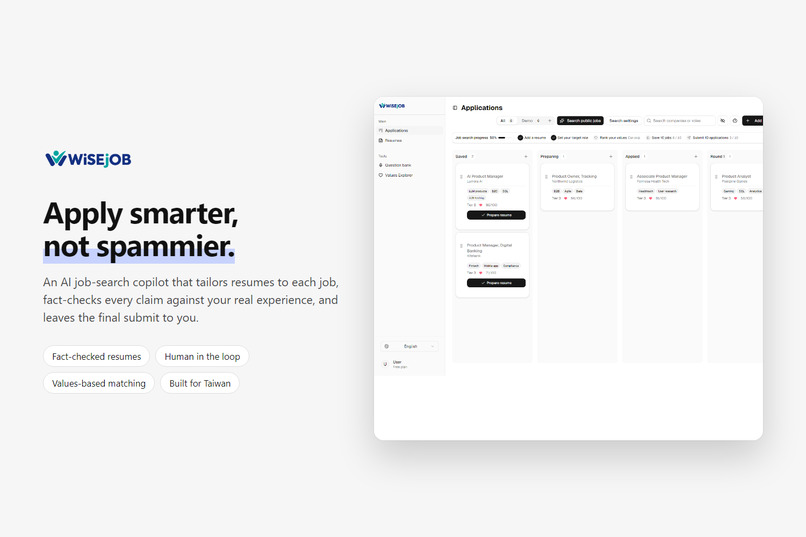
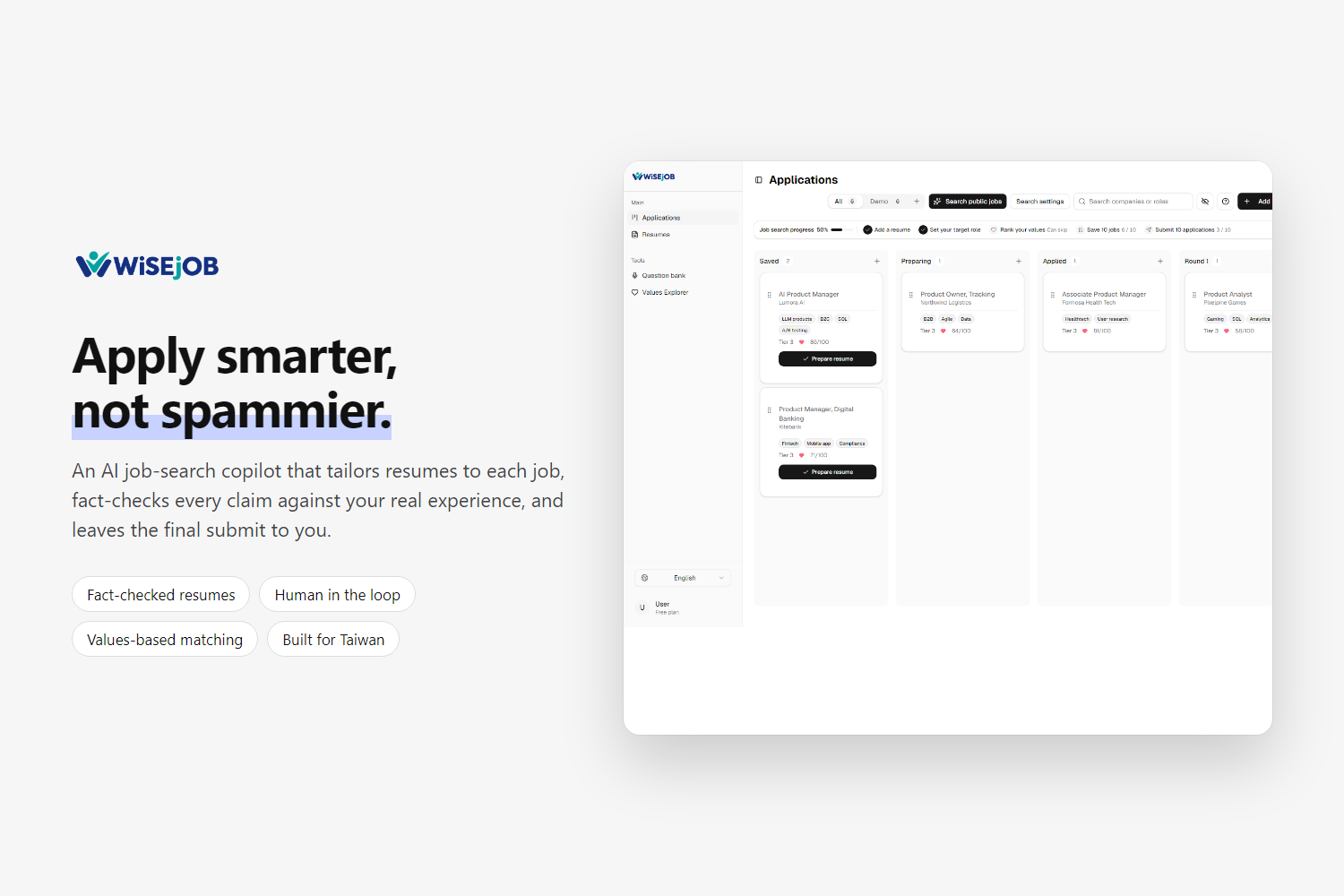
WiSEjOB: an AI job-search copilot that tailors, fact-checks, and leaves the submit to you.
-
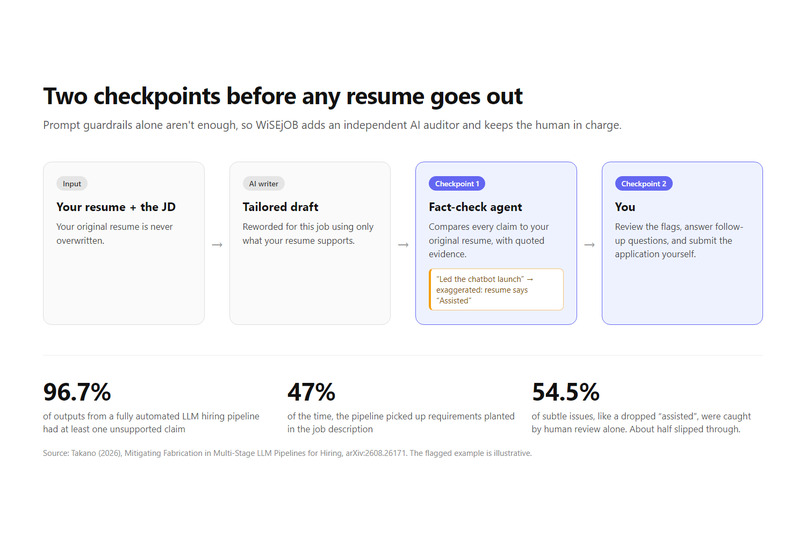
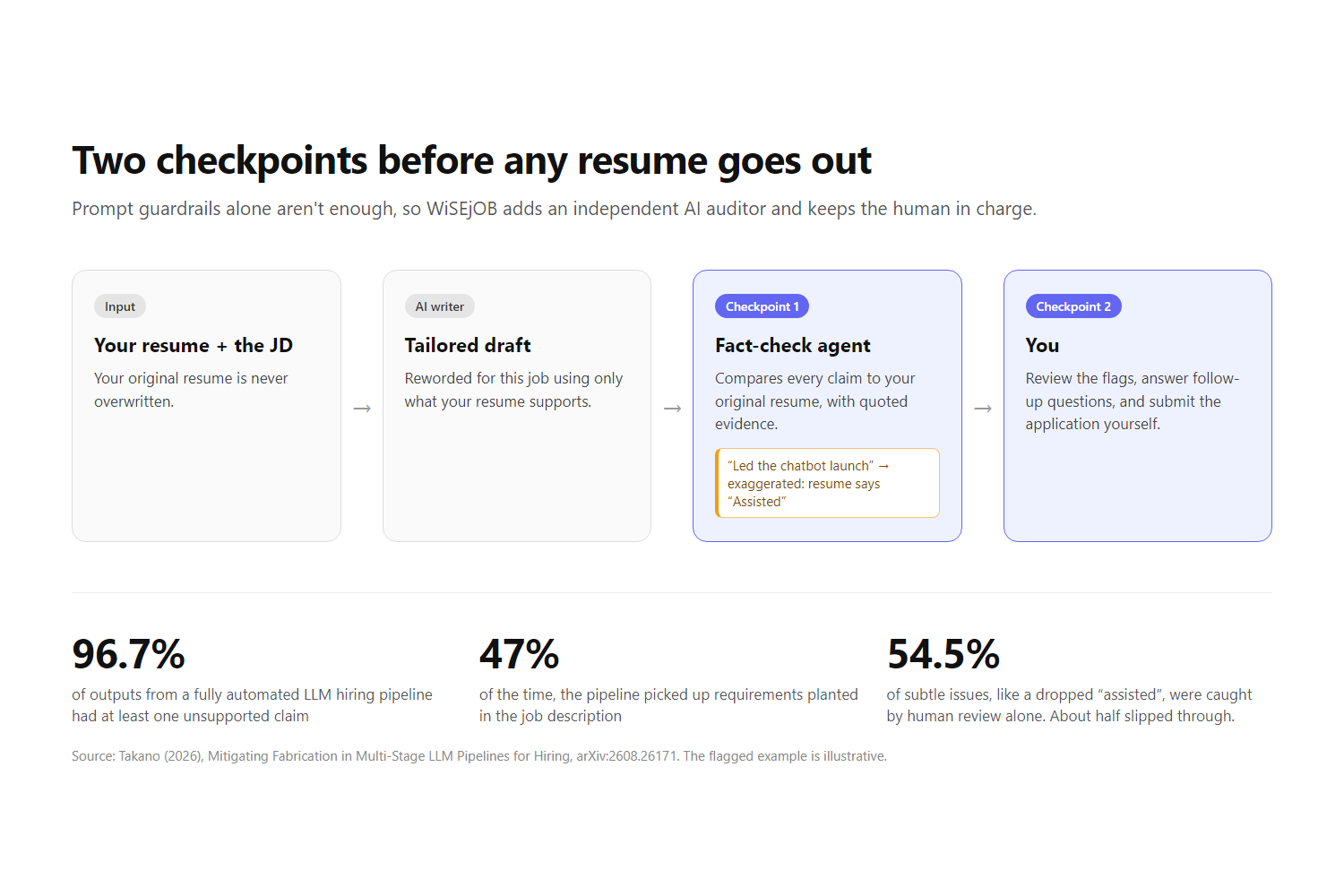
Two checkpoints before any resume goes out: an independent fact-check agent, then you.
-
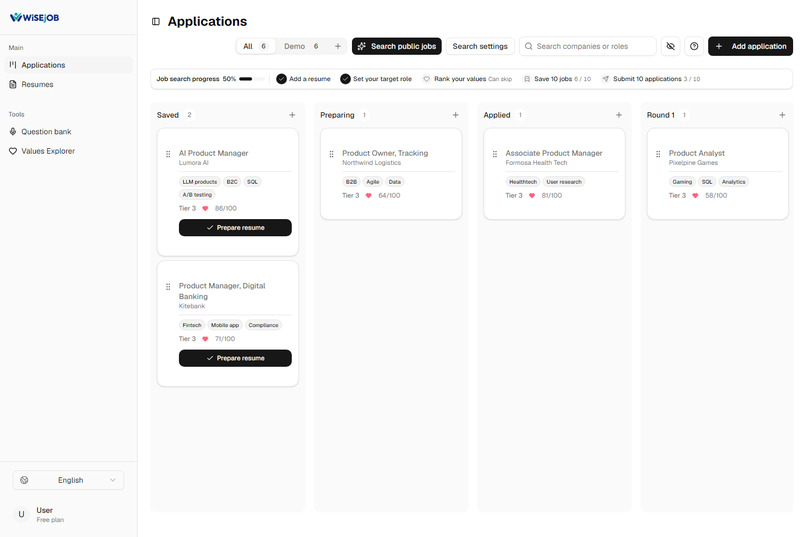
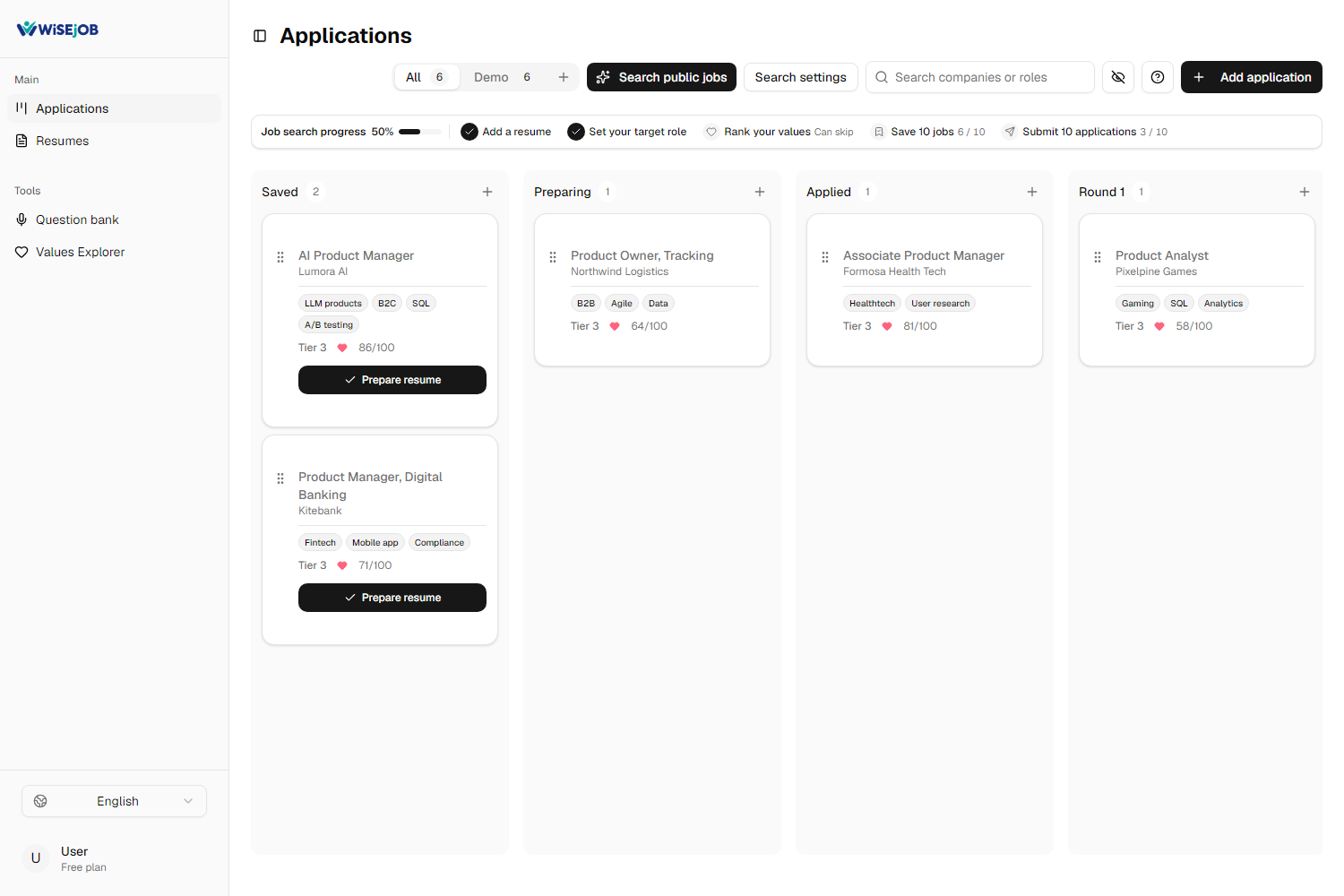
Track every application on one board, from saved to offer.
-
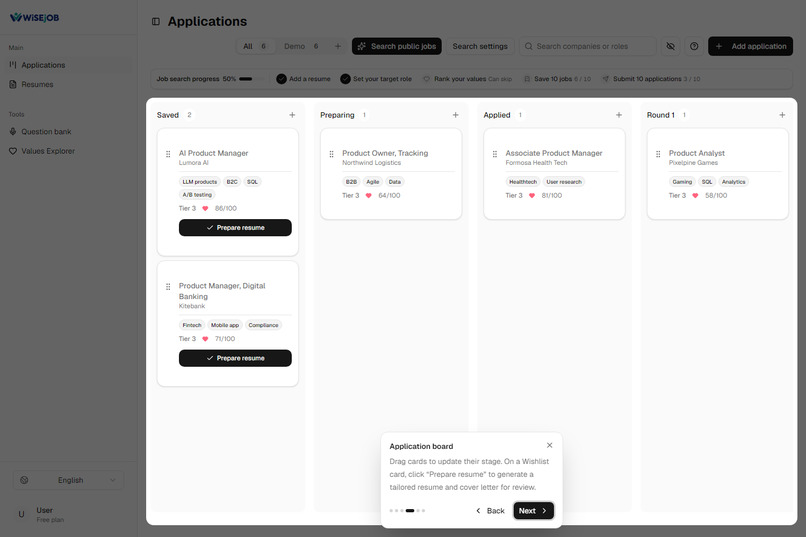
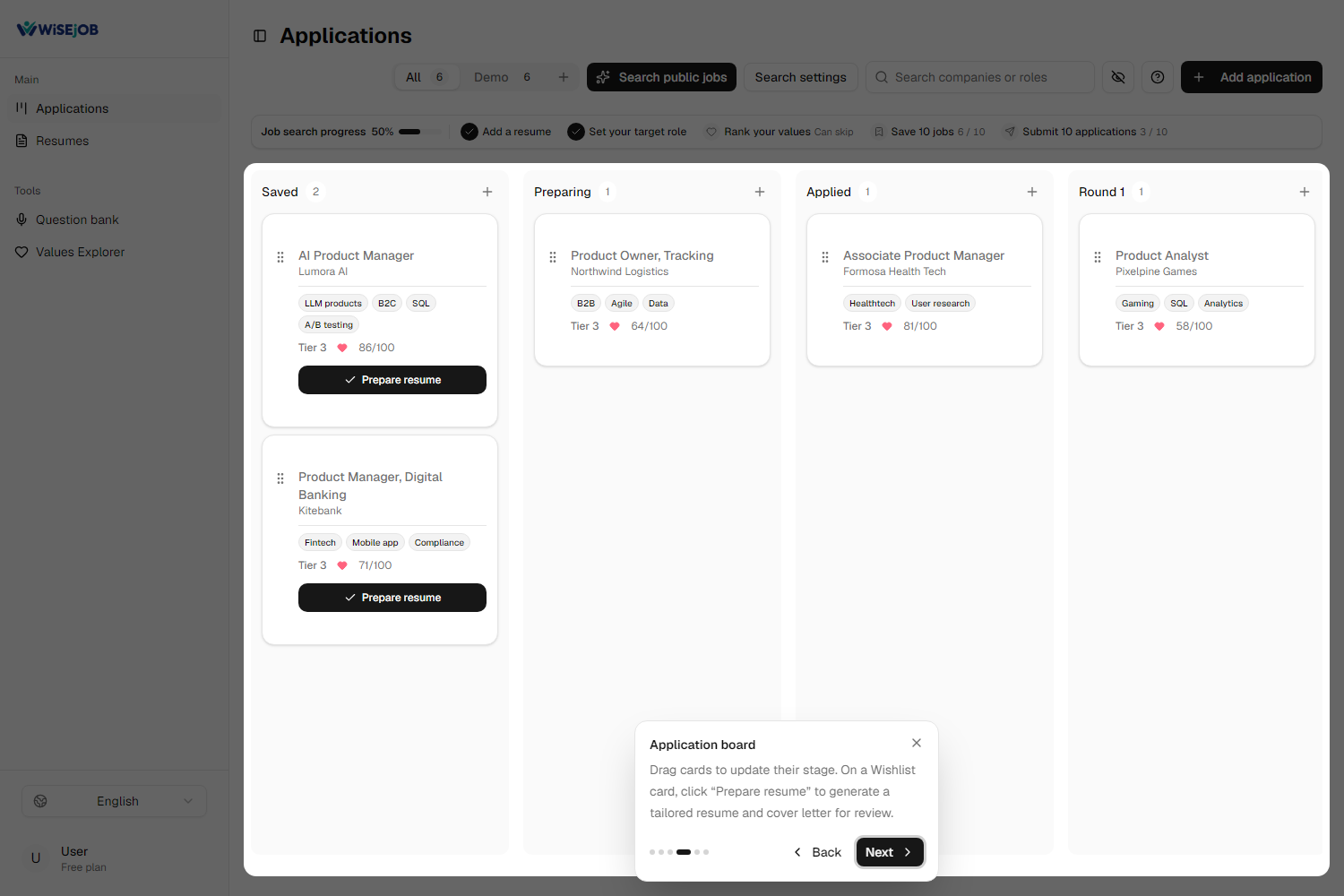
A spotlight onboarding tour guides new users through the flow.
-
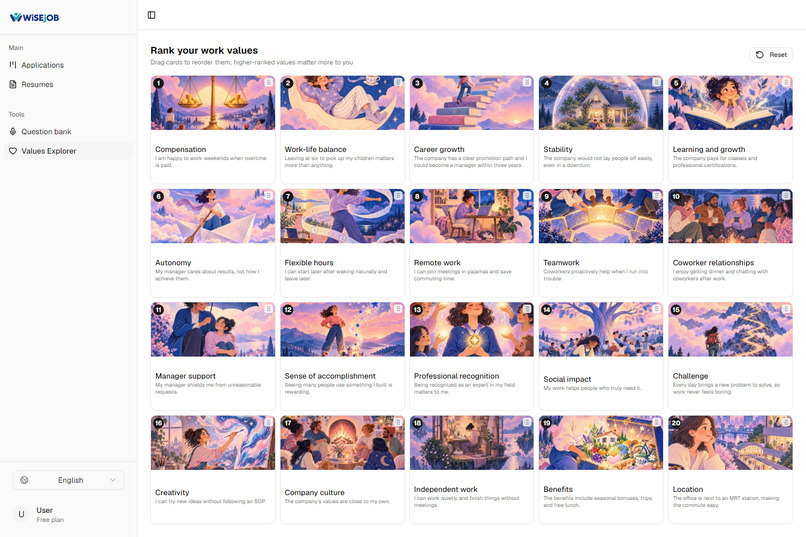
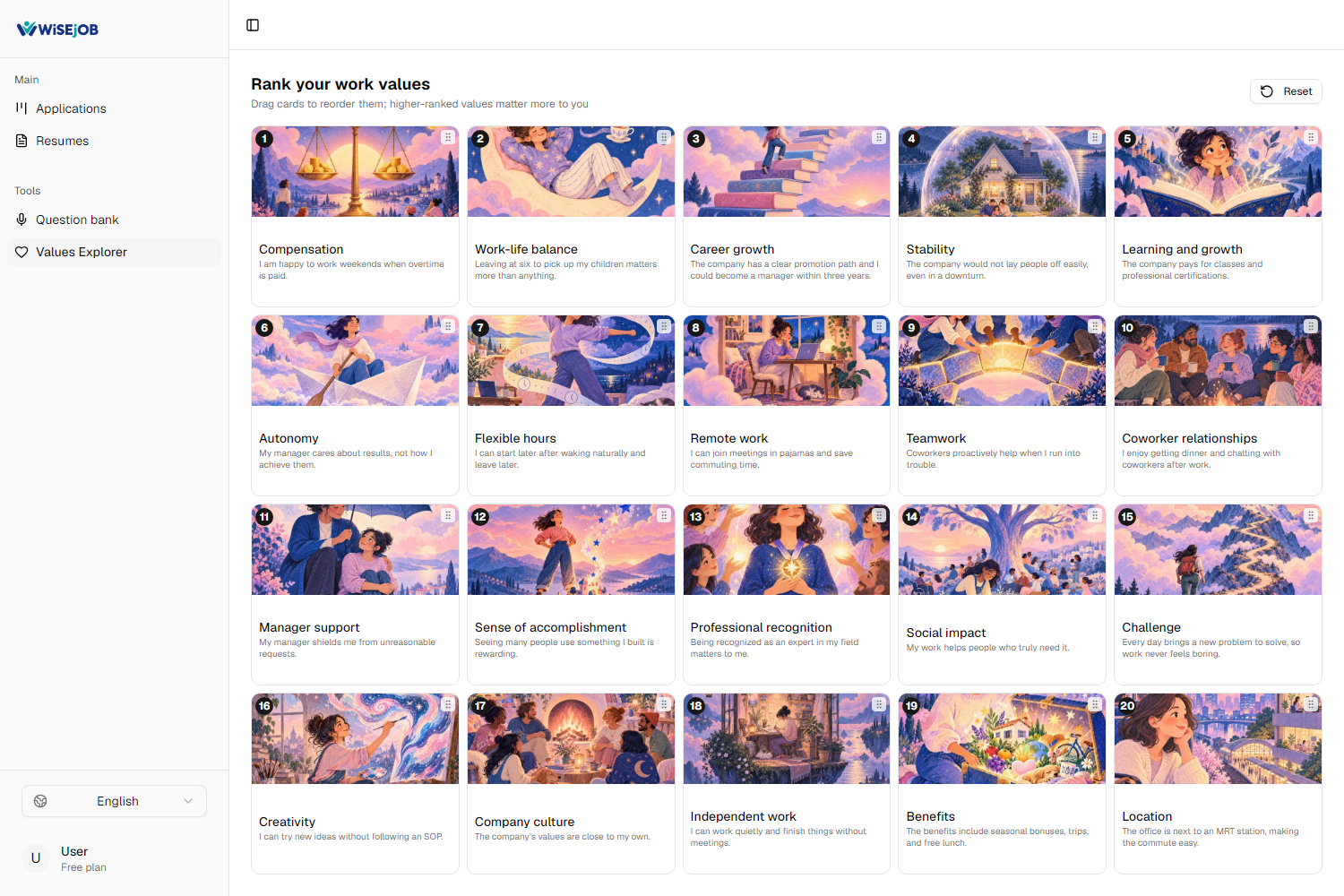
Rank 20 work values; every job gets a values-fit score.
-
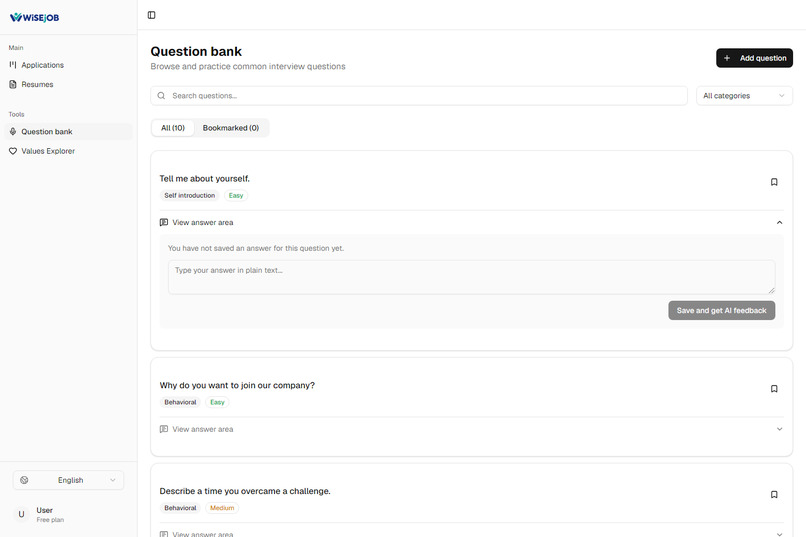
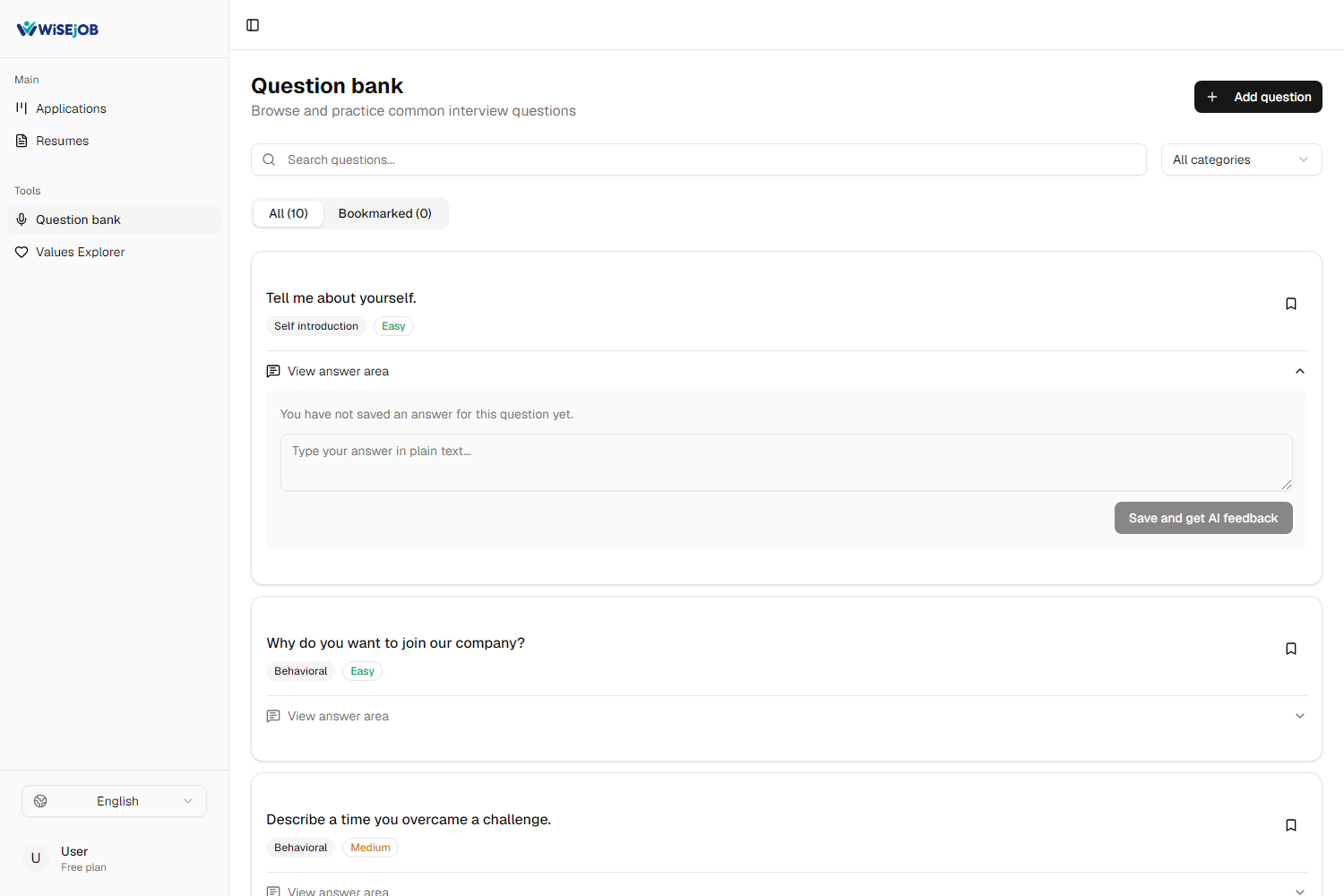
Answer interview questions in plain text and get AI feedback.
Try it: sign in at wisejob.vercel.app with [email protected] / Demo-5qeipz03, open the Demo tab, and click Prepare resume on the card.
Inspiration
Job hunting today rewards volume over fit. Auto-apply bots spray hundreds of generic applications, and AI resume tools happily rewrite "assisted with" as "led", or stuff in keywords you don't actually have. Recruiters drown in noise, and candidates end up with resumes they can't defend in an interview.
Research backs this up. In Takano (2026), Mitigating Fabrication in Multi-Stage LLM Pipelines for Hiring, a fully automated LLM hiring pipeline produced at least one unsupported claim in 96.7% of its outputs, and picked up requirements planted in the job description 47% of the time. Human review alone wasn't enough either: reviewers caught every blatant fabrication, but subtle ones, like a quietly dropped "assisted" or a plausible new claim, were removed only 54.5% of the time. The paper's conclusion is that prompt guardrails alone are insufficient; you need checkpoints.
That shaped WiSEjOB's design. We built two checkpoints into every tailored resume:
- An independent fact-check agent compares each claim in the AI draft against the original resume and flags anything unsupported or exaggerated, with evidence.
- The human stays in the loop. The user reviews the flagged claims, can answer follow-up questions to add real experience the AI can safely use, and submits the application themselves. WiSEjOB never applies on their behalf.
Because humans miss subtle exaggerations about half the time, the agent's job is to point them to exactly where to look.
What it does
WiSEjOB is an AI career copilot that covers the whole job search, from finding a role to preparing for the interview:
- Discover jobs. Search public listings on LinkedIn, Indeed, Cake and 104 by role, skills, location and experience, on demand or as a daily background search. Results become reviewable leads; nothing is ever applied to automatically.
- Collect jobs from anywhere. Paste a link or job description, use the paired LinkedIn companion extension, or paste an informal hiring post from Threads or Facebook. The AI pulls out the company, role, requirements and contact details.
- Track everything on one board. A drag-and-drop Kanban covers Saved → Preparing → Applied → interview rounds → Offer.
- Tailor resumes and cover letters, then fact-check them. One click produces a job-specific resume and cover letter from your base resume. A separate AI reviewer then checks every claim against your original resume and flags anything unsupported or exaggerated. Each JD requirement is marked supported / partial / missing, with the evidence quoted from your resume. Your original resume is never overwritten.
- Add real experience through follow-up questions. If the draft misses something you've genuinely done, answer a few follow-up questions. The resume is regenerated with your answers and fact-checked again.
- You press submit. WiSEjOB prepares the application, but it never applies on your behalf. A job is only marked as applied after you confirm you sent it yourself.
- Choose jobs by what matters to you. Rank 20 value cards (growth, work–life balance, remote work, and more), and every job gets a values-fit score next to its company tier.
- Built for Taiwan. Company reviews and interview experiences are gathered from local sources (Dcard, PTT, Qollie). A take-home pay calculator accounts for labor and health insurance, rent, commuting and meals. The interface switches between Traditional Chinese and English, and JDs and resumes can be translated.
- Practice interviews. Answer common interview questions in plain text and get AI feedback. Your strengths and areas to improve are saved for the next session.
How we built it
- Frontend: Next.js 16 (App Router), React 19, Tailwind CSS, shadcn/ui, dnd-kit for the Kanban board, and Framer Motion for the onboarding spotlight tour.
- AI: All inference runs server-side through one AI gateway. By default it uses Nebius Token Factory with NVIDIA Nemotron 3 Nano; the provider is configurable. Writing and auditing are separate calls: one model drafts, and an independent low-temperature pass verifies the facts.
- Data: Turso (libSQL) stores each user's applications, resume versions, tailored drafts and agent runs, kept separate per account.
- Automation & integrations: a Vercel cron job for daily job discovery, a paired Chrome extension for LinkedIn, crawlers for Taiwanese review sites, and LINE and Gmail hooks for notifications and cover-letter drafts.
- Open source under the MIT License.
The keyword match shown to users is deliberately simple and transparent:
$$\text{match} = \frac{|\text{matched keywords}|}{|\text{matched}| + |\text{missing}|}$$
Every score is labeled as an estimate. When a JD is too short to judge, we show no score rather than invent one.
Challenges we ran into
- Getting reliable JSON from a reasoning model. Nemotron sometimes adds
<think>blocks or Markdown fences around its output. We wrote a tolerant parser and made errors report the real cause instead of a generic failure. - Preventing hallucination without killing usefulness. As the Takano paper predicts, one prompt that says "don't make things up" wasn't enough. Splitting the work into a writer and an independent auditor, with requirement-by-requirement evidence, made the difference.
- Failure-safe workflows. Early versions moved a job card forward before the AI finished, so a failed generation left it stuck with no way to retry. We changed the flow so that status only advances on success and rolls back on failure.
- Platform changes mid-hackathon. We migrated the database from Supabase to Turso, moved AI behind one provider-agnostic gateway, and split data per user, while keeping the app working.
- Job sites resist scraping. Many listing pages block automated fetches, so we built several capture paths (search, extension, paste, social posts) instead of relying on one crawler.
Accomplishments that we're proud of
- A research-backed, two-checkpoint design that makes AI resume tailoring something you can trust, not just something that is fast.
- A complete loop from discovering a job to preparing for the interview, in one product.
- Localized features that global tools don't offer, such as Taiwanese review sources and real take-home pay.
What we learned
- Trustworthy AI comes from structure (separate roles, cited evidence, honest uncertainty), not from a longer prompt.
- Putting a human at the decision point is a feature: it protects the candidate's reputation and keeps the tool on the right side of job platforms' rules.
- Small UX details, like progress steps, an onboarding tour and clear failure states, decide whether people finish the flow.
What's next for WiSEjOB
- Targeted follow-up questions generated from each flagged claim, which the user must resolve before submitting
- Voice answers for interview practice, with transcription
- Interview scheduling with calendar sync, and smart reminders
- Tracking response rates to learn which resume versions actually work
Built With
- cheerio
- chrome
- dnd-kit
- framer-motion
- gmail-api
- libsql
- line-messaging-api
- nebius
- next.js
- node.js
- nvidia-nemotron
- radix-ui
- react
- react-pdf
- shadcn-ui
- tailwindcss
- tiptap
- turso
- typescript
- vercel
- zod


Log in or sign up for Devpost to join the conversation.