Inspiration
Workplace accidents often happen because nobody notices a missing helmet, a worker entering a dangerous area, or someone who has collapsed until it's too late. Most sites already have cameras, but nobody can watch every screen all day. We wanted to turn those cameras into an always-on safety officer that costs nothing to run.
What it does
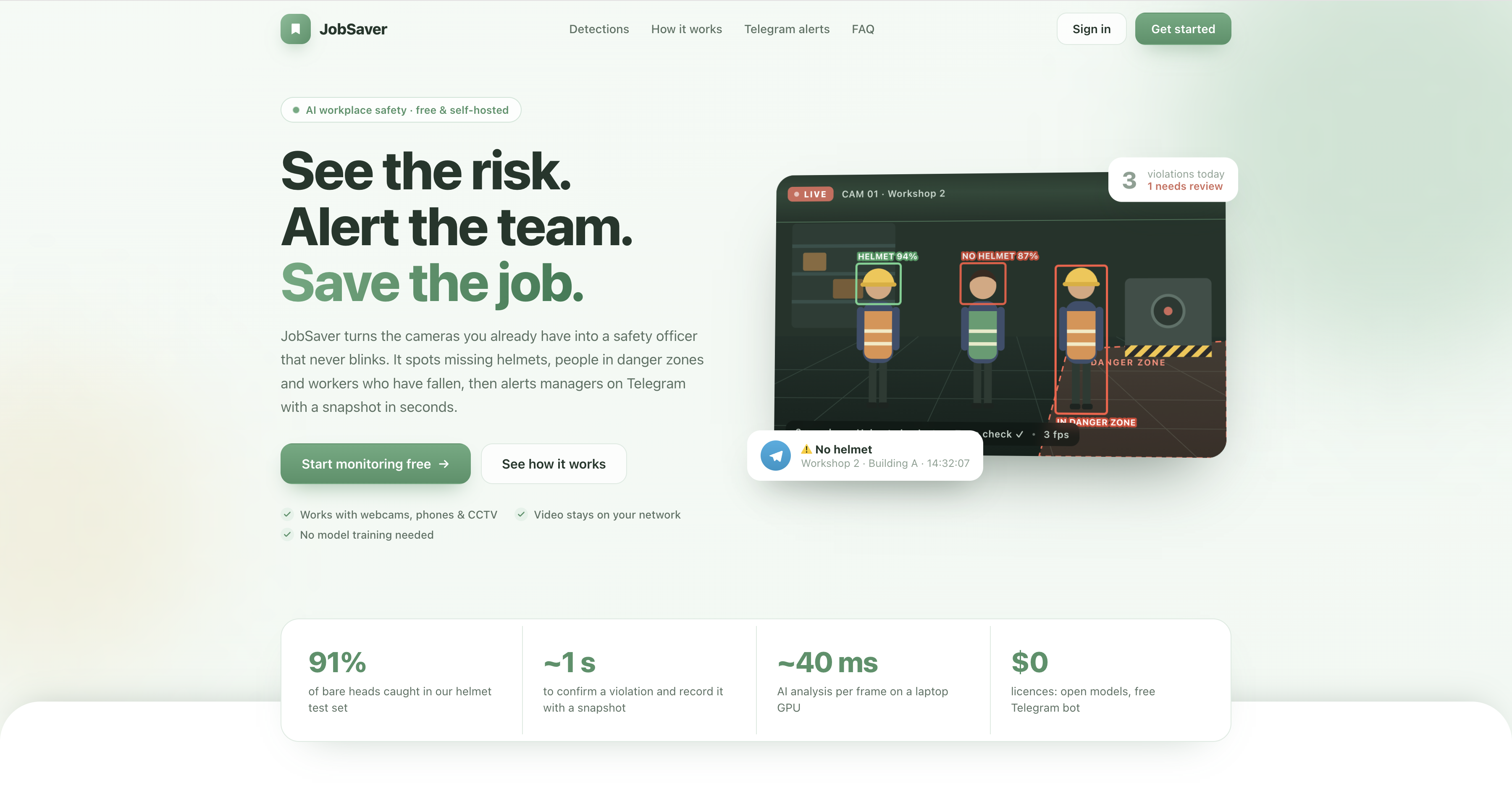
JobSaver watches live camera feeds and detects safety risks in real time:
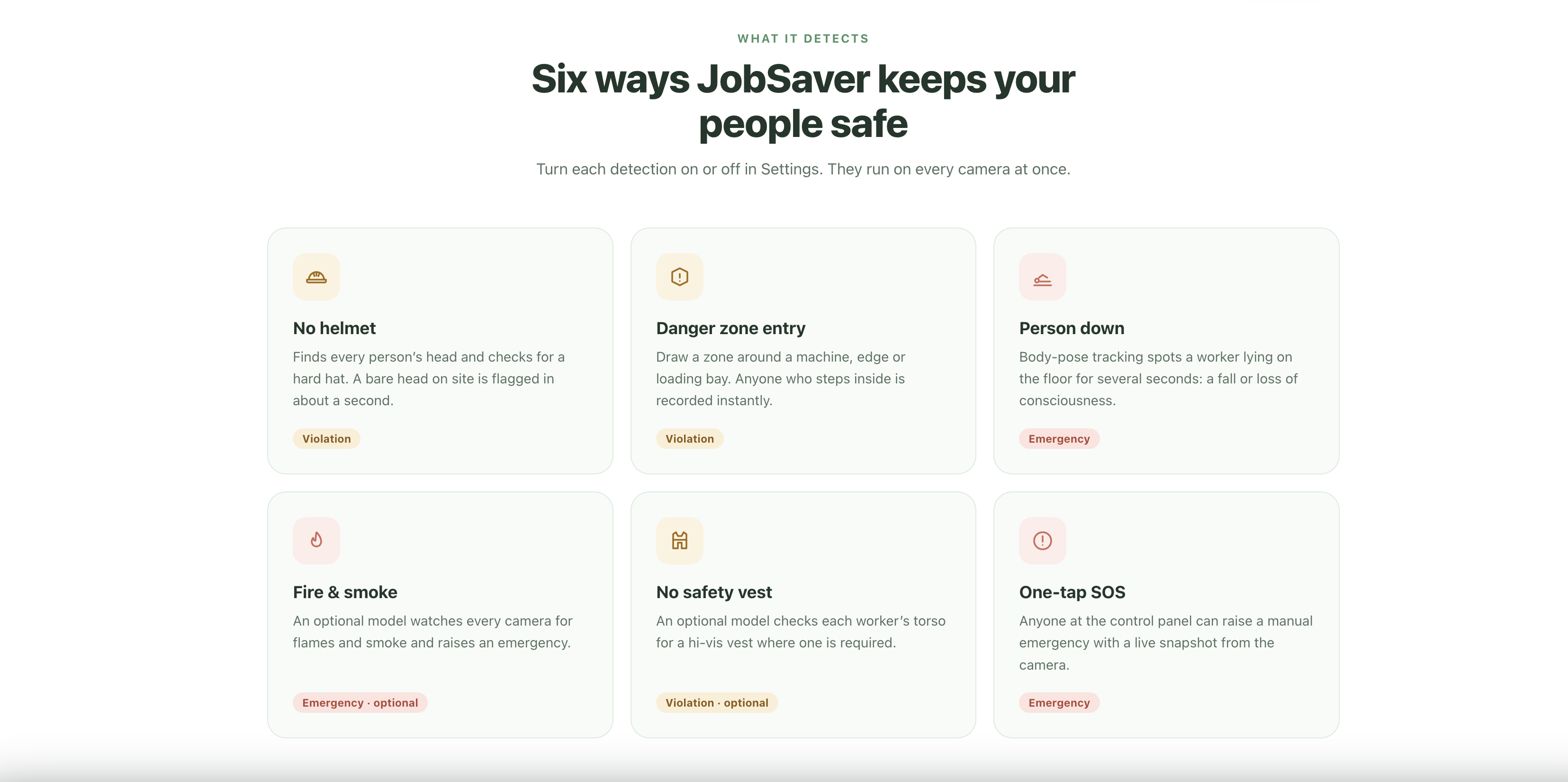
- Violations: missing helmets, entering a danger zone you draw on the camera view, and missing safety vests (optional model).
- Emergencies: a person down (fall or loss of consciousness), fire or smoke (optional model), and a manual SOS button.
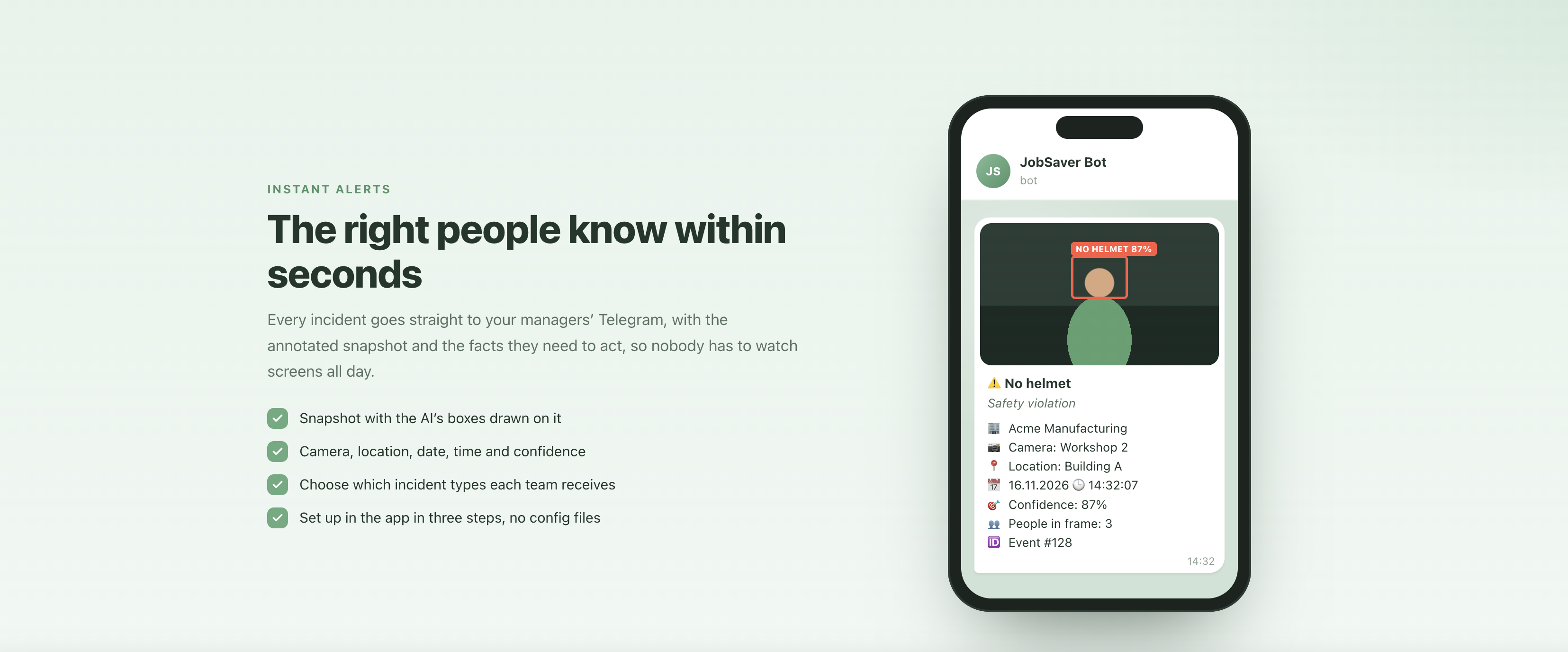
Each incident is saved with an annotated snapshot, camera, location and time. Managers get an instant Telegram alert with the photo and details. A web dashboard shows live cameras, incident journals, weekly statistics and filters by incident type.
Cameras can be laptop webcams, phones (front or back), IP/CCTV streams, or uploaded videos.
How we built it
- Backend: Python and FastAPI, SQLite, and one worker per camera running OpenCV.
- AI: free pretrained YOLO models. A hard-hat detector combined with a pose model checks each person's head for a helmet. The same pose model detects falls (body angle) and danger-zone entry (feet inside the drawn area).
- Frontend: React and Vite, with live video streaming and phone cameras streaming over WebSockets.
- Alerts: the Telegram Bot API, fully set up from the app's Settings page.
- Everything is free and self-hosted. Video never leaves the local network.
Challenges we ran into
- The first PPE model we tried found 0% of helmets. We built a labelled test set, compared models, and redesigned detection around each person's head instead of trusting the model's "no helmet" class.
- The stock pose model is unsure about people lying down, which made fall detection hard to tune without false alarms.
- Phones only allow camera access over HTTPS, so streaming from a phone needed a secure local setup.
- Avoiding alert spam: violations must persist across several frames, with a cooldown afterwards.
Accomplishments that we're proud of
- 91% of bare heads caught on a labelled test set, with only 2% of helmets wrongly flagged.
- About 1 second from a violation on camera to a recorded incident with a snapshot.
- Runs fully free on a regular laptop (about 40 ms per frame on its GPU), with no cloud and no model training.
- A complete product: detection, dashboard, phone cameras, danger zones and Telegram alerts, all set up from the UI.
What we learned
- Measuring accuracy on real labelled data is essential; the model that looked right on paper didn't work.
- Combining simple models with rules (pose + helmet detector + geometry) can beat relying on a single model.
- Reliable alerting needs as much thought as detection: confirmation frames, cooldowns and clear messages.
What's next for JobSaver
- Fine-tune models on real site footage (falls, vests, fire) for higher accuracy.
- Escalation: repeat alerts until acknowledged, plus an "Acknowledge" button inside Telegram.
- More detections: missing gloves or goggles, overcrowding, unsafe use of machinery.
- Multi-site support with roles for managers and supervisors.