-
-
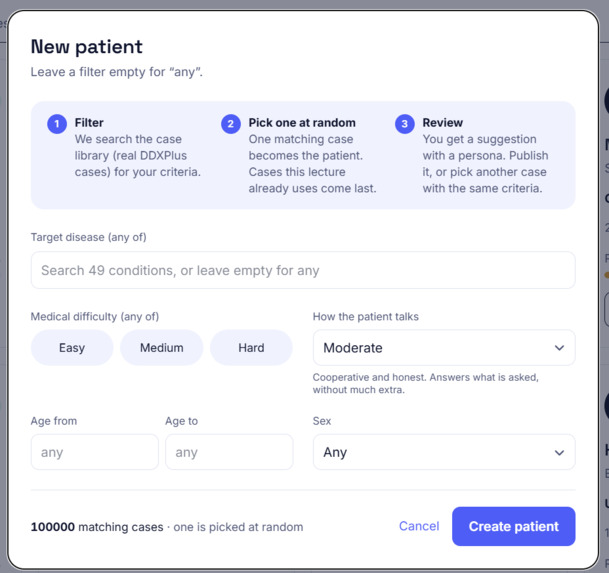
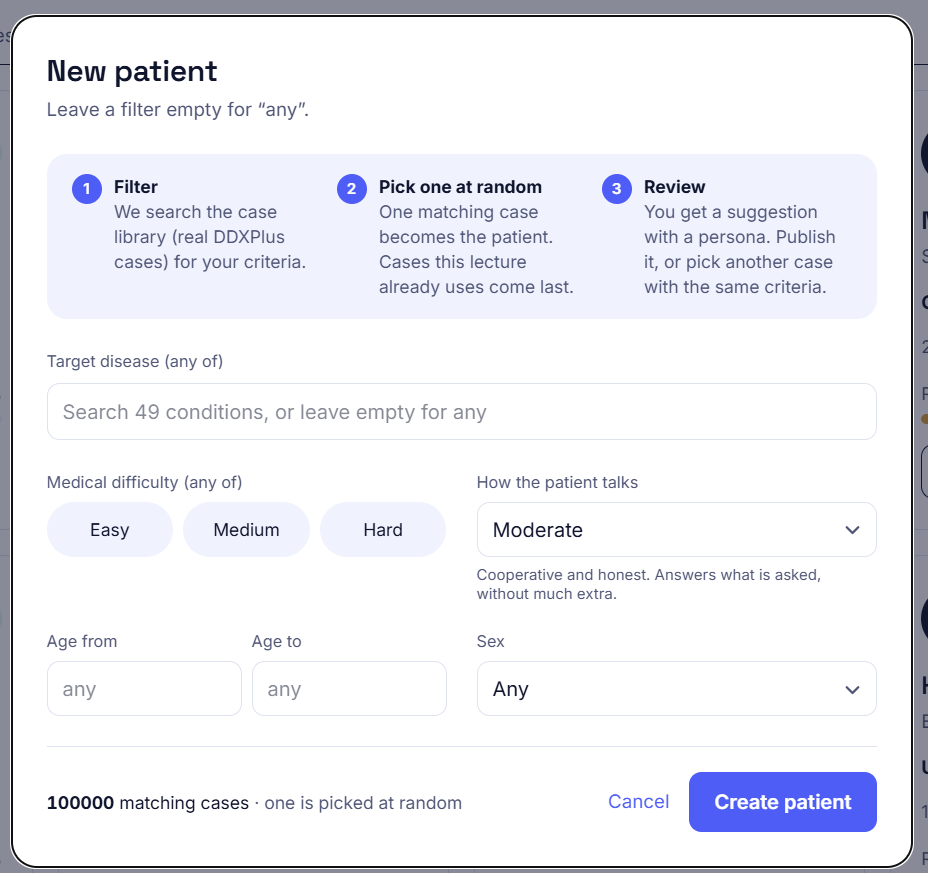
Lecturer View: Create new Patient
-
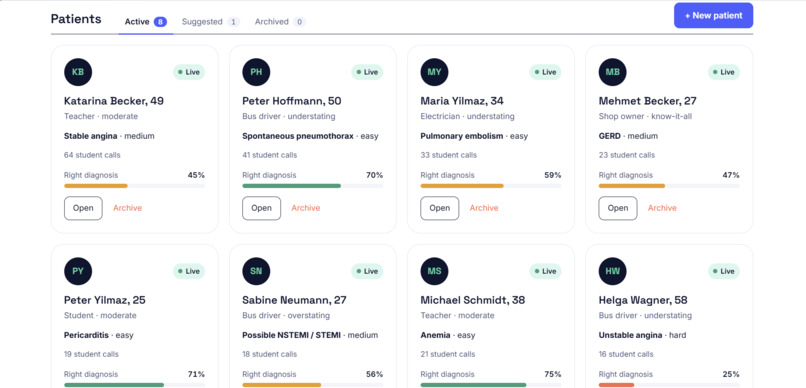
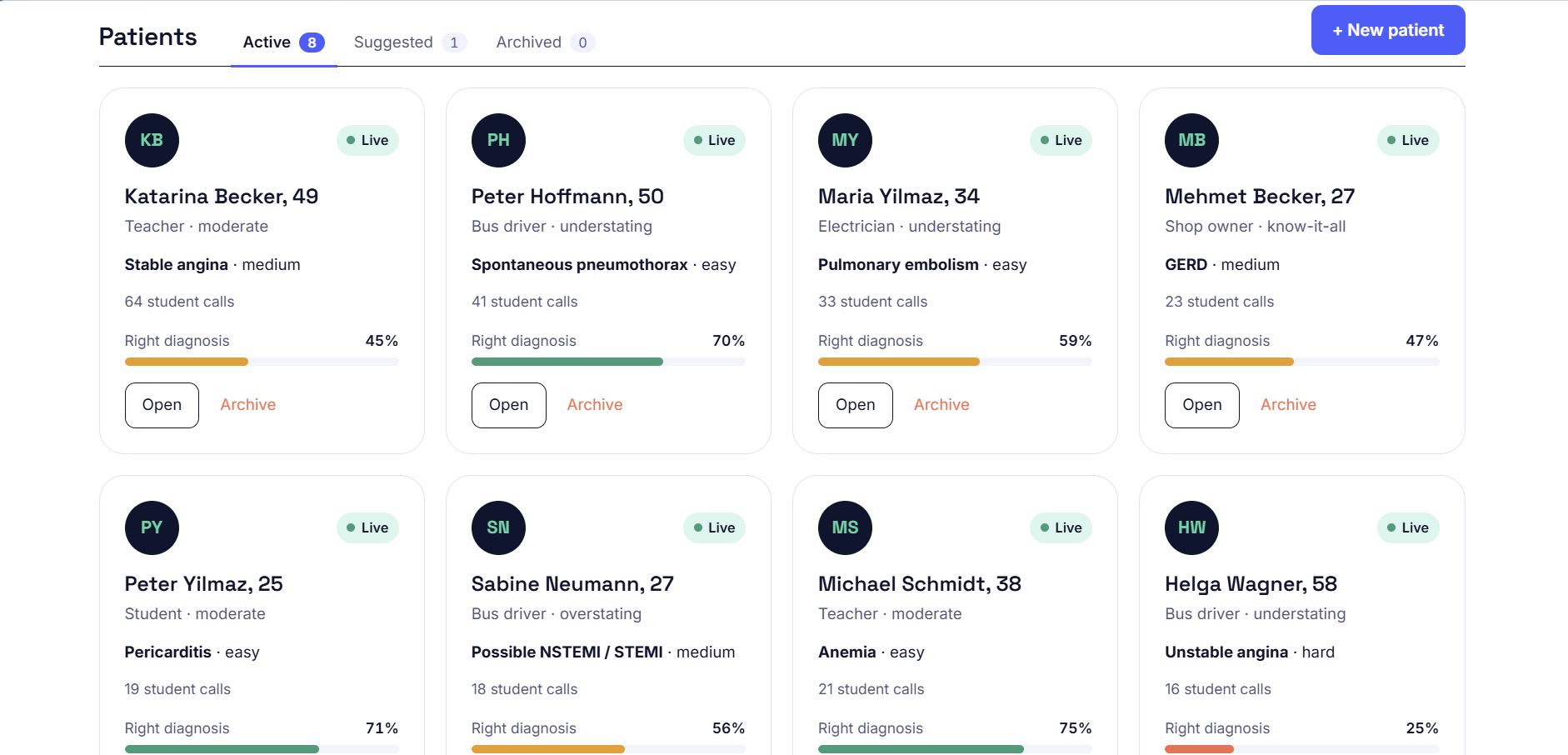
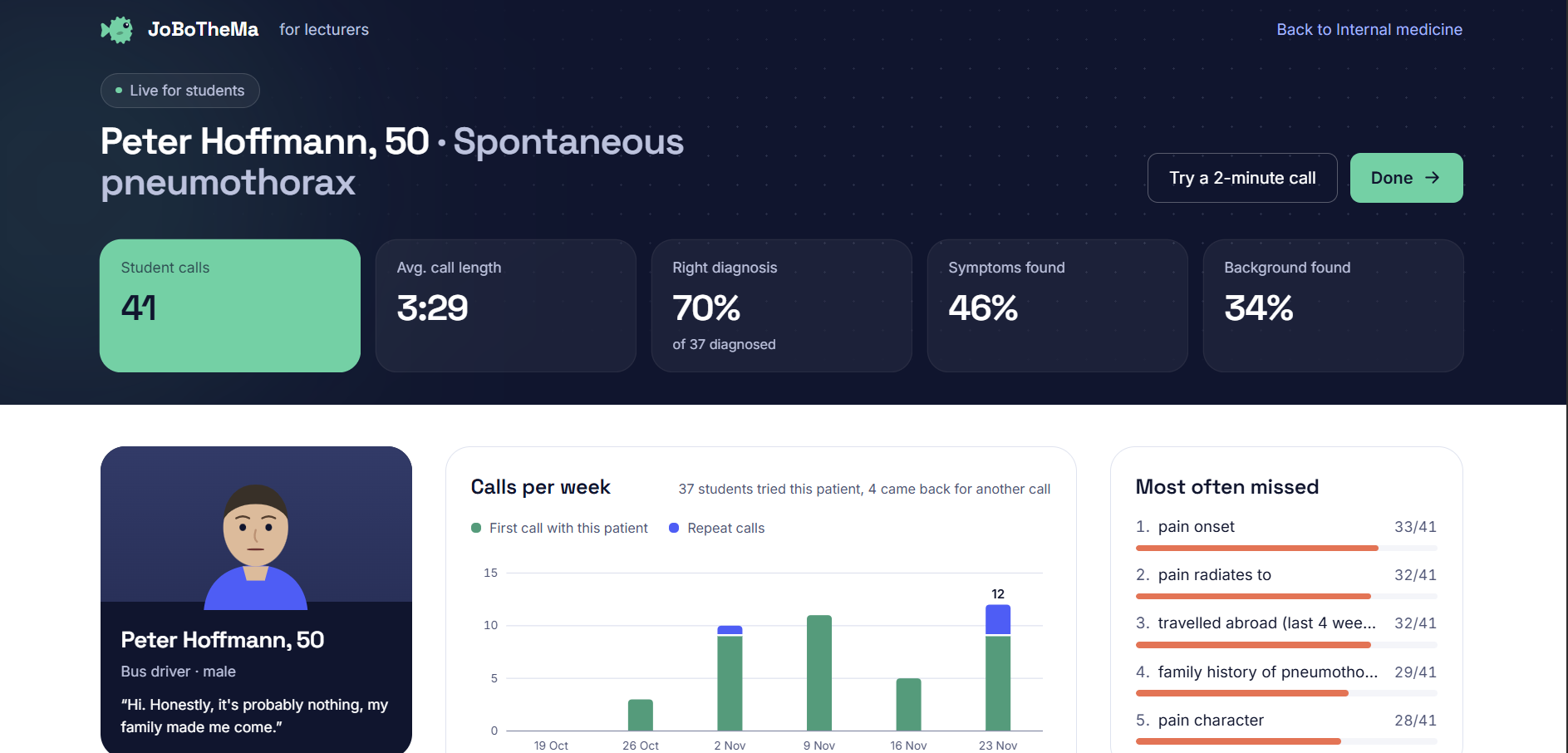
Lecturer View: Patient Overview
-
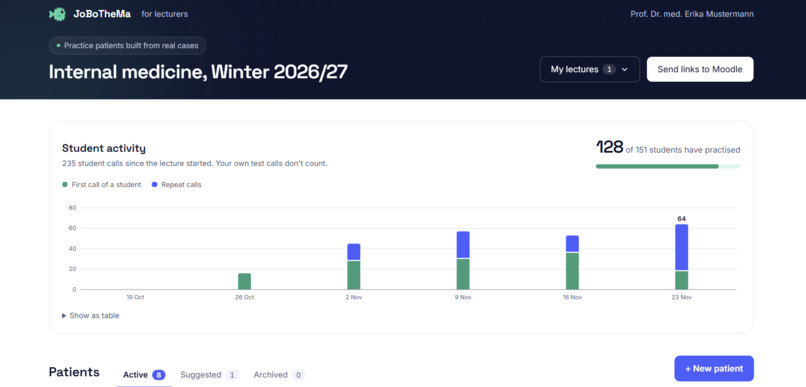
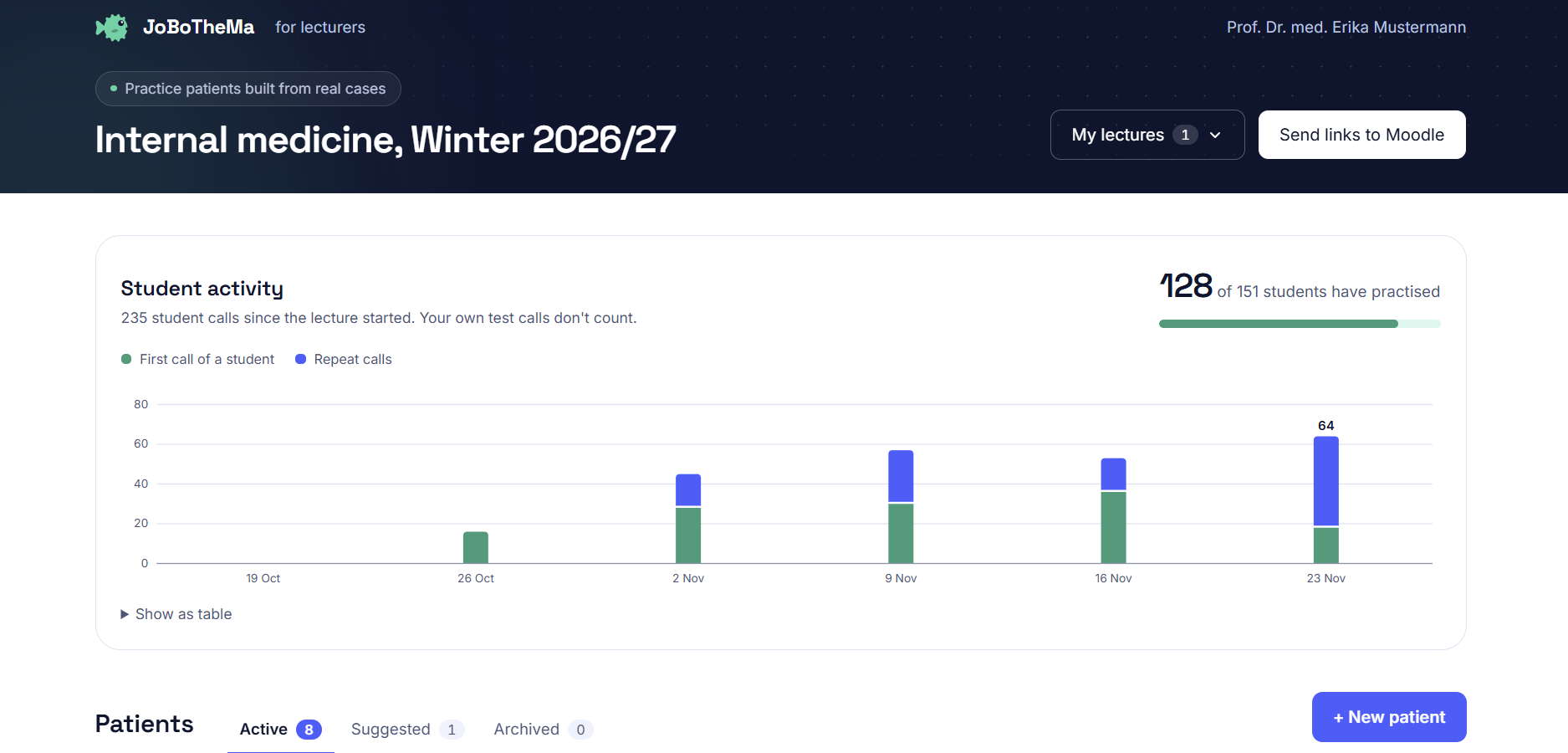
Lecturer View: Patient Overview (Basis adoption stats)
-
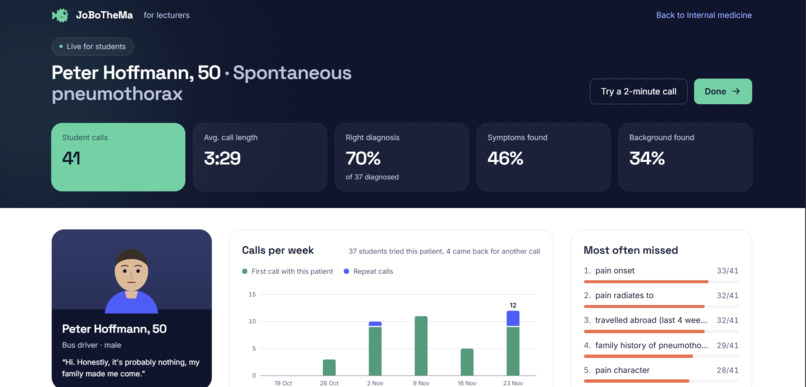
Lecturer View: Patient Details (Analysis)
-
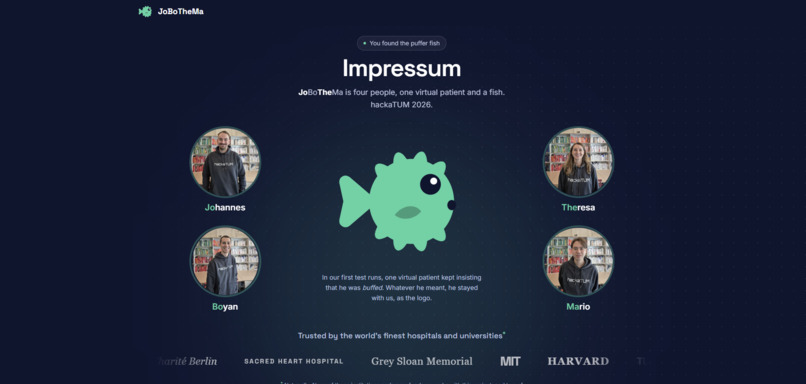
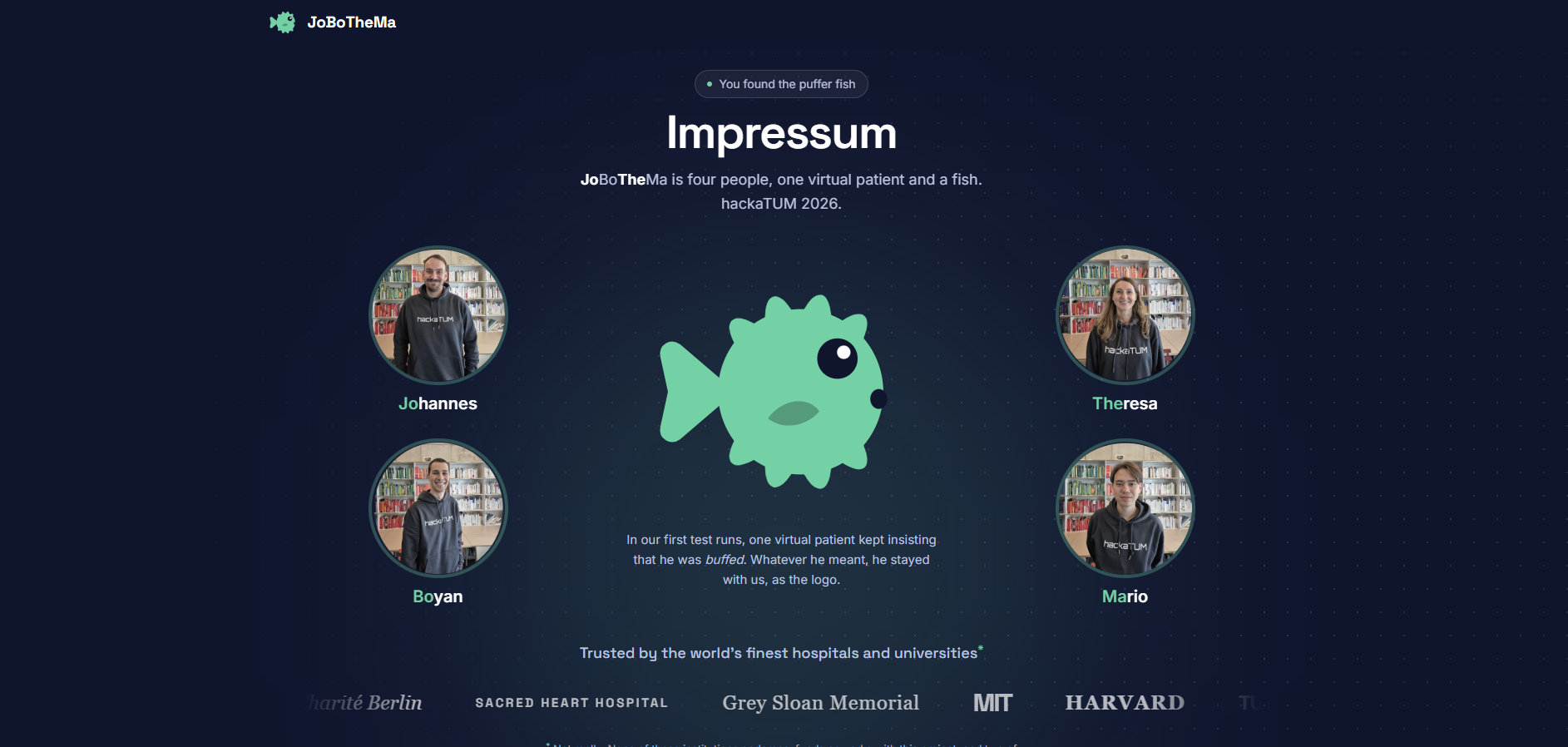
Impressum
Inspiration
Medical students learn history taking by talking to patients, but practice time with real or acted patients is rare, expensive and hard to schedule. Most digital alternatives are multiple-choice quizzes or chatbots that feel nothing like a real consultation. For the Avelios challenge at hackaTUM 2026, we wanted a patient that feels real: one you call and talk to with your voice, who stays consistent, has a personality, and only tells you what you actually ask about.
What it does
JoBoTheMa is diagnosis practice with virtual patients built from real cases.
- Lecturers create a patient by picking a target disease, a medical difficulty and how the patient talks: cooperative, playing symptoms down, worried and dramatic, or a know-it-all who has already googled their own theory. Each patient is built from a real case of the DDXPlus data set, with a complete hidden health history. Lecturers then send their students a personal link.
- Students call the patient by voice in the browser, on the phone or in a VR consultation room, in a headset or with a phone in a Cardboard viewer. They take the history, then name their diagnosis when they hang up. They see whether it was right, what they uncovered and what they missed. Missed findings only show their topic, so the case stays useful for another try. If students agree to share the transcript, they also get tips on their communication: open versus closed questions and medical jargon.
- Lecturers see per patient how often it was called, how many students got the diagnosis right, how much of the history they uncovered, and which details the class misses most.
No accounts and no stored audio: access works through secret links, and transcripts are only kept with consent.
How we built it
- Stack: MERN (MongoDB, Express 5, React 19 with React Router, Vite, Tailwind) in npm workspaces, with a shared contracts package for all API types. Each feature lives in its own vertical slice, from the API route to the page.
- Voice: OpenAI's realtime speech-to-speech model over WebRTC, straight from the browser, for natural turn-taking and replies as fast as 0.3 s in our tests. A cascaded fallback (speech-to-text, then a chat model, then text-to-speech) covers cases where realtime is not available. Without any key, a demo mode answers typed questions from the case file.
- The patient: one prompt shared by both pipelines, built from the persona, the conversation type and the case findings. The diagnosis is never in it. Which facts the student uncovered is detected from the transcript, off the audio path, so it never slows down a reply.
- Captions: the realtime model delivers an answer's text within about two seconds, while the audio plays for up to fifteen. A small pacer releases the captions at speaking pace and adapts to each patient's voice, so they match what you hear.
- VR: a hand-built, toon-shaded consultation room and patient in three.js, with no external 3D assets. It runs with WebXR on headsets, in a stereo Cardboard mode with head tracking on phones, and as a preview of that mode on laptops. Each patient gets a stable look: build, hair, clothes, glasses and facial hair. There is also a fish tank with a puffer fish, our mascot.
- Tooling: OpenAPI docs for every route, and a cost tracker that records the token usage of every model call.
Challenges we ran into
- Latency versus control: speech-to-speech feels natural but is harder to steer than a text pipeline, so we built both and made them share one patient prompt.
- Revealing facts only when asked: a patient that volunteers everything is useless for practice. Getting deflection first and the truth on a good follow-up question, without the patient inventing symptoms, took many rounds of prompt work.
- Turning data into a person: DDXPlus cases are questionnaire answers ("Do you smoke cigarettes? → yes"). Making those sound like a 49-year-old teacher on the phone, and keeping the diagnosis from leaking through facts that name it, is still an ongoing challenge.
- Captions running ahead of the voice, until we built the caption pacer.
- VR on real devices: most phones have no WebXR, so we built our own Cardboard mode. Low depth precision on mobile GPUs made thin objects such as a clipboard on the desk flicker.
- Moving fast in parallel: several big refactors landed at the same time, including a switch from lecture slides to real cases as the patient source, so we merged a lot.
Accomplishments that we're proud of
- A voice conversation that feels like a phone call, not a chatbot, with fast replies.
- Patients with distinct personalities on top of real medical cases. The same disease can be played four different ways.
- One patient that works on a laptop, a phone and in VR, from the same link.
- Feedback that teaches without spoiling the case, and privacy by design: no accounts, no stored audio, transcripts only with consent.
- A 3D consultation room and patient built entirely in code.
What we learned
- Most of the realism comes from the small things: short spoken sentences, a hesitation, a deflection, a mood that shifts, captions in sync with the voice.
- Keeping the model honest is a data problem as much as a prompt problem. Clean, well-phrased facts beat longer instructions.
- Choosing the voice pipeline is a trade-off between speed and control. Having a fallback paid off.
- Building VR for phones and laptops first made the headset version easier.
What's next for JoBoTheMa
- Test with real students and lecturers, and on the Valve Index headset.
- Rephrase the case facts into natural patient language, and filter out facts that give away the diagnosis.
- Automated quality checks: scripted test conversations, a judge model, and a report with pass rates and latency for every patient.
- Push-to-talk for noisy rooms, and more languages, starting with German.
- Patients generated from a lecturer's own slides, alongside the real-case library.
Built With
- mern
