-
-
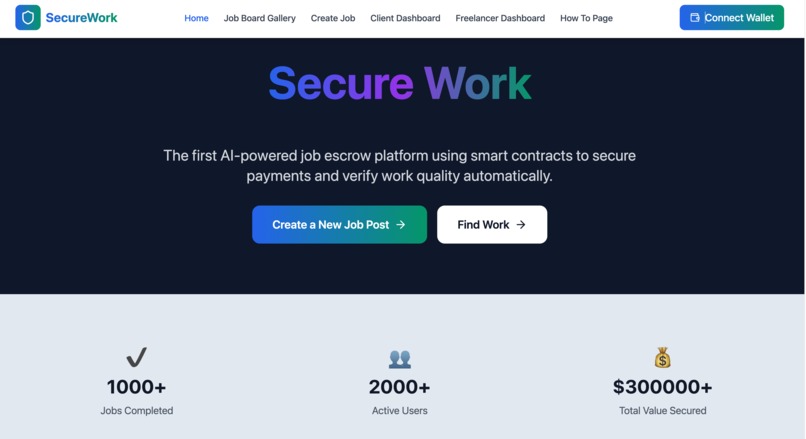
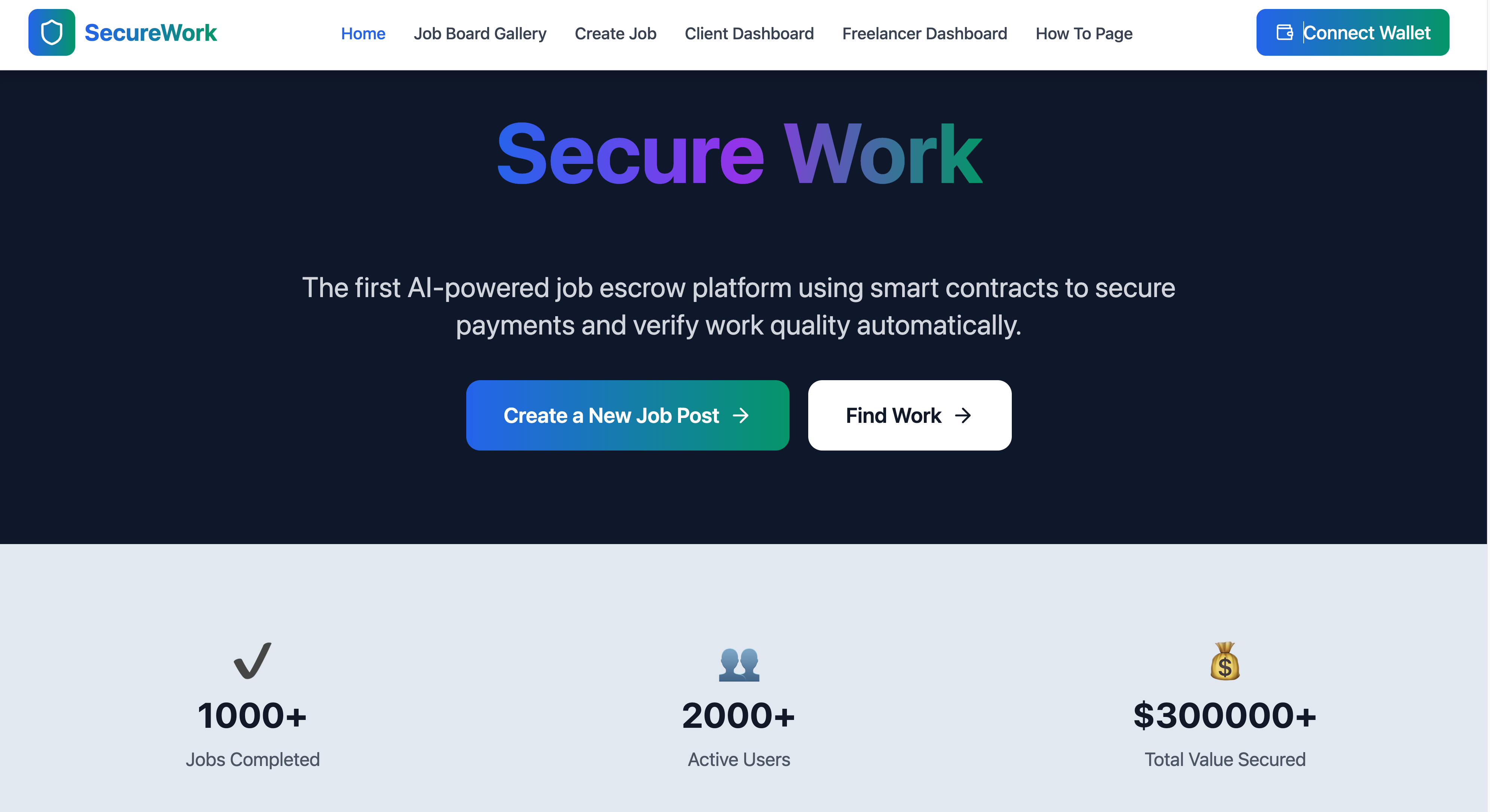
Screen shot of Hero Image on Landing Page for Secure Work
Inspiration
I built this because there is a lack of security in knowing if you do work for someone whether they will pay you or take advantage of your time.
Jobs get rescheduled and rescaled repeatedly, leaving freelancers with loss of time and lack of payment.
I wanted to create a verifiable platform where freelancers and clients can securely collaborate on jobs.
The goal was to build a system with documented records of truth and verifiable funding using escrow smart contracts.
I sought to eliminate trust issues and provide clarity on work progress, payments, and deliverables.
What it does
SecureWork is a blockchain-powered freelance escrow platform.
It allows clients to create job contracts with verifiable terms and funding held securely in escrow.
Freelancers can accept jobs, submit work, and receive payments automatically upon approval.
All actions and states are recorded on-chain, providing a documented record of truth for both parties.
AI verification assists in reviewing submitted work before final approval.
The platform facilitates transparent communication and protects freelancers from payment risks.
How I built it
I started the build on June 6th I believe on Bolt.new which wrote over 70% of the code. I build the smart contracts for job creation, escrow funding, freelancer assignment, work submission, and payment release using a factory contract to deploy job, this was written in Solidity and deployments using Hardhat Framework.
React and TypeScript power the frontend, integrating wallet connection and contract interactions via ethers.js.
Netlify serverless functions handle off-chain tasks like IPFS metadata uploads and email notifications using Resend.
OpenZeppelin libraries provided tested contract modules for security and standards compliance.
The workflow integrates AI verification via serverless functions to automate review feedback.
Continuous deployment and environment management were set up through Netlify for easy updates.
Challenges I ran into
no about challenges, challenge is about 30% of my code was written without bolt this is due to Bolt having two times wrote over all my edits that i made . So that I didnt lose anymore work to that i had to duplicate my repository and rename one to ensure Bolt could not affect my code from afar as i had my github linked. Do to the lack of clarity on how to prevent such editing by Bolt as Bolt has a desire to return all code to the starting point, I had to build about 30% of the app off the platform and in vscode.
Bolt rewrote my code edits multiple times which caused me to lose almost 30% of my work.
This forced me to disconnect from Bolt’s UI editing and rewrite the last part manually in VS Code.
The loss of progress was frustrating and slowed development.
Maintaining control over custom code while using Bolt was uncertain,
It required me to have to create a second repository not connected to the Bolt interface to avoid future overwrites and preserve hand-crafted logic.
Accomplishments that we're proud of
We built a fully functional escrow system that guarantees documented, verifiable funding on-chain.
The smart contracts handle multiple job lifecycle stages with clear permissions and roles.
Our platform allows seamless wallet integration with clear user flows for clients and freelancers.
The integration of AI-assisted work verification adds an innovative layer of trust and automation.
We established a scalable architecture that connects on-chain logic with off-chain storage and email notifications effectively. I believe with Bolt.new and with some of my eye on details we made a user friendly pretty application.
What we learned
Decoupling UI tools and manual code editing preserves project integrity and control.
Combining AI with smart contracts unlocks new possibilities but needs thoughtful UX integration to avoid confusion.
Serverless functions are powerful for bridging blockchain with traditional backend tasks like email and file storage.
The power of starting with Bolt.new for building the framework structure of a project and for ideating.
What's next for SecureWork
Improve UI polish and mobile responsiveness for wider accessibility.
Expand AI verification to include dispute resolution support and partial approvals.
Challenge Categories:
I wish to be entered into are:
Best Use of AI
Secure Work uses AI at the core of the product: all submitted work is reviewed and evaluated by GPT-4, which compares deliverables against the contract’s original requirements stored on-chain. This ensures an unbiased, scalable, and transparent decision process for approving or rejecting work and automating fair payment release. AI is not an add-on, but an integral, trusted part of the workflow.
Most Beautiful UI
Secure Work is designed for non-technical and technical users alike, with a streamlined, step-by-step interface. Every stage—from contract creation to file upload, AI review, and payout—is intuitive and visually clear. Responsive design and modern UI patterns make the experience smooth on both desktop and mobile, lowering friction for all users.
Uniquely Useful Tool
Secure Work addresses the universal problem of trust in remote work and freelance contracting. By combining smart contracts, AI-powered verification, and automated payments, it creates a genuinely useful tool for clients and workers worldwide. No more worrying about fraud, disputes, or missed payments—every job is validated and settled fairly.
Sharpest Problem Fit
We precisely target the core risk in gig and freelance work: how can both sides guarantee fair exchange? Secure Work removes ambiguity by making terms on-chain, automating escrow, and using AI for independent, consistent review. Both clients and workers get a solution tailored to their actual concerns, not just generic “marketplace” features.
We Didn’t Know We Needed This The fusion of decentralized contracts and AI-powered arbitration unlocks a new way of working together online—trustless, borderless, and fair by design. Secure Work goes beyond conventional solutions, creating a new category of “automated trust” that will be indispensable as digital collaboration grows.
Most Likely to Get Funded
Secure Work solves a massive, well-known pain point, and is built with a scalable, secure architecture. Its smart contract/AI engine can be adapted for dozens of markets—HR, consulting, open-source bounties, and beyond. This flexibility and market potential make it an appealing investment.
Deploy Challenge (Netlify)
Secure Work is fully deployed on Netlify, using its serverless functions and global CDN to ensure rapid, reliable access for all users. Netlify’s simple deployment process allowed us to focus on building, not infrastructure, making it possible to launch a production-ready dApp with zero DevOps friction.
Best Use of Bolt.new
We used Bolt.new to quickly scaffold and iterate on Secure Work, leveraging real-time previews and built-in collaboration. Bolt.new’s rapid prototyping enabled us to deliver a polished, full-stack dApp from scratch within the hackathon window.
Built With
- chatgpt
- dropbox
- ethers.js
- hardhat
- javascript
- netlify/functions
- openzeppelin
- react
- resend
- solidity
- tailwind
- typescript
- vite

Log in or sign up for Devpost to join the conversation.