Inspiration
Job Detective came from my own experience of applying for jobs. I was keeping track of where I applied, but I realised that simply knowing whether an application was pending, rejected, or at the interview stage did not really tell me what I could improve.
I wanted to build something that could look at the overall application history and answer a more useful question: "What patterns can I learn from my job search?"
That became Job Detective — a job application tracker that uses AI to turn application history into practical insights.
What it does
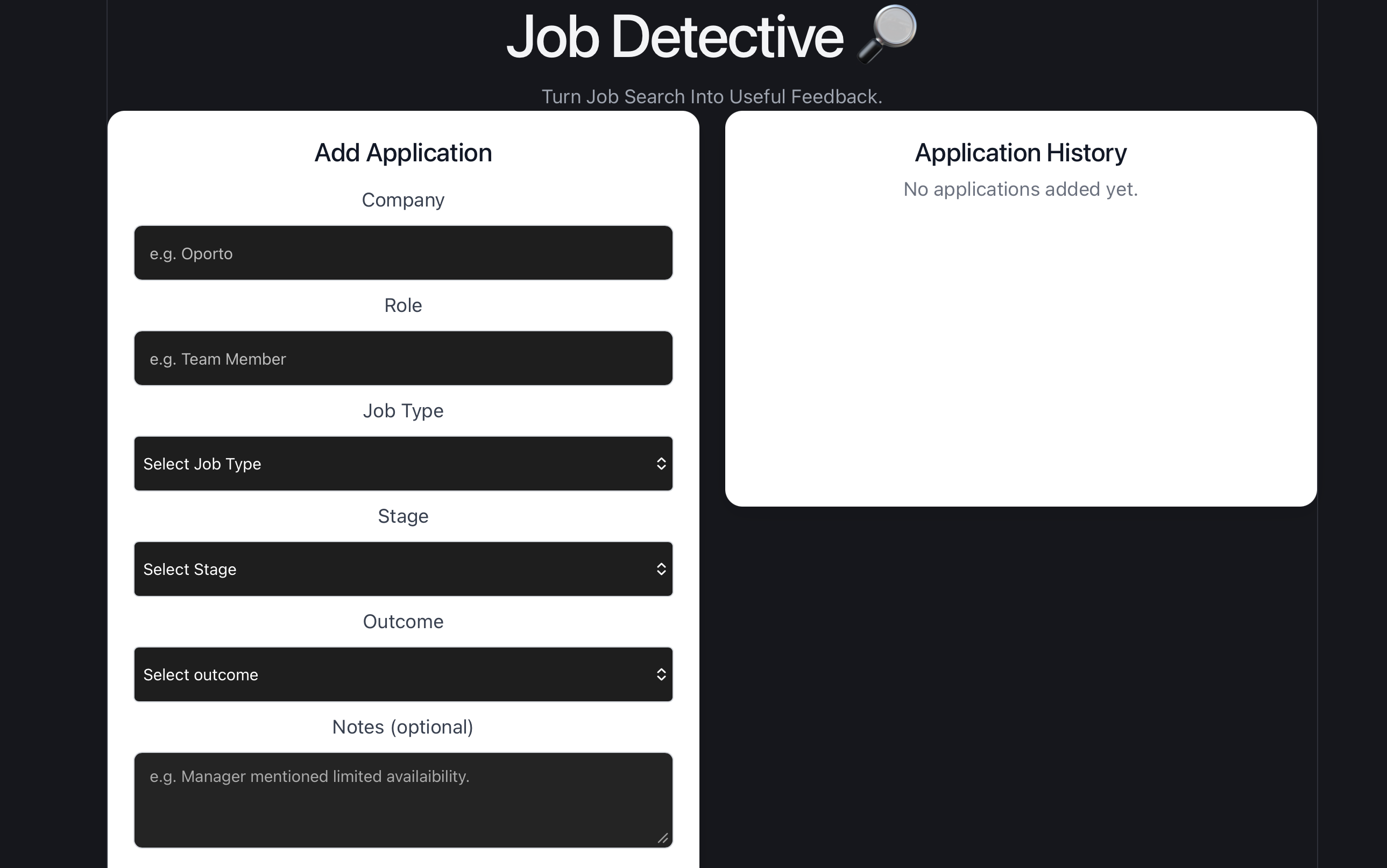
Job Detective allows users to record their job applications, including the company, role, job type, hiring stage, outcome, and notes.
The application then provides a dashboard showing application statistics and a visual breakdown of the hiring stages.
The main feature is AI Analysis. Job Detective analyses the user's application history and returns three simple insights:
- A pattern it detected
- A possible issue in the job search
- A practical recommendation
The goal is to make a job tracker useful not only for organisation, but also for improving the way someone approaches their job search.
How we built it
I built Job Detective as a full-stack application.
The frontend was built with React and Vite, with Recharts used for the application visualisation. The backend was built using Python and Flask, with REST API endpoints connecting the frontend and backend.
SQLite is used to store application data. For the AI analysis, the Flask backend sends the application history to the OpenAI API and receives structured insights that are displayed in the React interface.
I used GitHub for version control and deployed both the frontend and backend using Render.
Challenges we ran into
One of the biggest parts of this project was learning how all the pieces of a full-stack application communicate with each other.
I ran into several problems while building it, including HTTP request errors, incorrect JSON structures, CORS issues, database errors, and problems connecting the frontend to the AI analysis endpoint.
Deployment was another new challenge because the application had previously only been running locally. I had to configure the production backend, environment variables, dependencies, and update the frontend to communicate with the deployed API.
Debugging these problems helped me understand the application much better instead of just getting it to work.
Accomplishments that we're proud of
I’m most proud that I built Job Detective as a solo project and took it from an idea to a fully working and deployed application. My goal for this hackathon was not just to finish a project, but to challenge myself and actually understand what I was building. I worked through the frontend, backend, database, AI integration, debugging, Git/GitHub and deployment myself. Seeing the final application running live and producing useful AI insights from real application data was probably the most rewarding part of the whole experience.
What we learned
My main goal for this hackathon was to challenge myself and learn.
Building Job Detective made me much more confident with React, Flask, REST APIs, SQLite, API integration, Git/GitHub, debugging, and deployment.
More importantly, I now understand much better how a complete application moves data from the frontend to the backend, stores it, processes it, and returns results to the user.
What's next for Job Detective
Some features I would like to explore next are:
- User authentication
- More detailed job-search analytics
- Resume-based insights
- Longer-term application trend analysis
- More personalised AI recommendations
For this hackathon, I focused on building a working end-to-end product that solves the original problem and that people can actually use.

Log in or sign up for Devpost to join the conversation.