-
-
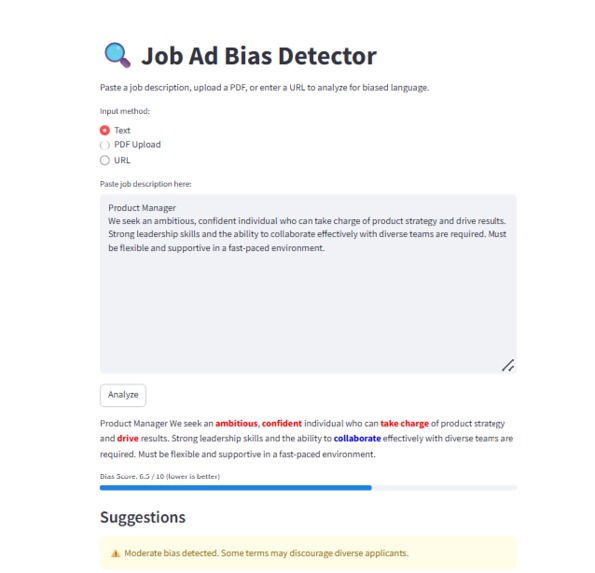
Testing Example via text
-
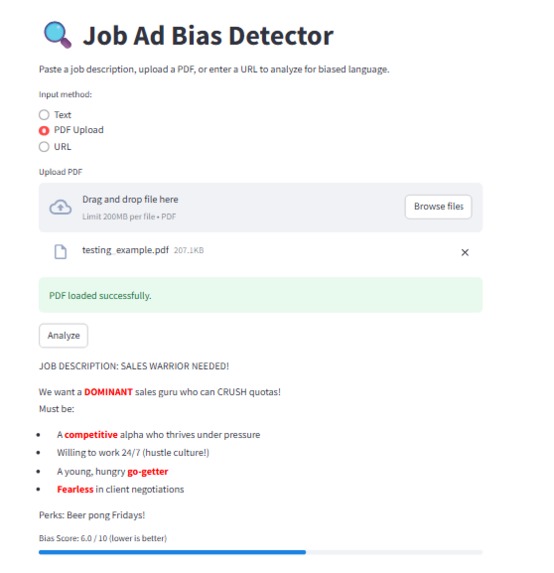
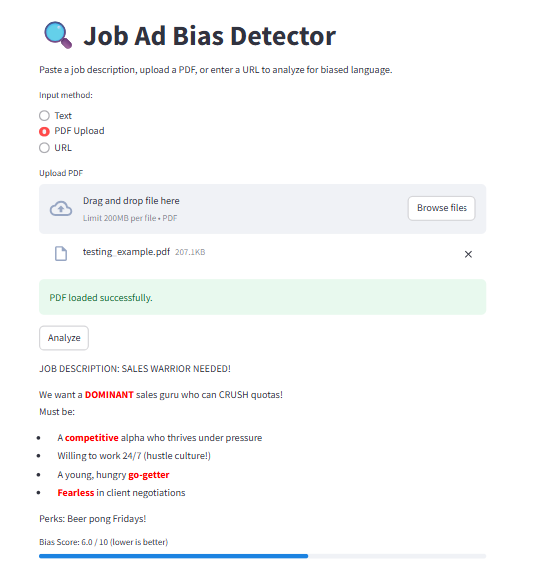
Testing Example via pdf
-
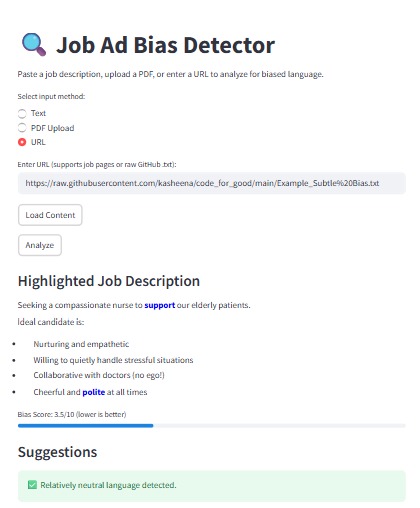
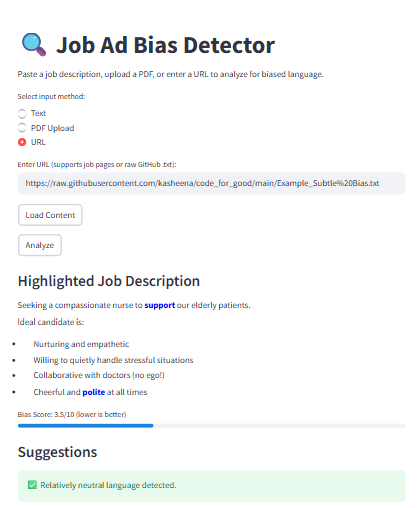
Testing Example via url
Inspiration
While reviewing hiring trends and job descriptions in the tech industry, I observed recurring patterns in how language was being used—often subtly—but with potentially significant implications on inclusivity. Inspired by a desire to build something practical yet socially conscious, I explored how the language of job postings can unintentionally shape candidate self-selection, particularly across gender lines.
A study titled “An Exploration of Gender Bias in Information Technology Job Advertisements” (2023, ResearchGate) empirically demonstrates that subtle gender-coded language continues to persist in modern job ads, which can affect how men and women perceive their suitability for roles. This insight sparked the idea to develop a tool that goes beyond surface-level keyword detection to actively assist recruiters and hiring managers in making their job descriptions more inclusive and welcoming to all.
What it does
Job Ad Bias Detector is a lightweight web app that analyzes job descriptions for gender-coded language and exclusionary phrasing. Users can input text manually, upload a PDF, or paste a URL. The tool then identifies gender-coded terms—masculine-coded, feminine-coded, and exclusionary phrases—highlighting them in real-time using intuitive color coding.
It also provides a bias score from 0 to 10 to quantify how inclusive the language is and suggests neutral alternatives. The aim is not to censor, but to inform and support language revision in a constructive way that increases the reach and equity of recruitment efforts.
How we built it
This application was developed using Python and Streamlit for a fast, responsive interface. Text content is parsed using PyPDF2 for PDFs and BeautifulSoup for HTML scraping. A curated list of gender-coded and exclusionary terms—sourced from academic research and modern job market studies—drives the analysis logic.
The script tokenizes text, compares it with word banks using regular expressions, and presents findings with color-coded highlights. The scoring algorithm weights each term based on its intensity and category, balancing precision and accessibility for non-technical users.
Challenges we ran into
One of the more nuanced challenges was avoiding over-flagging common words that may be context-dependent. For example, terms like “lead” or “supportive” can be gender-coded but are also widely used in neutral contexts. To address this, I refined the bias dictionary through trial, error, and contextual testing.
Also, ensuring smooth handling of different input formats (especially malformed PDFs or web pages with dynamic content) required creating fallback mechanisms for robust parsing.
Accomplishments that we're proud of
Creating a tool that raises awareness around inclusive hiring in a tangible, interactive way is something I'm genuinely proud of. It doesn’t just present data—it gives users a clear pathway to action. Despite being a solo developer, I was able to prototype, build, and refine a product with real-world relevance in just a few weeks.
What we learned
This project deepened my appreciation for sociotechnical design—the intersection where language, human behavior, and software tools converge. I also improved my ability to design user-centric interfaces and translate research insights into practical applications.
What's next for Job Ad Bias Detector
Next, I plan to implement contextual NLP models (like spaCy or transformer-based classifiers) to increase accuracy and reduce false positives. I also envision developing a Chrome extension that can analyze job boards in real-time, as well as plug-ins for HR platforms like Greenhouse or Lever to seamlessly integrate inclusive language checks into the hiring pipeline.
Ultimately, the goal is to create a smart, scalable, and empathetic assistant that supports fairer recruitment—one job post at a time.
Built With
- asyncio
- beautiful-soup
- bias-detection
- pdf-parsing
- python
- regex
- requests
- streamlit
- web-scraping

Log in or sign up for Devpost to join the conversation.