-
AR vision

Inspiration
There's no reason for home Wi-Fi access point upgrades to be as needlessly complex and unproductive as the current market has allowed them to be. The Internet is an amazing place, and network quality assessment should be a skill everyone can pick up as easily as reading, cooking, driving, or calculating the optimal elbow pressure that'll get you to the front of the Forbes Cafe snack crowd.
What it does
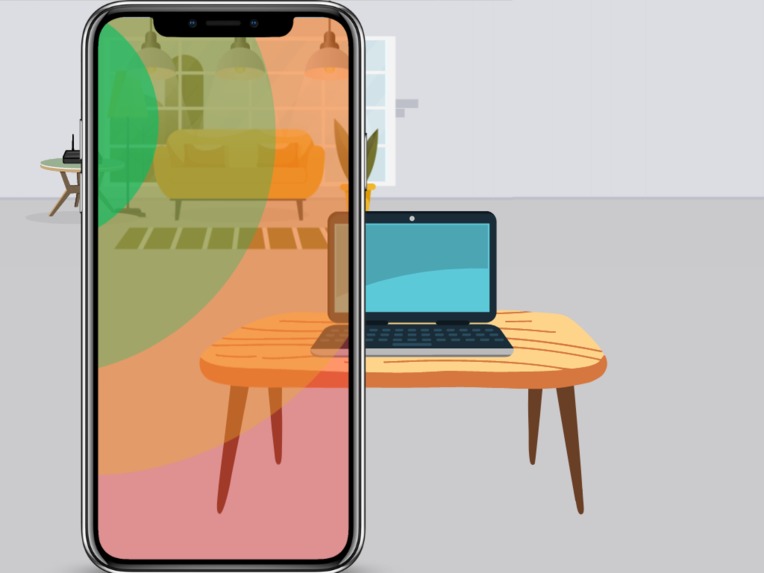
That's why we built Jive-Fi. Well maybe not for that last one. Jive-Fi is an augmented reality system for real-time Wi-Fi performance visualization. Our snappy mobile app pairs with a light-weight analytics service to peel back the surface and glimpse the radio-frequency reality propagating through your home.
Supporting access point coverage projection, application-specific quality monitoring, and more, Jive-Fi's intuitive AR monitoring system turns arduous network configuration tasks into a vibrant, interactive exploration of just how much you can do with a simple wireless network.
How we built it
Jive-Fi is built on React-native, with live updating quality metrics supplied by a Reflex back-end API. Complete with an illustrative Call Quality Simulator running on a local-first Ubiquiti Mesh AP, Jive-Fi's open source will soon be available to support the development community everywhere - including the 2.6 billion people on the planet without a reliable Internet connection - or any Internet at all, who are inventing the future of a truly global Internet through offline-first community networks.
Challenges we ran into
React-native
We learned React-native from scratch, and we were able to use it to run our AR from our phones using the ViroReact framework. However, we did not have enough time to incorporate the wifi coverage lines.
Python
We successfully implemented Python through the reflex platform, whose representatives helped us set it up.
Javascript
We used JavaScript alongside react native in the machine learning algorithm as it used Tensorflow.js. We learned it and transformed it into react native components.
Teachable- Machine
One of the challenges we ran into was using a machine-learning algorithm to detect our devices using a set of stickers and then being able to track them and follow them around. At first, the model only had two categories, which resulted in a false classification of objects that did not fit into either category of stickers. In response to this, we created another class for random objects and images that did not contain either of the stickers and hence avoided overfitting tendencies. This helped us avoid overfitting tendencies and optimize our machine-learning algorithm, minimizing errors in recognizing devices. We thought we would have to train a machine learning model to recognize specific images, but we ended up finding a simpler way to recognize images using the ViroReact frameworks.
Typescript
Accomplishments that we're proud of
We take immense pride in our ability to conceptualize and execute a project that has the potential to make a tangible impact. Our successful integration of various technologies to create a unified, functional prototype within the limited timeframe of a hackathon is a testament to our team's resilience, adaptability, and collaborative spirit. We learned about the inner workings of networks and how they can be visualized to assist a proper configuration and hence troubleshooting, which could reduce the time and resources needed to "DIY", making internet available for more people.
What we learned
Through Jive-Fi, we learned not only about the complexities of network configuration and AR development but also about the power of teamwork in the face of daunting challenges. Each team member brought distinct skills and perspectives, enabling us to learn from each other and grow collectively. We also learned to use Linux, Bash, Reflex, and Ubiquiti complex programs that we got familiar with quickly to ensure proper implementation of Jive-Fi.
What's next for Jive-Fi
As we look to the future, our vision for Jive-Fi is its expansion and refinement. We aim to fully implement the predictive wifi coverage lines, enhance the user interface, and optimize the machine learning algorithm. Our ultimate goal is to see Jive-Fi deployed in communities where it can serve as a catalyst for change, narrowing the digital divide one network at a time.
Built With
- bash
- javascript
- linux
- python
- react-native
- reflex
- teachable-machine
- typescript
- ubiquiti

Log in or sign up for Devpost to join the conversation.