-
-
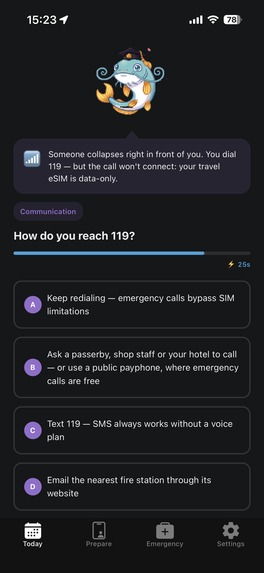
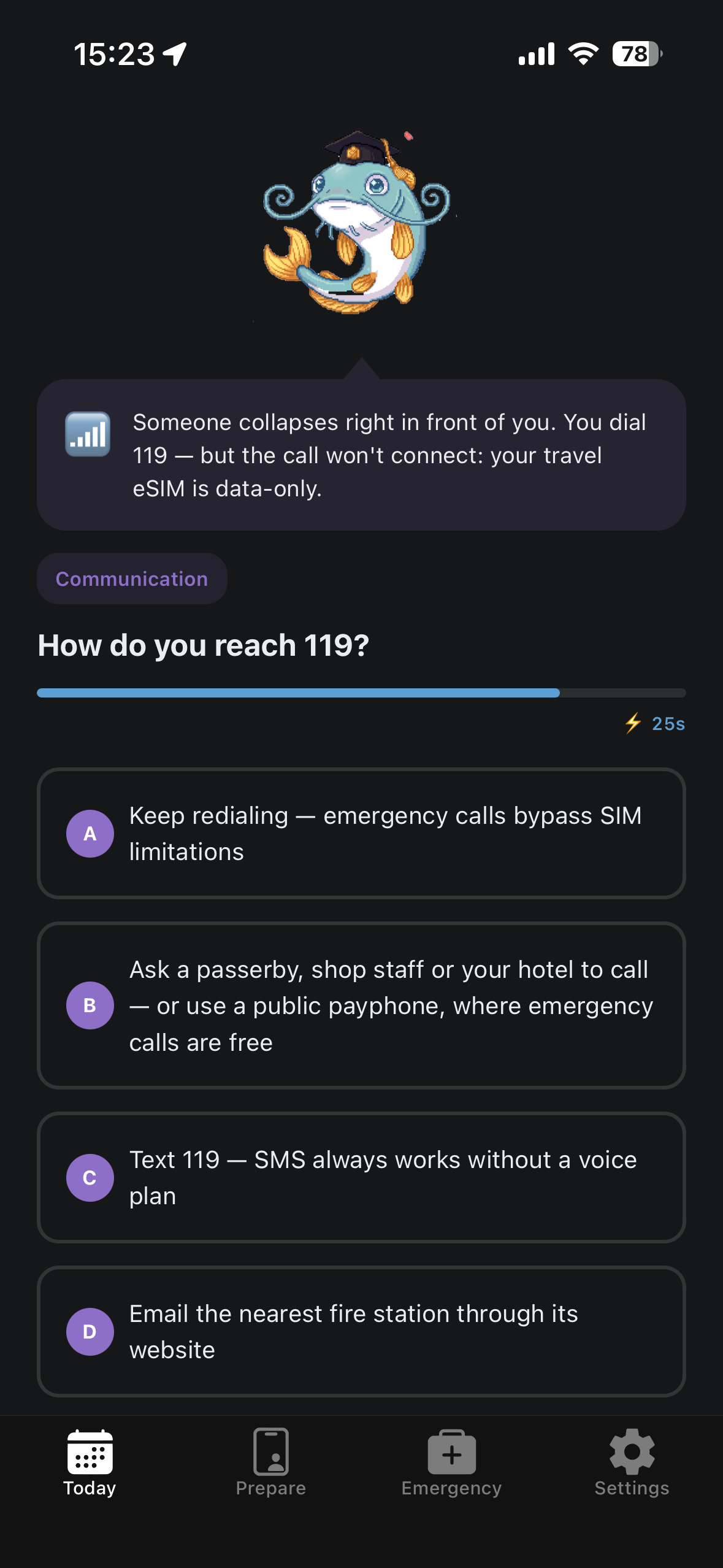
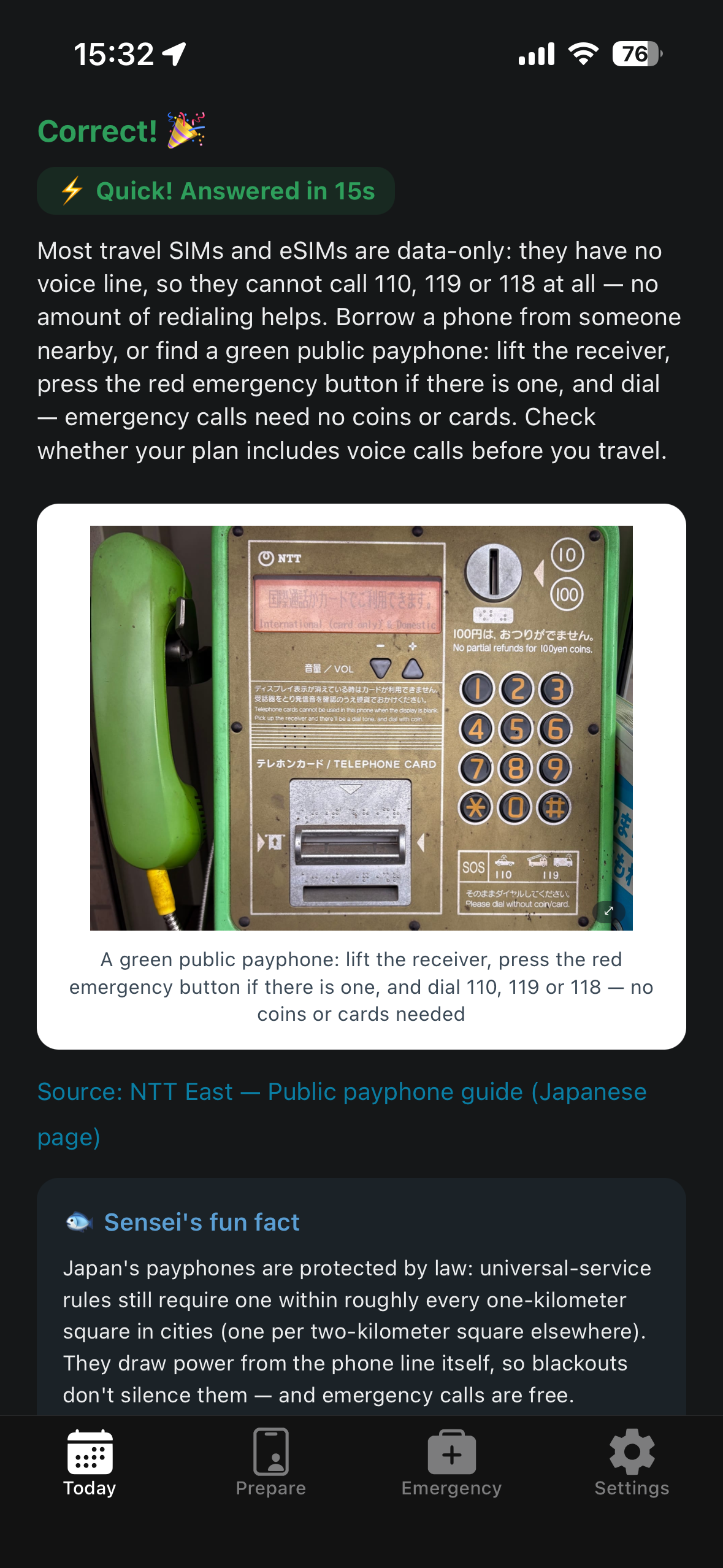
One real-life scenario a day, from a deck of 68. Here: your travel eSIM is data-only — how do you reach 119?
-
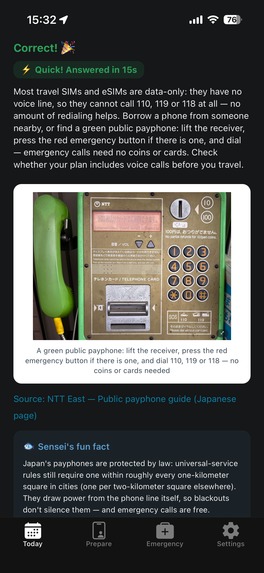
Every answer explains itself and links to the official source — here NTT East — with a photo where one helps and the sensei's fun fact.
-
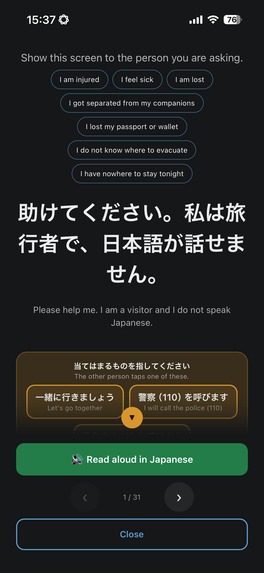
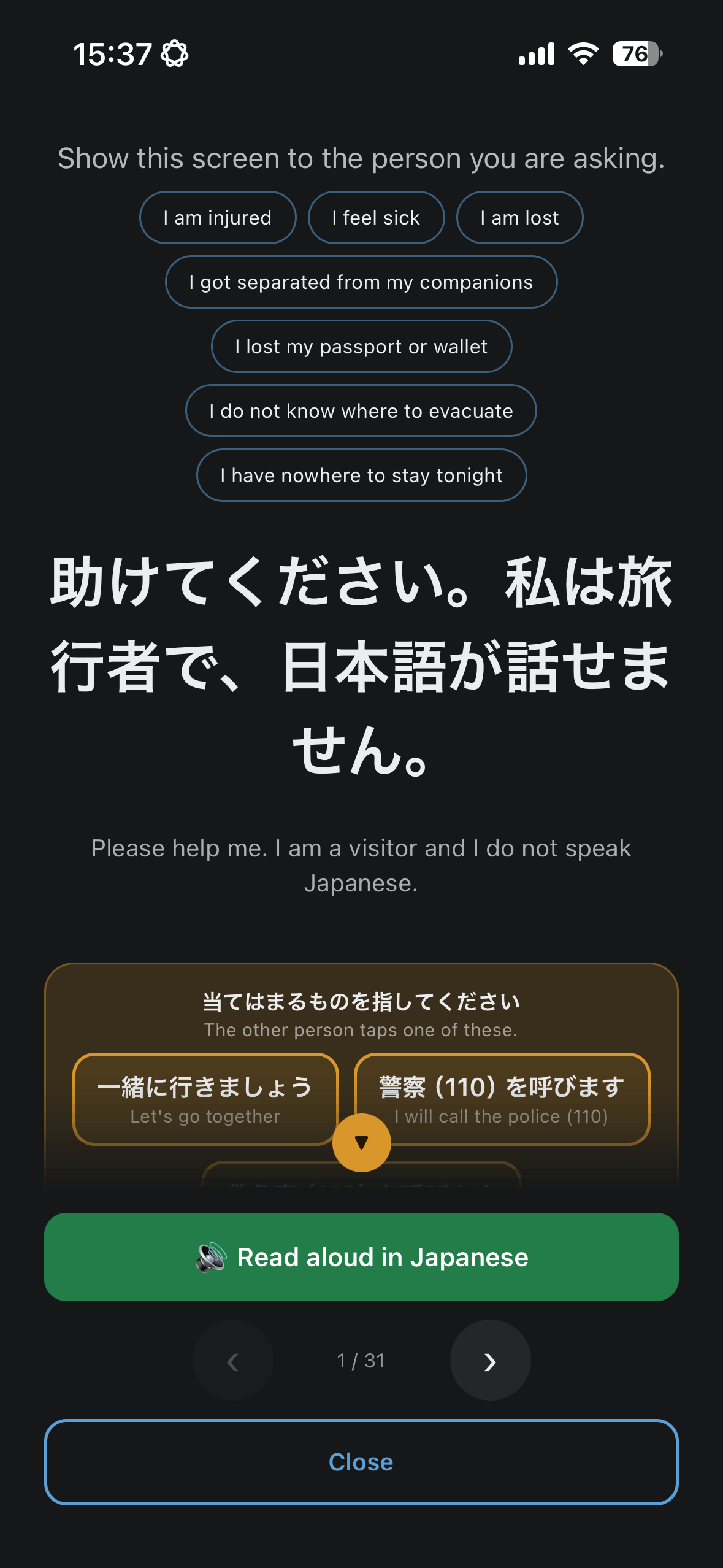
Communication cards in large Japanese. Pick what happened in your own language and the card writes the Japanese; a tap reads it aloud.
-
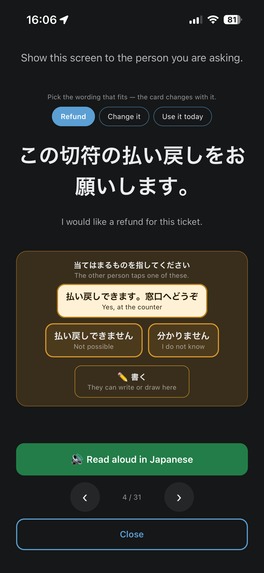
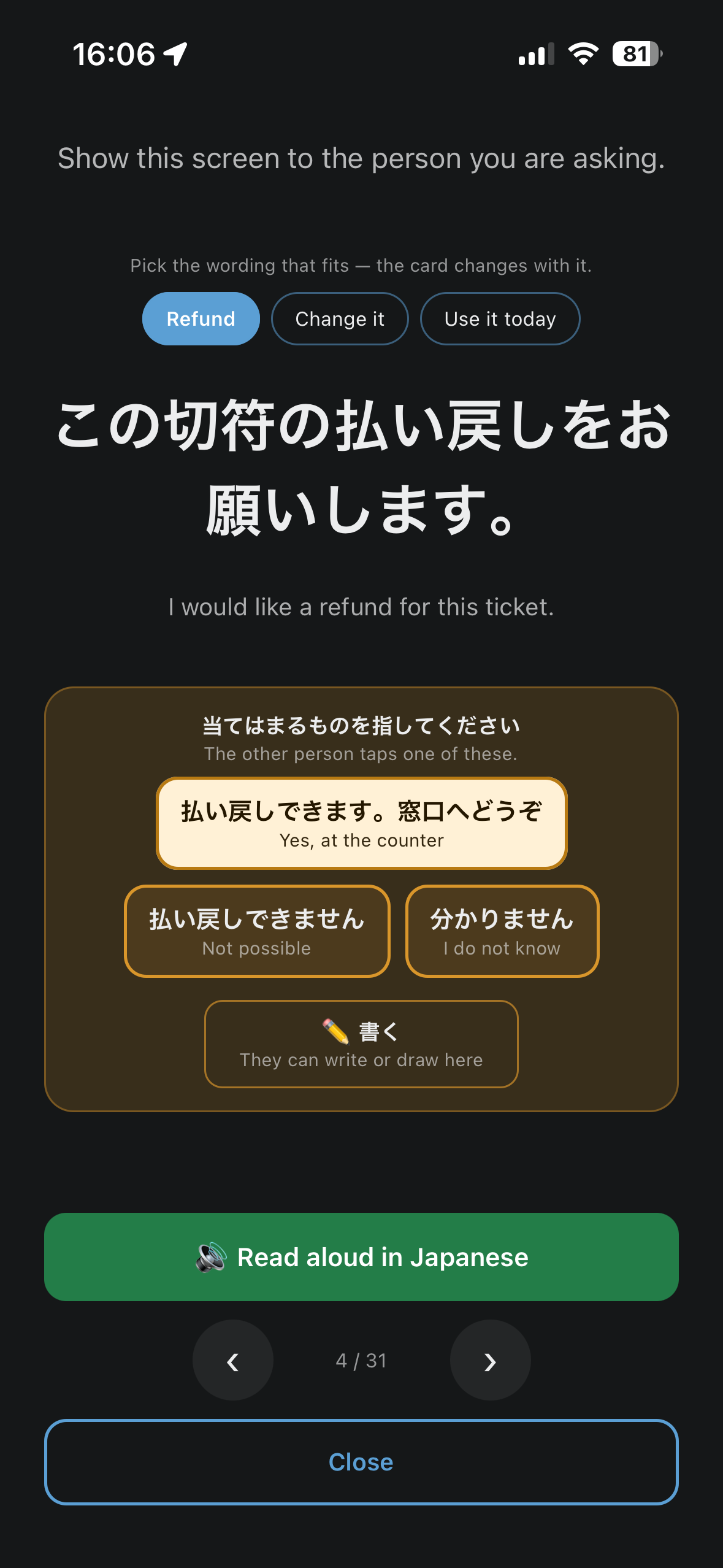
Refund, change, or use it today? Pick the wording and the Japanese follows. The other person answers on the board, in your language too.
-
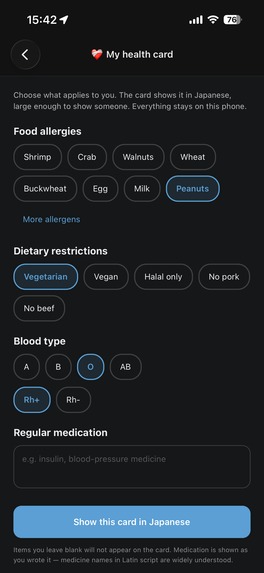
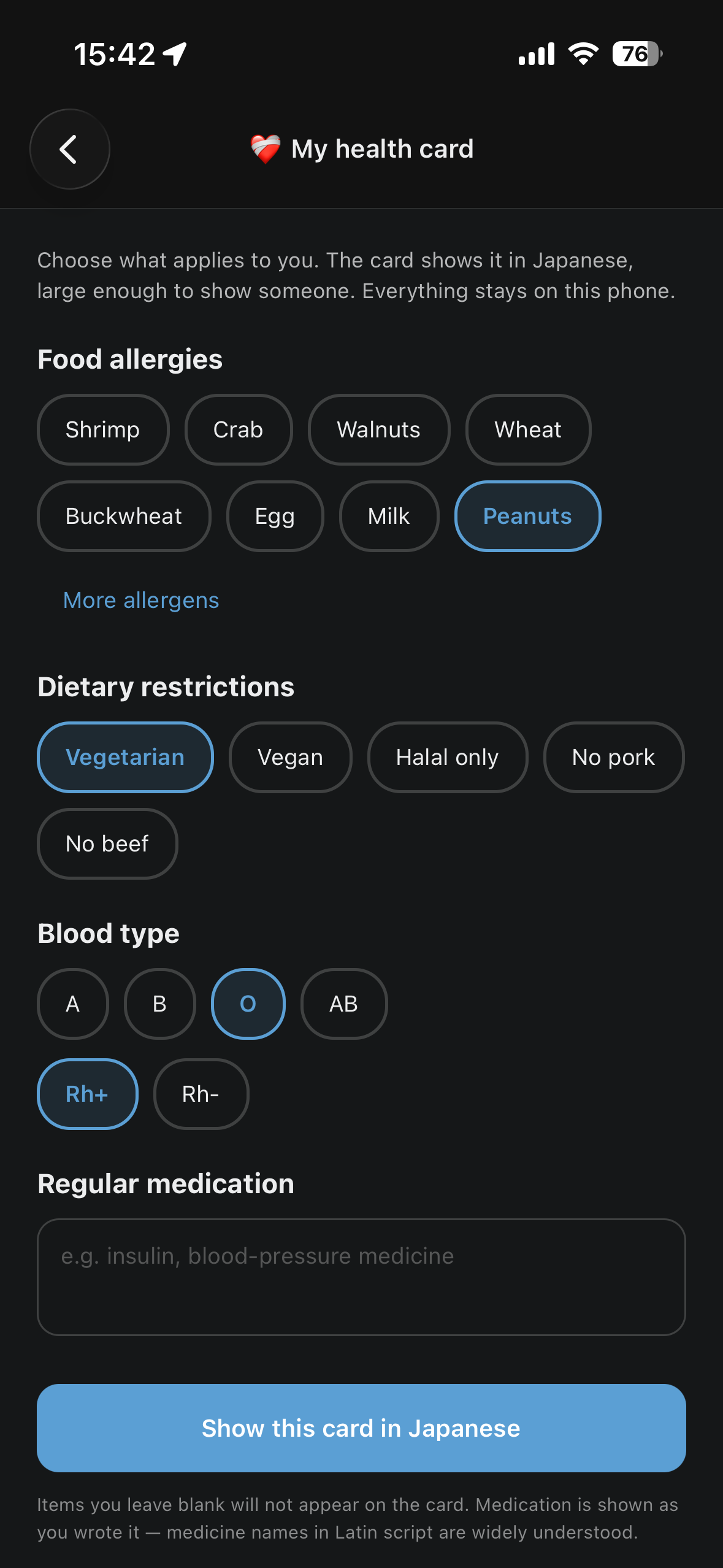
My health card — allergies, diet, blood type, medication — in Japanese, kept in the iOS Keychain, saved as a lock-screen image.
-
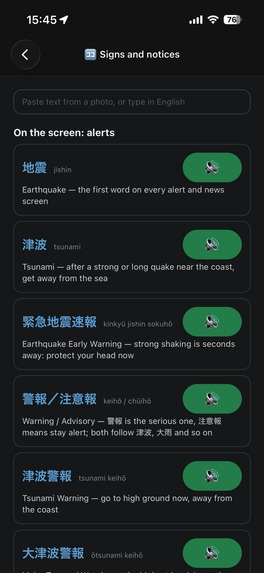
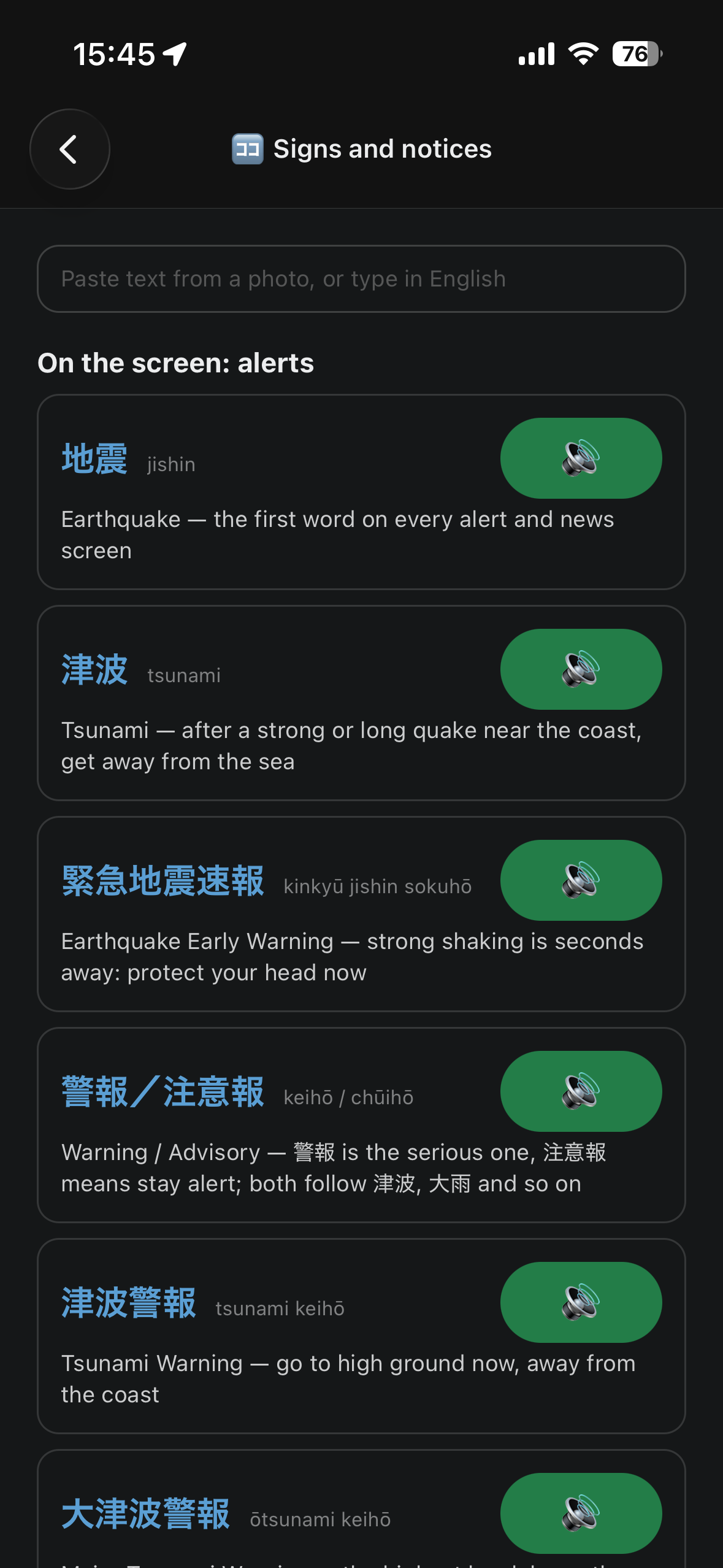
Signs and notices — the Japanese on walls and screens after a disaster: 39 words in five languages. Paste text from a photo to look it up.
-
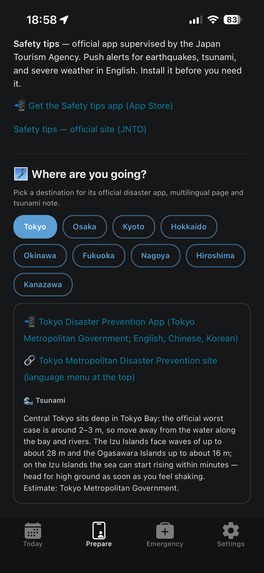
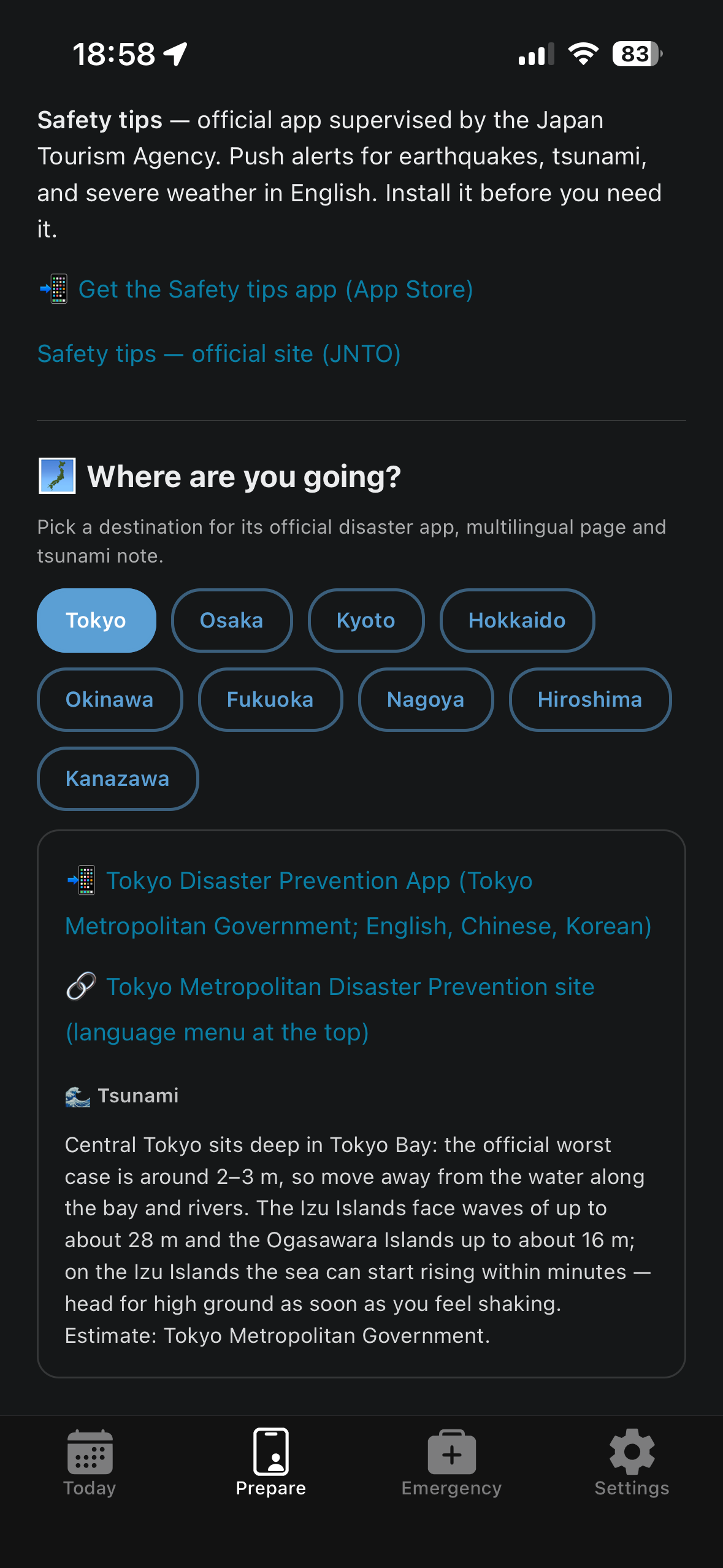
Destinations — nine areas: the official disaster app where there is one, a multilingual site and a tsunami note from official estimates.
-
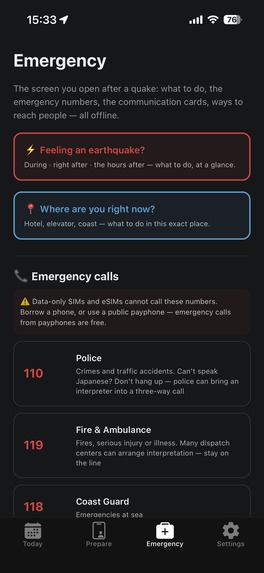
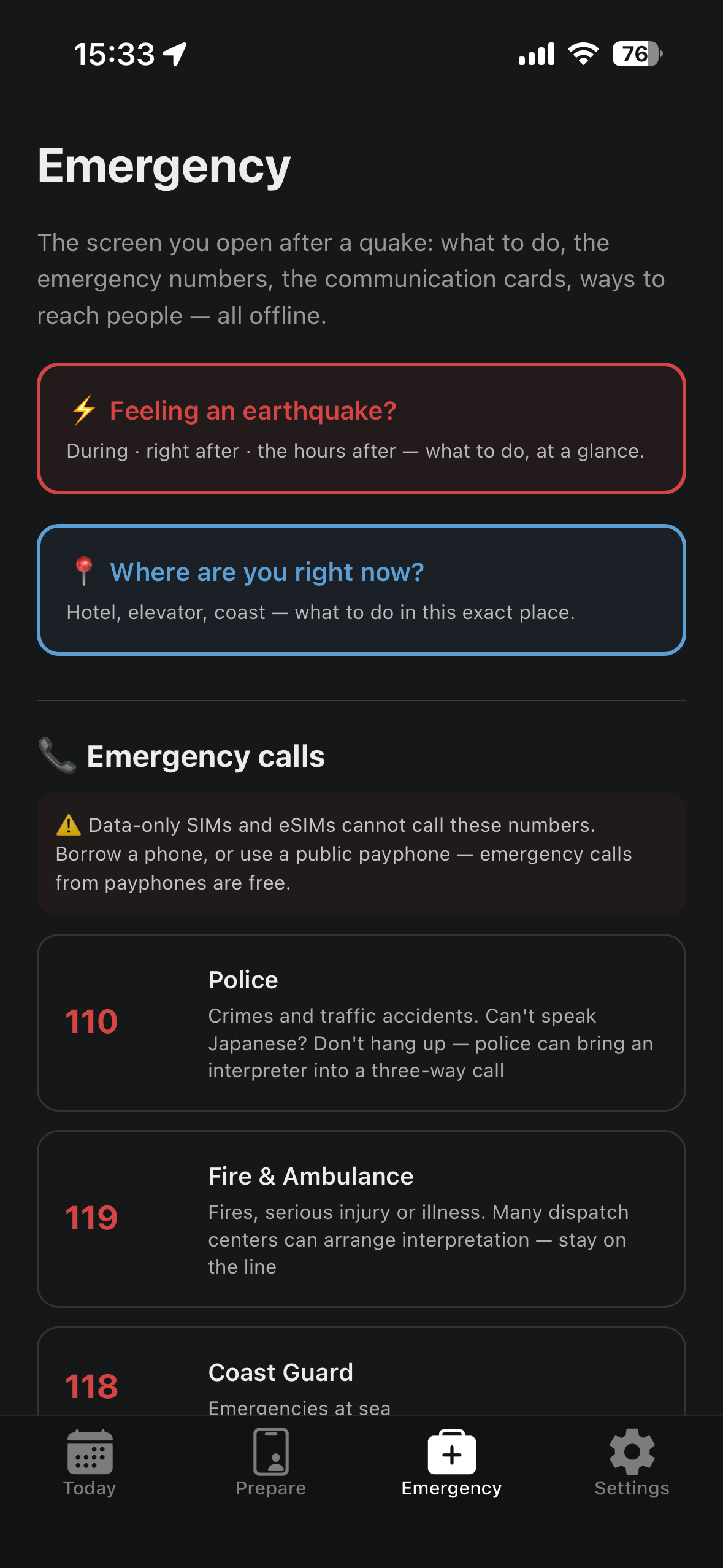
Emergency tab — what to do while it shakes, sorted by where you are, and Japan's emergency numbers. This tab makes no network calls.
-
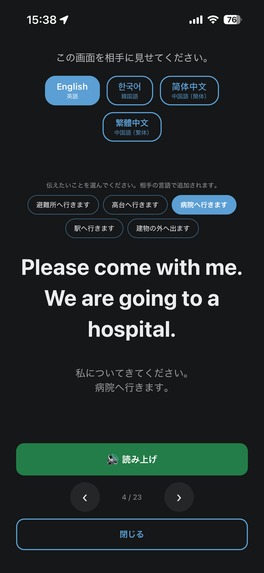
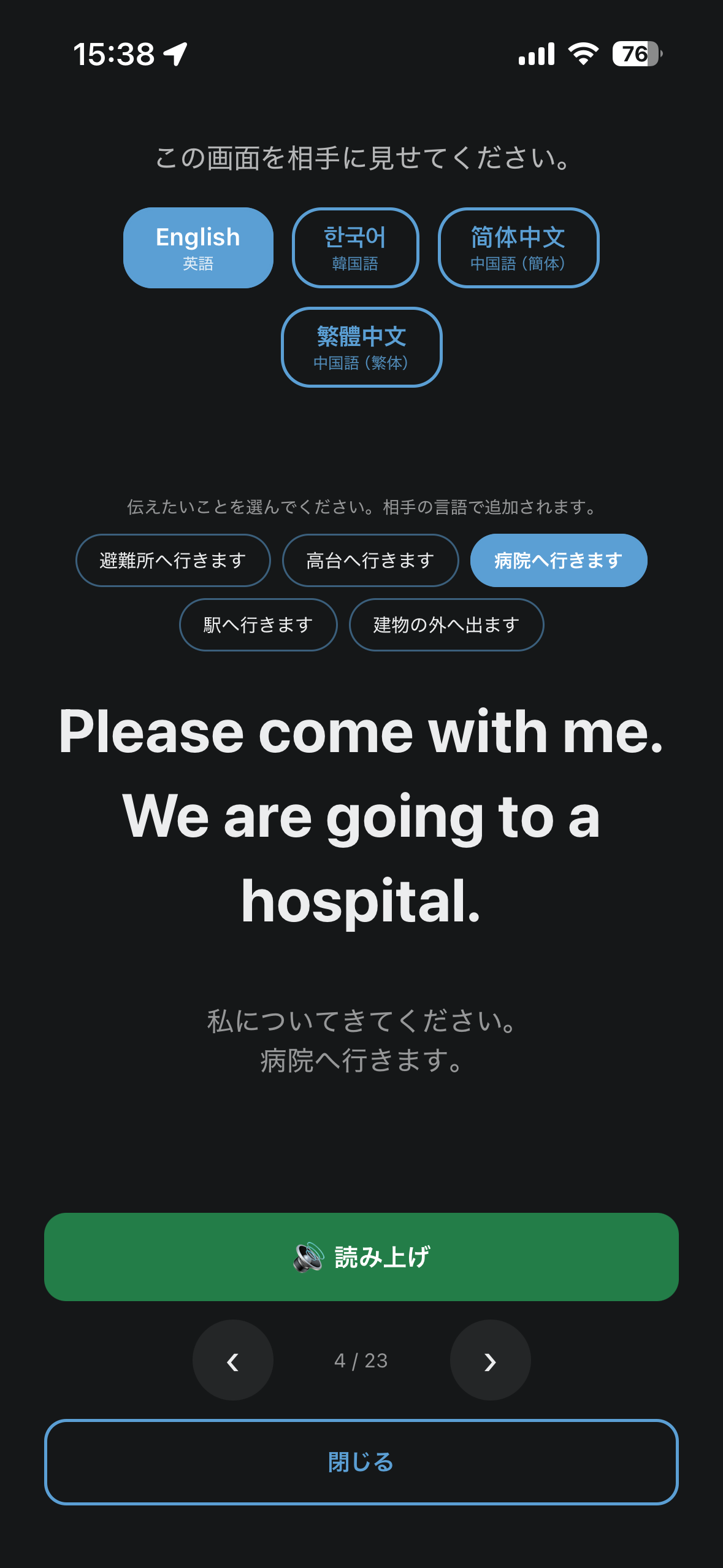
In Japanese, the cards turn around to help a visitor: shown in their language, read aloud at a tap. Nothing needed on their phone.
-

Jishin Sensei app icon (1024 × 1024)

Inspiration
People came to Japan in record numbers last year — for the food, the temples, the cherry blossoms, the trains that run on time. Japan is also one of the most earthquake-prone countries on earth. As far as I know, nobody has ever come for that. The ground, unfortunately, does not check what you came for.
If you grow up here, you are drilled from childhood — under the desk, cover your head, stay put until the shaking stops — until it is reflex, not knowledge. Many visitors never had that drill.
On July 28, 2026, a magnitude 7.1 earthquake struck Kumamoto. What stayed with me from the news that evening: somewhere in that footage there had to be visitors from abroad — frightened, with no information, unable to make themselves understood.
Shipaton opened four days later. Motivation from a news broadcast has a half-life; the only defense I know is to ship before it decays.
So: something for before the shaking, something for after. And for a teacher, I hired the giant catfish that Japanese folklore blames for earthquakes. It seemed only fair.
What it does: one night, told twice
Knowing what to do is one problem. Being understood is another. Picture the night that has both.
A Tokyo hotel room, ninth floor, after midnight, and the bed begins to move. If you have been playing along, you have been in this room before: it is one of the 68 scenarios in Today — one a day, thirty seconds, with the answer, the reason, and a link to the official source. So you are under the desk with your head covered, not in the elevator. (The whole deck is underneath: Study Mode, a timed Challenge, and a Certificate of Completion, signed by a catfish.)
Then the shaking stops. Emergency is for what comes next, aftershocks included: what to do while it shakes, in the first ten minutes and in the hours after — shoes on before the broken glass, the stairs and not the elevator, leave the luggage. It also sorts the same advice by where you are, and lists the emergency numbers. This tab makes no network calls; tonight there may be no network to call.
Downstairs, the second problem starts: the lobby is full and the announcement was in Japanese. Open Prepare, tap what you need to ask in your own language — "Is this building safe? Should we evacuate outside?" — and the card writes it in large Japanese and, at a tap, reads it aloud. Under it is a board of replies the clerk can point to: "It is safe. Please stay here", "Do not use the elevator" — each tile in Japanese and in your language, so you both read the same answer. Thirty-one cards; nearly every one has its board.
By the elevator, a sheet of paper says 断水; the app's dictionary of 39 words you may see on walls and screens after a disaster says: the water is off. And if tonight had gone worse — your phone in someone else's hands, and locked — your health card is on the lock screen where you put it, in Japanese: allergies, blood type, medication.
Now picture it again — this time, you have never heard of this app. The clerk has. Their iPhone is in Japanese, and in Japanese the cards turn around: the Prepare tab becomes サポート (Support), and its 27 cards are for helping a visitor. One tap — この建物は安全です… — and you read, large, in your language: "This building is safe. Please stay inside. Don't rush outside." Another tap, and the phone says it aloud. You point to "I understand" on their screen. You needed nothing on yours.
Who it helps, and why it is realistic
Impact. In 2025, Japan had 4,456 earthquakes you could feel — and 42.7 million visitors, many of whom have never felt one. The app is built for those with the least information at the worst moment: visitors and new residents who cannot read Japanese. Korean, Simplified and Traditional Chinese cover South Korea, China, Taiwan and Hong Kong — about 65% of all arrivals — and English much of the rest. After an earlier Kumamoto earthquake, in 2016, Survey Research Center asked 34 visitors from abroad who had been in the area: 44% said their hotel gave no evacuation guidance, and 12% got it in Japanese they could not follow. Half named hotel staff as a source of helpful information, more than any other. The lobby card above draws on that survey.
Feasibility. It is a small app by one person. It reached the App Store on August 18 — three weeks after the news, ten days after the first commit — and, nine releases later, has five languages, every question sourced, and no server to fall over. And because the cards turn around in Japanese, only one side needs the app: a front desk or a shelter volunteer can help a visitor who has never heard of it.
What you pay for: nothing
The rule from the start: nothing you might need in an emergency sits behind a purchase. Through 1.0.5 there was still a small paid unlock for the study extras. Nobody had bought it, which made the next question easier: what did I actually want? Not revenue: as many people as possible carrying this knowledge into Japan. A price, however small, is a reason not to. So in 1.0.6 I removed it. Everything is free, for everyone.
What replaced it is a tip jar: three consumables that unlock nothing — a reward for the catfish. RevenueCat got more interesting, not less: the tip is offered in five places, each its own offering with the same three products, so the dashboard can show not just how many people tipped but which moment earned it.
What is true, and how it is built
Writing safety content turned out to be mostly deleting. Each of the 68 questions cites an official source — mostly JMA, JNTO and the Tokyo Metropolitan Government — and anything I could not trace to one came out. The rule caught me too. When heavy rain hit Chiba on August 14, I found one of my own questions teaching that underground spaces are relatively safe in an earthquake — true, and exactly the instinct that kills people in a flood — and wrote its counterpart. Every week, a script checks that each source in the English version still contains the lines its answer rests on.
Five languages, all checked against a single English reference — a missing line fails the type check or falls back to English, never to a blank. Terminology follows JMA's multilingual dictionary, and the Korean and Chinese versions were each reviewed line by line against the English by a different AI (Gemini) from the one that built the app. That catches lines that are wrong or missing, not whether the text reads like a native speaker's; no native speaker has checked them yet.
No server of my own, no account, no analytics or ad SDKs. AI wrote all the code, drafted the questions, drew the catfish, and carried me through App Store review, the screenshots and the video; I supplied the judgment, and hired the catfish — all from a Windows PC with no Mac. More than a hundred over-the-air updates: a polite way of saying I kept finding things to fix. The first version was rough; most of what is good came in the updates since.
The technical part was not hard, and that is the point. What was hard was judgment: what is true, what to charge (nothing), and what the person in that lobby actually needs.
What's next
I do not yet know whether this helps the person it was built for. No new feature will tell me. Finding out has begun: since September 14 I have introduced it to more than 180 organizations, from hotels and international associations to volunteer guides and schools. One city's international association agreed to put up the poster; four public bodies declined, most because it is a personal app. Most have not replied yet. Next: sit down with the staff and travelers who try it, learn what they opened and what they ignored, and improve from there. Android comes after.
For judges
- Categories: RevenueCat Peace Prize and RevenueCat Design Award.
- App Store: https://apps.apple.com/app/id6799572857 — 1.0.10 is live on iPhone and iPad.
- Nothing to unlock, so there is no promo code.
- Try it offline: turn on airplane mode, and turn off silent mode to hear the voice. Prepare → Communication cards → "Please help me…" → tap "I am injured" → Read aloud in Japanese, then scroll down to the answer board. Then Emergency → "Feeling an earthquake?".
- Then switch sides: Settings → Language → 日本語. The Prepare tab is now サポート (Support): open 🗣 コミュニケーションカード → 私についてきてください。 (Please come with me, under 誘導する) → tap 避難所へ行きます (We are going to the shelter) → 🔊 読み上げ, then scroll down to the board the visitor answers on. Switch back under 設定 → 言語 → English.
Built With
- async-storage
- expo-router
- expo-secure-store
- expo-speech
- expo-updates
- expo.io
- github-actions
- ios
- react
- react-native
- reanimated
- revenuecat
- typescript
