-
-
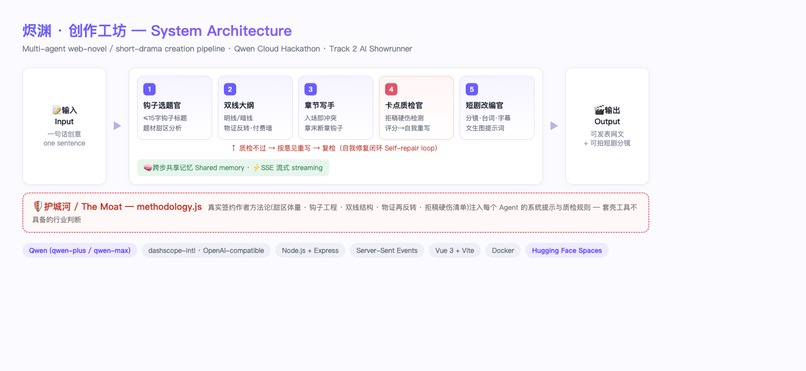
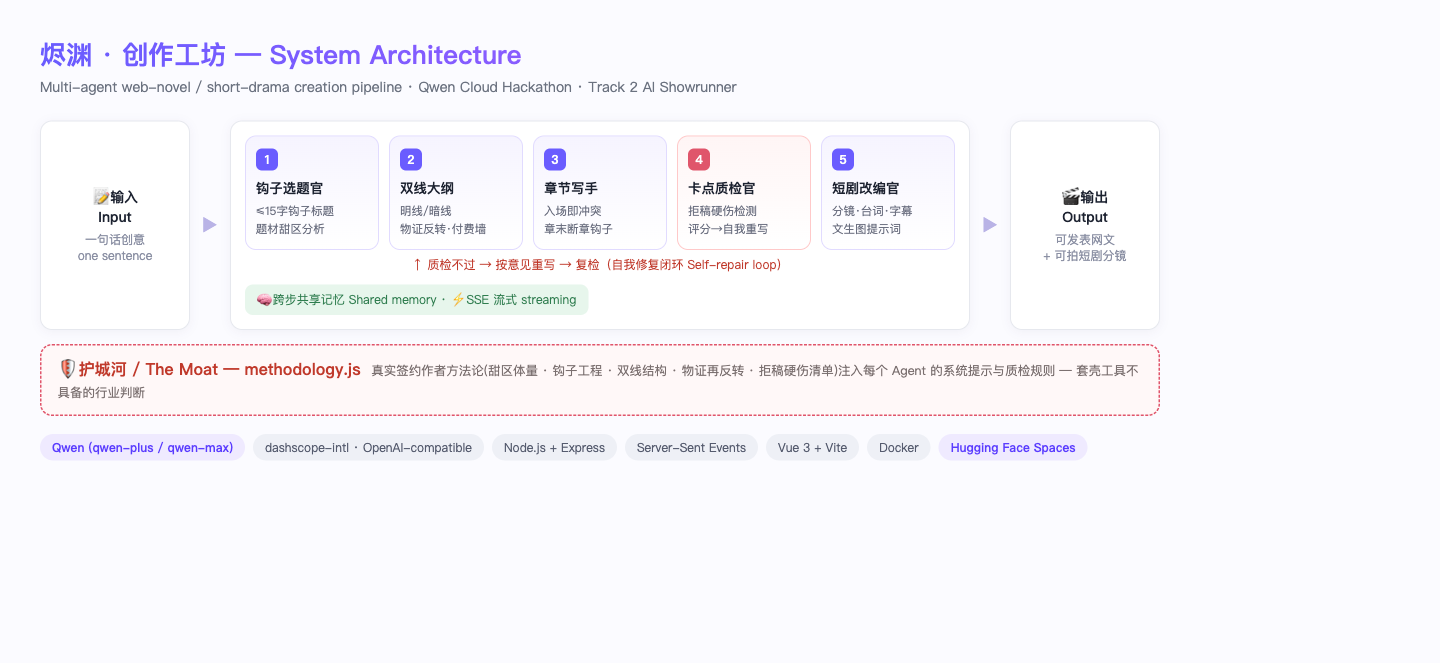
架构图
-
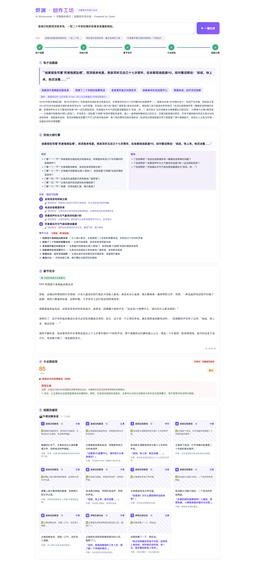
成品效果截图
-

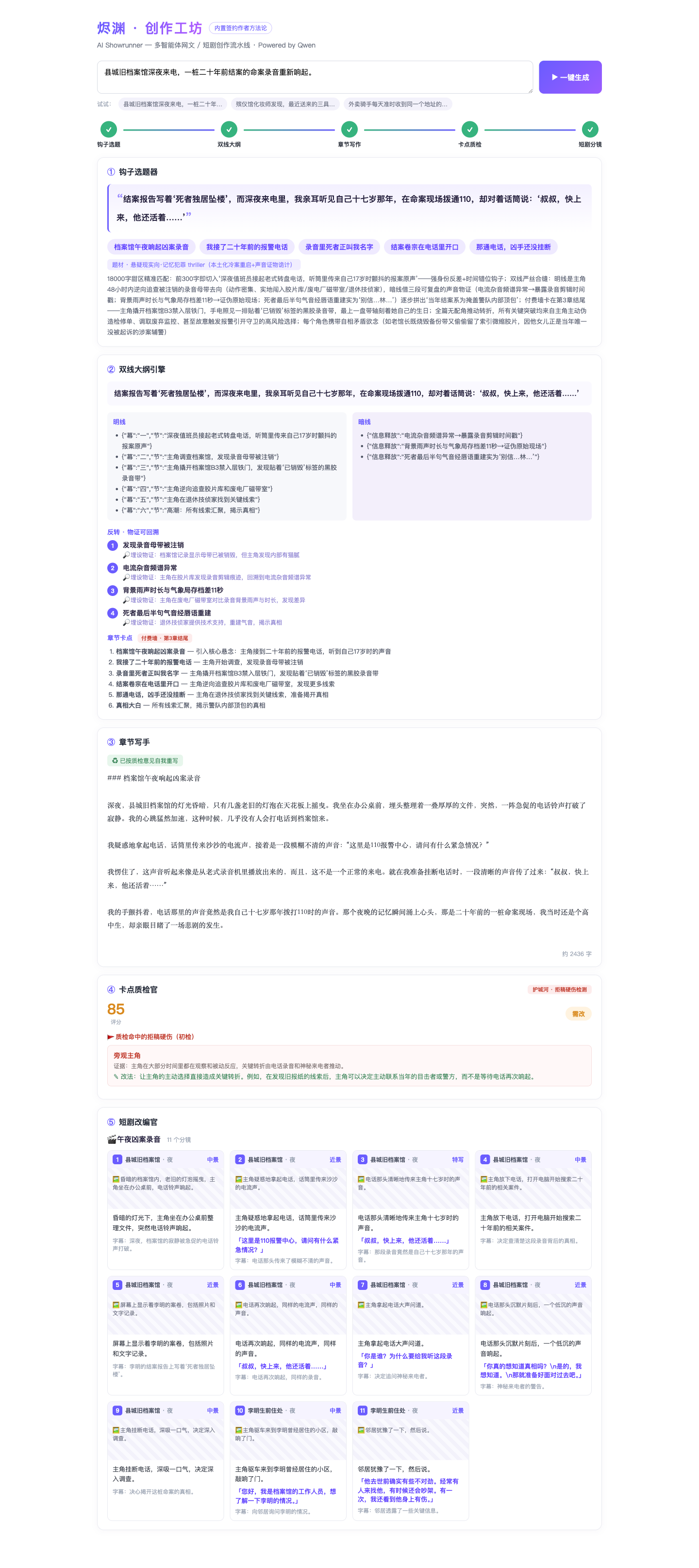
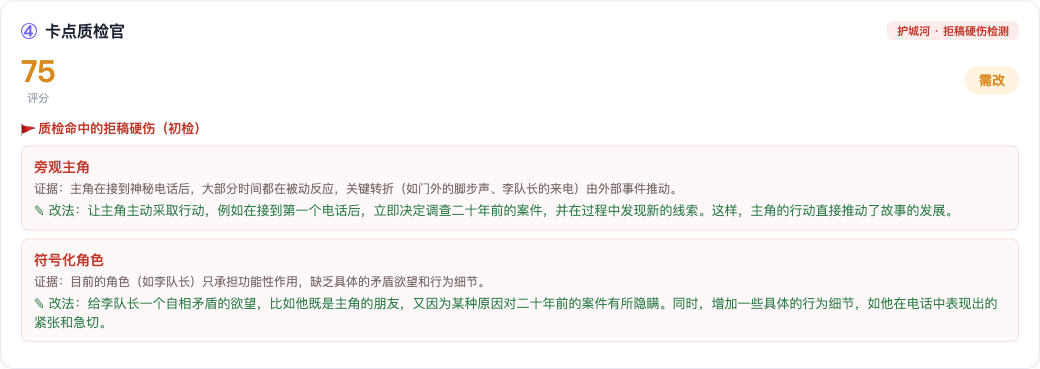
质检算分截图
Inspiration
China's web-novel and micro-drama industry runs on speed, but most "AI writing" tools are thin LLM wrappers that produce generic prose an editor would reject on sight. I'm in a rare position: I'm a contracted web-novel author and a full-stack engineer. So instead of building another wrapper, I encoded the actual commercial craft that gets stories signed — hook engineering, dual-line structure, evidence-locked reversals, and the specific "rejection traps" editors kill manuscripts for — directly into a team of cooperating agents.
## What it does From a single sentence, a pipeline of five specialized Qwen-powered agents collaborates to produce a complete creative package:
- Hook Strategist — ≤15-character clickable titles + genre / commercial sweet-spot analysis
- Dual-Line Outliner — main + hidden storylines, evidence-locked reversals, and paywall cliffhanger placement
- Chapter Writer — full chapter prose with an "enter-in-motion" opening and an end-of-chapter hook
- QC Editor (the moat) — audits the draft against a real rejection-trap checklist (passive protagonist, dissolved climax, symbolic characters, weak healing, missing end-hook, under-length). The
agent only detects each trap and its severity; the score is computed in code from fixed per-trap weights (e.g.
100 − passive-protagonist(severe −15) − symbolic-character(mid −7) = 78), so it's transparent and reproducible rather than a black-box number. A failing score triggers a targeted self-rewrite, and the recheck shows the improved score and which traps were resolved. - Short-Drama Adapter — converts the chapter into a vertical micro-drama storyboard: scene / shot / dialogue / caption + an image-generation prompt per shot.
- Casting & Video Director (multimodal) — auto-extracts the recurring characters from the story and generates a consistent reference portrait ("casting shot") for each, then produces a real vertical video clip per shot: it places the same characters into each new scene via reference-guided image editing (Wan2.7-image-pro) and animates that keyframe into video (Wan image-to-video). A project-level casting library keeps identity locked across shots and across chapters. One click auto-produces the whole episode, and ffmpeg assembles the clips into a single subtitled vertical short drama — closing the loop from one sentence to a shootable video.
The user picks a genre (suspense / romance / fantasy / sci-fi / urban / history…) and a length (short / medium / long), which drives word-count sweet-spots, chapter count, and paywall placement. Beyond chapter one, a "continue writing" action drafts subsequent chapters with full continuity, and a "re-adapt from the full novel" action turns every written chapter into a complete multi-scene storyboard.
The agents share memory (world, characters, plot) for cross-step consistency, stream their work live, and the QC → rewrite → recheck loop is a visible self-repair.
## How I built it
- Models: Qwen (
qwen-plus/qwen-max) via the OpenAI-compatibledashscope-intlendpoint - Orchestration: a Node/Express server running the agent pipeline with shared memory, a self-repair loop, and Server-Sent Events streaming
- The moat: a structured methodology rule-base (
server/src/agents/methodology.js) authored from real signing experience, injected into every agent's system prompt and into the QC scoring rubric - Frontend: Vue 3 + Vite — a pipeline-stepper UI with structured cards (hook chips, reversal-evidence outline, a score ring with initial-vs-recheck comparison, and a storyboard grid)
- Deploy: Express serves the built frontend as a single service, containerized with Docker, running on Hugging Face Spaces with the Qwen API key stored as an encrypted Secret
## Challenges I ran into
- The QC editor first anchored at "safe" scores; I added an explicit scoring rubric and a fair recheck pass so genuine fixes actually raise the score.
- Cloud account/region friction (mainland phone vs. international console) — resolved by deploying on Hugging Face Spaces with the Qwen API, which the rules allow.
- Keeping the API key secret while still shipping a public live link — solved with a thin backend plus platform secrets.
## Accomplishments that I'm proud of A solo build where the agents don't just write — they critique like a signed editor and fix their own work, catching real rejection traps (e.g. "passive protagonist") with textual evidence and a concrete fix. That domain depth is the unfair advantage a generic wrapper can't copy.
## What I learned Encoding tacit professional craft into explicit, machine-usable rules is where the real value sits — the orchestration and UI are means to surface that judgment. A small, well-prompted multi-agent loop with self-critique beats a single big prompt.
## What's next
- Wire each per-shot image prompt to a Qwen vision/video model for end-to-end short-video output
- Long-form series memory for multi-chapter continuity
- A B2B mode for short-drama studios and a creator subscription
Built With
- dashscope
- docker
- express.js
- node.js
- qwen
- vite
- vue.js
- wan


Log in or sign up for Devpost to join the conversation.