-
-
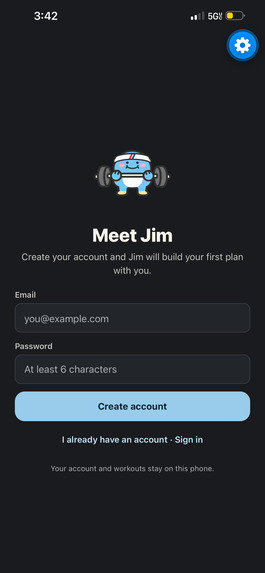
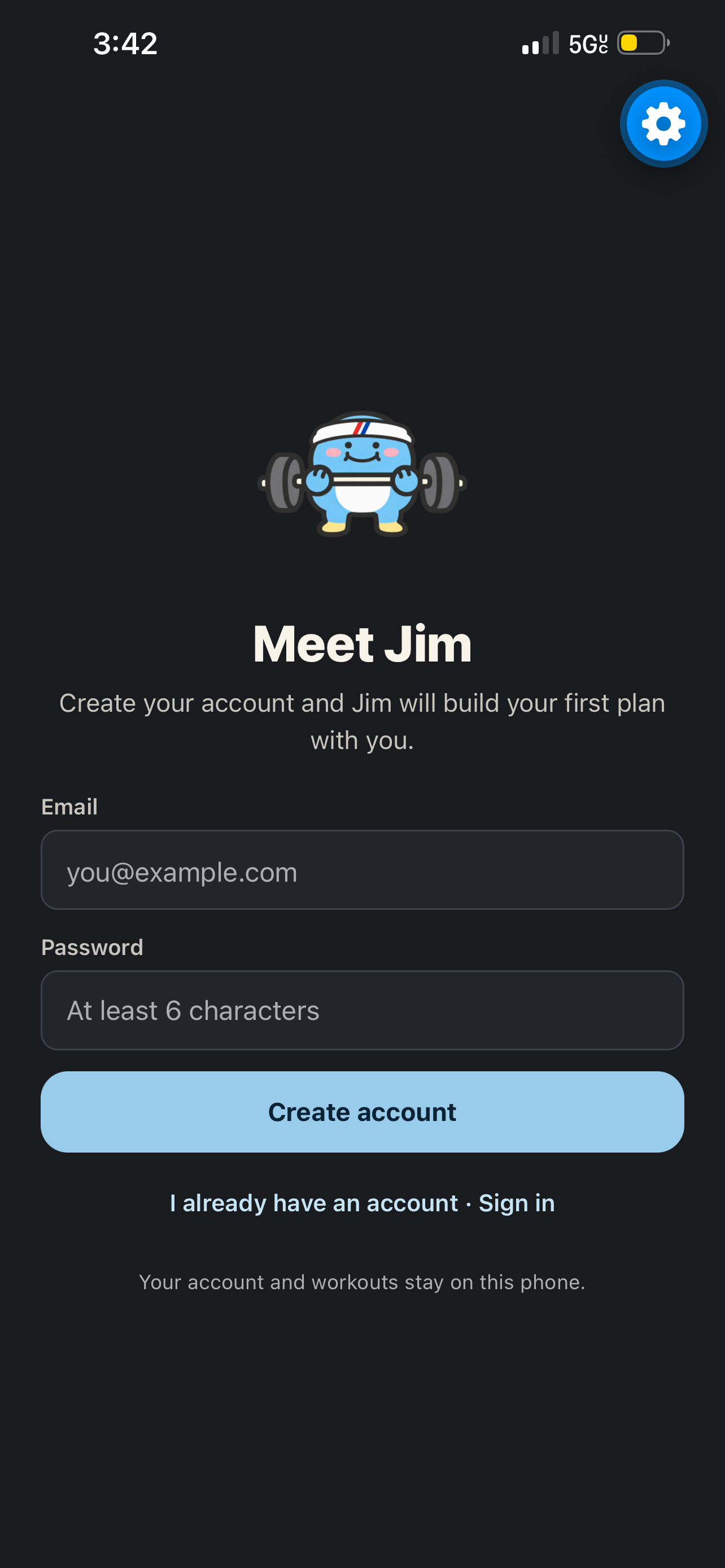
Sign-in/up for your JimBro account.
-
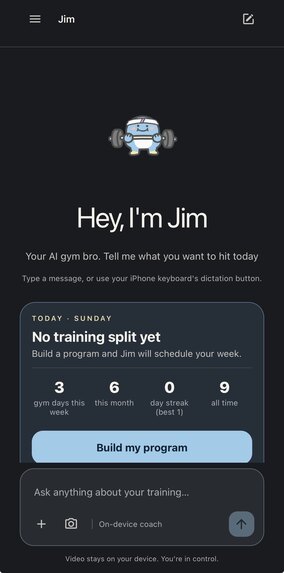
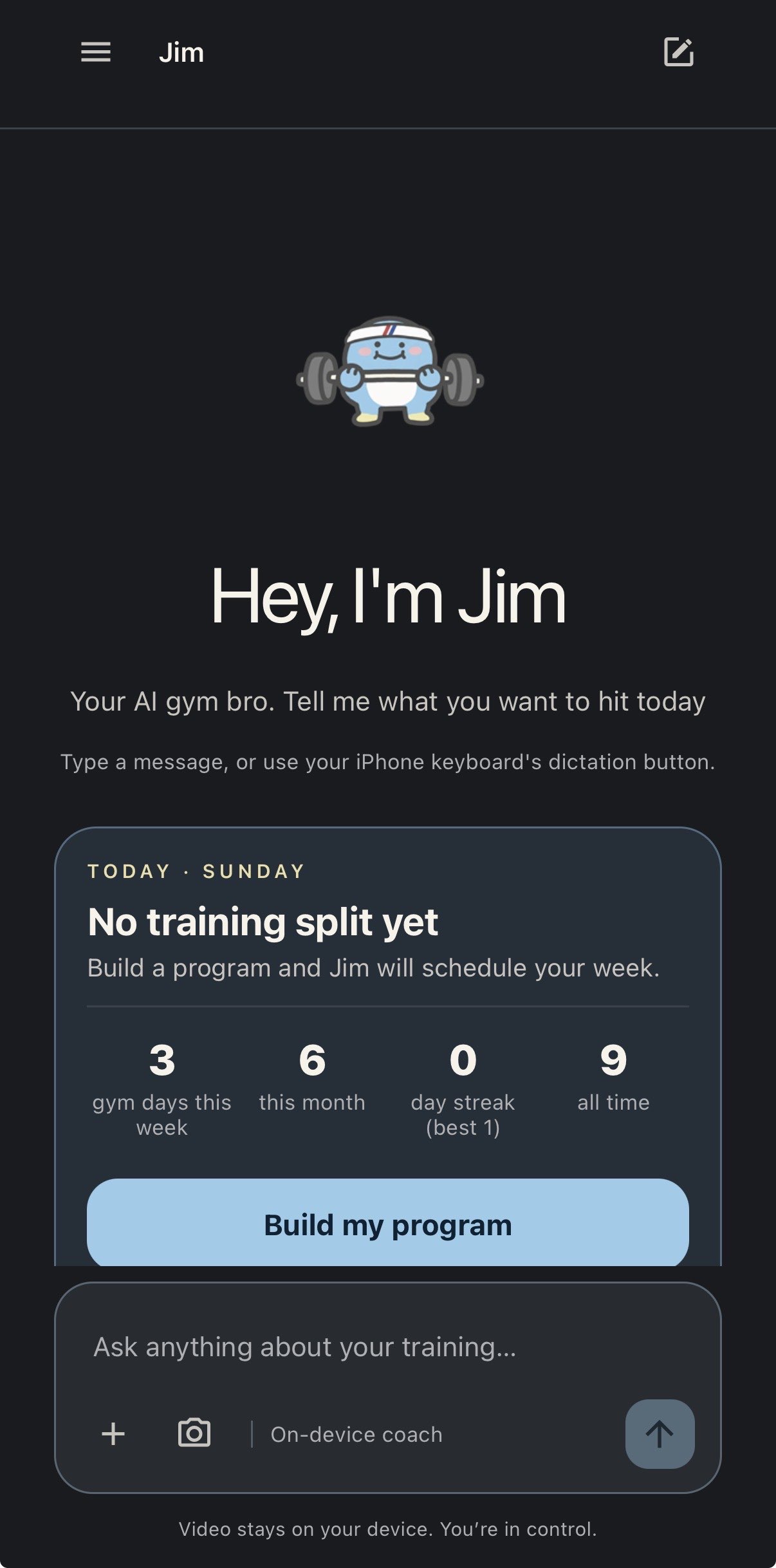
Chat with Jim- Consult Jim and build a plan.
-
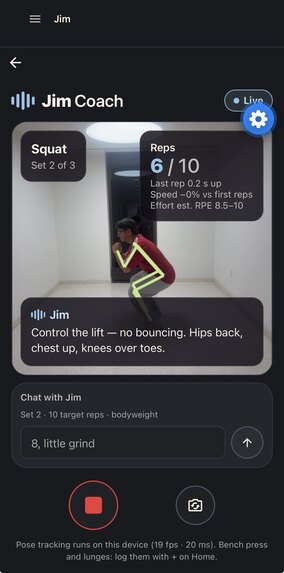
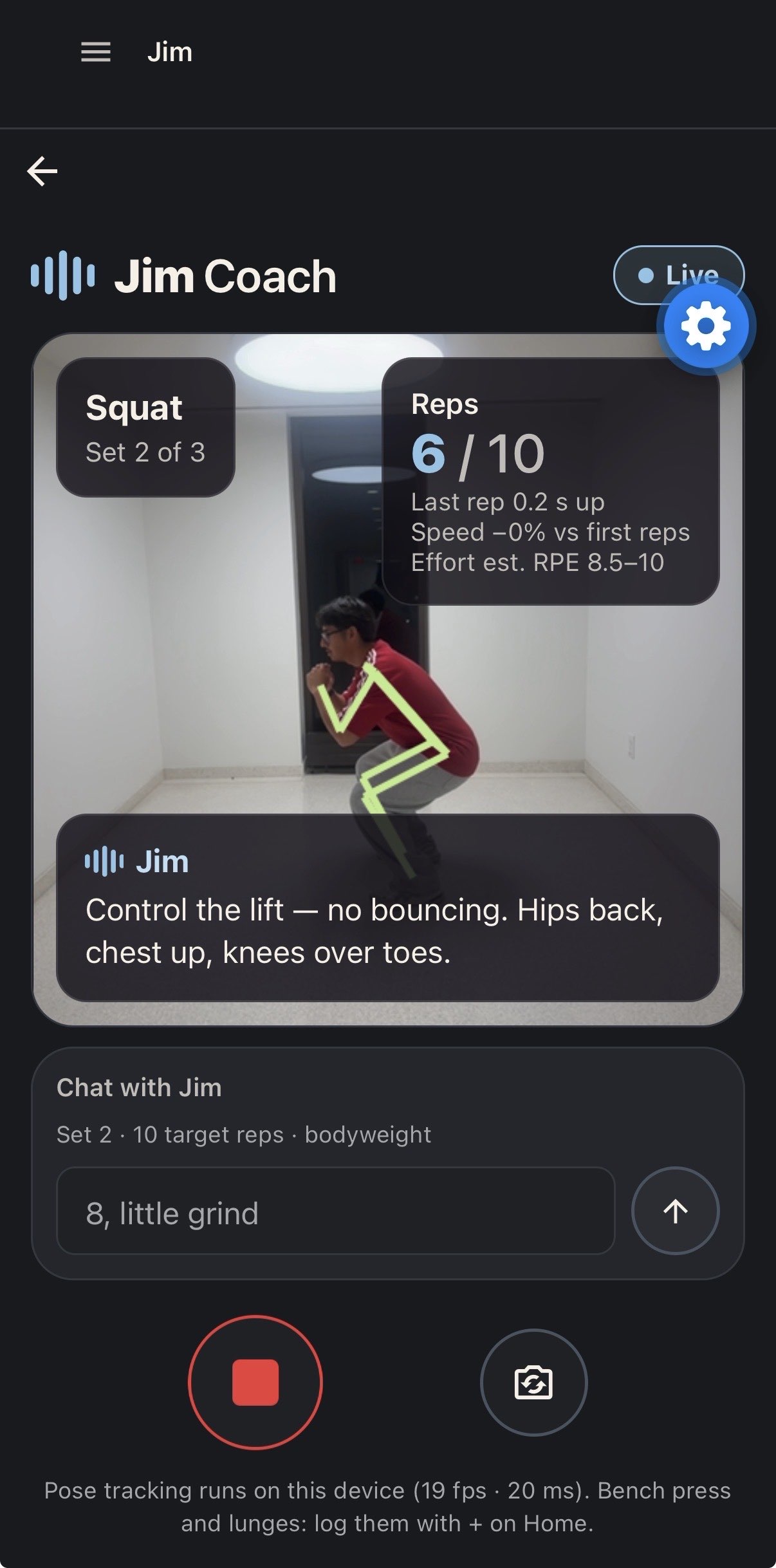
Workout Studio- refine your form and track your reps/sets with Jim.
-
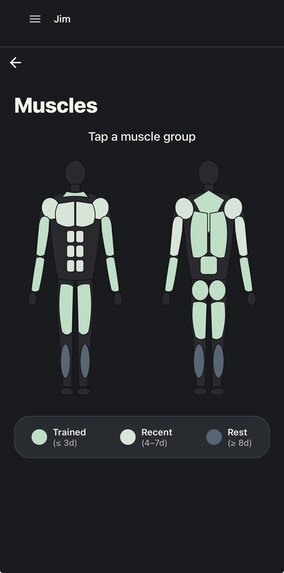
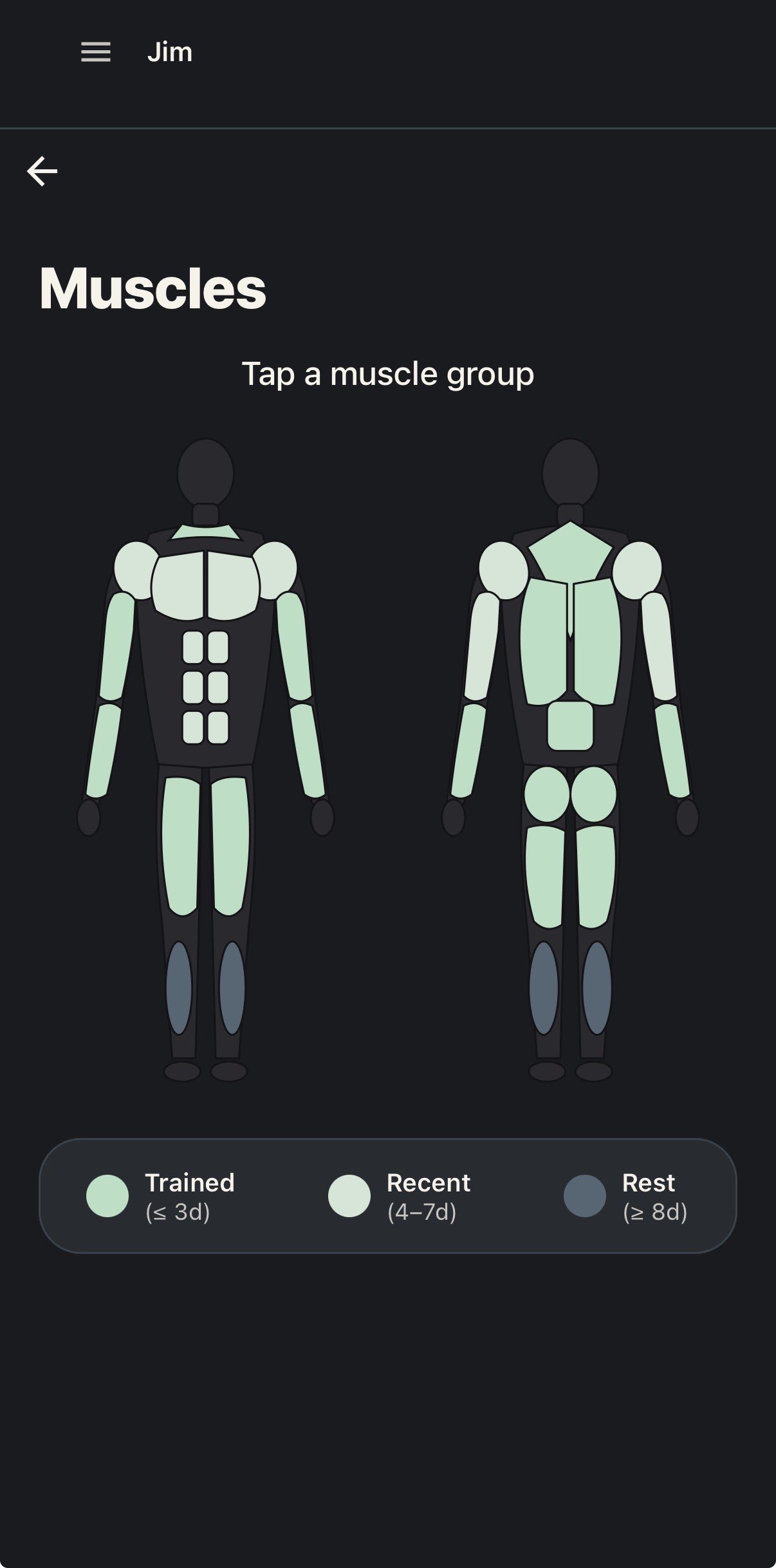
Muscle & Recovery- track the progress of each muscle group.
Inspiration
Most workout apps expect you to understand fitness before you even start using them.
This is exactly why we created JimBro.
Our team started JimBro because we've each personally experienced the frustration of trying to improve at the gym without knowing whether we're actually making progress. One of our members found himself constantly stopping between workouts to manually log exercises, compare previous sessions, and figure out if he was actually improving. Time that could have been spent training was instead spent navigating a spreadsheet.
We realized there was a bigger problem: for someone new to fitness, going to the gym can already feel super intimidating. You're surrounded by unfamiliar equipment, conflicting advice, and people who already seem to know exactly what they're doing. Personal trainers can help, but not everyone can afford one or schedule their day around a single coaching session. When people don't have guidance, they're often left guessing whether they're performing exercises correctly. More often than not, this is what kills motivation and momentum in the gym.
We wanted to change that.
What if your phone could become a workout partner that was available whenever you needed? One that could watch your sets, count your repetitions (reps), help you understand your mistakes, and remember your progress without requiring you to repeatedly manually enter data? That's why we built JimBro.
What It Does
JimBro makes fitness more accessible and personalized. Instead of relying entirely on manual workout logs, JimBro uses your phone's camera to observe your form while working out and count your reps. However, counting isn't enough. We wanted JimBro to recognize when a movement shouldn't count as a completed rep. For supported exercises, JimBro analyzes body landmarks and movement patterns to identify completed reps and reject certain incorrect movements, like swinging your arms during a bicep curl.
After a set, users can review their performance, including their counted reps, rejected movements, exercise tempo, and personalized feedback. JimBro also helps users plan their workouts based on their goals, previous sessions, and available time. Its progress-tracking features help users understand what they've trained and how their performance changes over time.
Because we believe fitness guidance should be accessible, JimBro is designed around the smartphone people already own, with camera processing performed on-device.
How We Built It
We built JimBro using React Native and Expo to create a mobile-first experience.
For our computer vision system, we combined MediaPipe pose estimation with exercise-specific movement analysis. By extracting body landmarks from camera frames, we can calculate joint angles, track movement through different phases, and determine whether a rep of supported exercise meets our counting criteria.
We quickly realized that detecting movement and understanding an exercise are two very different problems. A person's arm can move through the correct angle without them actually completing a proper curl. So, we needed more than basic angle thresholds. To address this, we developed additional movement-validation rules and used simulated test-driven development to evaluate how our rep counter handled legitimate and misleading movements.
For the coaching experience, we integrated an optional Claude-powered AI service with our workout history and planning system. This allows JimBro to use workout information to generate contextual coaching responses and propose adjustments, while keeping critical workout calculations separate from the language model.
Challenges We Ran Into
Our biggest challenge was teaching JimBro the difference between movement and a legitimate rep. Initially, tracking joint angles looked promising. However, while testing we discovered that someone could manipulate the rep counter by swinging their arms or making movements which resembled an exercise. Technically, the camera detected motion. But the application wasn't interpreting the motion correctly.
This defeated one of our main goals: providing users with honest feedback.
So, we improved our detection pipeline by adding movement constraints, developing regression tests, and evaluating labeled video examples and simulated body-landmark sequences. Another major challenge came along while integrating the AI coaching system with our other features. We didn't want a chatbot that simply generated workout advice completely disconnected from what the user had actually done. We wanted coaching to be informed by exercise data and workout history.
Finally, managing development itself proved to be a significant challenge. With multiple team members and coding agents contributing features, merges and communication could quickly become bottlenecks. We addressed this with automated testing, CI checks, and a pull-request workflow that helped us identify integration problems before they reached our main branch.
Accomplishments We're Proud Of
- We turned our original idea into a working MVP with camera-based exercise analysis.
- Seeing JimBro recognize repetitions and provide feedback, making JimBro feel like more than just any old workout tracker to us.
- We built a system that connects several parts of the workout experience: planning, camera-based tracking, exercise feedback, progress history, and AI coaching.
- Improving our rep detection after discovering that our original implementation could be fooled. Instead of ignoring the issue, we made it part of our testing process.
- How we organized our engineering workflow under the pressure of a hackathon.
We weren't just trying to produce features quickly. We were truly trying to build something which showed our passion to share accessible fitness and could survive continued development.
What We Learned
One of our greatest lessons was understanding that computer vision is definitely not the same thing as understanding human movement. Detecting a joint angle is relatively straightforward. Determining whether that movement represents a meaningful exercise repetition is much, much harder.
We also learned how valuable testing becomes when building larger AI-assisted systems. A model or algorithm can very easily appear accurate during a controlled demonstration, then behave differently when someone changes their position, moves unexpectedly, or leaves the camera frame.
Another lesson was found in understanding that adding AI doesn't automatically make an application intelligent. The real value comes from connecting AI to useful information and giving it a meaningful role in the UX. For JimBro, this meant connecting workout history, movement analysis, feedback, and planning so the user doesn't have to interpret everything on their own.
Finally, we learned that truly good collaboration requires more than just dividing up tasks. Automated testing, source control, and communication become significantly more important when multiple developers and agents are contributing simultaneously.
What's Next for JimBro
Our vision for JimBro goes far beyond counting reps.
We want to build a fitness companion that grows alongside the user, learning from their workout history and helping them understand how to improve as time goes on. Our next priorities are to expand the number of exercises supported by our camera systems, improving our movement analysis with more real-world testing, and building a more comprehensive database for long-term workout tracking.
We also want to explore more health and fitness integrations, to make it easier for users to understand their training habits and progress, all in one place.
Eventually, we hope to introduce sustainable subscription options that keep personalized coaching affordable while supporting continued development.
Most importantly, we want to make JimBro more accessible to people who might otherwise feel overwhelmed, intimidated, or financially excluded from personalized fitness guidance.
Because getting started at the gym is already hard enough.
Understanding how to improve should not be.


