-
-
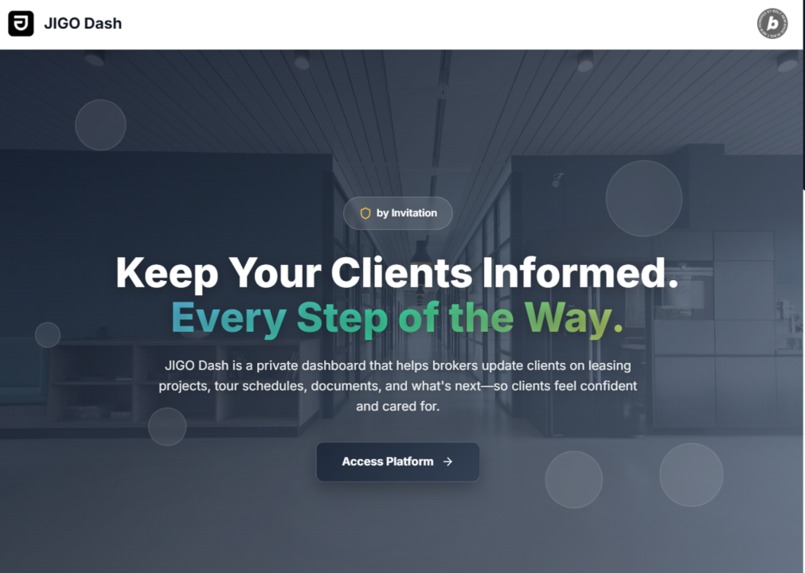
Landing Page
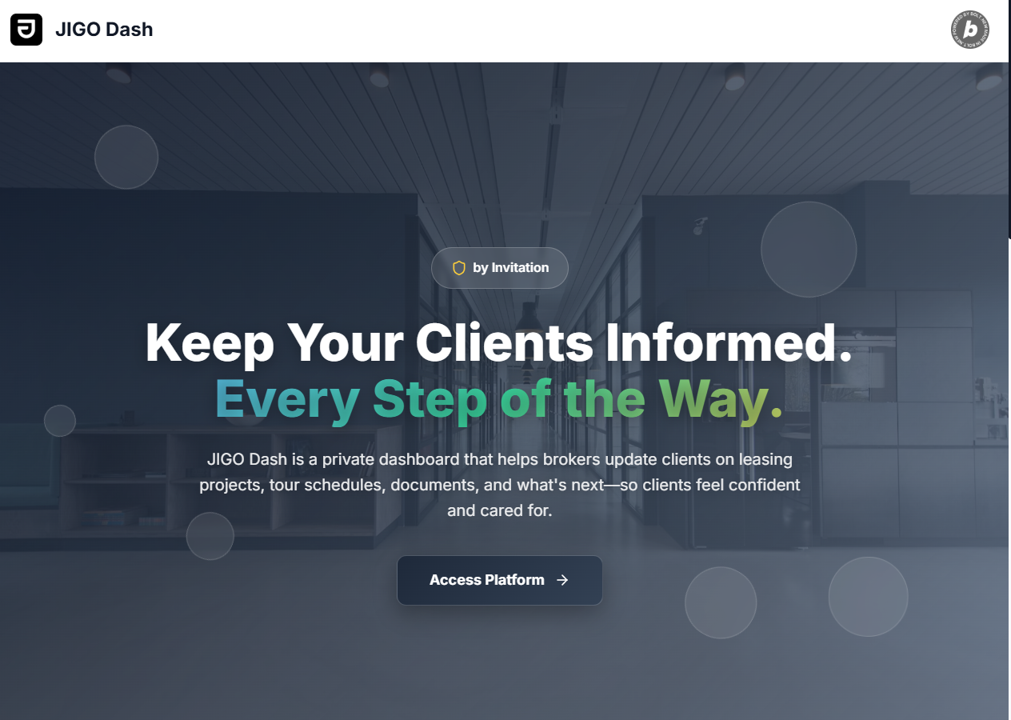
Inspiration
As a new commercial real estate agent, I kept hearing the same frustration from tenants and clients: they had no visibility into how their real estate lease or purchase projects were progressing. The process felt like a black box, and brokers often struggled to keep clients consistently informed.
To help solve this, I started sending weekly email updates to my clients—but it was a highly manual and time-consuming process. I searched for tools to streamline this, but couldn't find anything that fit the unique needs of CRE professionals and their clients. So I decided to build one myself.
What it does
JIGO Dash is a commercial real estate (CRE) project management tool—focused initially on leasing—that helps brokers keep their clients informed without extra manual work.
Brokers can manage each of their client projects through a dashboard that stays up to date automatically. An AI agent reads emails and documents related to a deal, extracts key information, and updates the project details in real time. Once updated, brokers can share a secure Dashboard URL with their clients, who can then see what's happening, what’s coming next, and even schedule tours—all in one place.
How we built it
JIGO Dash was built in real-time, during actual commercial real estate deals. As Ryan worked through live transactions with clients, he identified pain points and immediately iterated on the tool—adding new features or making changes to streamline the process and improve client experience.
Whenever a new feature was needed, Ryan would implement the update and submit a pull request (PR). John would then review the PR, clean up the code as necessary, and push it to production. This tight feedback loop meant that the time from idea to deployment was often just a matter of minutes.
Challenges we ran into
As the codebase grew, we began to hit limitations with using Bolt as our coding assistant. It started making unintended changes, leaving old code untouched when introducing new logic, or even introducing bugs while trying to fix others.
Over time, this meant John had to spend significantly more time reviewing and cleaning up the code to maintain overall quality and consistency. While AI helped accelerate development early on, it also created new challenges around reliability and maintainability at scale.
Accomplishments that we're proud of
During the hackathon itself, Ryan was able to onboard 5 new clients and even close 2 lease deal using JIGO Dash - a lease value of $60K and roughly $6K in commission.
Several other brokers have expressed interest in gaining access, and we're planning to launch the platform more broadly soon.
We’re also proud of how our team figured out how to work effectively on a project that relied heavily on Bolt. One of the biggest early questions was: If one person is vibe-coding with AI, what does the other person do? Through trial and iteration, we established a tight workflow—idea → build → review → production—that helped us identify gaps in AI-generated code and enabled us to ship features 10x faster than before.
What we learned
The new world of the user-builder is here. Users are no longer just giving feedback—they can now actively participate in building the tools they need. This drastically reduces the friction of building for users, because they’re already part of the process.
That said, we also learned that building full end-to-end applications using vibe-coding tools like Bolt still comes with real challenges. As the codebase grows, the frequency and complexity of errors tend to increase proportionally, requiring a thoughtful balance between speed and code quality.
What's next for JIGO CRE Dash
We’re gearing up to launch JIGO CRE Dash as a product for the commercial real estate industry. The goal is to bring greater transparency, automation, and efficiency to leasing projects—starting with brokers and their clients, and eventually expanding to support the broader CRE ecosystem.
Built With
- clerk
- gemini
- github
- langchain
- langsmith
- python
- supabase
- typescript
- vite

Log in or sign up for Devpost to join the conversation.