-
Jibon | Saving Life
JIBON — Emergency Response Intelligence জীবন · "Don't wait for the patient to arrive before preparing for the patient."
The problem Someone collapses on a road in Kuakata. The only person there is a shopkeeper — not a doctor, not strong enough to carry anyone, and unsure who to call. They dial 999 and spend one to two minutes describing a scene the operator cannot see. The operator guesses and sends an ambulance. That ambulance is often a transport van: no defibrillator, no airway kit, no paramedic — because it was dispatched blind, it could not have been loaded correctly even in principle. It then drives to a hospital that does not know it is coming, where assessment restarts from zero: history, triage, imaging, hunting for a specialist, a free theatre, the right blood group.
Four failures, one cause: information that exists is not moving. The bystander can see but cannot interpret. The operator can interpret but cannot see. The crew knows neither until arrival. The hospital knows nothing until the doors open. Every handoff discards what the previous link learned — and in emergency medicine that is paid in minutes. Cardiac arrest survival falls roughly 7–10% per minute.
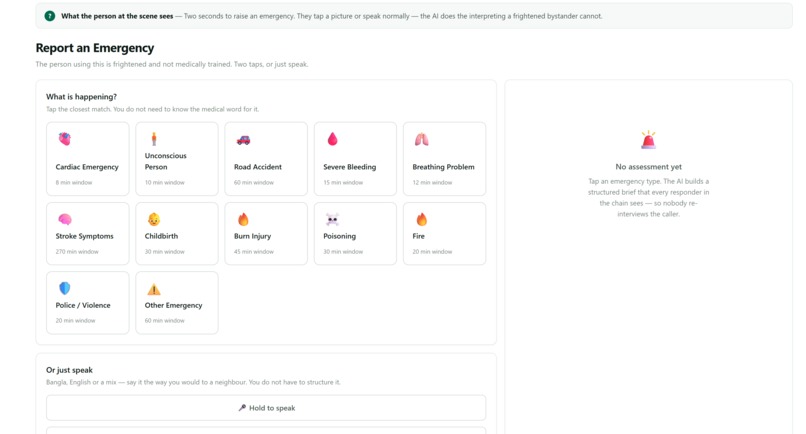
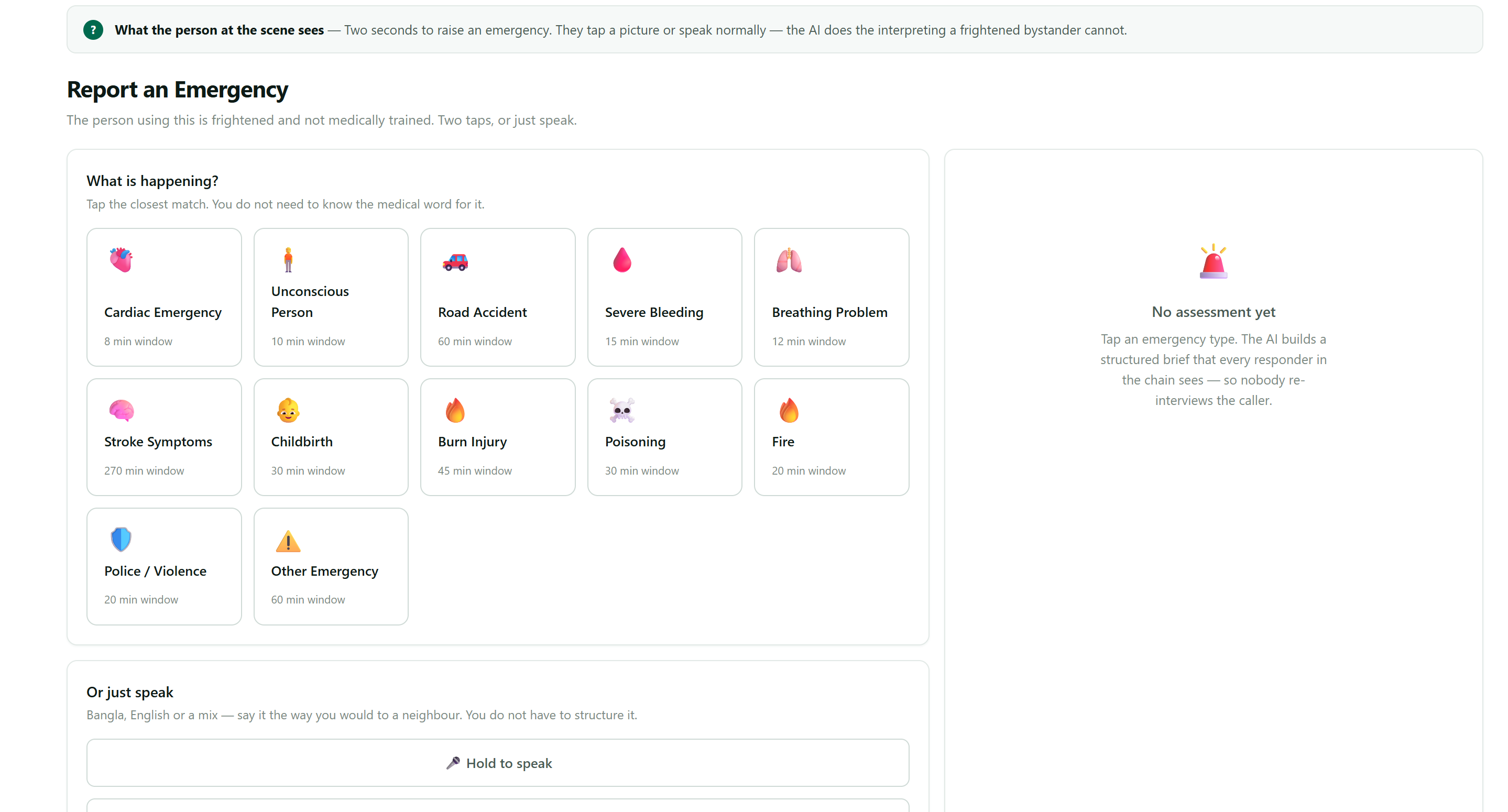
What JIBON does It replaces the single blind call with a continuous multimodal channel. The bystander taps one large icon or simply speaks — Bangla, English, or the Banglish people actually use. Gemini classifies the emergency from that speech, cross-checks it against a scene photo, assigns severity and a calibrated confidence, and routes directly to the correct specialist department instead of a generic operator.
The channel stays open. A doctor joins a session that is already briefed and never re-interviews the caller. A nearby off-duty nurse is dispatched on foot — in traffic, a volunteer beats a vehicle. And the ambulance is told exactly what to load for this emergency. That last one is free: the vehicle was going anyway.
The relay A patient in Kuakata needing neurosurgery in Dhaka passes through Patuakhali and Barishal. Today those hospitals are scenery. JIBON makes them relay points — each gets the full case and is told what to have waiting at the roadside, then hands blood, fluids and a clinician up to the moving ambulance. Transfer stops being dead time and becomes escalating care. No new hospital, no new ambulance, no new doctor.
Readiness, not just notification Knowing a patient is coming is half of it. JIBON allocates a named theatre, holds an ICU bed, starts a cross-match — and runs an inventory check against the receiving hospital's stock. If Barishal is two units short of what this case needs, that is known forty minutes out, and one click sources it from Patuakhali with an ETA ahead of the ambulance. A gap found now can still be closed. Found at the door, it costs the patient.
Gemini Not a chatbot bolted on. Gemini returns structured JSON against a schema — type, priority, consciousness, breathing, observations, missing information, confidence. That object is the case record every interface reads. It also writes routing rationale and answers operational questions grounded in pre-computed statistics, so it cannot invent totals.
Safety is explicit: it never diagnoses, never names a medication, and labels every line — Reported, Observed, AI inferred, Verified. Low confidence escalating to a human is a correct outcome, not a failure.
Github Rep: https://github.com/imran-me/jibon Deployed live: https://imran-me.github.io/jibon/
Built With
- chatgpt
- claude
- css3
- gemini
- html5
- javascript
- python
- vanillajs

Log in or sign up for Devpost to join the conversation.