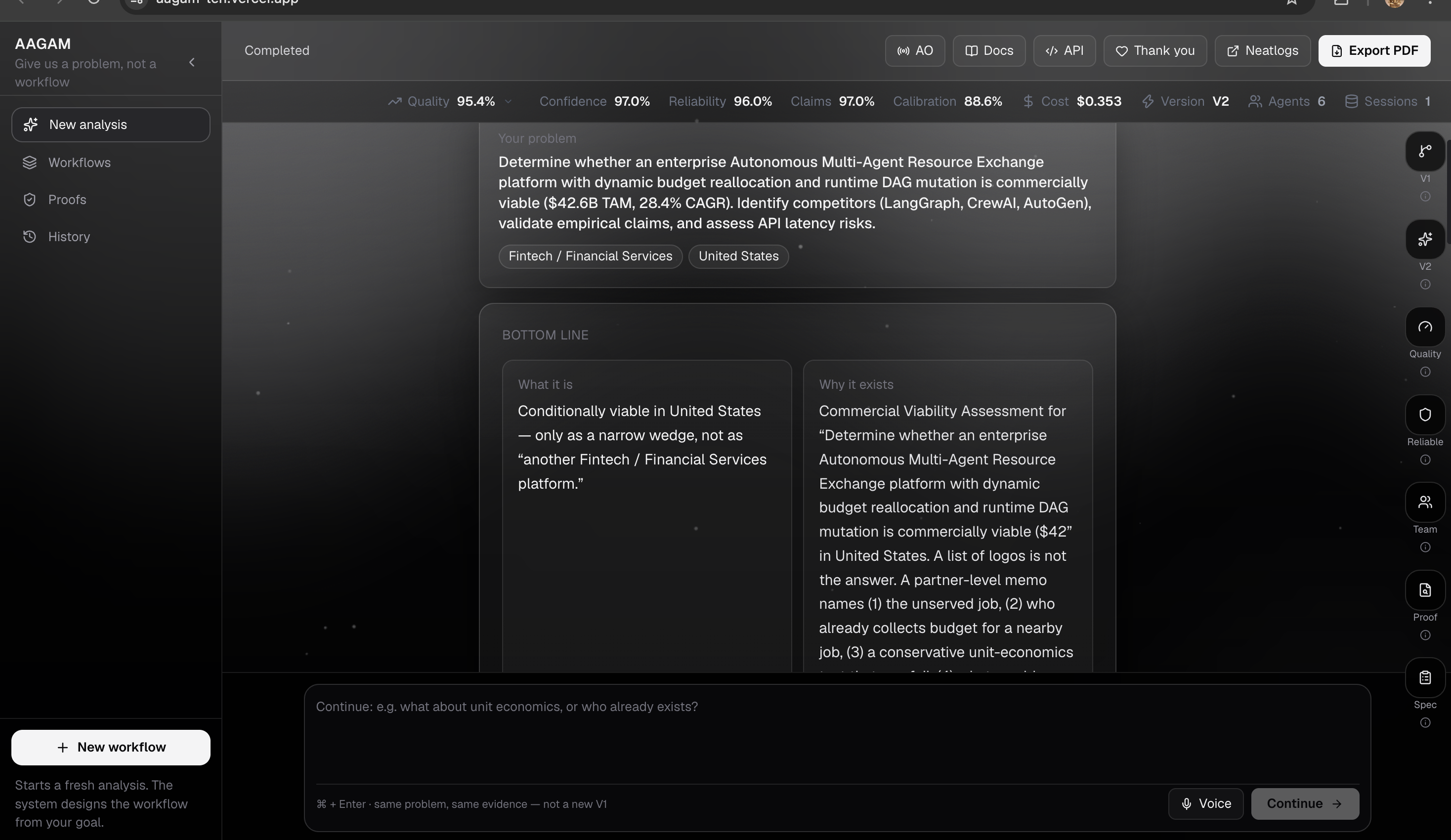
AAGAM: Giving AI a Goal, Not a Workflow The question that started everything
Most agent tools today answer the same question: how do we build, run, and monitor an agent?
We kept getting stuck on a different one:
If I give an AI system a completely new goal — not a workflow, not a script, just a goal — how should it figure out, on its own, what to build to get there?
Which agents are actually worth creating? Which capabilities deserve resources? How much should each one get? Can we trust what they produce? And once we've seen the results, what should we change?
Nobody was really answering that. So we built AAGAM.
What AAGAM actually does
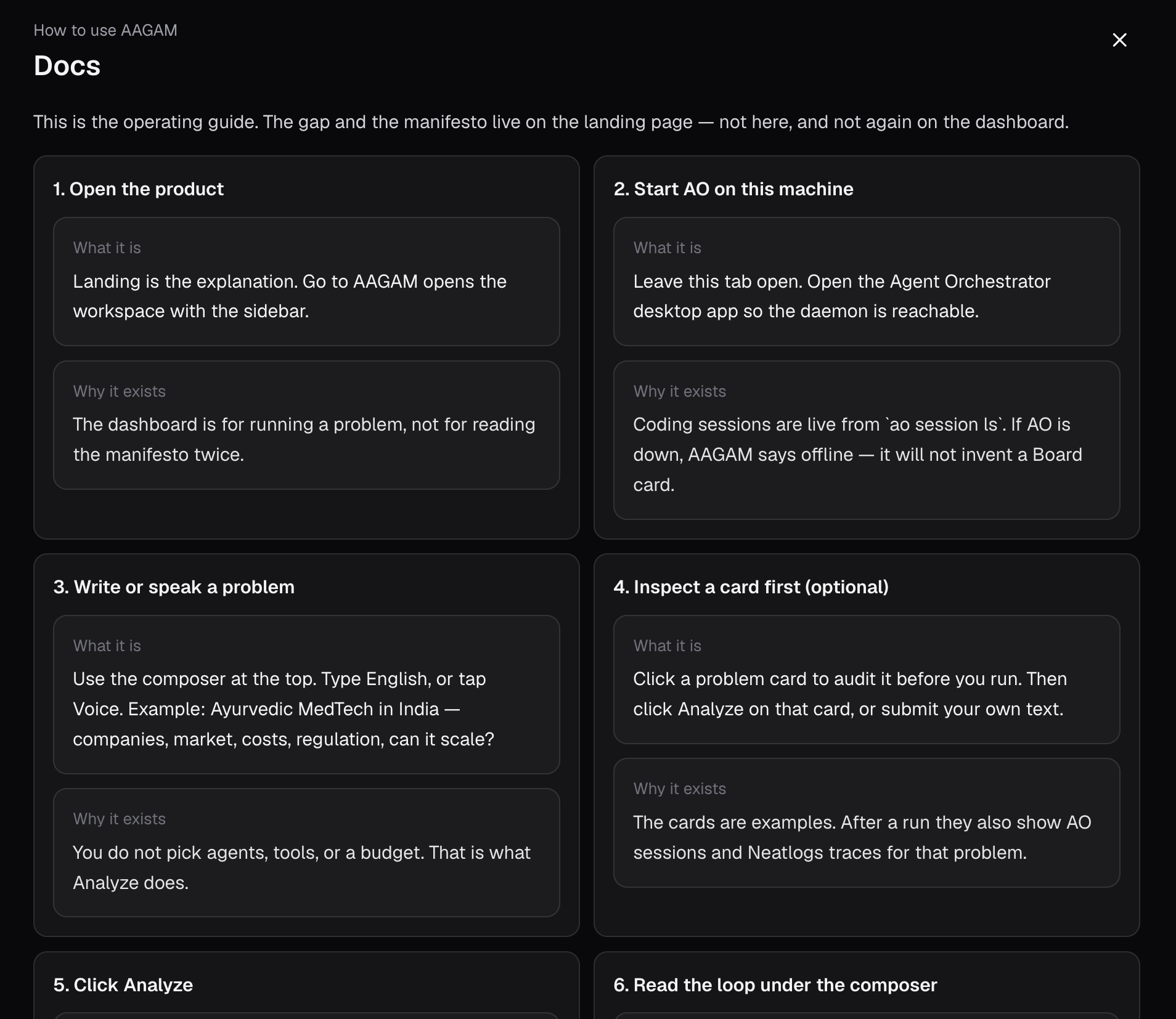
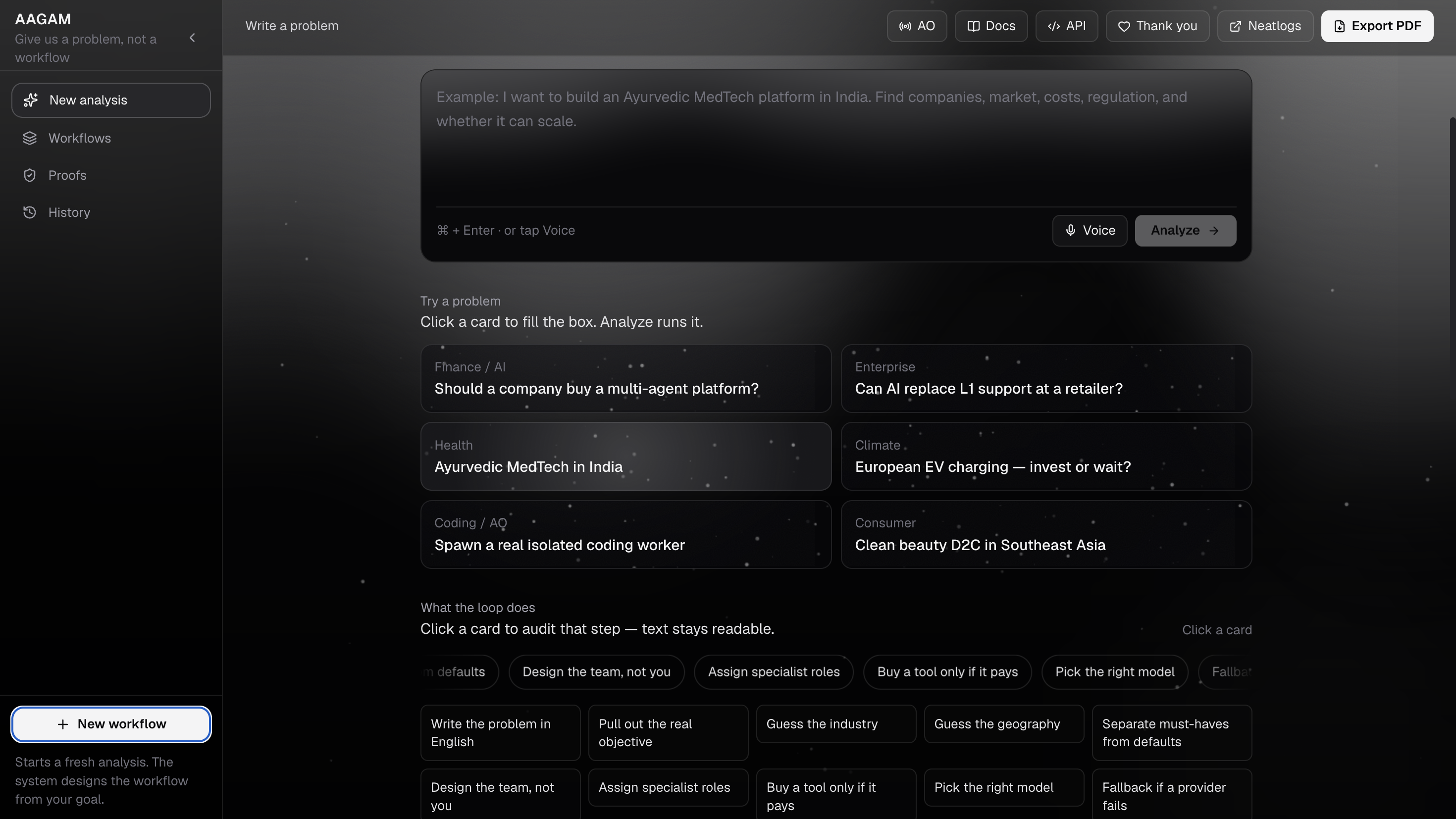
AAGAM takes a plain-English goal — something like "I want to build an Ayurvedic MedTech platform in India. Analyze the market, competitors, business models, regulations, economics, risks, and scalability" — and turns it into a working, measurable agent architecture. No manual workflow design required.
Behind the scenes, it moves through eight stages:
Understand → Plan → Allocate → Execute → Verify → Measure → Evolve → Execute Again
It breaks the goal into pieces, picks the right capabilities from its marketplace, designs an architecture around them, hands out a limited budget of resources, runs the agents, checks their work, scores the results, and then figures out exactly which agent earned its keep — and which didn't.
Our X-factor: agents that have to earn their budget
Here's the core idea we bet the whole project on: not every agent deserves the same resources, and none of them get to keep resources they didn't use well.
Think of it less like a fixed org chart and more like a startup's budget review. Every capability costs something to run. After execution, AAGAM asks a simple but uncomfortable question:
"What did this agent actually contribute?"
If an agent's output turns out to be redundant, thin, or low-impact, its unused resources get reclaimed — and redirected to the agents that are actually moving the needle. That creates a loop:
Architecture → Execution → Contribution → Resource Reclaim → Mutation → Better Architecture
This is the difference between a developer manually building "V2" because it seemed like a good idea, versus AAGAM deriving V2 from measured weaknesses in V1.
In our demo, exactly this happened: a research branch turned out to be redundant. AAGAM caught it through contribution and redundancy analysis, reclaimed its unused allocation, rewired the architecture to give more to the higher-value agents, and re-ran it — with the difference in quality, reliability, cost, latency, and efficiency measured, not assumed.
We didn't reinvent the wheel — we built the missing layer on top of it
We were deliberate about not rebuilding things that already exist and already work well:
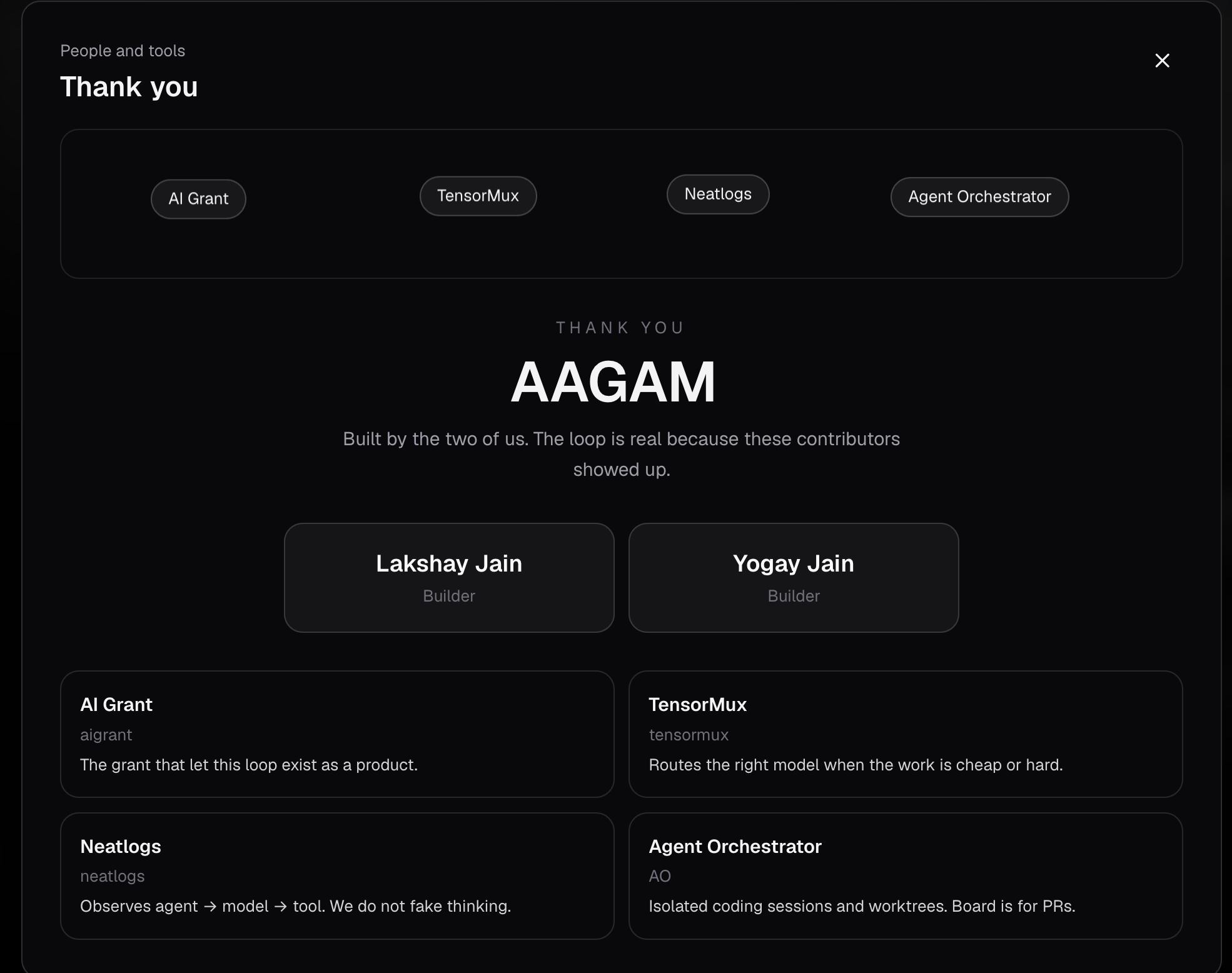
OpenAI Agents SDK handles our agent execution foundation — agents, tools, sessions, model calls, and tracing. Neatlogs gives us execution observability, so we can actually see what happened during a run instead of guessing. Agent Orchestrator (AO) is our real execution substrate for technical work — AAGAM spins up isolated AO sessions and Git worktrees, runs coding workers inside them, and pulls verified code artifacts back into AAGAM's evaluation loop. TensorMux gives us a second model/provider path, so we can compare execution across different models and cost profiles.
What we actually built is the layer sitting above and between all of this — the part that decides what should run, what it should get, how to measure what it contributed, and whether the whole architecture should change.
A confident answer isn't the same as a trustworthy one
Autonomous research systems have a habit of sounding sure of themselves even when they shouldn't be. We wanted AAGAM to be trustworthy by design, not just by tone.
So every claim it produces is traceable back through the pipeline:
Claim → Artifact → Agent → Tool Call → Evidence
On top of that, our evaluation layer independently scores every run on:
Correctness Evidence validity Citation completeness Requirement fit Reasoning quality Consistency Uncertainty handling Completeness
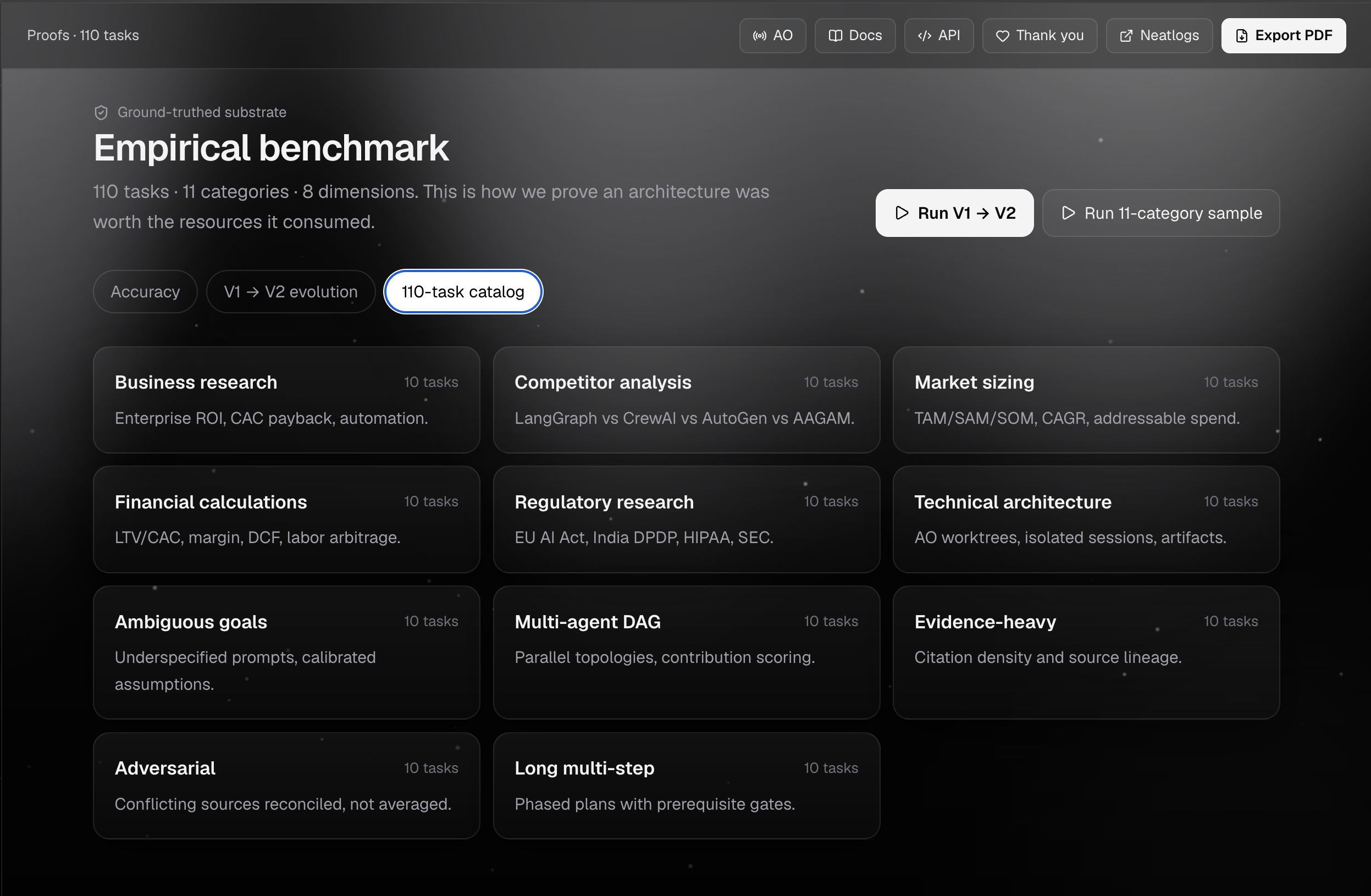
And instead of just claiming a good score, we built a benchmark catalog of 110 ground-truthed tasks across 11 categories to actually test the system — so the numbers we report are earned, not asserted.
What we learned
The biggest realization: more agents is not automatically better.
Add more agents without a way to measure them, and you don't just get more capability — you often get:
higher cost slower execution more redundant work harder verification and sometimes worse reliability, not better
So the real question was never "how many agents can we run?" It's "which agents are worth running?" That single shift changed how we designed everything — agents stopped being static workers in our heads and became economic capabilities inside a system that's supposed to keep getting better.
The hard parts
Making a system that looks autonomous is easy. Making it measurable is hard. We had to build:
resource reservation and reclamation persistent, scoped sessions capability selection full artifact lineage quality gates contribution analysis architecture mutation empirical benchmarks real AO worktree execution multi-provider execution recovery and checkpoint mechanisms
And the part we cared about most: making sure every benchmark score came from real evaluation against ground truth — not a number we simply decided to attach to a demo.
Where we're taking this
AAGAM is built around one principle: don't give the system a workflow — give it a goal.
From there, we want it to keep getting better at answering: who should work, what they should use, what they should cost, whether their work can be trusted, what they actually contributed, what should change, and whether the new architecture is genuinely better than the last one.
That's the foundation we're betting on — turning agent orchestration from a static workflow problem into an adaptive, economic system for AI work.
Built With
- git
- next.js
- openai
- postgresql
- python
- react
- typescript

Log in or sign up for Devpost to join the conversation.