CCW — Compliance + Competitor Watch
Inspiration
I am not a developer. My background is consulting. I spend my days diagnosing why businesses leak money and writing the business case to fix it. I had never shipped a line of working software in my life before this weekend.
The challenge was to build an agent that does real work on the open web. I kept coming back to a niche I understand: independent aesthetic clinics. London is full of them, they are fighting each other for bookings, and almost all of them are quietly breaking UK advertising law without realising it. Advertising Botox to the public is illegal here. Clinics do it every single day, in plain sight, in their live Meta ads.
That is the kind of expensive, invisible problem I have spent a career hunting. The difference is that this time I wanted the agent to find it and fix it, not me.
What it does
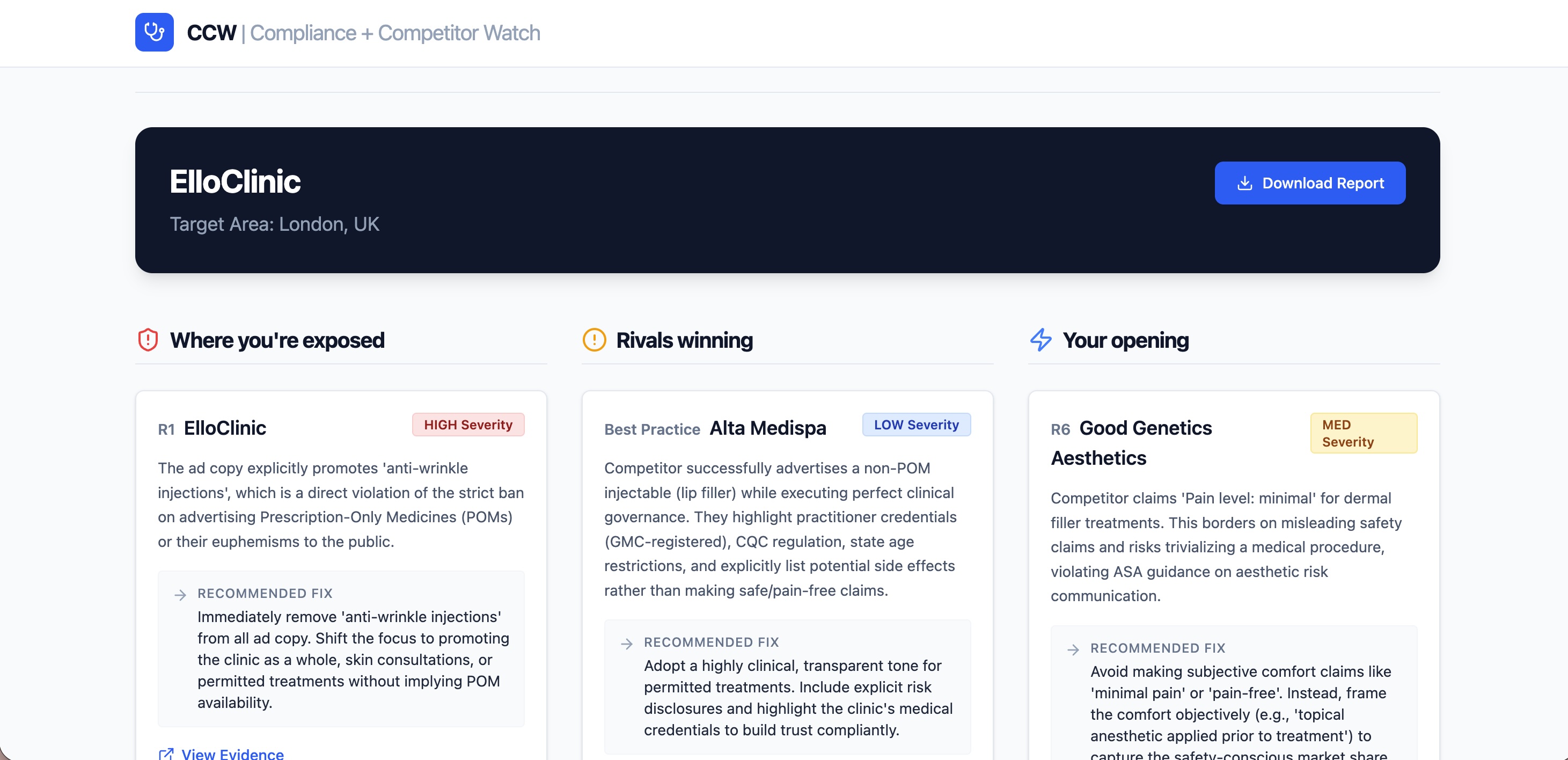
You point CCW at a clinic. It reads that clinic's live Meta ads and its local competitors' ads, then returns a sourced brief:
- Where you are exposed — every ASA/MHRA breach in your own advertising
- Where rivals are winning — the positioning and trust signals they use and you do not
- Your opening — where a competitor is breaching the rules, so you can take that ground compliantly
- Ranked moves — the highest-impact compliant fixes, each tied to live evidence
Every claim links back to the actual ad in the Meta Ad Library. The finished brief is then published to cited.md as agent-citable context, priced per fetch via x402.
What I learned
- Shipping beats planning. I am a chronic over-architect. I planned this idea to death, then learned more in the first ten minutes of real data than in an hour of strategy. The moment I ran the engine on a real clinic, it found genuine breaches I had not predicted.
- The constraint was the product. UK advertising law looked like a risk. It turned out to be the wedge. Encoding the ASA/MHRA rules is the thing no generic audit tool does.
- You do not need to be an engineer to build now. You need a clear problem, a tight spec, and the discipline to keep the model on the rails. The agents did the typing. I did the judgement.
Challenges I faced
- Never having built before. Half the weekend was learning what an API key even is and where it goes. Confusing a model login with an app key cost me real time.
- Saturation. My first idea (a generic local-business audit) was already shipped by someone else, including the exact agent angle. I had to validate hard, kill it, and pivot to the compliance niche where I actually had an edge.
- Grounding without hallucinating. In a regulated niche, a wrong compliance flag is a liability, not a bug. Forcing every finding to cite a live source was the only way to trust the output.
- A clock and a dying account. A temporary environment that deletes tomorrow forced me to build for portability from the start, and to export everything before it vanished.

Log in or sign up for Devpost to join the conversation.