-
-
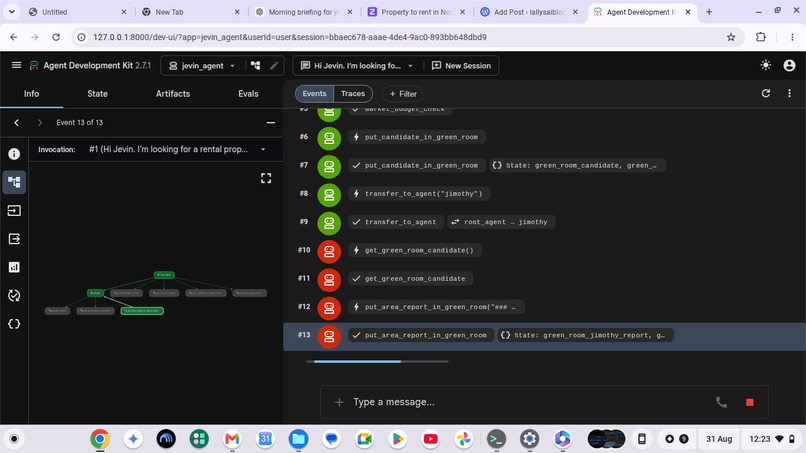
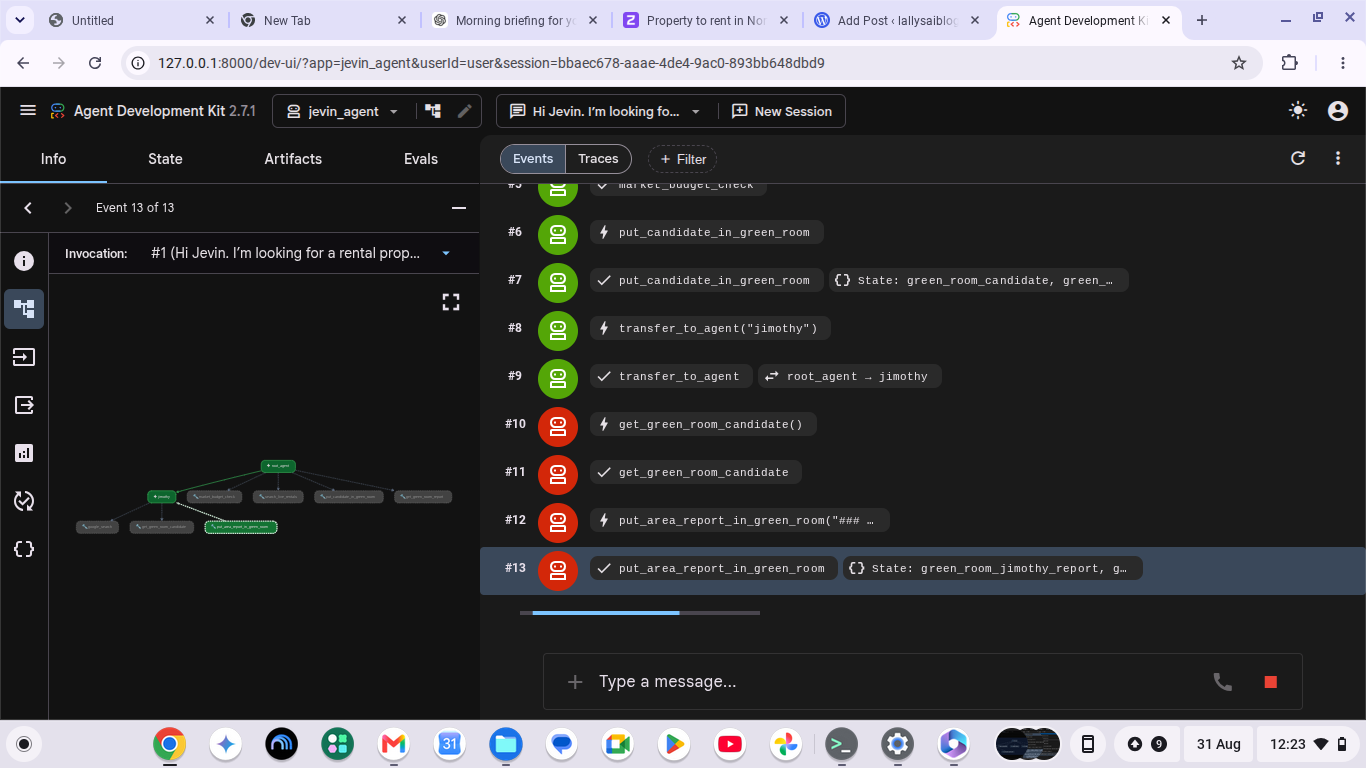
Jevin hands over to Jimothy
-
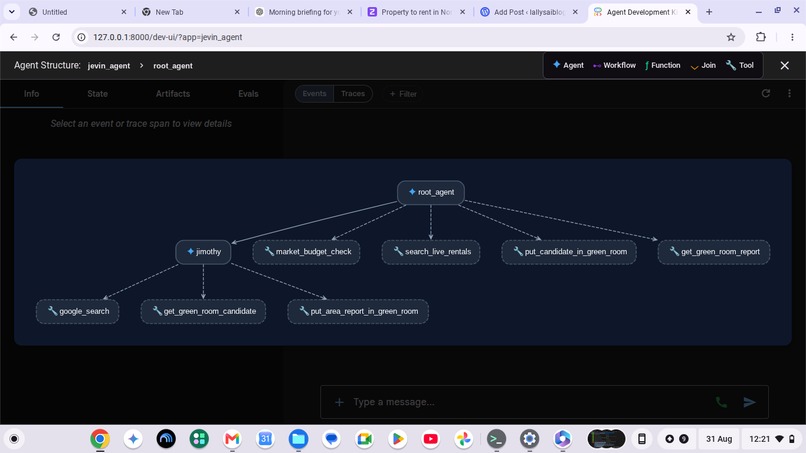
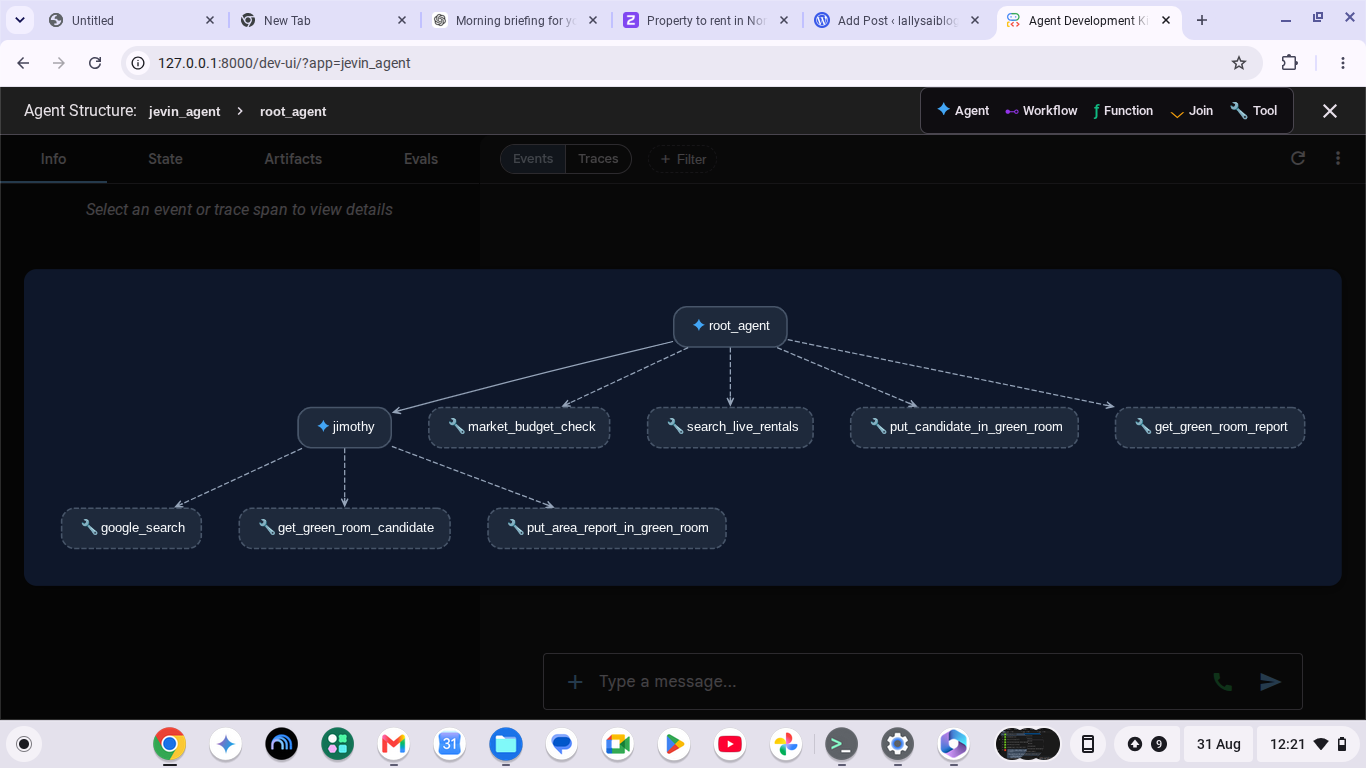
adding the green room to Jimothy and Jevin
-
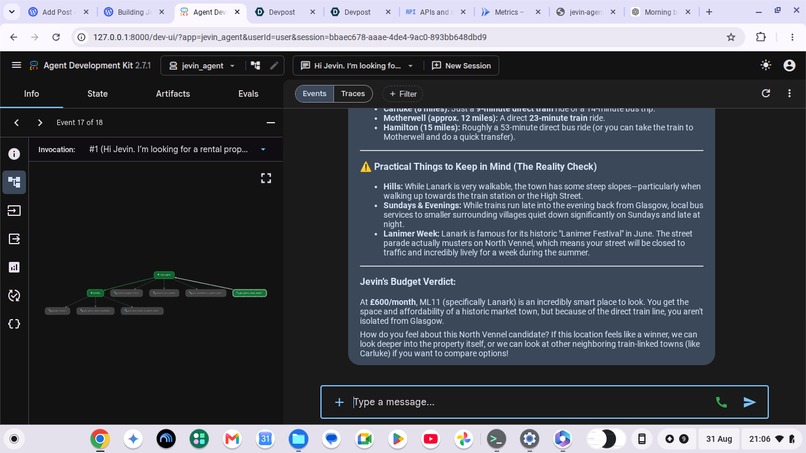
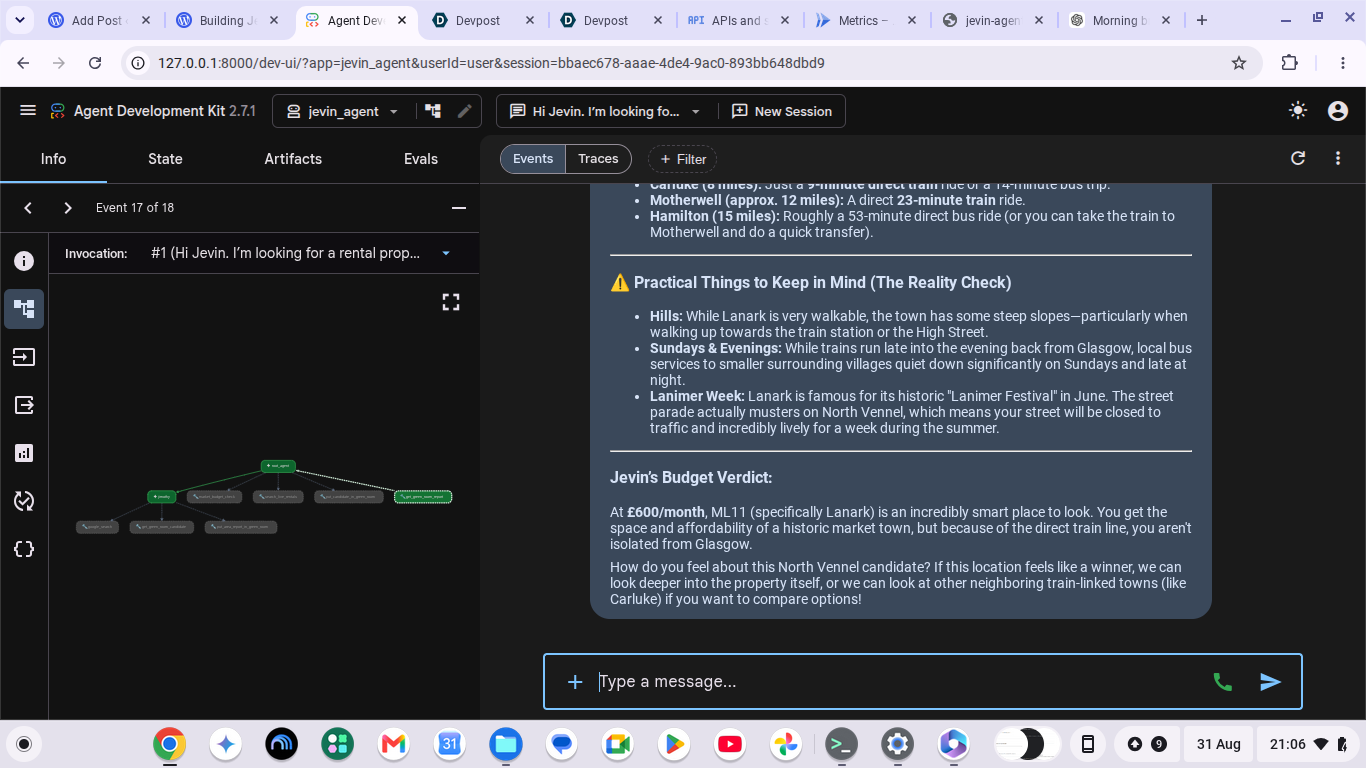
The finished result giving the combined work of both agents.
-
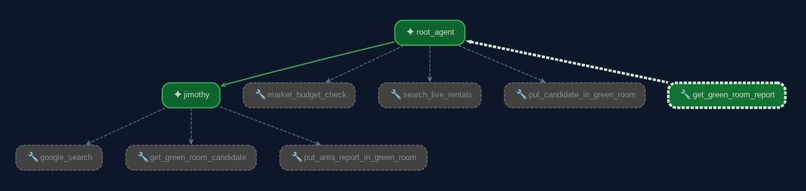
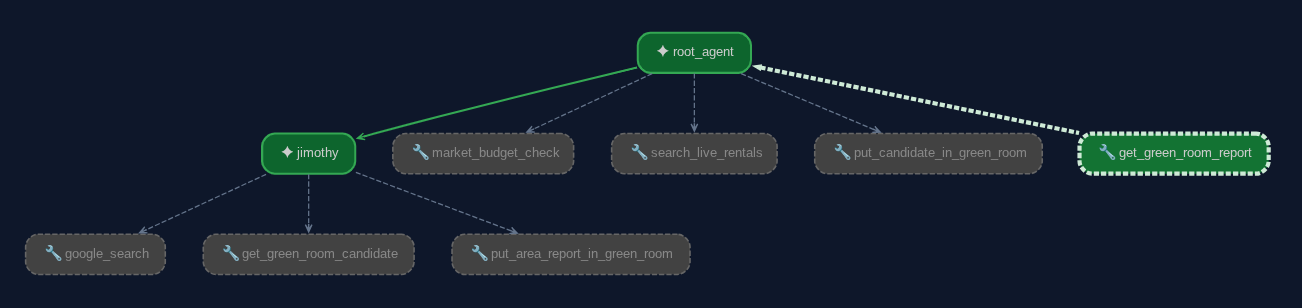
showing the agents dropping / collecting things from the green room
Inspiration
Jevin started with a very ordinary but genuinely difficult problem: finding somewhere to live.
Searching for a rental property is rarely just about finding a listing. A property can be affordable but badly connected, in the wrong location, or impractical for everyday life. The information needed to make that decision is scattered across property data, transport information, local services and other sources.
I wanted to explore whether an AI agent could do more than simply return search results. Could it take responsibility for different parts of that workflow, decide when specialist research was needed, and bring the useful information back together for the human making the decision?
That question became Jevin.
As the project developed, it also became an experiment in a broader idea: instead of giving one agent every tool and every piece of context, what happens if agents have clearly bounded roles and share only the information needed for the task?
That led to Jimothy and, eventually, the Green Room.
What it does
Jevin is an agentic property-search and relocation assistant.
The client can give Jevin a location, rental budget and requirements. Jevin can investigate the rental market and search property data for potential candidates.
When a viable candidate needs further investigation, Jevin can delegate local-area research to Jimothy, a specialist agent responsible for understanding what living around that property would actually be like.
Jimothy researches practical information such as public transport, shops, services, nearby towns and other relevant local factors.
Between them sits the Green Room, a shared-state coordination layer. Rather than passing the entire conversation between agents, Jevin places a concise property candidate and research request into the Green Room. Jimothy retrieves the relevant information, performs his research and places his report back into the shared state. Jevin then retrieves that report and synthesises it with the property information for the client.
The result is not simply two AI responses placed next to each other. It is a coordinated workflow:
Client → Jevin → Green Room → Jimothy → Green Room → Jevin → Client
The architecture is designed to extend this pattern beyond property and local-area research. The next planned specialist is Ellie, an email and appointment-management agent. Once Jevin and Jimothy have established that a property is worth pursuing, Ellie would take responsibility for the administrative stage: managing enquiries, viewing correspondence and appointment coordination.
This creates a natural progression from finding → researching → recommending → acting, while keeping each specialist within a clearly defined role.
How we built it
Jevin is built in Python using Google Agent Development Kit (ADK) and Gemini 3.5 Flash, accessed through Google Cloud/Vertex AI.
Jevin is the root agent and has tools for rental-market budget checks and property searches using the Property Market Intel API.
Jimothy is an ADK sub-agent with a deliberately narrower responsibility: local-area intelligence. Google Search gives Jimothy access to information needed to investigate transport, amenities and other practical considerations.
The Green Room is implemented using ADK's shared session state. Custom tools allow Jevin to store a candidate and research request, allow Jimothy to retrieve it, and then allow Jimothy to return his completed report for Jevin to retrieve.
This creates a lightweight coordination mechanism without introducing another agent simply to manage the agents.
The completed system was deployed from source to Google Cloud Run. Sensitive credentials, including the property-data API key, are kept out of the deployment source and supplied securely to the Cloud Run service using Google Secret Manager.
Challenges we ran into
One of the biggest challenges was deciding how much information agents should share.
Initially, it would have been easy simply to give every agent access to everything. Instead, the project evolved around the idea of bounded expertise and relevant context: each specialist should receive the information necessary to do its job, rather than inheriting the entire conversation.
Another challenge was delegation. Jevin should not call Jimothy simply because Jimothy exists. During testing, Jevin encountered a search where there was no suitable candidate to investigate and correctly did not delegate the task. That became an important part of the design: useful agentic systems need considered delegation, not maximum delegation.
Property data also demonstrated an important real-world limitation. A record being available through an API does not necessarily guarantee that the corresponding consumer listing is still current. This reinforced the distinction between successful agent orchestration and the freshness or quality of the external data being orchestrated.
Finally, deployment required translating a locally working multi-agent ADK project into a secure cloud deployment without disrupting the working agents or exposing API credentials.
Accomplishments that we're proud of
The biggest accomplishment was seeing the complete multi-agent circuit work end-to-end.
During the successful test, Jevin searched for a property candidate, placed the relevant information into the Green Room and delegated the local research to Jimothy. Jimothy retrieved the candidate, performed the specialist research and returned his report to the Green Room. Jevin retrieved that work and produced one coherent response combining the property and local-area findings.
That demonstrated that the Green Room was functioning as shared working state rather than simply being an architectural idea.
We are also proud that Jevin makes a decision about whether delegation is useful rather than automatically invoking every available agent.
The completed ADK application was also successfully deployed to Google Cloud Run, with the live Cloud Run service recognising jevin_agent as an available application.
What began as one house-hunting agent became a working example of specialist agents collaborating through deliberately limited shared context.
What we learned
The project changed the way we think about multi-agent systems.
More agents do not automatically produce a better system. What matters is defining responsibilities, deciding who should handle each part of a task, determining what information they actually need and creating a reliable mechanism for returning useful work.
Shared state also does not need to mean shared everything.
The Green Room became useful precisely because it provides a small common working environment where agents can exchange task-relevant information while retaining their separate responsibilities.
We also learned that orchestration and data quality are separate engineering problems. An agent workflow can behave correctly while an external source contains stale or incomplete information. Production systems need ways to communicate that uncertainty rather than treating every retrieved record as equally reliable.
Perhaps the most important lesson was that effective agent autonomy can include knowing when not to delegate.
What's next for Jevin
The next stage is to extend the working Jevin–Jimothy–Green Room architecture with Ellie, the specialist already represented in the project's architecture design.
Ellie is intended to handle the communication and appointment-management part of the property workflow. Once Jevin identifies a suitable property and Jimothy establishes whether the surrounding area is practical, the system would bring the findings together into a recommendation.
At that point, the system would create a printable PDF property report containing the information gathered during the workflow: property details, budget assessment, local-area findings, transport and amenities, potential drawbacks, questions to ask at the viewing and Jevin's overall recommendation.
This gives the client a useful document that can be saved, compared with other properties or taken to a viewing, rather than leaving all of the research trapped inside a chat session.
Crucially, this is also where the workflow returns the decision to the client.
Once the evidence and recommendation have been presented, Jevin would ask whether the client would like to pursue a viewing.
Only after the client approves that next step would Ellie take over the administrative work: contacting the agent or landlord, managing email correspondence, checking suitable dates against the client's availability and helping coordinate the viewing appointment.
This extends the workflow into:
Find → investigate → recommend → report → ask the client → act
Ellie would remain a bounded specialist, rather than giving Jevin unrestricted control over communications and calendars. Actions such as sending an email or confirming an appointment could require explicit human approval.
This continues the project's principle of considered delegation: autonomy where it is useful, human agency where it matters.
Property-data verification is another priority. Future versions could compare freshness signals across authorised sources and make the confidence or age of property information clearer to the client.
The Green Room itself could also evolve from its current lightweight shared state into a richer coordination environment, recording task status, provenance, confidence and hand-offs while maintaining the principle that agents receive only the context relevant to their responsibilities.
Longer term, the architecture is deliberately extensible. Jevin does not need to become an enormous agent with every possible tool. New specialists can be introduced when a workflow genuinely requires them.
Ultimately, Jevin is not simply about automating property search. It is an exploration of considered delegation: specialist agents doing the work they are best suited to, sharing only the context they need, producing useful real-world outputs, and recognising the points at which the decision belongs back with the human.
Can we build agent systems where specialists find, investigate and act together, share only what they need, and keep the human above the system rather than removing them from it?
That is where we want to take Jevin next.
Built With
- gemini3.5flash
- google-cloud
- googleagentdevelopmentkit(adk)
- googlecloudrun
- googlesearch
- googlesecretmanager
- propertymarketintelapi
- python
- vertexai

Log in or sign up for Devpost to join the conversation.