-
-
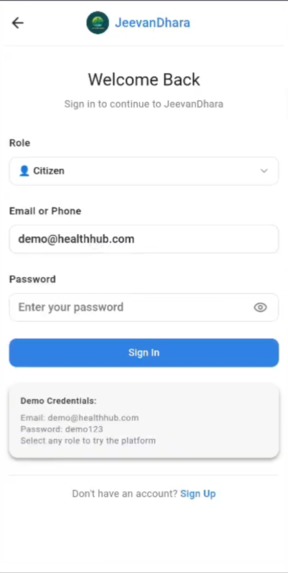
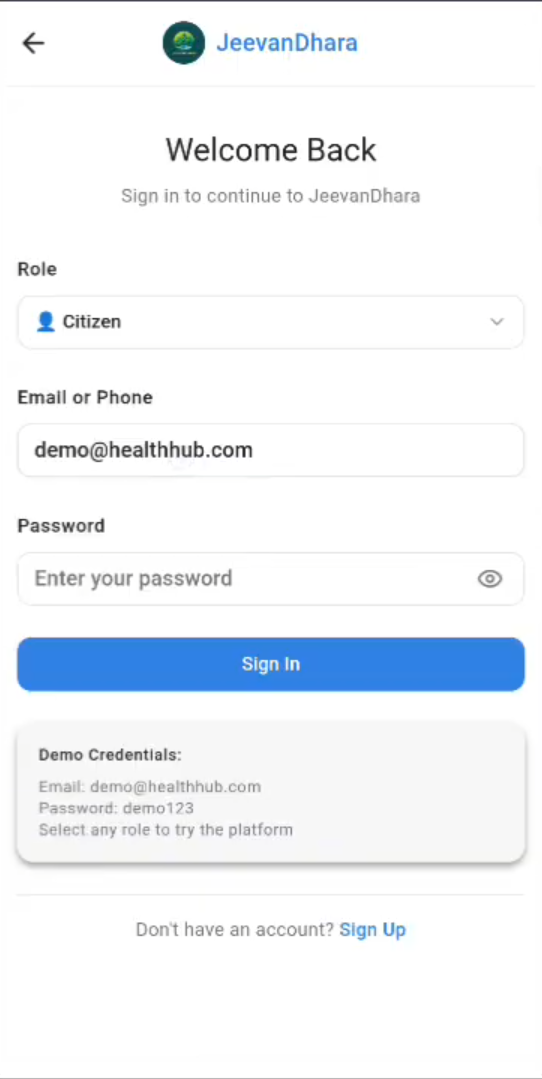
mobile
-

login
-
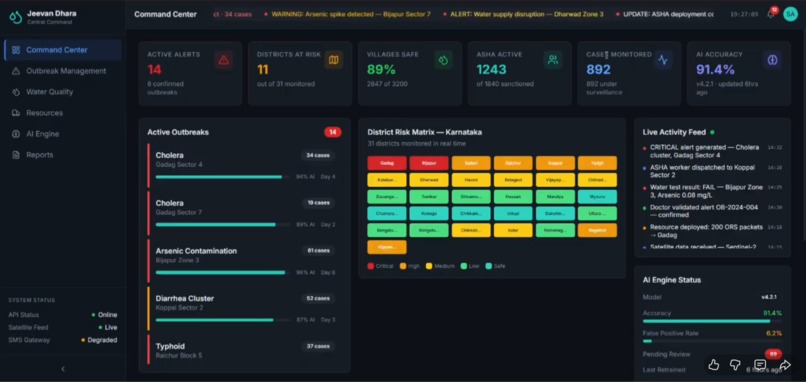
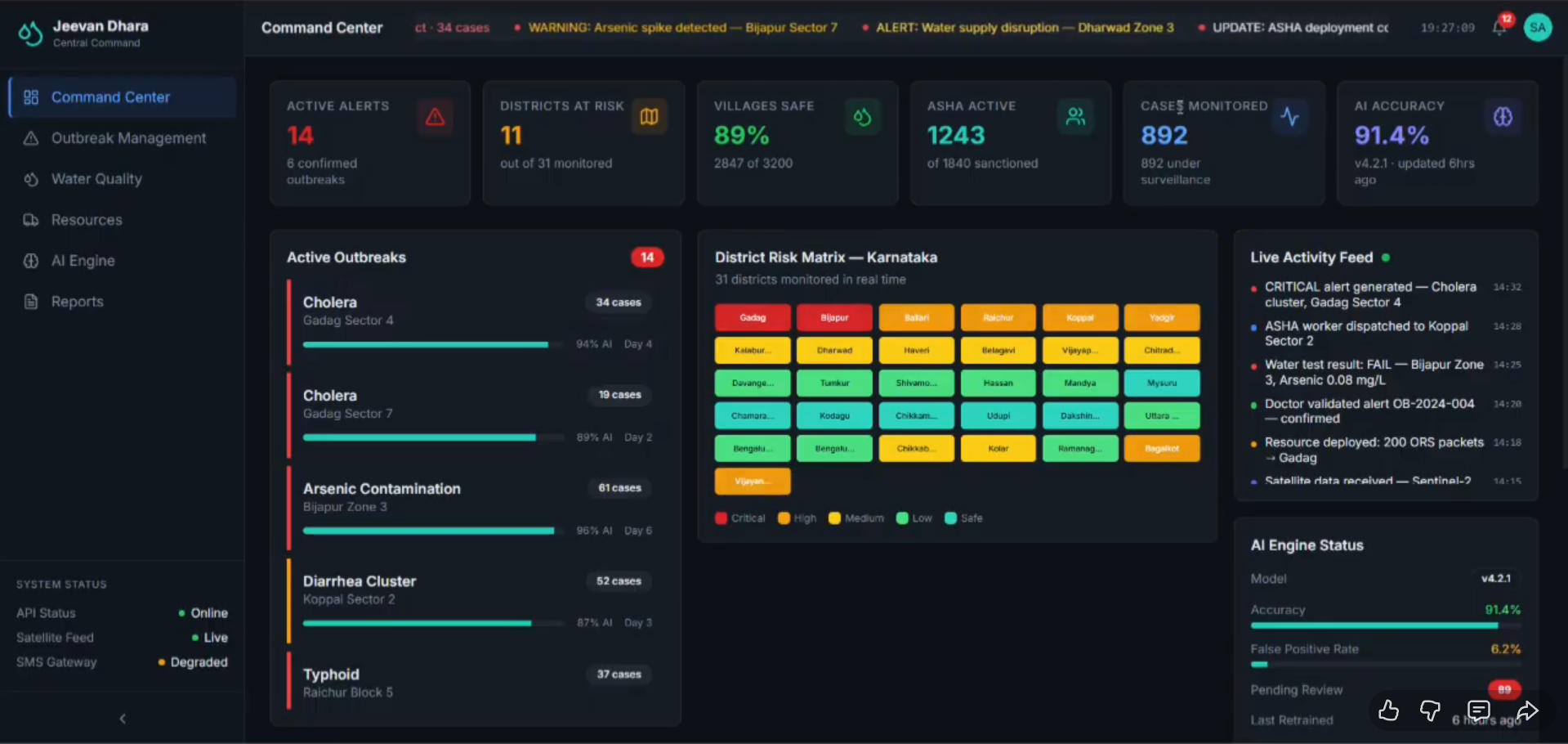
Central DashBoard
-
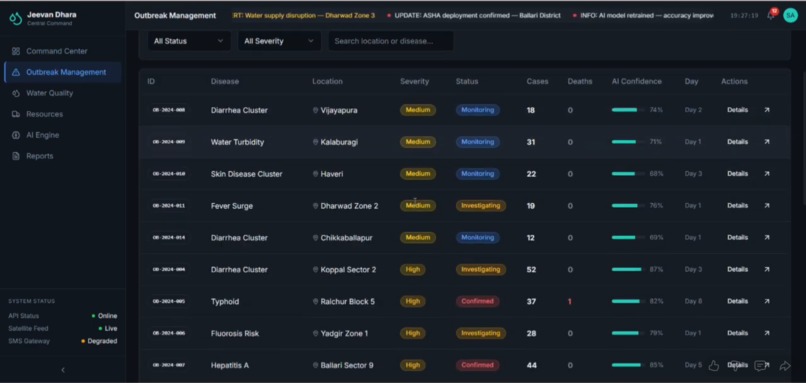
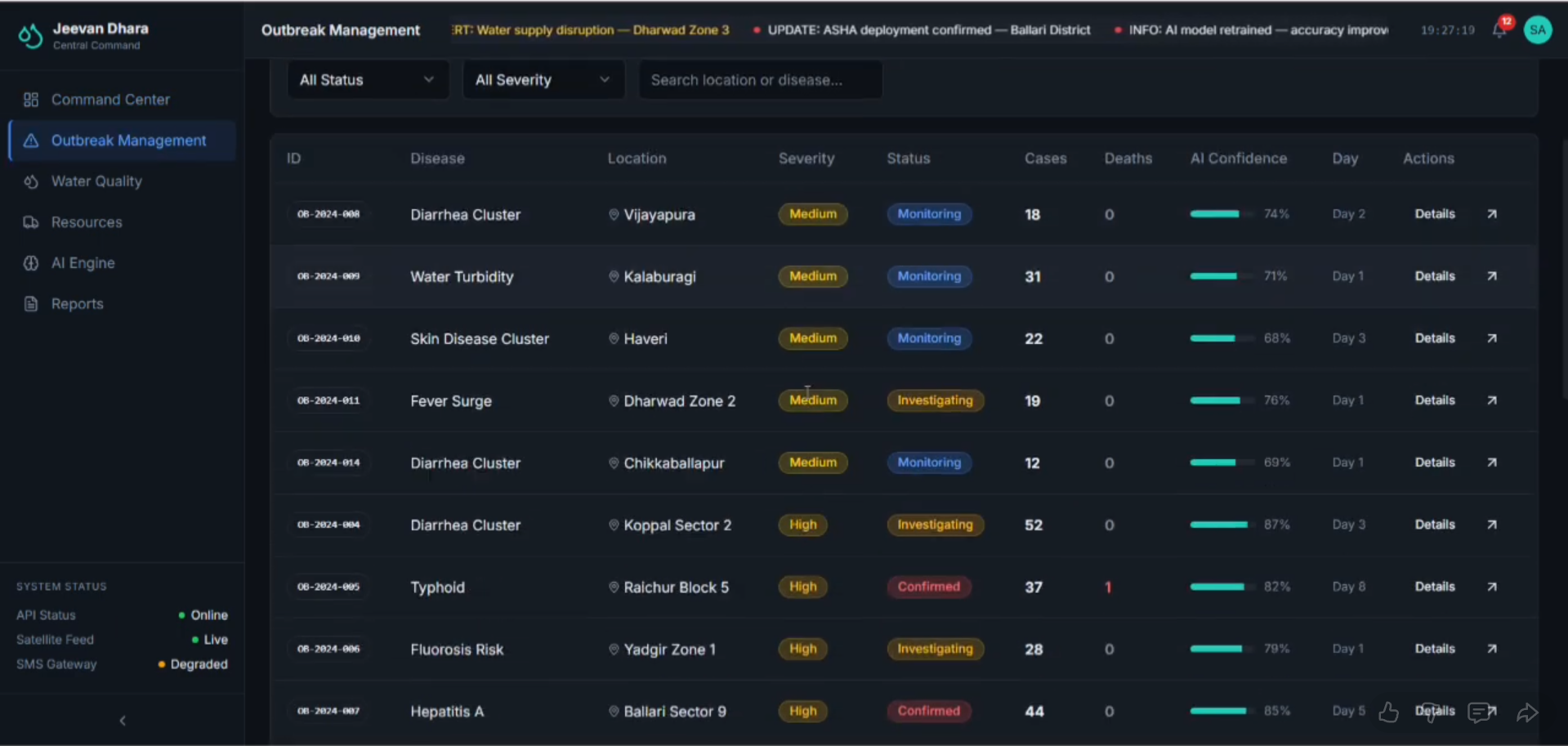
geospatial labeling
-
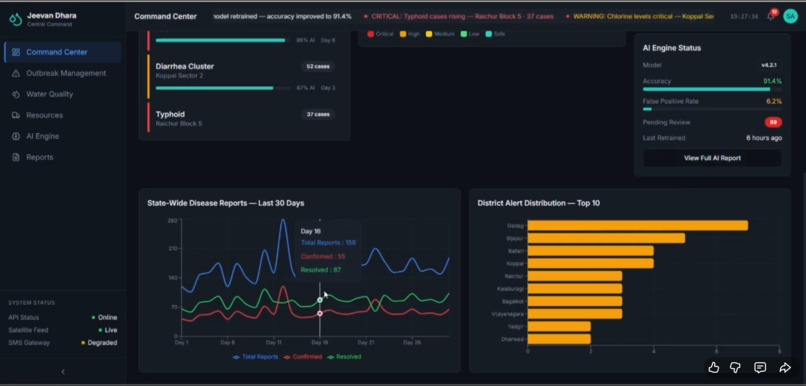
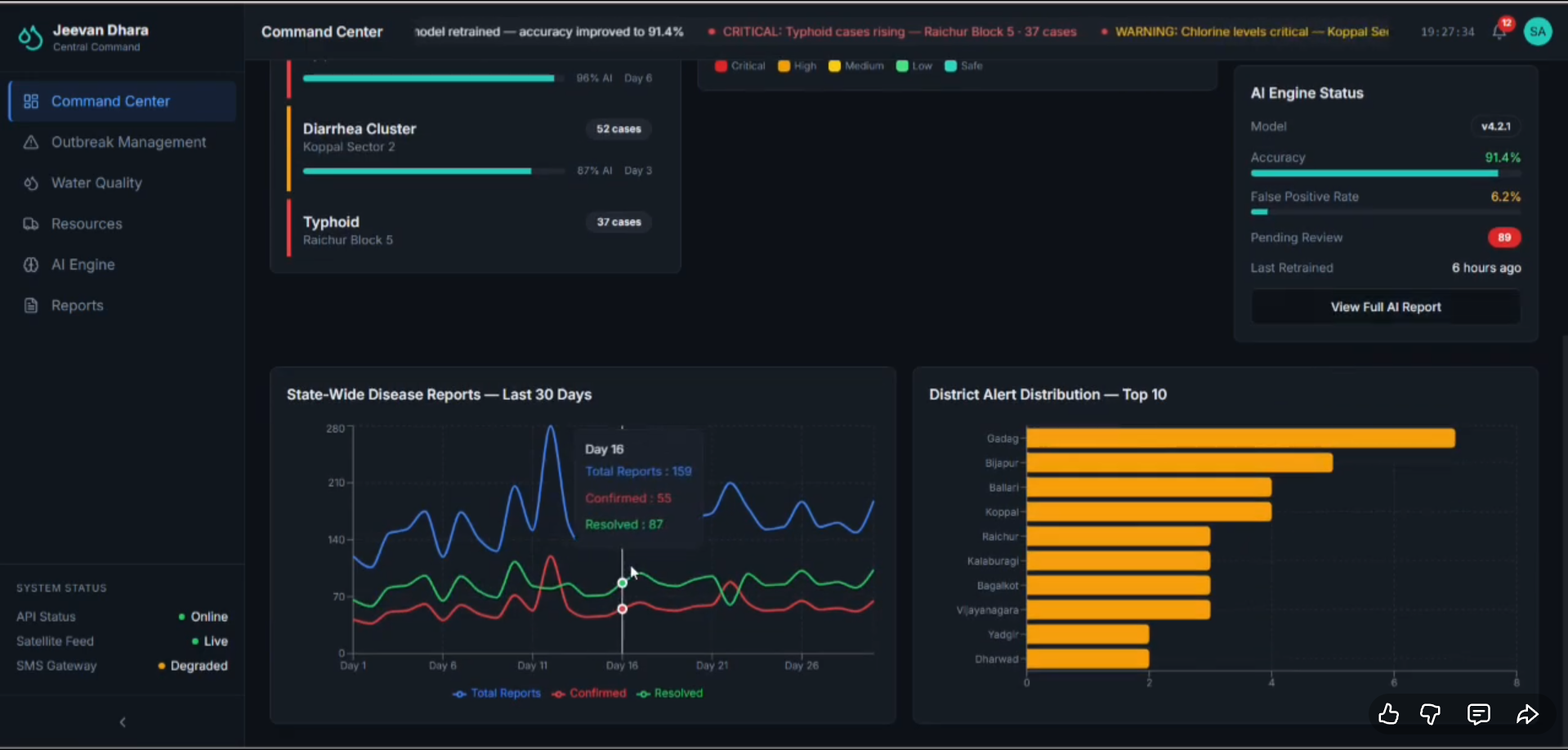
Trend Analysis

About the Project :- Jeevan Dhara
💡 Inspiration
There's a number that doesn't make the front page often enough: 3.77 crore.
That's how many Indians are struck by waterborne diseases every single year :- cholera, typhoid, dysentery, viral hepatitis illnesses that are almost entirely preventable. These diseases cost the nation roughly ₹4,900 crore annually. And the human cost? Around 1.5 lakh children are estimated to die of diarrhoea alone each year in India children who had names, families, and futures.
What makes this especially painful is that we know the solution. Clean water.
India has been sprinting toward that solution. The Jal Jeevan Mission, launched in 2019 when barely 17% of rural households had tap connections, has been one of the most ambitious infrastructure drives the world has ever seen. By 2024–25, rural tap water coverage had climbed from under 20% to near-universal reach. Pipes are being laid. Taps are being installed. The hardware is arriving.
But then came the number that quietly unsettled us: only 76% of household water samples actually pass basic laboratory microbiological tests even in villages officially declared "Har Ghar Jal." People equate water clarity and taste with safety, while microbial contamination stays completely invisible.
The pipes are there. The intelligence is not.
Right now, water quality monitoring still relies heavily on manual lab reports samples collected, shipped, tested, results returned. That process takes days. And clinical symptom data the early human signal that something is wrong lives in a completely different silo from water quality data. The result? Governments can only react after a hospital overflows. By then, hundreds are already sick.
We sat with that reality for a long time and asked a deceptively simple question: What if the system could warn us not after the outbreak, but before it?
That question became Jeevan Dhara.
🔍 What It Does
Jeevan Dhara is an AI-powered predictive health and water-defense platform, built from the ground up for rural India the India where connectivity is patchy, data is messy, and the people most at risk are the farthest from help.
The core idea is this: contaminated water leaves fingerprints. It shows up in IoT sensor readings before it shows up in a hospital ward. A spike in reported stomach aches across three adjacent villages is a statistical signal, not a coincidence. Satellite imagery of a flooded watershed upstream is a risk event, not just weather news.
Jeevan Dhara connects all these dots satellite imagery (EO/SAR), IoT water sensors, manual chemical test kit results, and grassroots clinical symptom reports from ASHA workers into a single AI pipeline that does one thing relentlessly: tell you where the danger is heading, up to 14 days before it arrives.
The AI Engine: A Four-Stage Pipeline
Rather than building a black-box model and hoping it works, we engineered something interpretable at every stage:
1. Smart Ingestion An NLP model takes the messy, multilingual, often spoken inputs from field workers and structures them into clean, machine-readable data. A health worker saying "ten people with loose motions since yesterday" becomes a structured data point the AI can actually reason over.
2. Instant Contamination Scoring A Tree-Based Meta Learner (Random Forest + XGBoost ensemble) processes incoming sensor and test kit data in real time, producing a Water Contamination Score with "Feature Importance" flags that tell you exactly which contaminant is the culprit bacterial load, pH deviation, turbidity, or otherwise.
3. Outbreak Forecasting A Recurrent Neural Network (GRU/LSTM architecture) learns from historical health timelines layered against water quality patterns and computes probabilistic outbreak forecasts across a 14-day horizon. In mathematical terms, we're estimating:
$$ \ P(outbreak \mid W_{t-n:t}, H_{t-n:t}, E_t) \ $$
where \(mathbf{W}\) is the water quality sequence, \(mathbf{H}\) is the health event history, and \(mathbf{E}\) captures live environmental signals like rainfall and flood proximity.
4. Automated Action Reports A custom LLM translates probability scores into plain-language alerts that a frontline health worker can actually act on — not a spreadsheet that a data scientist needs to decode first.
Graceful Degradation :- The Fallback That Makes It Real
Most AI systems are brittle. They assume clean, complete data. Rural India offers neither. Sensors break. Networks drop. Kits run out.
So we built a Flag System an adaptive logic layer that degrades gracefully instead of failing silently:
- 🔴 Red Flag — Sensors confirm contamination. Act now.
- 🟡 Yellow Flag — The most powerful feature. Even with sensors completely offline, if the NLP layer detects an anomalous cluster of clinical symptoms across a village, the system infers a biological risk and triggers an investigation alert. The absence of data becomes a data point.
- 🟢 Green Flag — Sufficient cross-verified evidence confirms the water is safe.
Zero-Internet Sync :- Bluetooth Mesh Hopping
Under JJM, over 24.80 lakh women have been trained to test water using Field Testing Kits but that data goes nowhere when there's no signal. We solved this with a Bluetooth Hopping Mesh Network: symptom reports and test results "hop" peer-to-peer between nearby phones until they reach a device with cellular connectivity, which then automatically bulk-uploads everything to the central server. No internet required at the point of collection. No data lost. No village left behind.
🛠️ How We Built It
We treated every architectural decision as if connectivity and reliability would always be the hardest constraints because in rural India, they always are.
- Frontend: Flutter + Dart a single codebase delivering a multilingual mobile app for citizens and ASHA workers, and a desktop command center for Medical Officers. Hive handles offline-first data caching locally so the app works even with zero signal.
- Backend: Node.js + Express, with a MongoDB Atlas + CouchDB hybrid for seamless offline-to-online data synchronisation.
- ML Layer: Python-hosted on Hugging Face and Render the NLP ingestion model, the XGBoost contamination scorer, and the GRU/LSTM forecaster each run as independent, updatable microservices.
- Data Foundation: We synthesised training datasets from real government sources the Central Ground Water Board (CGWB), the Assam Pollution Control Board, and the Integrated Disease Surveillance Programme (IDSP) to ensure our models reflect the actual distribution and seasonality of Indian waterborne disease events.
🧱 Challenges We Ran Into
1. The "Perfect Data" Myth
Real government health data is not clean. It's imbalanced, incomplete, and dominated by the boring outcome — "no outbreak." Severe contamination events are statistically rare, which means a naive model learns to always predict "safe" and achieves high accuracy while being entirely useless.
We tackled this with TS-SMOTE — Time-Series Synthetic Minority Over-sampling Technique — which generates synthetic sequences of high-risk events during training, forcing the model to take the rare, dangerous outcomes seriously. This was not a plug-and-play fix; calibrating the over-sampling ratio without introducing unrealistic patterns required weeks of iteration.
2. The Connectivity Barrier
Designing the Bluetooth mesh sync was conceptually elegant but practically brutal. Data packets would duplicate, arrive out of order, and corrupt as they hopped across devices with different OS versions, Bluetooth stack implementations, and storage limits. We had to build deduplication checksums, sequence-aware reassembly logic, and conflict-resolution protocols from scratch none of which exist off the shelf for this specific use case.
🏆 Accomplishments We're Proud Of
- An AI pipeline that doesn't crash when data goes missing a feature, not a limitation, of our architecture.
- A 14-day outbreak forecast window validated against historical IDSP epidemiological data.
- A Bluetooth mesh sync that works across feature phones and smartphones with zero shared infrastructure.
- An interface that a first-generation smartphone user in rural Assam can navigate in their own language, without training.
📚 What We Learned
We learned that a 99% accurate model means nothing if the data from the village can't reach it.
The real engineering problem wasn't the AI. It was building something that could survive power outages, broken sensors, absent internet, and a health worker with ten minutes between home visits. Solving for resilience taught us to treat every missing data point as a signal in itself and that philosophy is now baked into how our Yellow Flag inference system works.
We also learned that technology doesn't replace trust. The ASHA worker network is 10 lakh people strong. Our system only works if they believe in it, which means it has to speak their language, give them clear guidance, and make their job visibly easier not more complicated.
🚀 What's Next for Jeevan Dhara
The architecture we built is modular by design. The satellite imagery pipeline, the symptom clustering engine, the environmental data ingestion all of it can be pointed at a different disease vector without rebuilding from scratch.
Our immediate next step is extending the model to vector-borne diseases Dengue and Malaria using the same environmental and clinical signal fusion approach. The stagnant water that breeds mosquitoes after a flood and the contaminated water that spreads cholera are often the same water, in the same flood, in the same village.
The larger vision is full integration with Jal Jeevan Mission and Ayushman Bharat building Jeevan Dhara into the operational intelligence layer that these missions currently lack: not just pipes to every house, but a living, predictive immune system for rural India's public health.
WHO estimates that achieving truly safe water access for every Indian household could prevent close to 4 lakh diarrhoeal deaths and save approximately 1.4 crore Disability Adjusted Life Years (DALYs). We built Jeevan Dhara because we believe that number shouldn't wait for infrastructure alone. Intelligence can close that gap, faster.
Jeevan Dhara Because the river of life should never run toxic.
Built With
- bluetoothmesh
- couch.db
- eodata
- fastapi
- huggingface
- node.js
- react
- typescript
- vectordb
- vercel


Log in or sign up for Devpost to join the conversation.