Inspiration
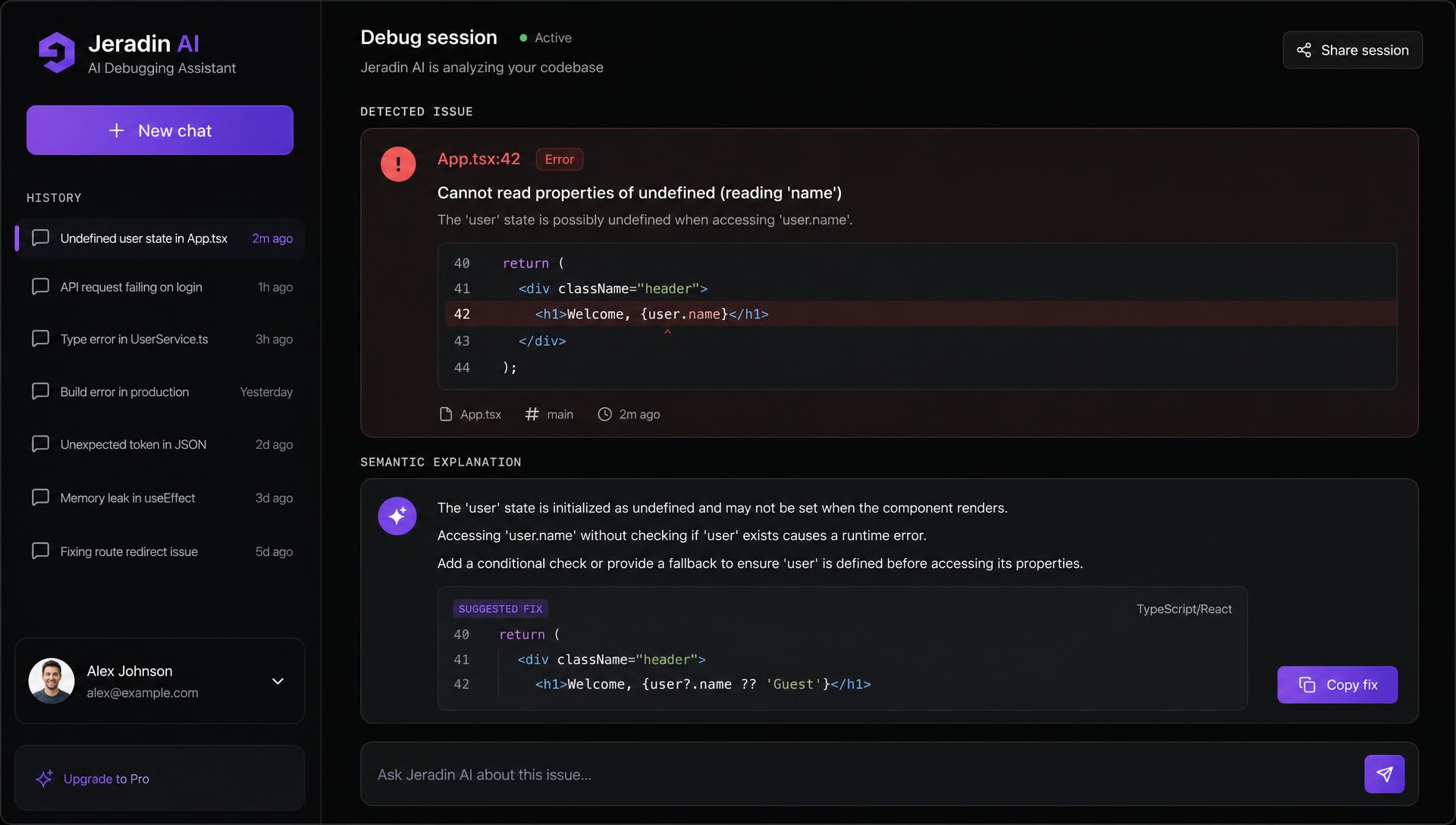
We kept watching builders lose whole days to the same loop: hit an error, screenshot it, paste it into a chat tool, get an answer that has no idea what the rest of the codebase looks like, try it, fail, repeat. The AI was smart but blind. It could not see the screen you were staring at, and it could not see the 400 files around the one you pasted. We wanted an AI that looks at what you are looking at.
What it does
Jeradin is one intelligence layer with four surfaces.
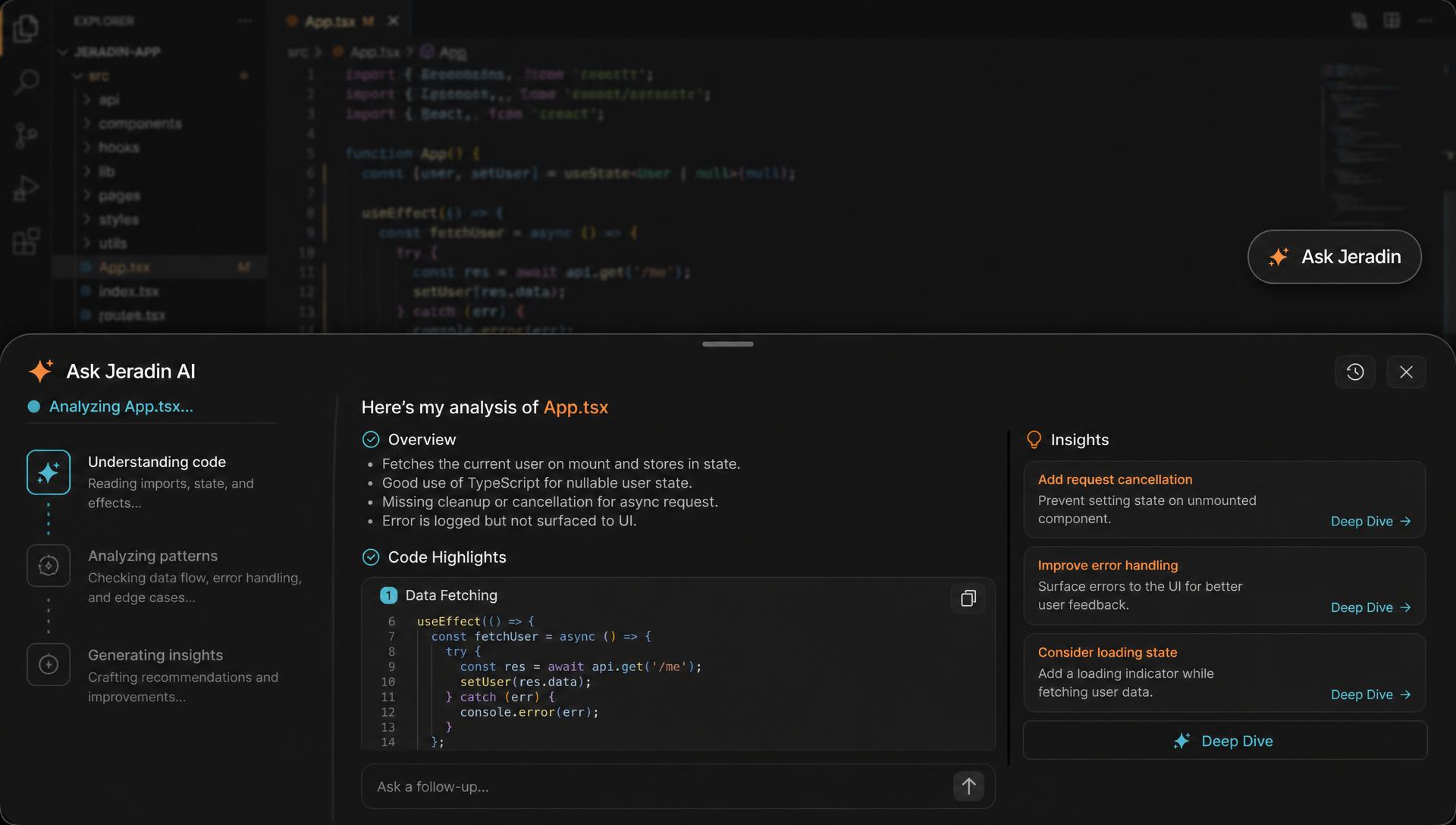
Screen Intelligence. You share your screen, and the moment you stop sharing, a floating "Ask Jeradin" pill appears right in the tab you are working in. An overlay streams the analysis in place: what it sees, what is failing, why it is failing, and ready to paste code. You never leave your work to get the answer.
System Intelligence. Point it at your repository and it produces a code health score, technical debt map, complexity heatmap, business logic graph, a refactor plan, and a new developer onboarding guide. It reads the whole project, not one file.
GitHub Intelligence. Ask questions about your real repository and get answers grounded in the actual files, with the file paths as evidence. No guessing, no hallucinated function names.
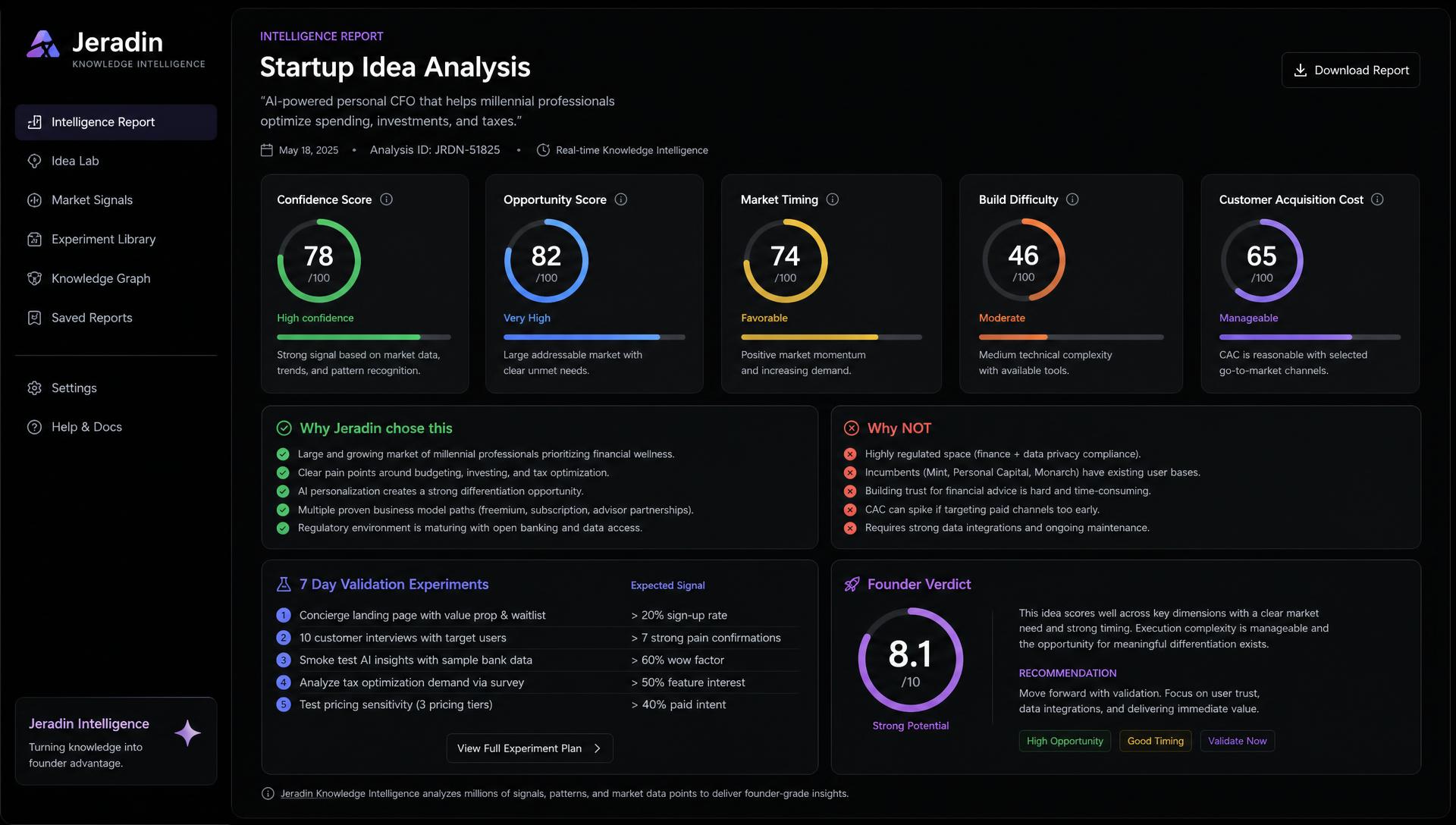
Knowledge Intelligence. Validate an idea, a market, a price point or a stack choice. It returns confidence scores, funding chance, market timing, build difficulty, customer acquisition cost, why we chose this, why not this, and a seven day validation experiment you can actually run.
Everything streams section by section so you read the first answer while the rest is still being written. History syncs across devices, and a Chrome extension carries the overlay into any tab.
How we built it
React and TypeScript on TanStack Start, running server functions on Cloudflare Workers at the edge. Postgres with row level security for per user isolation, plus pgvector for semantic code search. A Chrome MV3 extension injects the overlay through a Shadow DOM so it never collides with the page it sits on. An intent router picks the right model and the right depth for each request, and every response streams over NDJSON so sections render independently instead of the user waiting on one giant blob.
For the codebase surfaces we index repositories into a graph of files, symbols and edges: what imports what, what defines which route, which code reads or writes which database table. That graph is what lets Jeradin answer questions about a whole system instead of one snippet.
Challenges we ran into
Cross tab overlays are a browser security wall. The web platform will not let a page draw over another origin, so we had to build the extension to do it properly, and make it correctly target the tab the user was actually sharing.
Speed was the second wall. First versions took twenty seconds and felt dead. We got Screen Intelligence to first token in one to three seconds by running sections in parallel, streaming progressively, and routing simple requests to a fast model instead of a heavy one.
Third was metering. Billing per analysis while streaming, without double charging on retries or letting a failure silently bypass the meter, took several passes to get right.
Accomplishments that we're proud of
Sub three second first token on screen analysis. A real cross tab overlay that works outside our own app. A repository graph that answers architecture questions with file level evidence. And a working credit system with live payments, built by a very small team.
What we learned
Context beats model size. A mid tier model that can see your screen and your repository beats a frontier model that can only see the paragraph you pasted. We also learned that streaming is not a nice touch, it is the difference between a tool that feels alive and one people abandon at second eight.
What's next for Untitled
Deeper repository reasoning across multiple repositories, an API so other tools can call the same intelligence layer, team workspaces with shared history, and pushing the overlay to more surfaces including the desktop.
Built With
- chrome
- cloudflare-workers
- gemini
- pgvector
- postgresql
- react
- tanstack-start
- typescript
- vite