
Inspiration
Jento started from a problem we experienced ourselves — planning a trip can sometimes feel like a project on its own. We found ourselves jumping between Instagram reels, YouTube videos, Google Maps, booking websites, screenshots, and notes just to plan a few days away.
We wanted to build something that could take all those scattered ideas and turn them into a trip that actually feels personal. That’s how Jento came about: an AI travel companion that helps you go from “Where should we go?” to “Okay, our trip is planned!” without all the hassle.
What it does
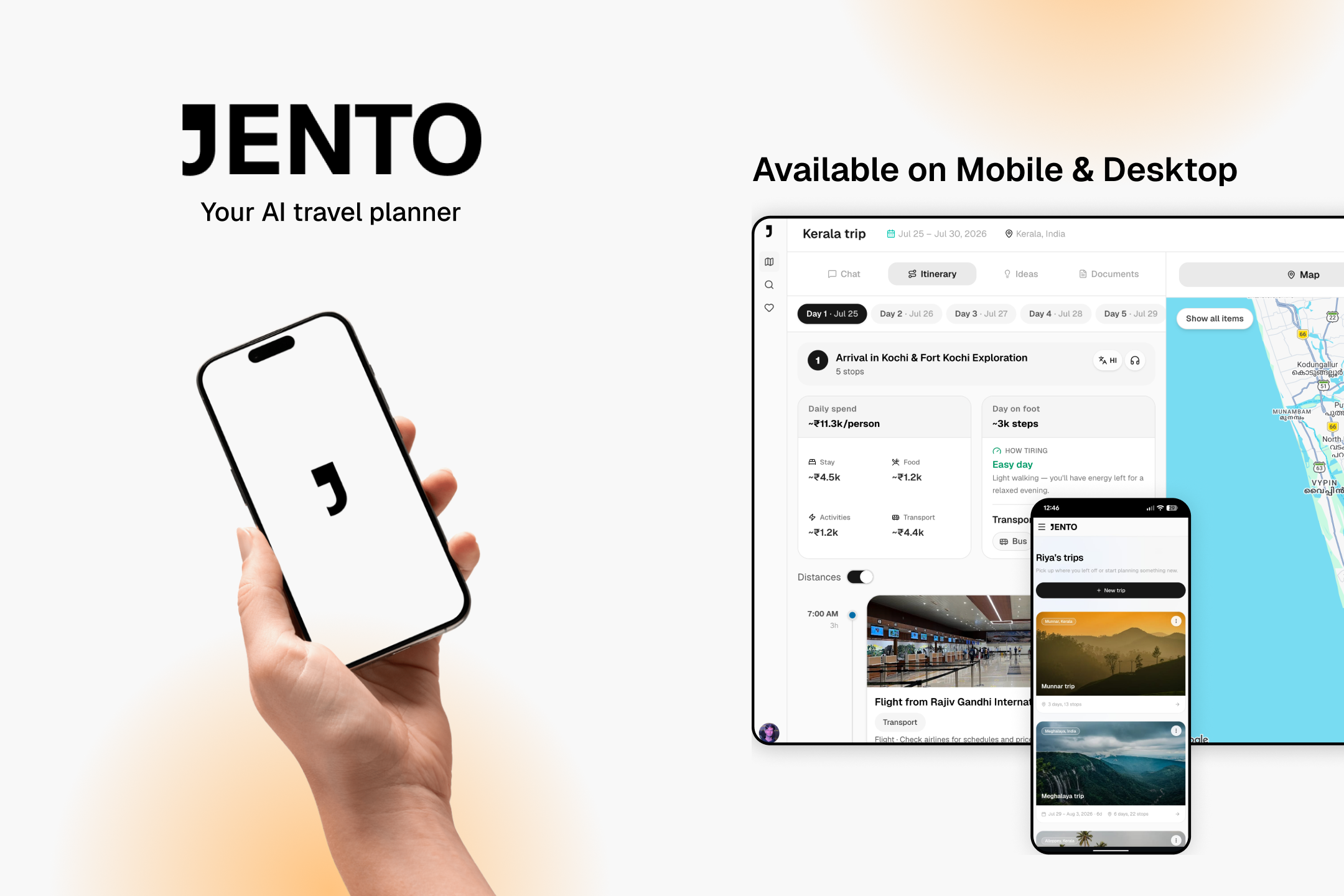
Jento is an AI-powered travel companion that helps you plan and manage trips in one place.
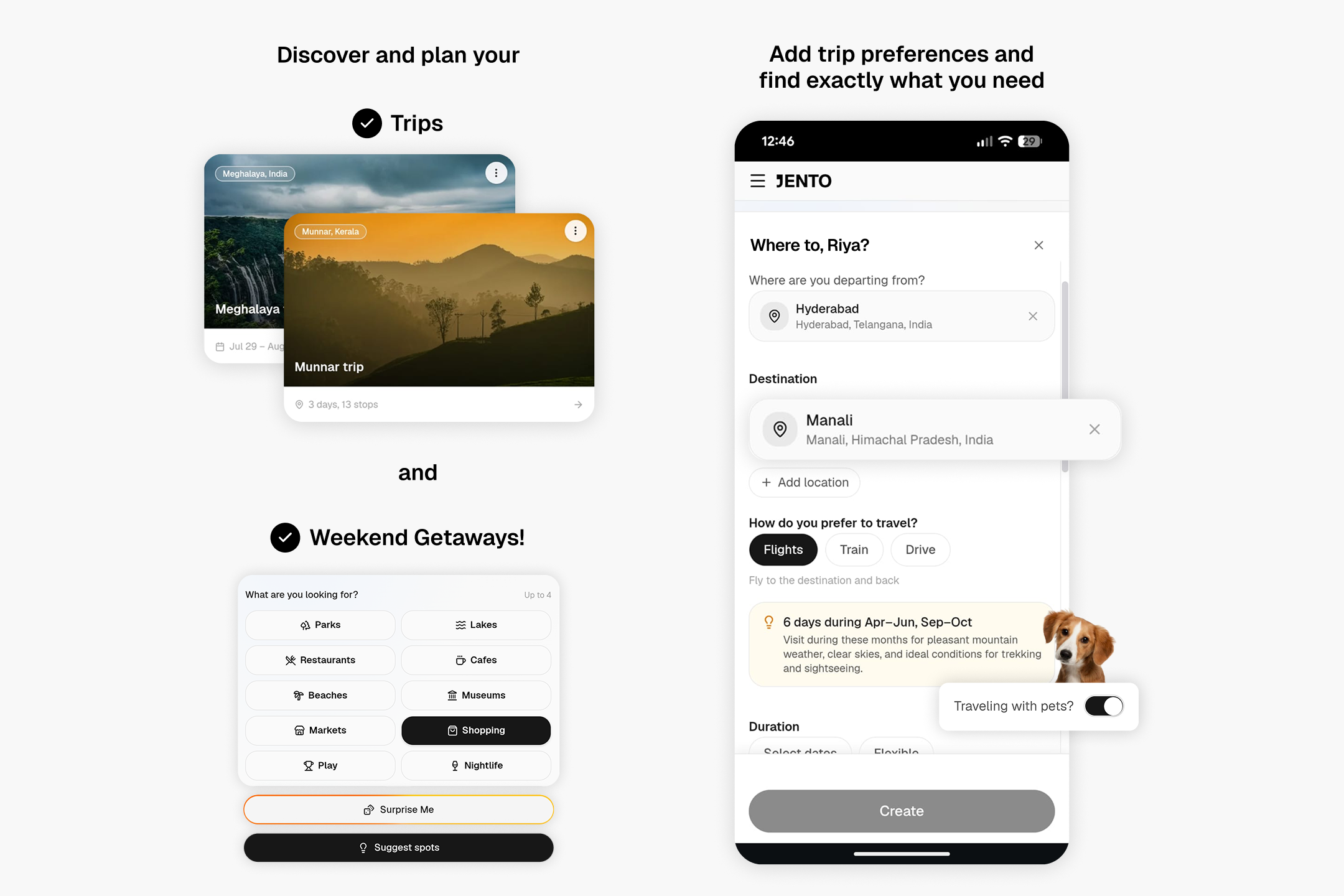
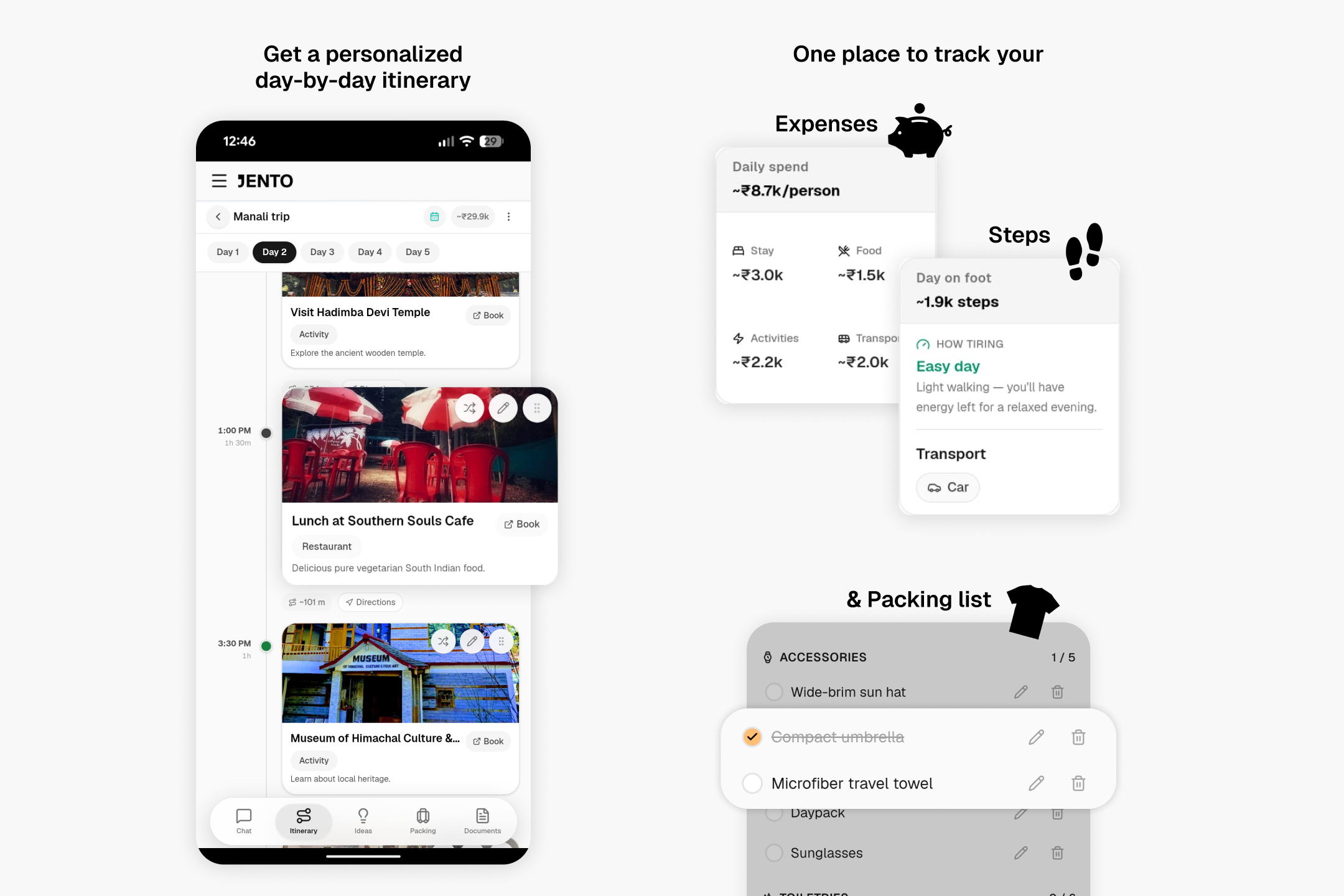
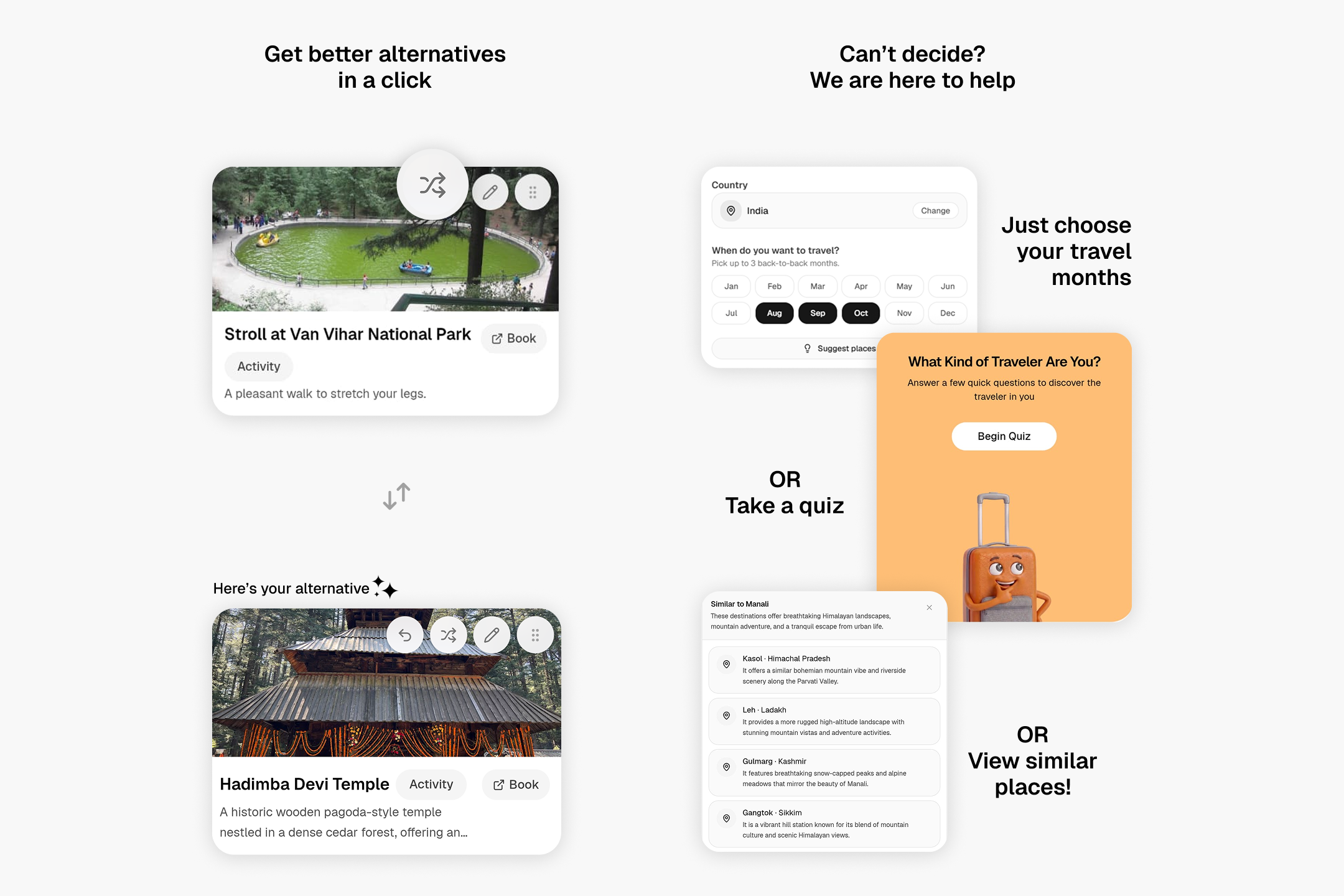
Enter your destination, dates, budget, interests, and preferences, and Jento creates a personalised itinerary you can easily customise. You can also plan quick weekend getaways, discover new places, or find places based on your interests.
Jento also helps you:
- Estimate trip expenses
- Generate activity-based packing lists
- Store bookings and travel documents
- Share trips with your companions
How we built it
We started by breaking down the travel-planning journey and identifying where people spend the most time and effort. From there, we designed and tested the experience, then built the product around AI-generated itineraries.
We gradually added features that solve the smaller problems around a trip too — like estimating expenses, generating a packing list based on the itinerary, keeping travel documents together, and easily creating weekend plans.
These came from thinking about what happens before, during, and around the trip, not just the itinerary itself.
Our goal throughout was to keep the experience simple:
Tell Jento what you want, get a plan, and make it yours.
Challenges we ran into
The single hardest problem wasn’t the AI itself, but making its output actually work in the real world.
Gemini would sometimes suggest a museum on Monday when it’s closed, a “short walk” between stops 8 km apart, or a restaurant that closed two years ago — and users would find out on day one, standing in front of a locked door in a foreign city.
That gap between “sounds plausible” and “logistically correct” is where most trip planners quietly die.
We tackled it with a server-side trust layer that includes:
- Strict schemas and prompts
- Google Maps grounding
- Post-save enrichment against real Places and Directions data
- Schedule recomputation when users edit their itinerary
- Budget correction grounded in live SerpApi prices
- Disconnect-safe generation so plans survive mobile drop-offs
This ensures Jento doesn’t just chat about trips — it produces itineraries you can actually follow.
Accomplishments that we're proud of
We're especially proud of creating an experience where AI isn't just a chatbot — it actually helps users create, customise, and manage an entire trip in one place.
We've built more than just an AI itinerary generator by focusing on creating a complete travel planning system where different features work together to make the experience more useful.
One of our biggest accomplishments has been building Jento so that the AI can work with multiple inputs such as:
- Destination
- Dates
- Budget
- Interests
- Travel preferences
These inputs are used to generate a structured and accurate itinerary rather than a generic list of recommendations.
This gives Jento an edge because we're not treating AI as a standalone chatbot; we're using it as the intelligence layer across the entire travel-planning experience.
What we learned
Building Jento taught us that a good AI product needs more than a good prompt. We had to constantly move between designing, building, testing, and refining the experience.
We learned two key technical lessons:
1. Grounding beats hallucination
An AI inventing a restaurant or hotel can quickly break user trust.
We use Gemini’s Google Maps grounding to verify recommendations and attach real Google Place IDs, while using trip coordinates to keep recommendations geographically relevant.
2. LLMs need structure, not just flexibility
Free-form chat works well for discovery, but itineraries need consistency.
We used Zod and Gemini to ensure every itinerary element follows a predictable structure before reaching our database.
We also learned that AI doesn't have to do everything for the user.
For Jento, we found that people want a starting point, not a fixed plan.
For example, AI can create a day-by-day itinerary, but the user should still be able to swap a place, change the pace, or add something they discovered themselves.
What's next for Jento — AI Trip Planner
We're just getting started.
Our next focus is to make Jento smarter, more personalised, and more useful throughout the entire travel journey.
We want Jento to:
- Better understand individual travel styles and preferences
- Improve recommendations based on real user behaviour and feedback
- Become more personalised over time
- Eventually become something you can rely on from the moment you start thinking about a trip until you come back home
Jento isn't just about planning your next trip. We're building an AI travel companion for the entire journey.
Built With
- clerk
- cloudinary
- cursor
- gemini
- google-directions
- google-maps
- google-places
- neon
- nextjs
- postgresql
- prisma
- serpapi
- tailwind
- unsplash
- vercel
- zod


Log in or sign up for Devpost to join the conversation.