-
-
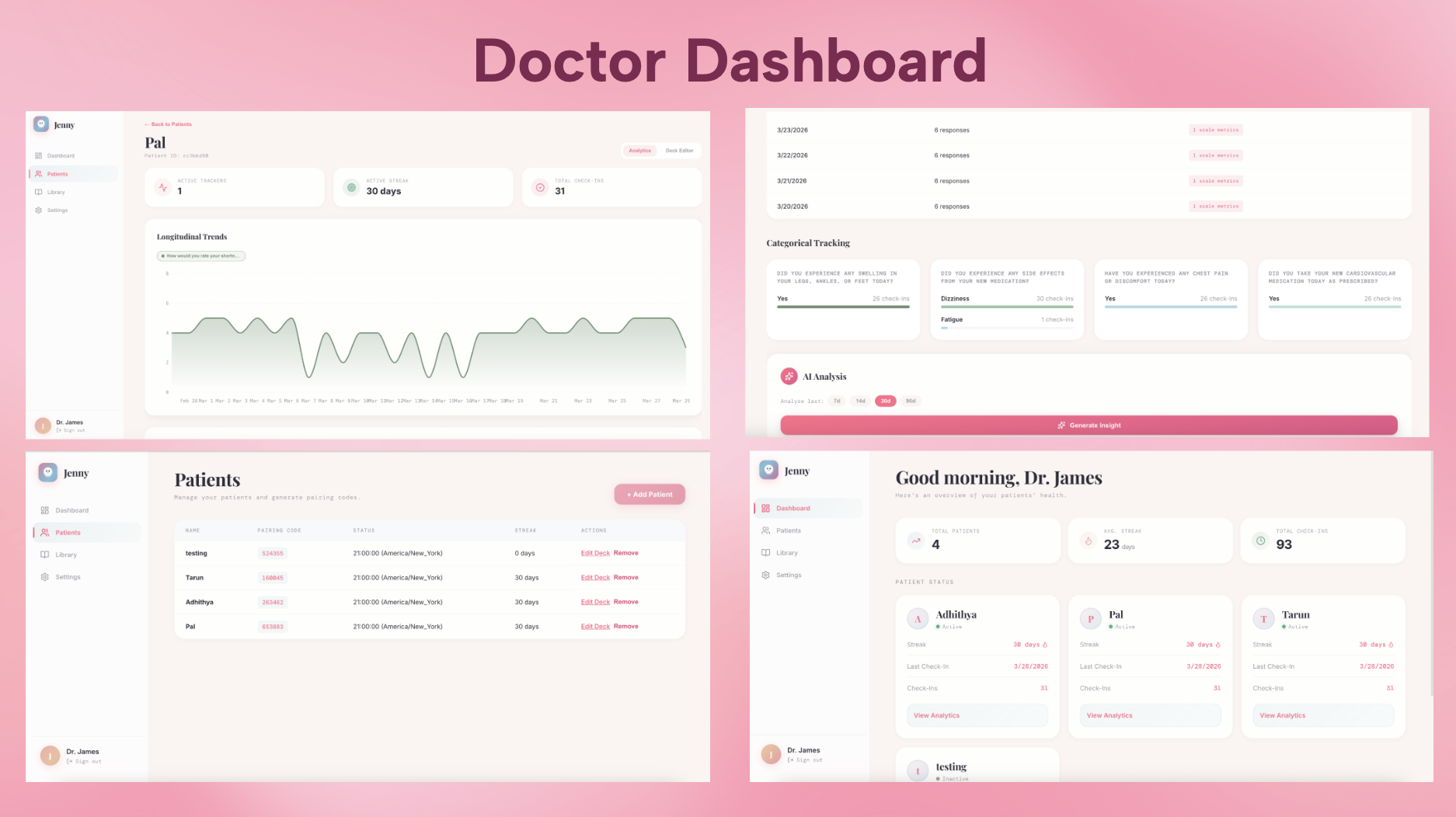
Doctor Dashboard
-
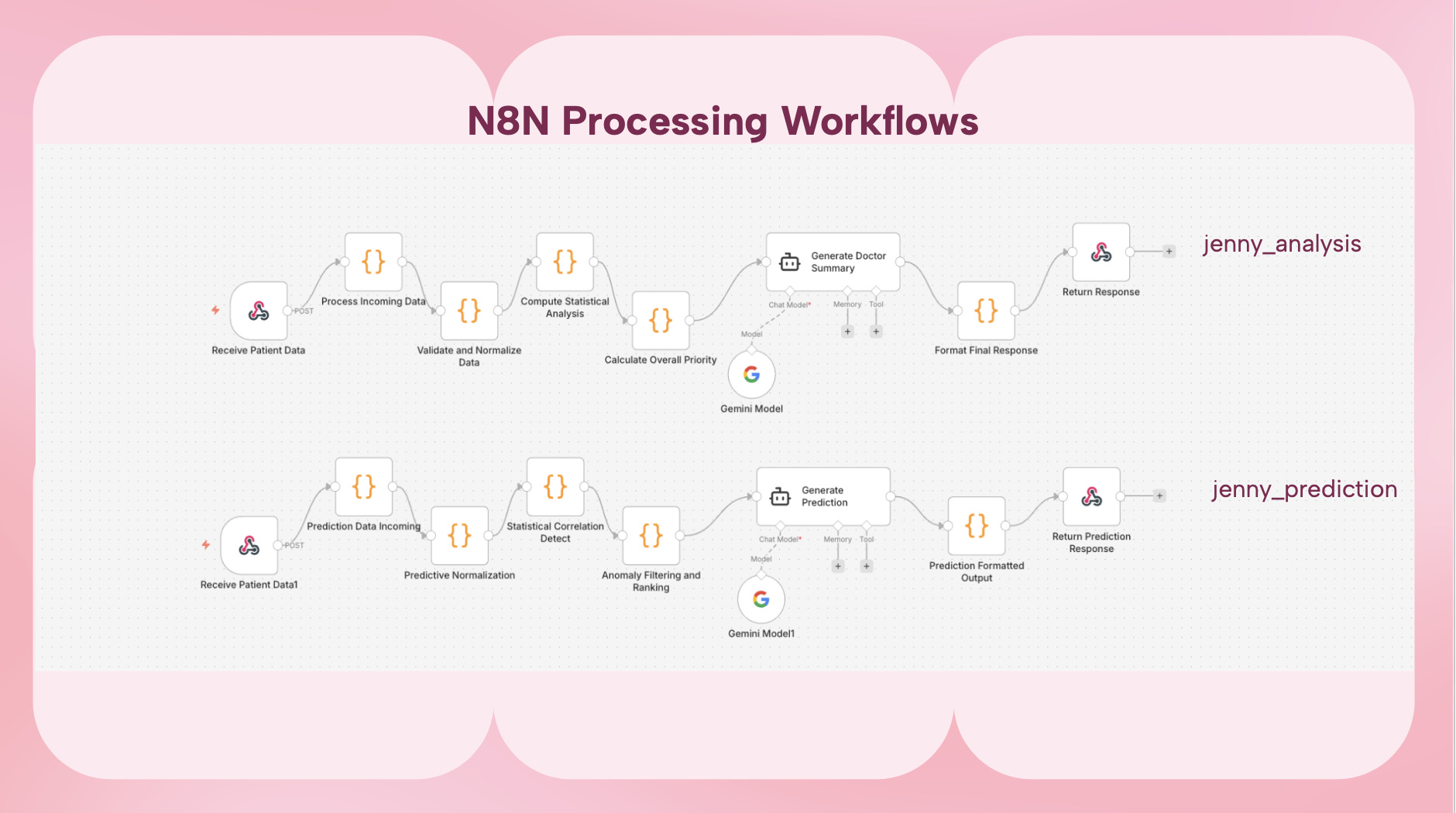
Backend Architecture
-
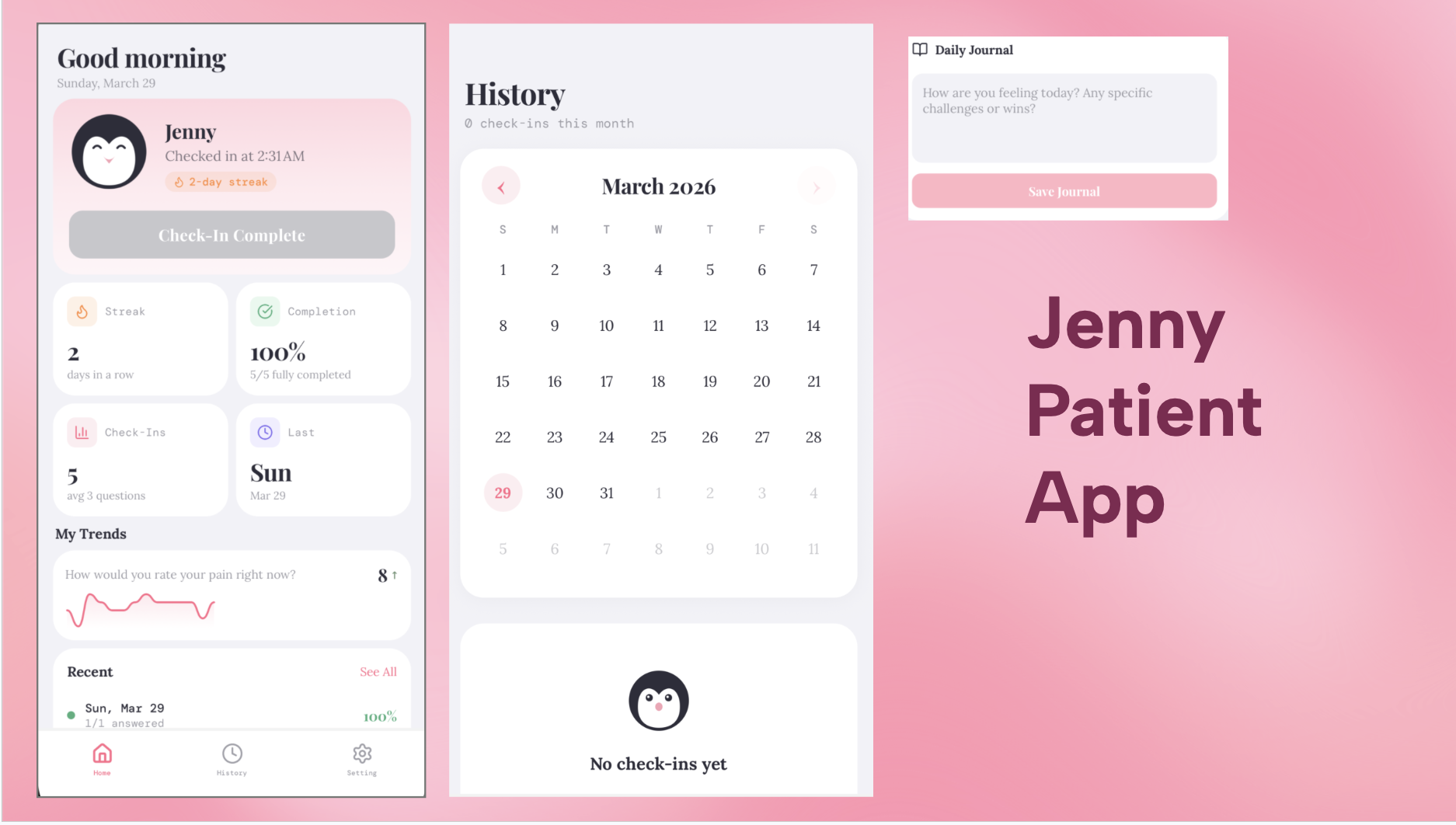
Jenny Patient App
-
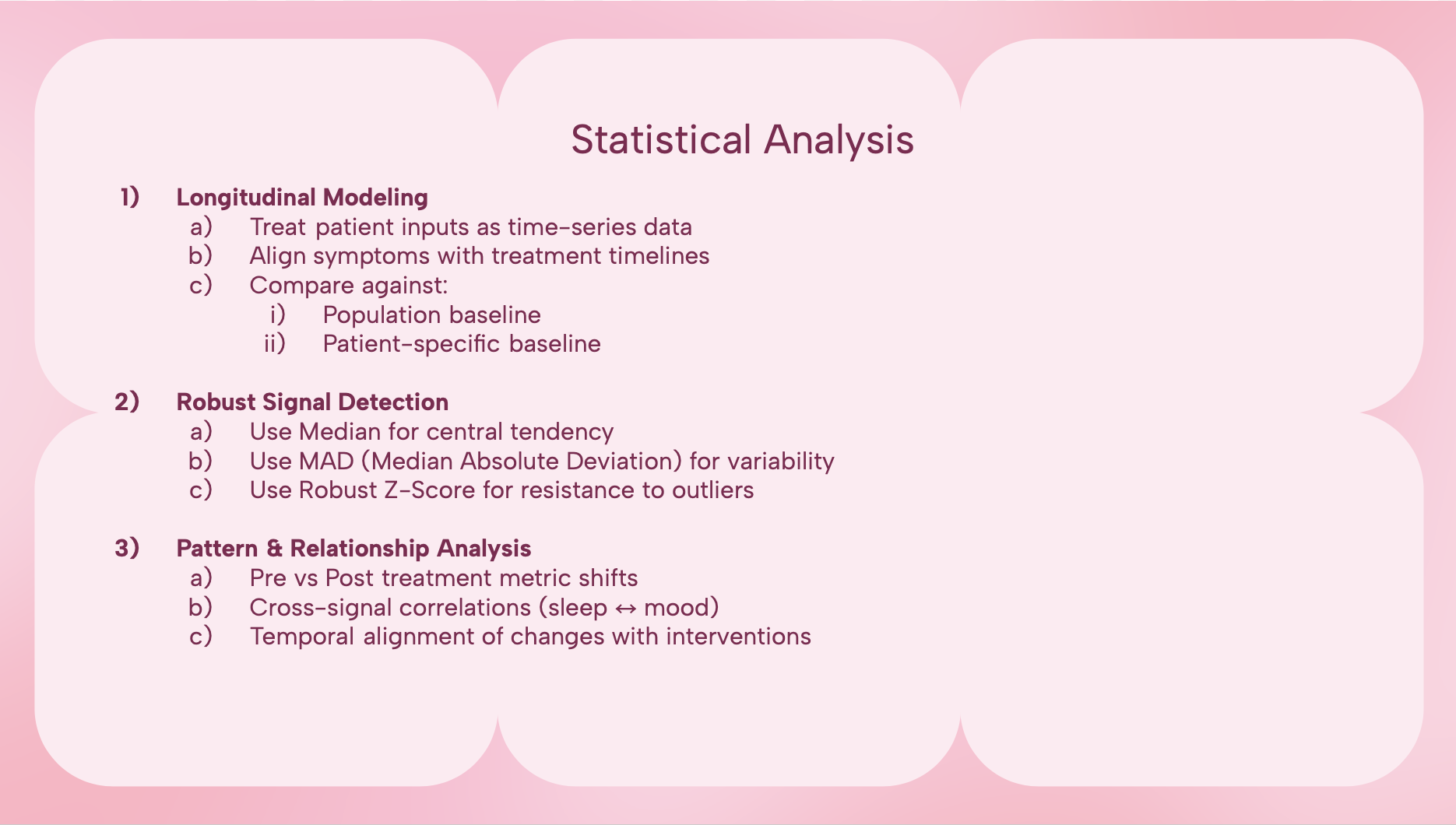
Statistical Analysis
-
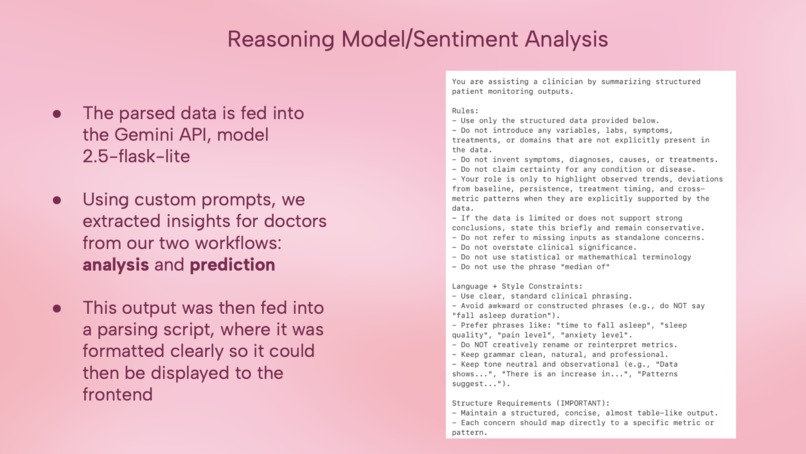
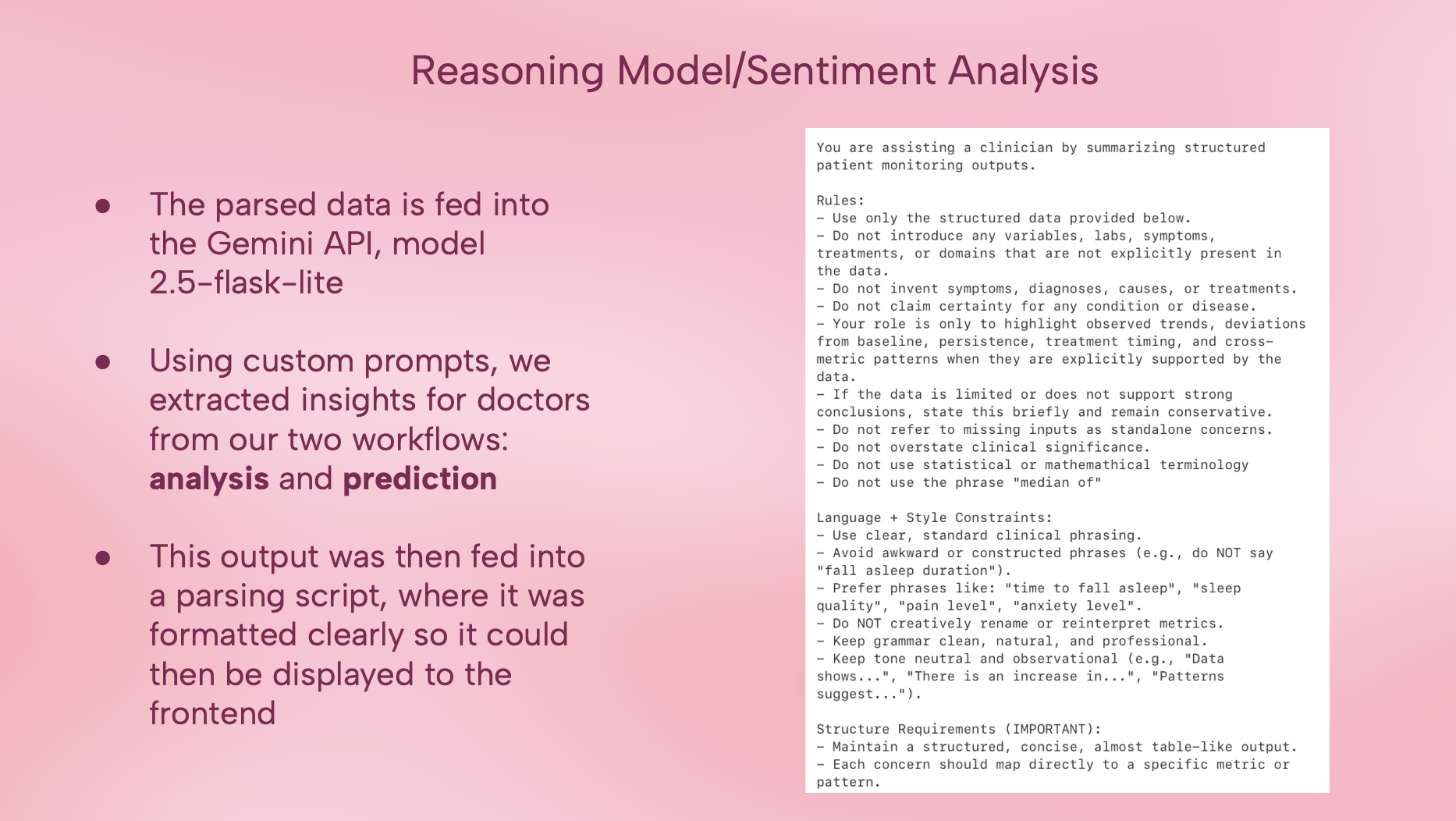
Model Prompt
Inspiration
When we started talking to doctors about how they keep tabs on patients between appointments, every conversation pointed to the same problem. After sitting down with physicians, we kept hearing that there is almost no reliable way to check in on patients between visits.
Medication side effects, stress-induced behaviors, and hormonal irregularities can all change significantly in the weeks or months between appointments, and doctors have no window into any of it until the patient is back in their office.
The financial cost of this is substantial. According to a 2025 study, the U.S. healthcare system wastes an estimated $935 billion annually in avoidable costs driven largely by delayed medical interventions. Additionally, chronic diseases account for roughly $4.1 trillion in annual U.S. healthcare spending and managing them well requires ongoing data that a single yearly appointment cannot provide.
What came through most in our conversations was how doctors were not asking for anything complicated, just a consistent way keep track of their patients between visits. That is what Jenny solves.
What it does
Jenny gives doctors a simple way to stay connected with their patients without scheduling another appointment. When setting up their account, doctors choose from a pre-built question bank covering common clinical areas like mood, energy, pain levels, medication adherence, and sleep, or they can write their own custom questions tailored to a specific patient or condition.
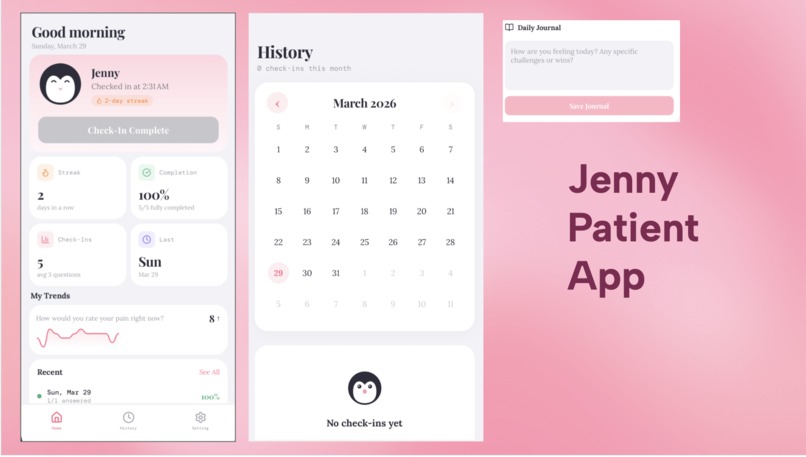
Once configured, Jenny sends those questions directly to patients on a schedule the doctor decides. The questions are kept short and designed to feel approachable rather than clinical, so patients are actually likely to answer them. Think quick taps and simple responses rather than long forms.
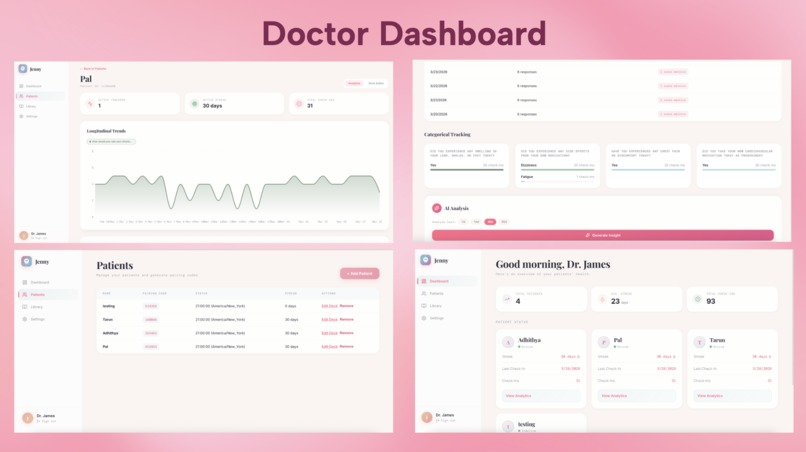
On the doctor side, the answers feed into a clean dashboard where trends and changes become easy to spot over time. If a patient's responses start shifting in a concerning direction, the doctor can see that before the next scheduled visit and act on it. The whole system is built around the idea that a few simple, well-chosen questions asked consistently can generate more useful clinical insight than a single comprehensive appointment once a year.
How we built it
Jenny runs on a React Native and Expo Router mobile app for patients, paired with a Next.js 14 web dashboard for doctors. Everything is connected through Supabase, which handles our database, authentication, and realtime syncing. Patients link to their doctor through a simple 6-digit pairing code that doctors generate from the dashboard.
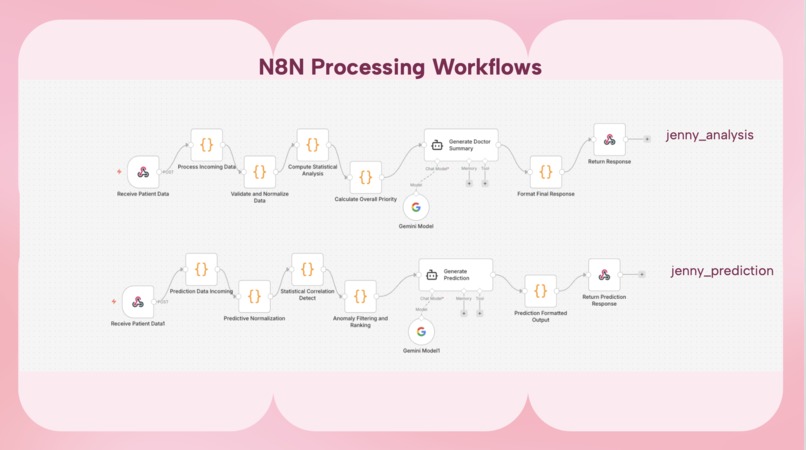
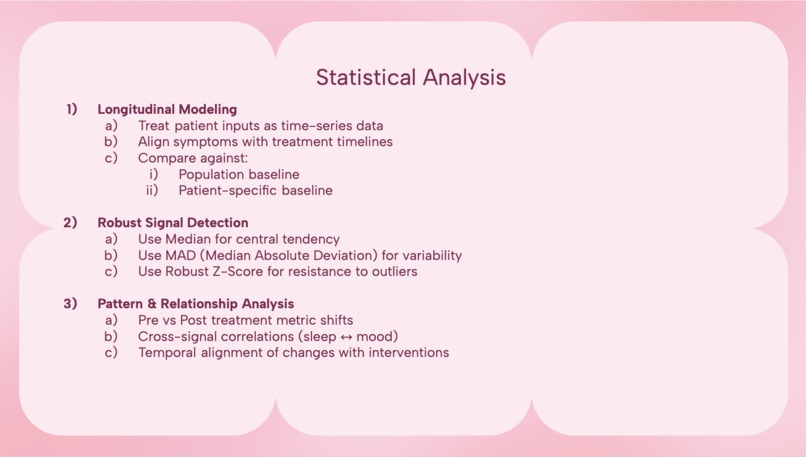
Response data is visualized two ways: interactive area charts for tracking metrics like mood and pain over time, and GitHub-style heatmap grids for yes/no and categorical patterns. Doctors can also hit a single button to generate an AI-powered summary of a patient's recent responses, processed through an n8n webhook pipeline connected to the Gemini API. The mobile app also supports offline mode, queuing responses locally and syncing them once a connection is restored.
Challenges we ran into
UI/UX - making the patient-facing questions feel light and engaging rather than like a medical form, while still capturing clinically useful data across very different question types like scales, mood grids, and yes/no toggles.
Data visualization - building the heatmap grids and area charts to meaningfully represent sparse or irregular response data was tricky, since patients don't always answer on a consistent schedule and gaps in the data needed to be handled without the charts looking broken.
Offline sync - queuing responses locally and reliably syncing them to Supabase without creating duplicates or out-of-order submissions required careful handling on the mobile side
Accomplishments that we're proud of
Honestly, the thing we are most proud of is how Jenny looks and feels. Building something that sits in the healthcare space without feeling cold or clinical was harder than we expected. We wanted patients to actually want to open the app, and that meant putting real thought into the visual design, the question formats, and the way information is presented. The heatmap grids and charts weren't just meant to be functional, we wanted them to be satisfying to look at. Getting that balance right, something a doctor trusts and a patient enjoys using, felt like the core design challenge of the project and we think we nailed it.
What we learned
By far it was the technical component. This was our team's first Hackathon, and so we had a large learning curve to overcome when it came to using our tech stack (Supabase, n8n, Next.js) and deploying the application from end-to-end.
What's next for Jenny - Patient Partner
The next step for Jenny is expanding how and where patients can interact with it. The most natural addition is Apple Watch support, letting patients respond to their daily check-ins straight from their wrist without even opening their phone. We also want to explore passive data collection through wearables more broadly, pulling in metrics like heart rate, sleep, and activity automatically so doctors get a richer picture without putting any extra burden on the patient. On the doctor side, we want to build out smarter alerting so that rather than checking the dashboard manually, doctors get notified when a patient's responses cross a threshold worth paying attention to. Longer term, we think Jenny could integrate directly with EHR systems so that check-in data lives alongside the rest of a patient's medical record rather than in a separate tool
Built With
- n8n
- next.js
- react-native
- supabase


Log in or sign up for Devpost to join the conversation.