-
-
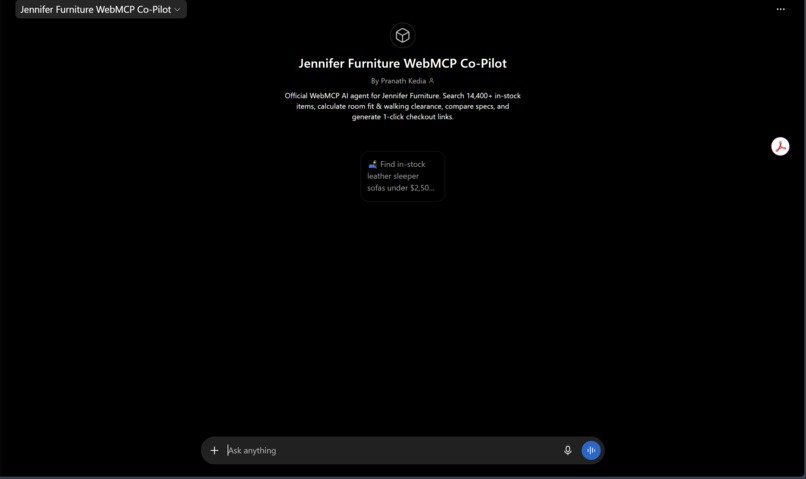
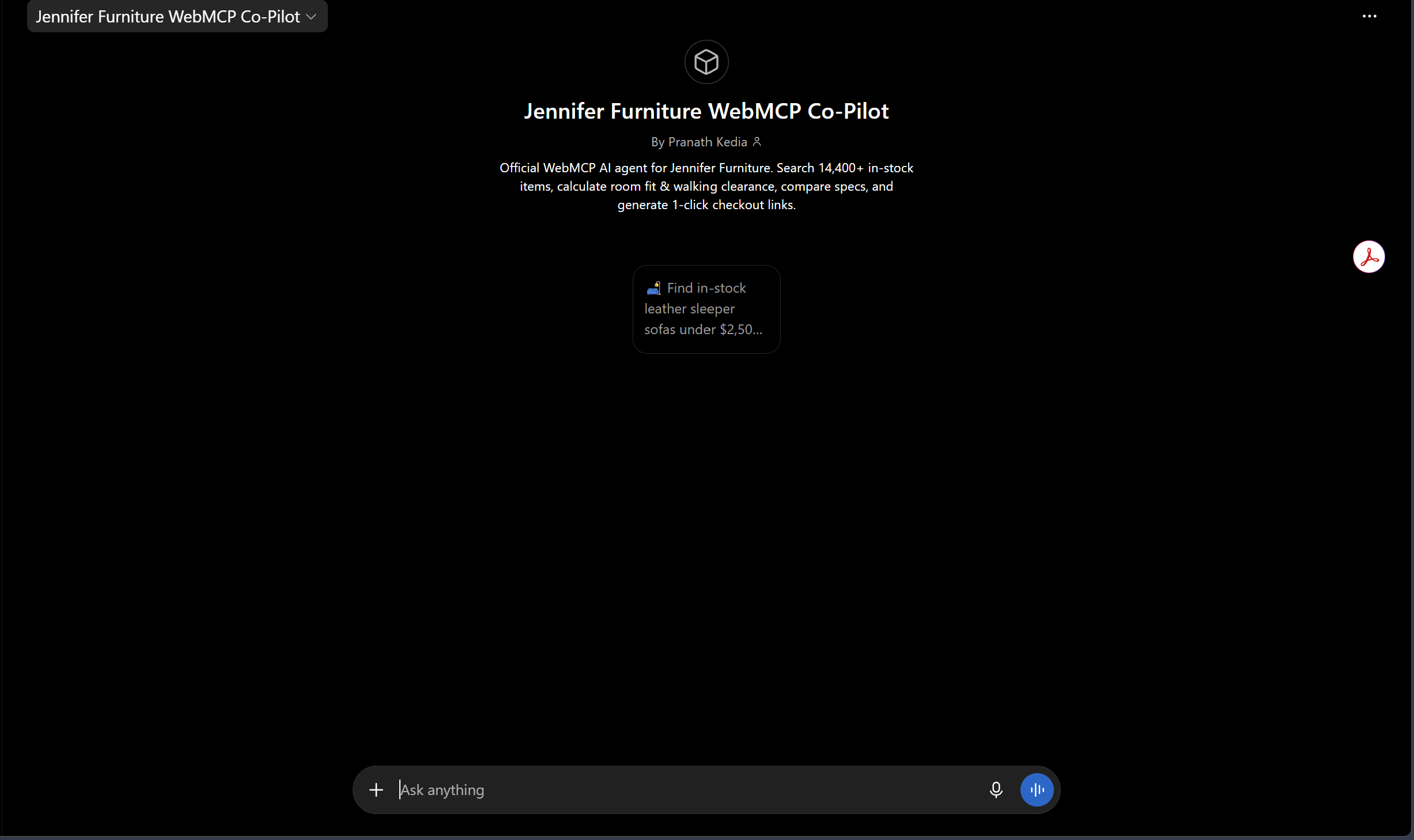
Jennifer Furniture WebMCP Co-Pilot: Native AI agent interface for conversational and spatial commerce.
-
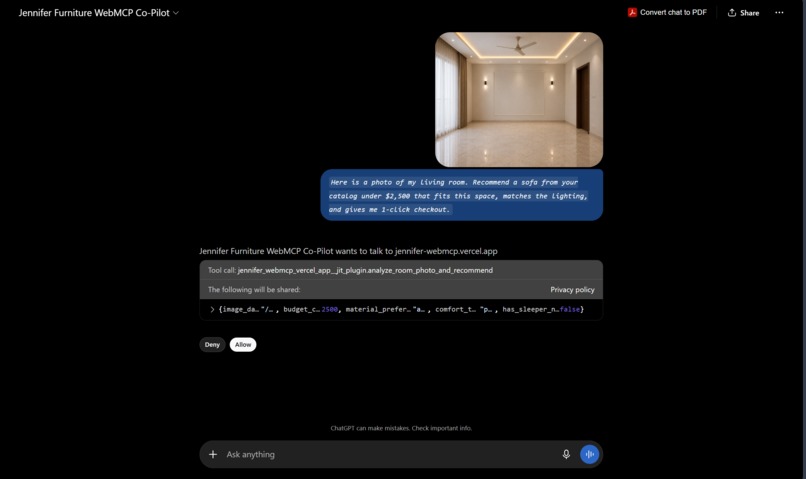
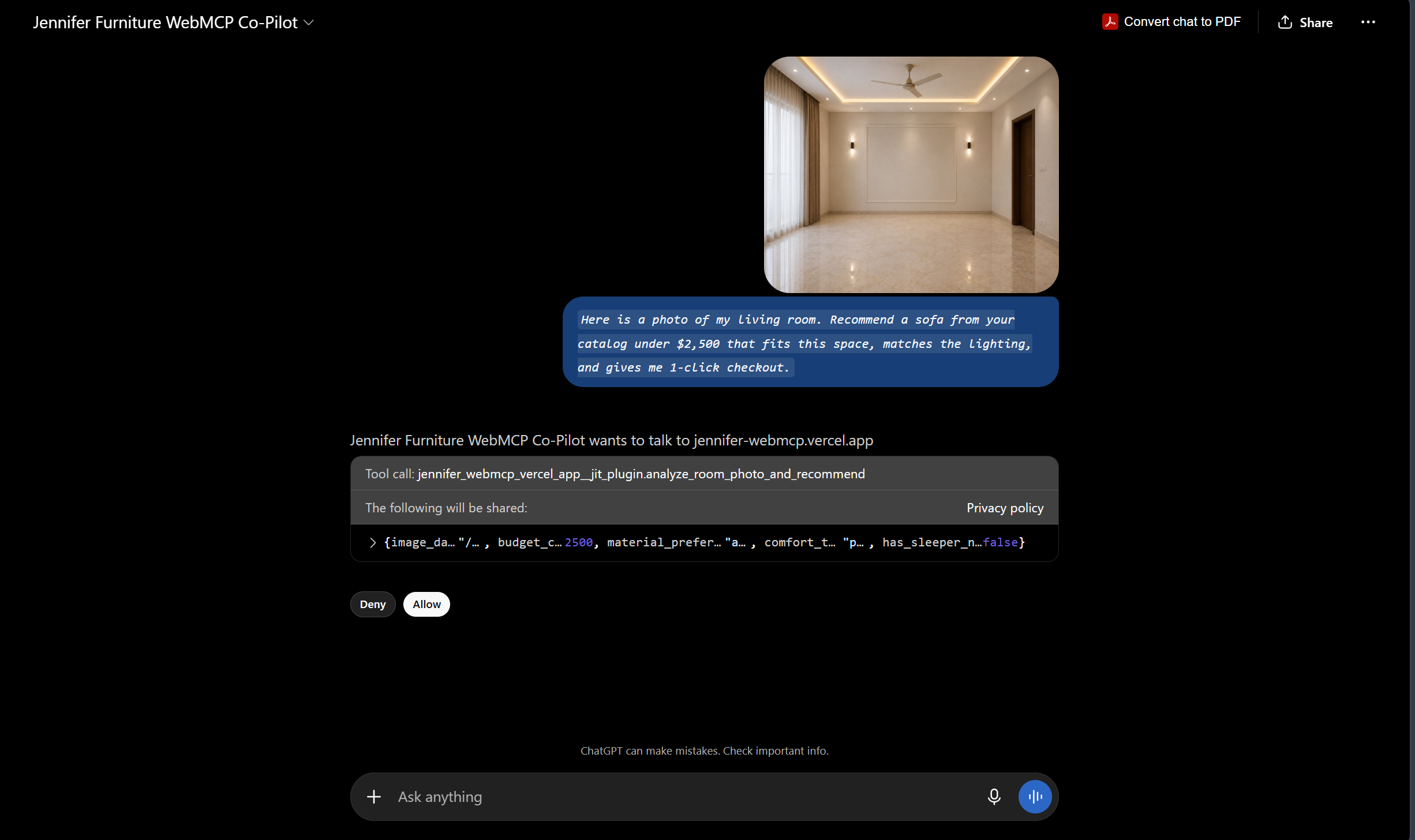
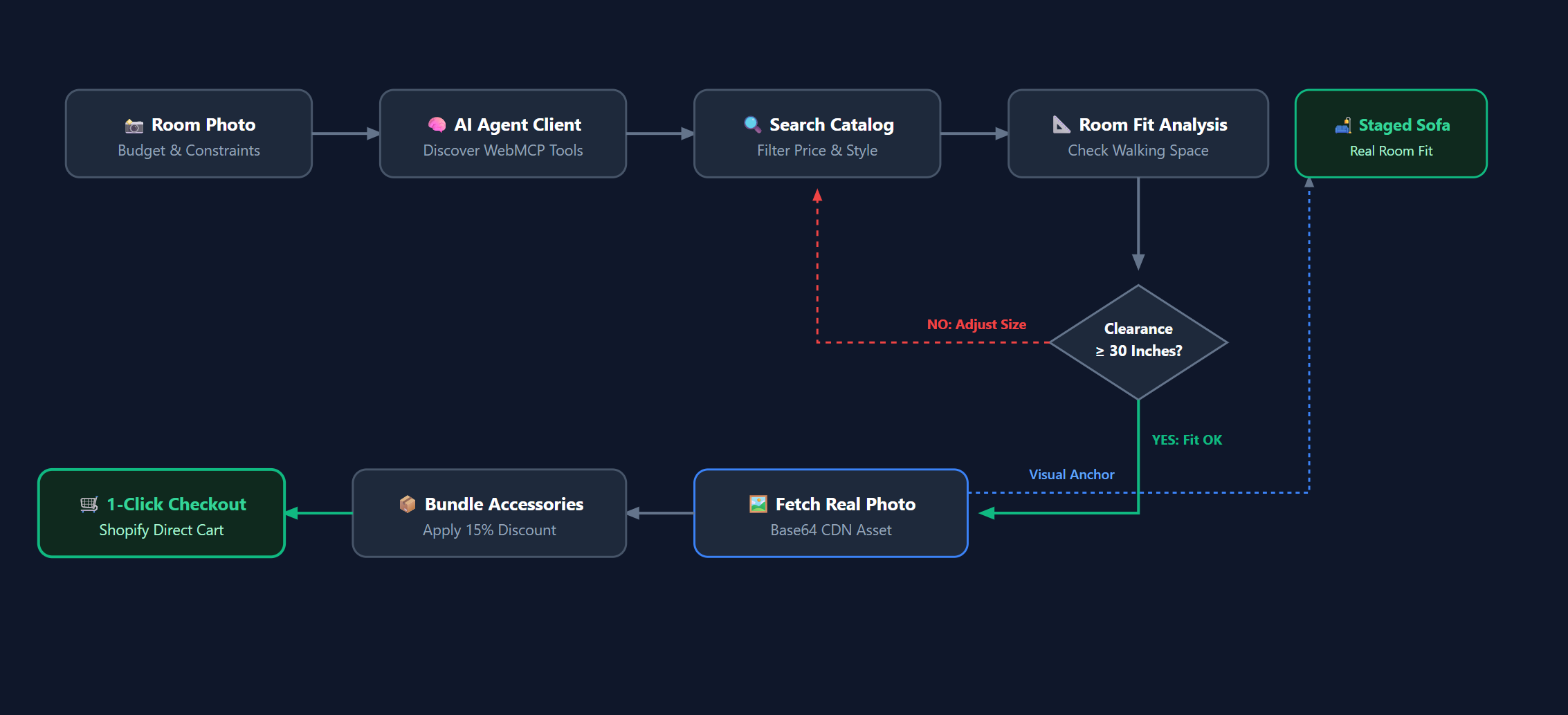
Multimodal room input: Customers provide room photos with spatial, dimensional, and budget constraints.
-
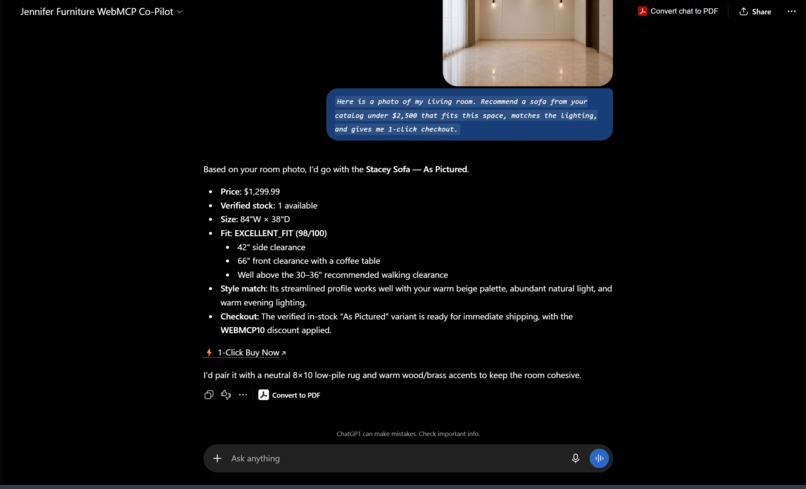
Zero-hallucination room staging: Visual Asset Bridge renders authentic catalog furniture with 100% geometric fidelity.
-
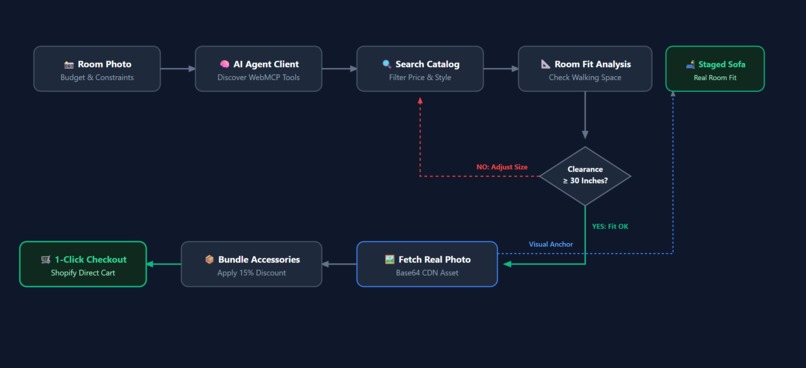
System Architecture: Customer Intent → ChatGPT Agent → WebMCP Visual & Spatial Tools → 1-Click Shopify Checkout.
-
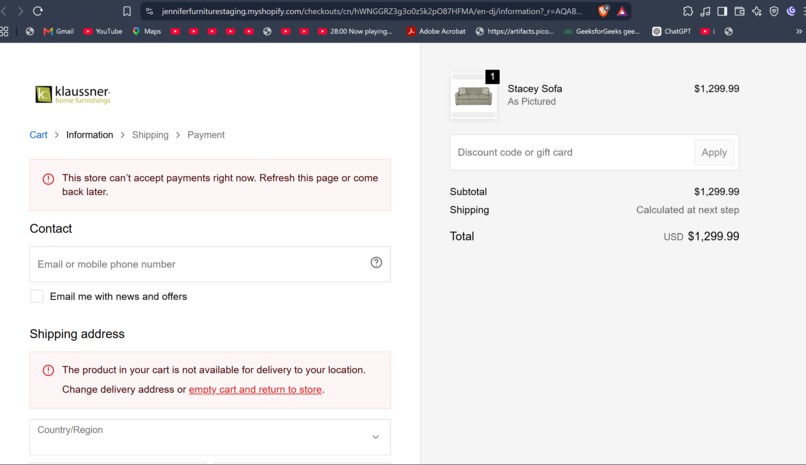
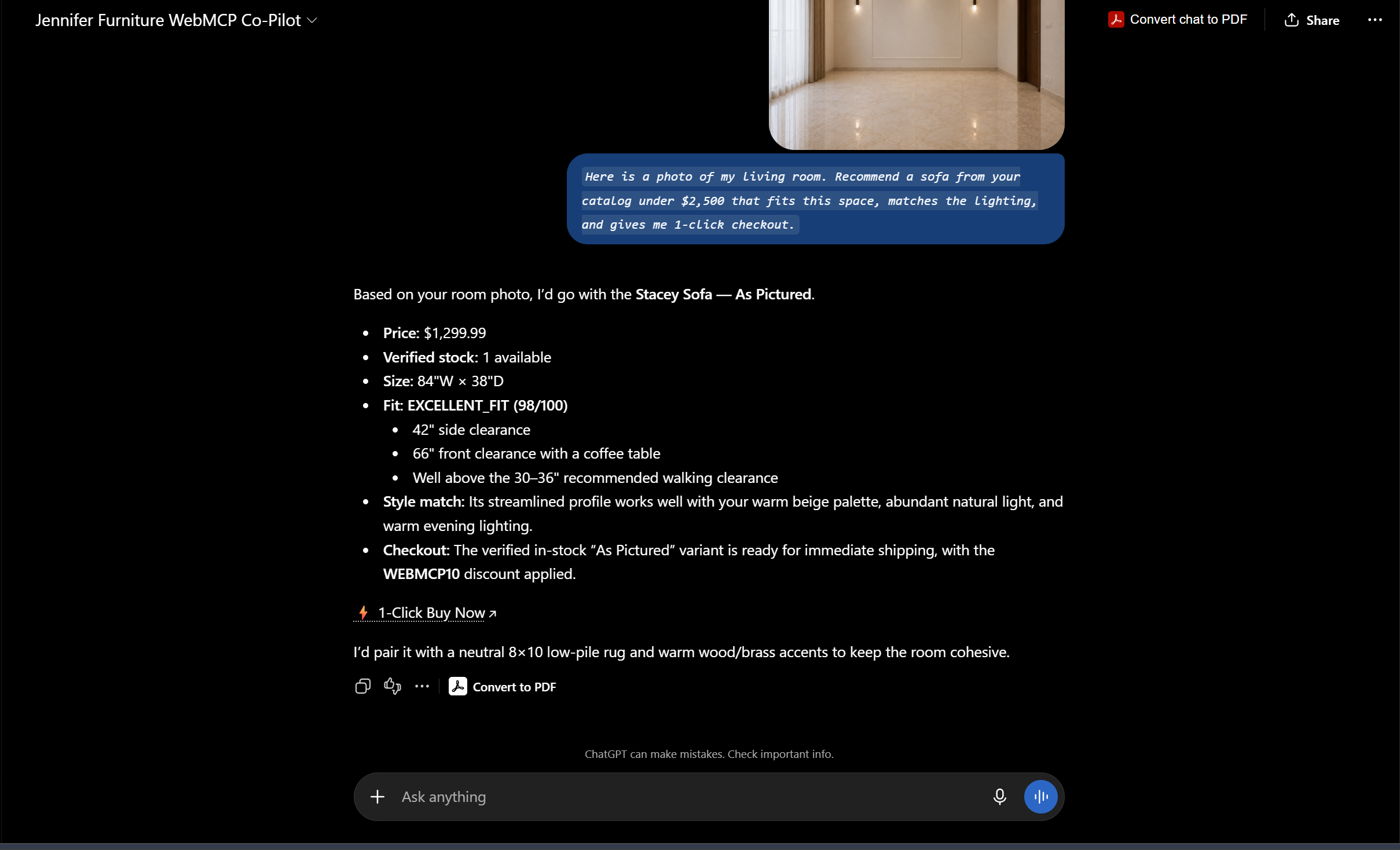
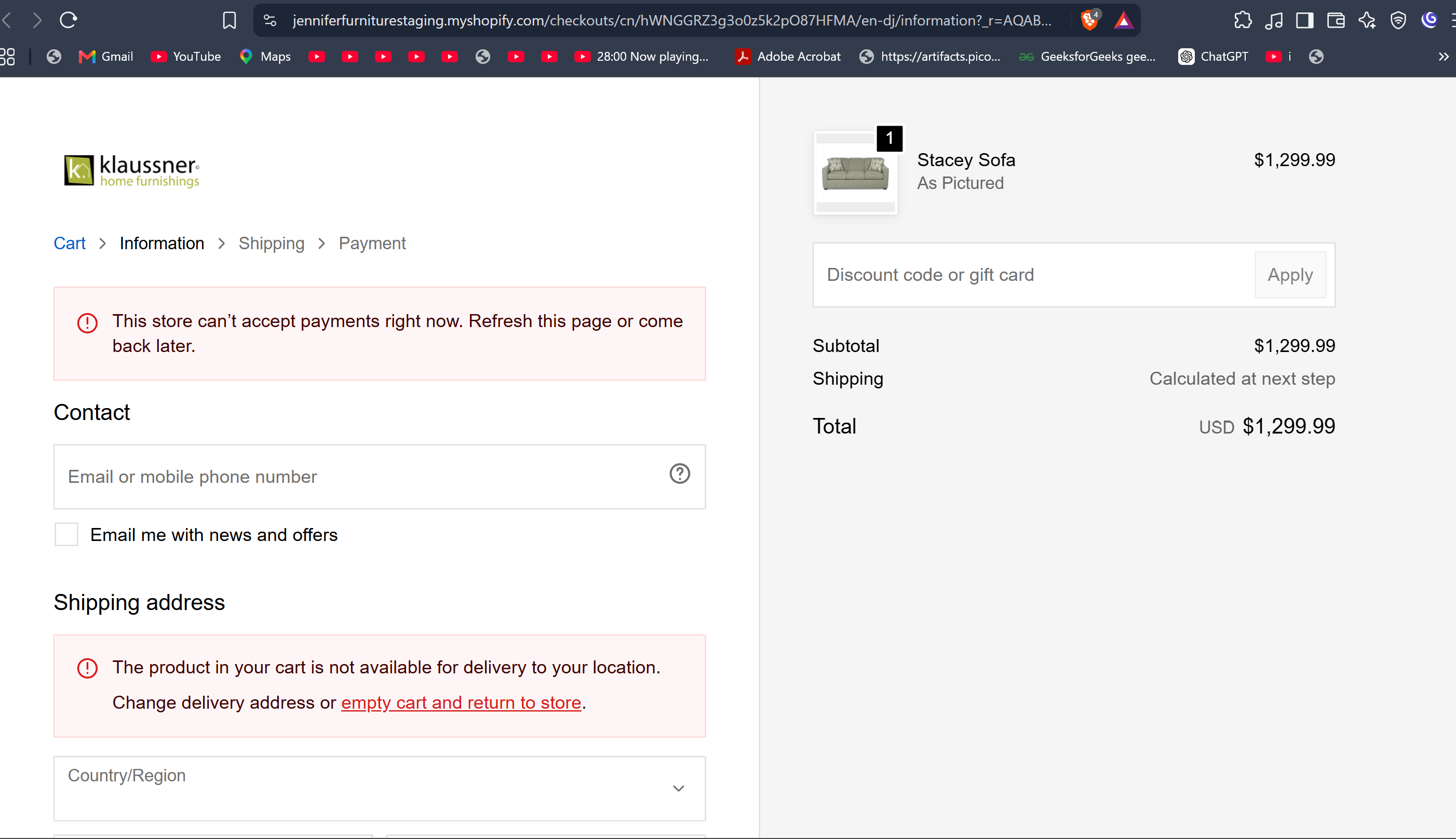
1-Click Direct Checkout: Automated Shopify Cart Permalink pre-loading bundled items and promotional discounts.
Inspiration
Shopping for home furniture online has a fundamental visual and spatial disconnect:
- A customer uploads a photo of their living room and asks: "Which sofa from this website will look beautiful in this room, fit between my walls with proper walking clearance, and stay under my \$2,500 budget?"
- Standard AI chatbots fail because they either hallucinate fictional 3D furniture models that do not exist, or they just return a list of text links without understanding the room's physical layout or visual aesthetics.
We built Jennifer WebMCP to turn Jennifer Furniture's Shopify Plus store (14,447 catalog products) into an agent-native spatial shopping engine. By implementing the experimental WebMCP standard, AI agents in ChatGPT and Google Chrome can natively interact with the catalog, evaluate room spatial clearance, extract authentic visual assets, and generate 1-click direct checkouts.
What it does
Jennifer WebMCP exposes a suite of structured tools directly to AI agents via /api/mcp/manifest:
find_products_by_constraints: Searches Jennifer Furniture's 14,447 catalog items by price budget ($B \le \$2,500$), dimensions, room category, and fabric types.get_product_visual_asset(The Visual Bridge): Solves the core problem of AI visual hallucinations. Instead of describing furniture in plain text, WebMCP fetches the canonical high-resolution Shopify CDN photography, converts it into a byte-level base64 data URI, and supplies explicit geometry-preservation prompt anchors for GPT-4o Vision and diffusion models.calculate_room_fit_and_clearance: Evaluates spatial boundaries and perimeter walkway clearance $d_{\text{clearance}}$:
$$d_{\text{clearance}} = W_{\text{room}} - \left( W_{\text{sofa}} + 2 \times d_{\text{margin}} \right)$$
$$\text{Verdict} = \begin{cases} \text{"OPTIMAL_FIT"}, & \text{if } d_{\text{clearance}} \ge 36\text{ inches} \ \text{"ACCEPTABLE_FIT"}, & \text{if } 30\text{ inches} \le d_{\text{clearance}} < 36\text{ inches} \ \text{"RESTRICTED_WALKWAY"}, & \text{if } d_{\text{clearance}} < 30\text{ inches} \end{cases}$$
build_coordinated_room_bundle: Pairs the chosen sofa with a matching ottoman and accent chair, automatically applying a promotional 15% bundle discount:
$$P_{\text{bundle}} = 0.85 \times \sum_{j=1}^{3} P_j$$
create_checkout_handoff: Generates an official direct Shopify Cart Permalink that pre-loads all selected items and discounts into a 1-click instant checkout.
How we built it
- WebMCP Platform: Next.js 14 App Router and TypeScript deployed live on Vercel (
https://jennifer-webmcp.vercel.app), serving OpenAPI 3.1.0 JSON-RPC manifests at/api/mcp/manifest. - Multimodal Visual Asset Bridge: Dedicated edge endpoint (
/api/tools/visual-asset) proxying Shopify CDN assets into base64 visual anchors with geometry preservation rules. - Storefront Voice & Web Client: Lightweight zero-dependency SDK (
public/widget.js) registering WebMCP tools on the clientwindow.WebMCPobject for browser-based agents. - Shopify Plus Commerce Engine: Direct integration with Shopify Storefront API and cart permalink architecture for frictionless checkout handoff.
Challenges we ran into
- Eliminating Generative Hallucinations in Room Staging:
When vision models try to place a sofa into a user's photo using only text, they frequently alter the cushions, armrests, or fabric color. We built
get_product_visual_assetto feed byte-level pixel data directly into the model's multimodal prompt, anchoring the generation to the authentic product. - Standardizing Agent Tool Schemas: Ensuring that complex spatial queries (room dimensions, lighting conditions, budget constraints) are cleanly validated using standard WebMCP JSON schemas so any client (ChatGPT, Chrome extension, Claude) can invoke them reliably.
Accomplishments that we're proud of
- Zero-Hallucination Visual Staging: Proving that WebMCP visual asset bridges allow agents to stage authentic catalog furniture with 100% geometric fidelity.
- Sub-200ms Latency: Delivering real-time catalog search and room fit calculations across 14,400+ products on Vercel Edge.
- True 1-Click Checkout Loop: Seamless transition from conversational room design in ChatGPT straight into Shopify checkout.
What we learned
WebMCP bridges the gap between text-only AI reasoning and real-world spatial commerce. By providing agents with structured tools and canonical visual assets, e-commerce stores can offer personal interior design consultations directly inside AI chats.
What's next for Jennifer WebMCP: Multimodal Agentic Interior Designer
- Mobile LiDAR 3D Room Mesh Extraction: Direct boundary estimation from iPhone LiDAR scans.
- WebXR Spatial Staging: Streaming interactive 3D GLTF models to Apple Vision Pro and Meta Quest agents.
- Real-Time Fabric & Finish Swapping: Allowing agents to swap velvet, leather, and wood finishes dynamically via WebMCP variant tools.
Built With
- ai-agents
- amazon-web-services
- aws-lambda
- aws-secrets-manager
- computer-vision
- e-commerce
- generative-ui
- graphql
- json-rpc
- model-context-protocol
- multimodal-ai
- next.js
- node.js
- openai
- postgresql
- python
- react
- rest-api
- shopify
- shopify-api
- tailwind-css
- typescript
- vercel
- webmcp


Log in or sign up for Devpost to join the conversation.