-
-
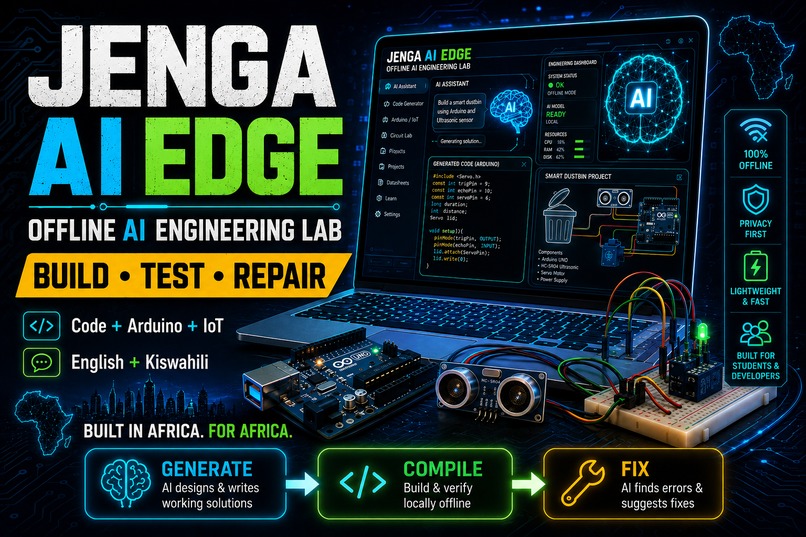
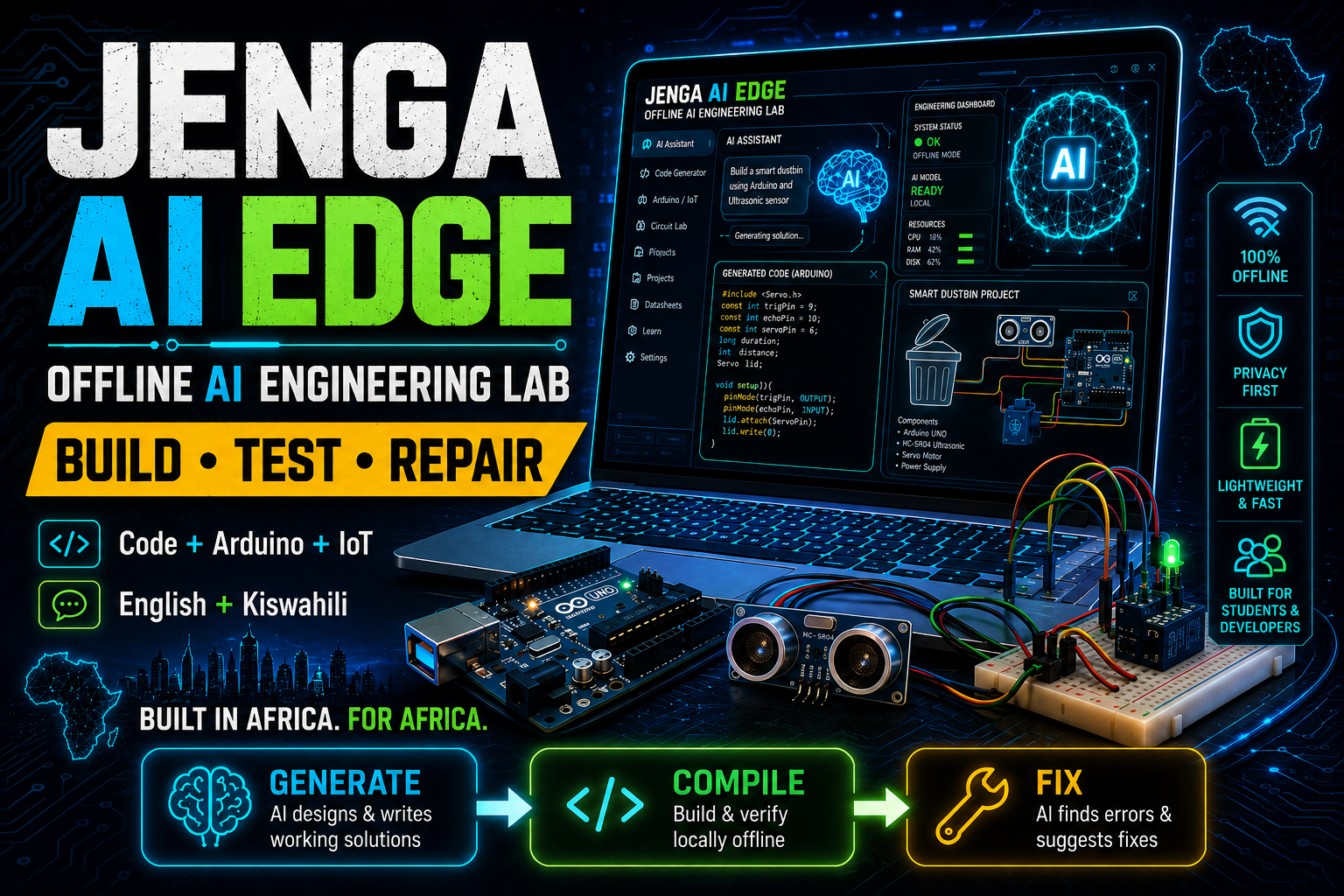
JENGA AI EDGE COVER PAGE
-
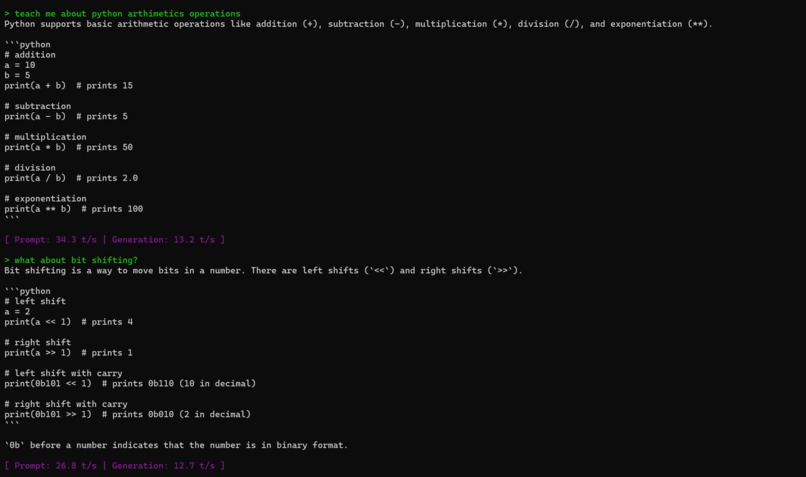
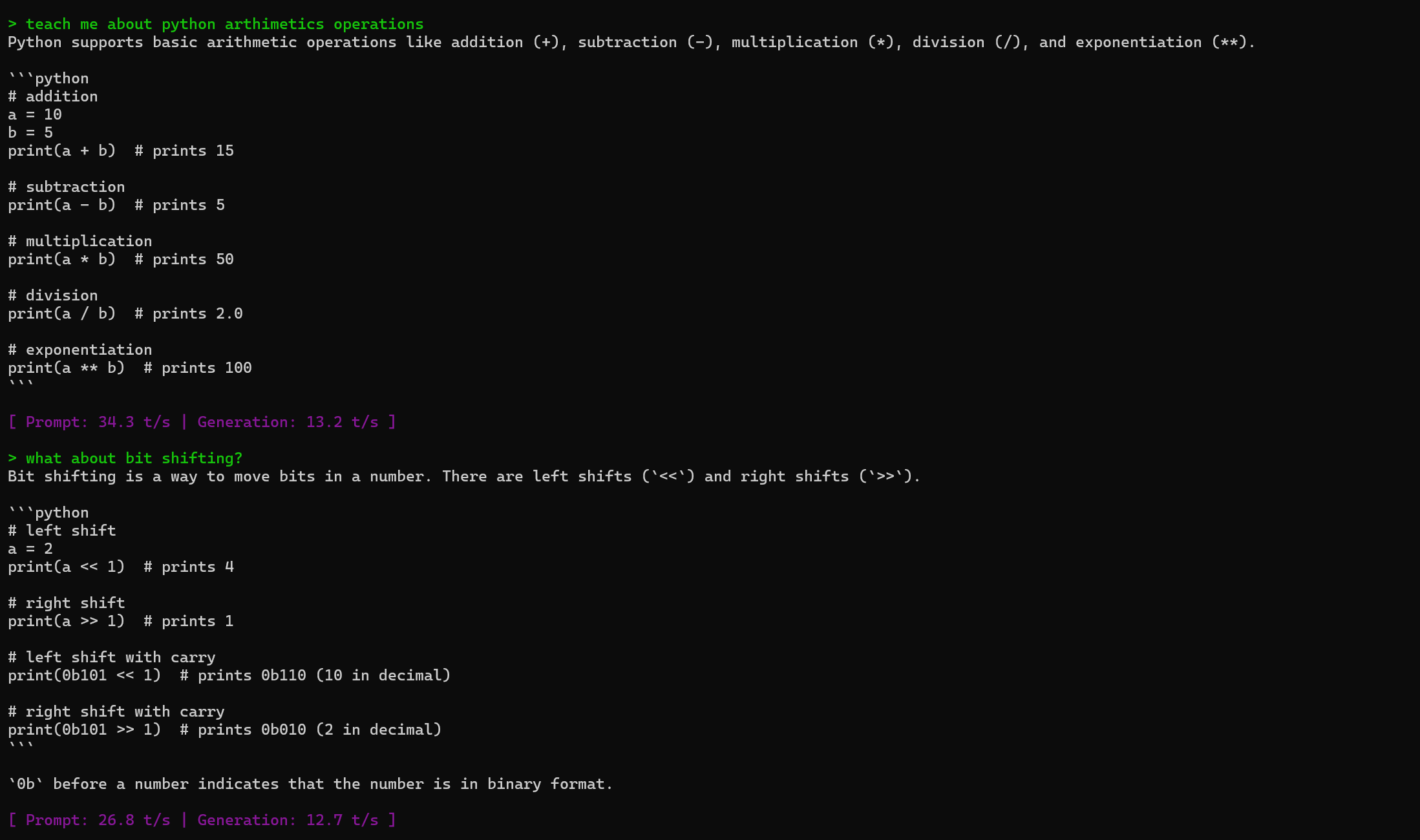
Python With jenga Ai
-
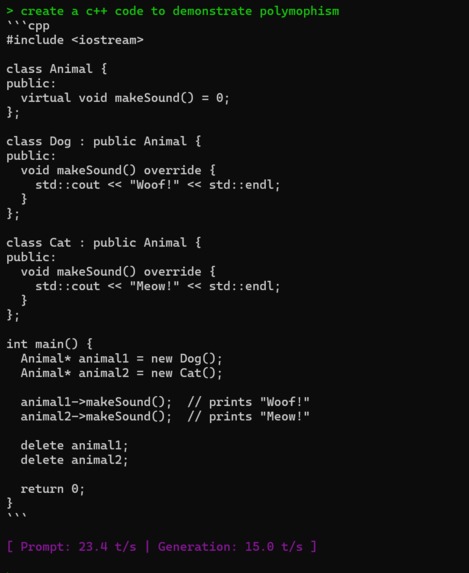
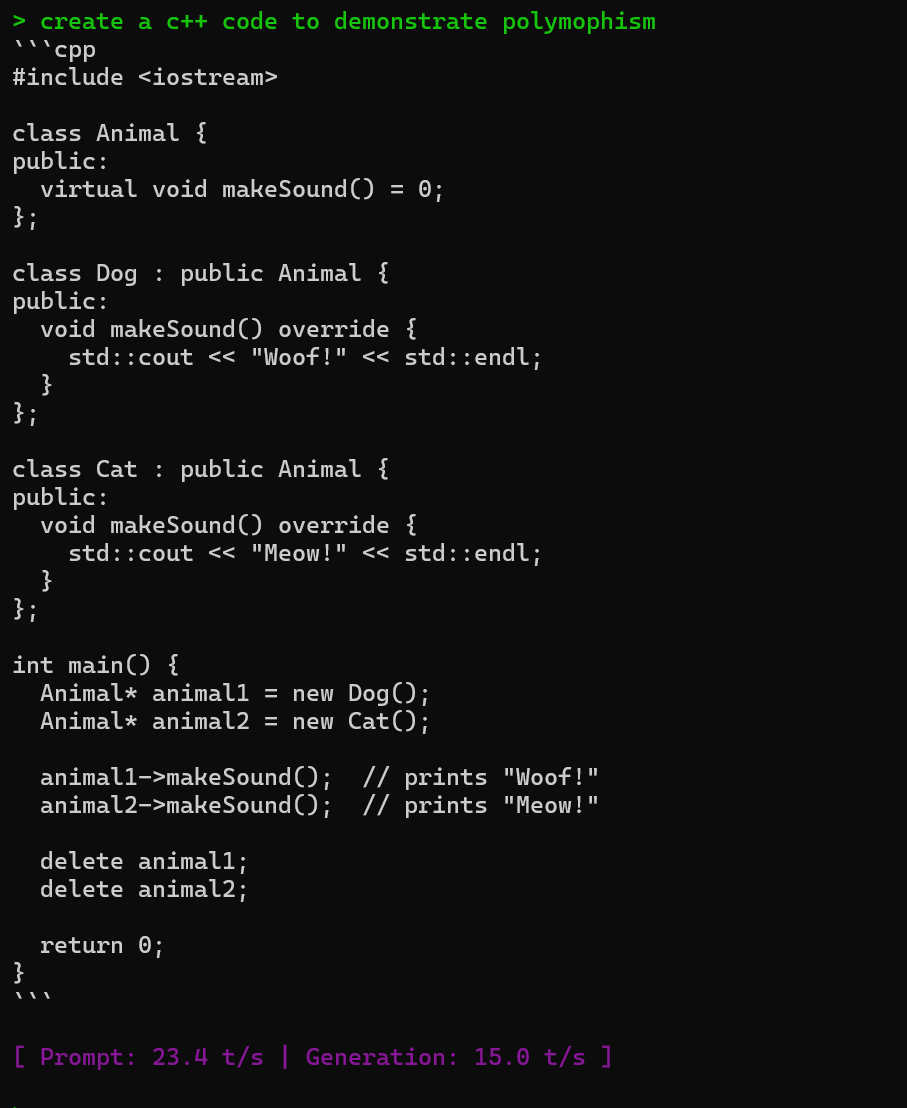
C++ polymophism with jenga Ai
-
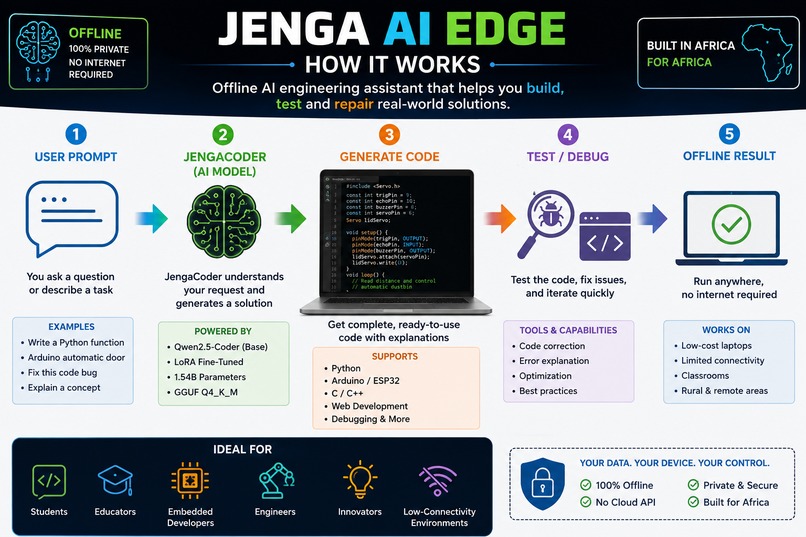
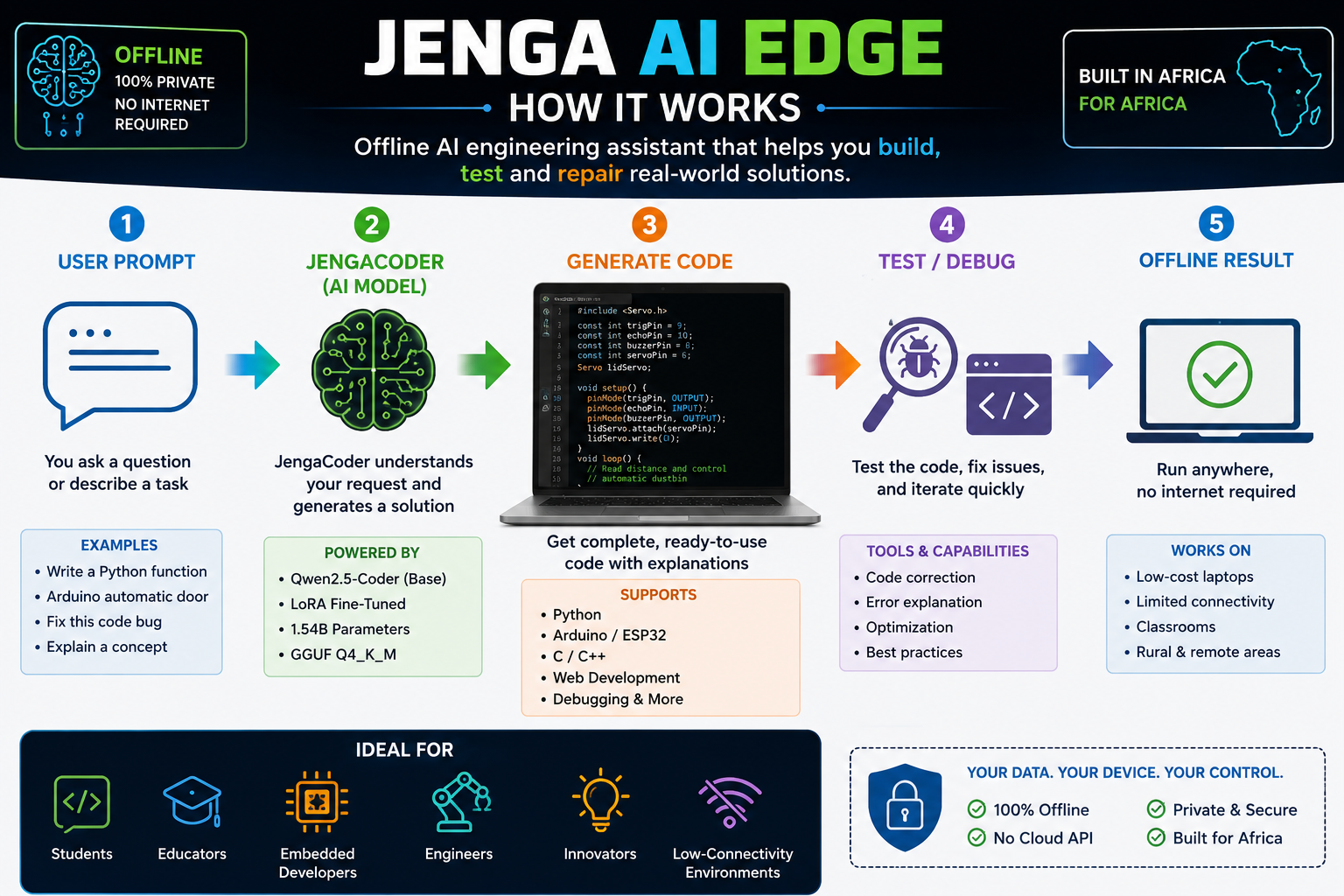
jenga working mechanism
Inspiration
Many African students, teachers and developers work with affordable computers, expensive mobile data and unreliable internet access. Most modern AI coding assistants depend on permanent cloud connectivity and hardware that is unavailable in these environments.
JengaAI Edge was created to demonstrate that useful coding and engineering assistance can run privately and completely offline on a budget laptop.
What it does
JengaAI Edge is powered by JengaCoder v1.2, a compact coding and engineering language model that runs locally through llama.cpp.
It can assist with:
- Python, C++ and basic web-development tasks
- debugging and code explanation
- memory-conscious programming
- Arduino and ESP32 project guidance
- embedded-system wiring and code
- technical education without cloud inference
After downloading the model once, inference does not require an internet connection. User prompts and generated code remain on the local computer.
How we built it
JengaCoder v1.2 was produced by QLoRA supervised fine-tuning of Qwen/Qwen2.5-Coder-1.5B-Instruct.
The training process used:
- 160 supervised training records
- 20 validation records
- two training epochs
- LoRA rank 16 and alpha 32
- NF4 four-bit training quantization
- seven transformer projection targets
- a fixed random seed of 42
The adapter was merged with the base model, converted to GGUF and quantized to Q4_K_M for efficient CPU inference through llama.cpp.
For Gate 2, we strengthened the project's authenticity and reproducibility evidence. The repository now includes:
- the recovered original LoRA adapter weights and configuration
- the authentic final trainer state and evaluation history
- the exact training script
- dataset and artifact SHA-256 checksums
- base-model revision and weight identity
- adapter-merging and GGUF-quantization scripts
- immutable Hugging Face model download
- complete base-versus-fine-tuned output comparisons
- frozen evaluation prompts, rubrics and results
Performance
The final ADTC participant profiler run confirmed:
- CPU-only inference
- no discrete GPU
- approximately 19 generated tokens per second
- approximately 1.69 GB peak resident memory
- 0.70 ARC Easy accuracy over 50 samples
- operation on an Intel Core i7-1065G7 laptop with 7.6 GB RAM
The model therefore remains practical for offline use on budget-class computers.
What we learned
Compact models can provide useful offline coding assistance, but model size alone does not guarantee dependable constraint following.
Our evaluation showed that JengaCoder performs well on straightforward coding and memory-conscious streaming tasks. It also revealed weaknesses in some tightly constrained physical-computing questions. We learned that embedded-system assistance requires training examples grounded in electrical safety, exact wiring, voltage levels, board capabilities and explicit hardware limitations.
We created a frozen ConstraintBench evaluation and began a corrective v2 dataset focused on these weaknesses. The v2 data was not used to train the submitted v1.2 model, and we disclose this clearly rather than claiming an unverified accuracy improvement.
Challenges
The main challenges included:
- running useful inference within limited RAM
- balancing quantization, speed and model quality
- preventing fine-tuning regressions
- enforcing strict hardware and component constraints
- recovering and documenting historical training evidence
- creating reproducible provenance without inventing missing records
- measuring performance consistently on CPU hardware
Experimental v1.3 and v1.4 adapters were rejected after private testing revealed weaker constraint following. We retained v1.2 because it remained the most stable evaluated artifact.
Accomplishments
We are proud that JengaAI Edge:
- runs entirely offline after installation
- requires no dedicated GPU for inference
- keeps user prompts private
- provides usable generation speed on budget hardware
- publishes an immutable, checksum-verified model artifact
- includes authentic adapter and training-state evidence
- documents both strengths and limitations transparently
What's next
The next stage will use the awarded GPU resources to train and evaluate a separate candidate model using the corrective v2 dataset.
A new model will replace v1.2 only if it:
- improves constraint-following evaluation
- corrects known physical-computing failures
- preserves general coding ability
- passes safety and memory-discipline tests
- remains efficient enough for offline CPU inference
Our long-term goal is to make trustworthy AI-assisted coding and engineering education accessible in schools and communities where connectivity, computing power and data cost remain meaningful constraints.
Links
- Source code and reproducibility evidence: https://github.com/theredteamtech/jengaai-edge/tree/gate2
- Published model: https://huggingface.co/theredteamtech/JengaCoder-v1.2

Log in or sign up for Devpost to join the conversation.