-
-
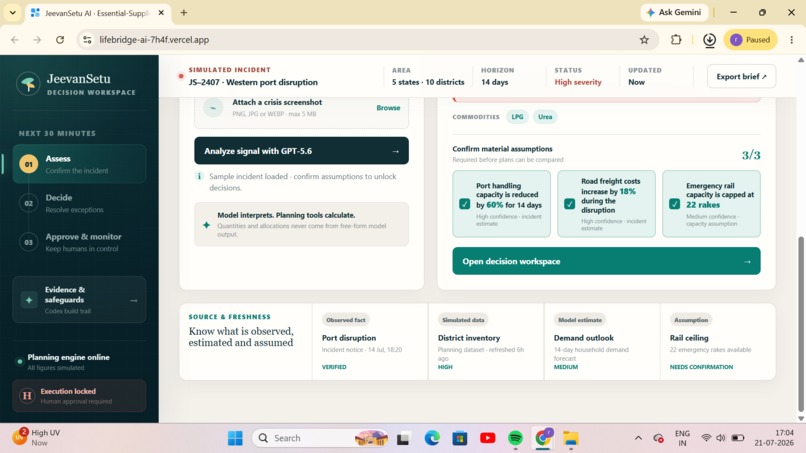
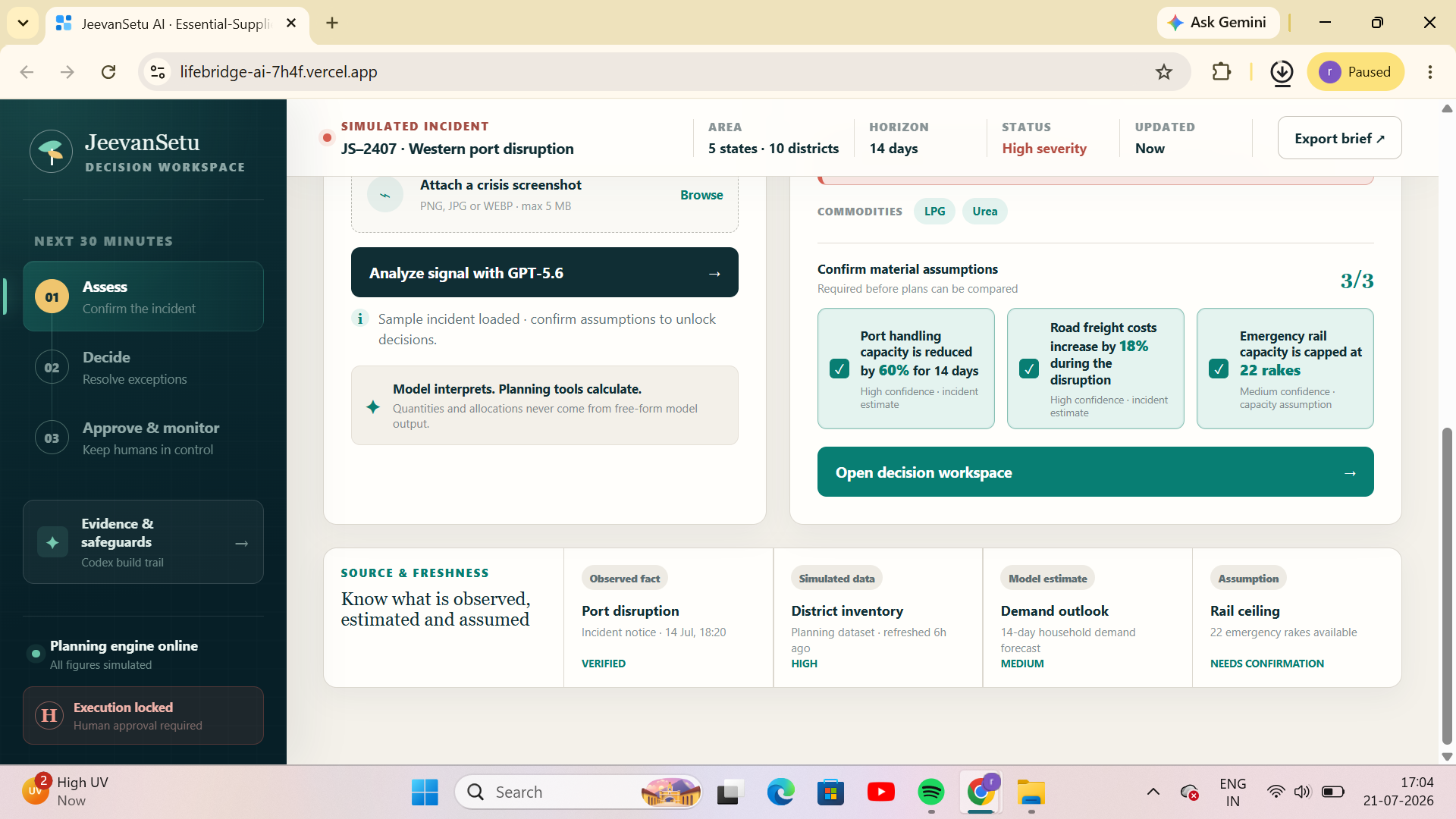
Assess: incident summary and material assumptions
-
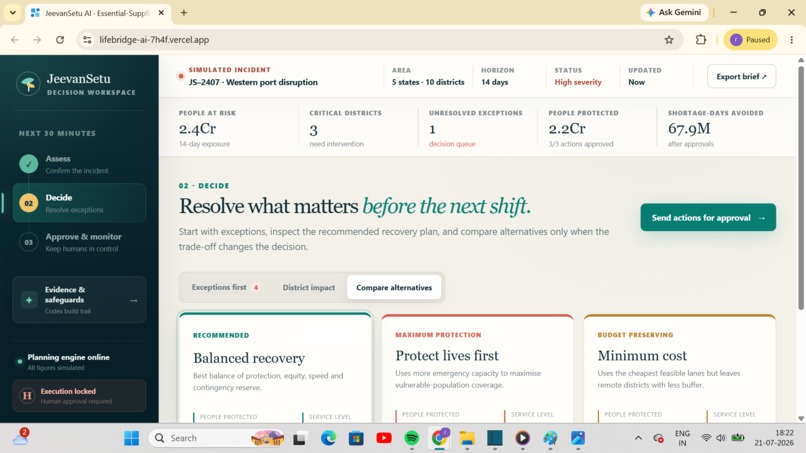
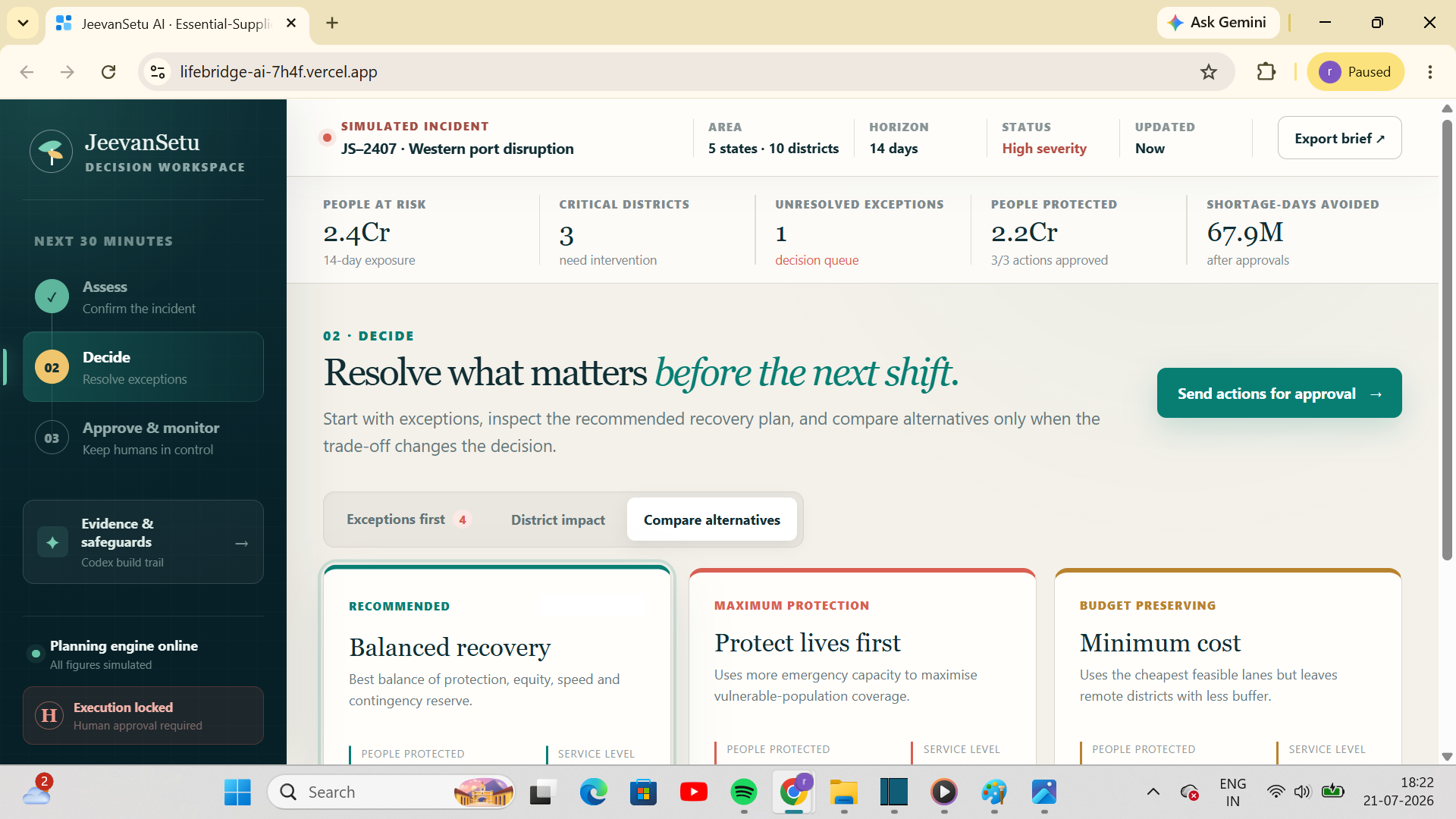
Decide: comparison of the three recovery alternatives
-
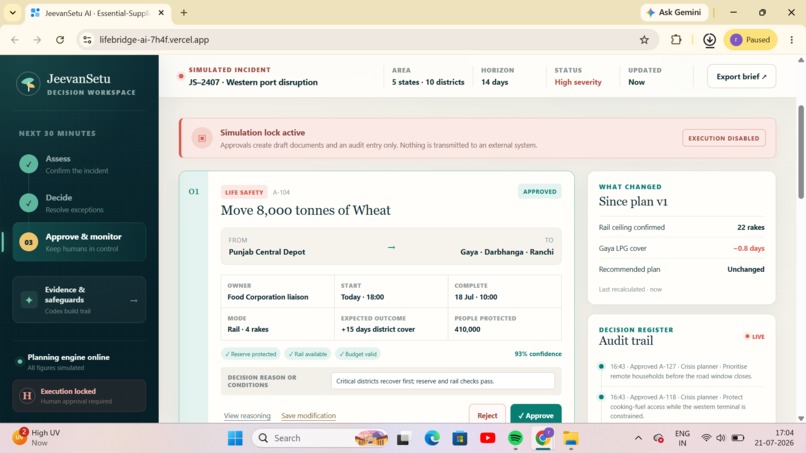
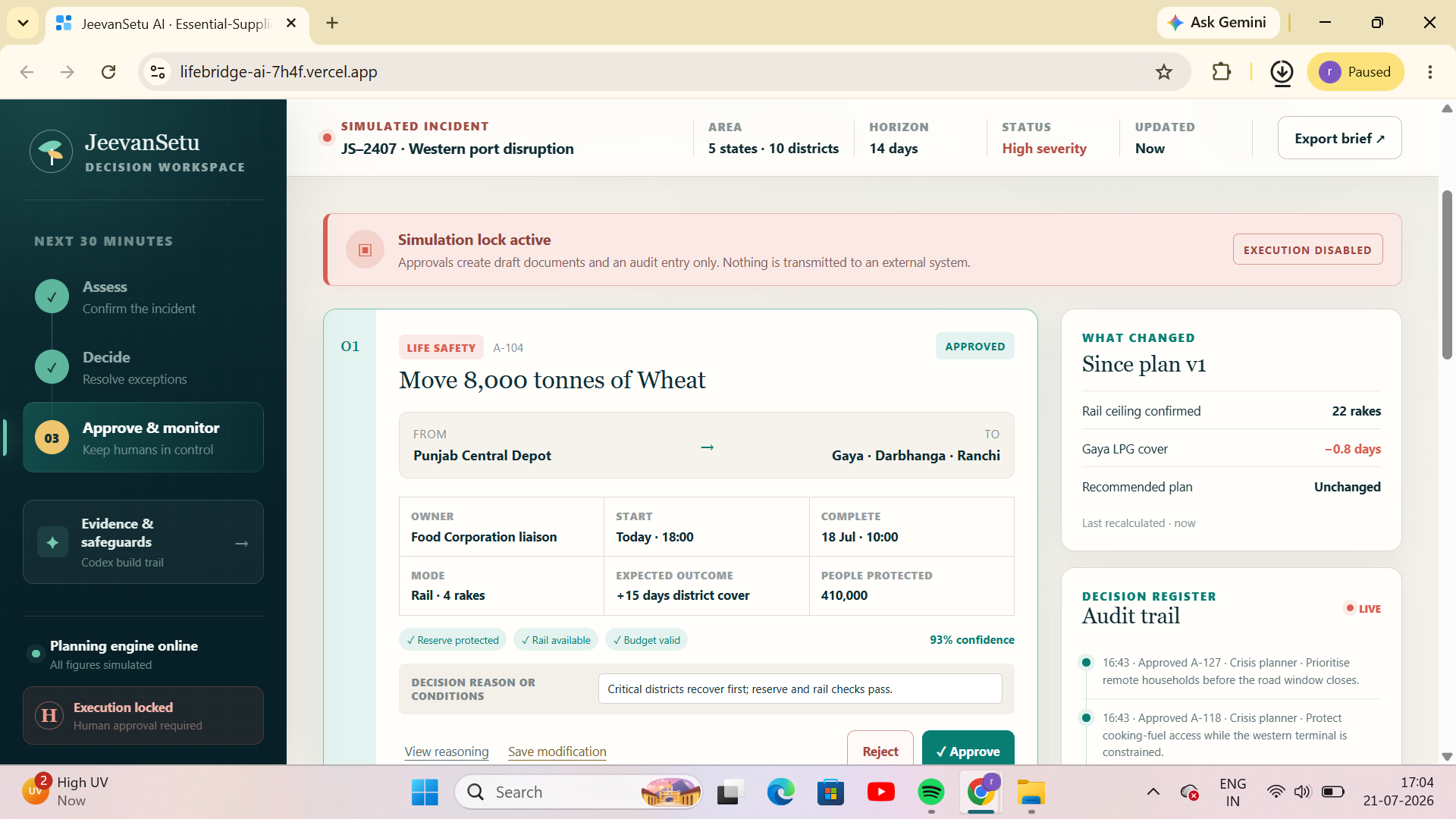
Approve & Monitor: human approval controls and decision/audit record
Inspiration
When essential supplies stop moving, time becomes the scarcest resource.
During a major disruption, teams may receive inventory reports, transport alerts, warehouse updates and district requirements from different sources. The problem is not simply a lack of information. The problem is converting fragmented and uncertain information into a responsible decision before shortages escalate.
Drawing on my experience in supply-chain planning and control-tower solution design, I asked:
Can AI help teams respond faster without taking accountability away from humans?
That question became JeevanSetu AI—a bridge from fragmented crisis signals to transparent, human-approved action.
What it does
JeevanSetu AI is a human-governed crisis decision-support workspace for simulated essential-supply disruptions.
It converts a crisis notice or optional screenshot into a structured workflow with three stages:
1. Assess
The user enters a disruption notice and may attach an image.
GPT-5.6 extracts a constrained incident assessment, while strict validation checks the response before it is accepted. Material assumptions and information gaps are displayed openly so that users can review them instead of treating uncertain AI output as fact.
The result is a shared operational picture showing:
- the disruption and affected locations;
- severity and expected duration;
- available resources and constraints;
- vulnerable areas;
- material assumptions requiring confirmation;
- exceptions requiring attention.
2. Decide
JeevanSetu AI compares multiple recovery strategies rather than presenting one unexplained answer.
A deterministic decision engine calculates and compares:
- people or demand protected;
- expected service level;
- estimated cost;
- implementation speed;
- resource utilisation;
- vulnerability;
- operational feasibility;
- unresolved exceptions.
The workspace recommends the most balanced alternative while keeping competing plans and their trade-offs visible.
3. Approve and Monitor
No proposed plan is executed automatically.
A human decision-maker can approve, modify or reject each simulated action. The workspace records the selected decision, assumptions and status changes, and can export a simulated decision brief.
The guiding principle is simple:
AI structures uncertainty. Deterministic code performs the calculations. Humans remain accountable.
How I built it
I built JeevanSetu AI using:
- GPT-5.6 and the OpenAI Responses API;
- Codex as an active engineering collaborator;
- Next.js, React and TypeScript;
- Zod for strict input and AI-output validation;
- deterministic TypeScript modules for risk, allocation and feasibility calculations;
- Vitest and Playwright for testing;
- Vercel for production deployment.
Codex supported the complete engineering workflow. It helped me translate the concept into an application architecture, develop reusable components, implement the Assess–Decide–Approve workflow, diagnose build issues, strengthen type safety, improve accessibility, redesign the interface as a crisis command centre and validate the production build.
I remained responsible for the key product and safety decisions: defining the problem, deciding which calculations must remain deterministic, designing the approval boundary, determining how uncertainty should be communicated and ensuring the application remained a decision-support prototype rather than an autonomous crisis-management system.
Challenges I faced
Preventing a black-box recommendation
The easiest design would have been to generate one AI answer. Instead, I designed the application to expose assumptions, compare alternatives and explain operational trade-offs.
Separating AI reasoning from operational calculations
GPT-5.6 performs constrained information extraction, but it does not calculate quantities, allocate resources or execute actions. These responsibilities remain in deterministic, testable code.
Designing for failure
The application includes a clearly labelled synthetic fallback workflow when live AI intake is unavailable, malformed or rejected. This allows users to understand the product without hiding system limitations.
Balancing urgency with human control
A crisis tool must be fast, but speed without accountability can create additional harm. Human approval was therefore designed as a core workflow boundary rather than a decorative confirmation button.
Accomplishments I am proud of
I am proud that JeevanSetu AI:
- converts an ambiguous disruption into a structured decision process;
- compares multiple alternatives instead of hiding them behind one recommendation;
- visibly separates facts, assumptions, risks and actions;
- keeps consequential decisions under human control;
- uses strict validation and deterministic planning rules;
- includes an offline evaluation framework with synthetic scenarios;
- provides a safe fallback when AI intake is unavailable;
- runs as a publicly accessible production application.
The most important accomplishment is not that the application produces a recommendation.
It is that it makes the reasoning around that recommendation visible and challengeable.
What I learned
This project reinforced that high-impact AI should not be designed around autonomy alone.
In consequential situations, the stronger product is often one that helps people:
- understand the situation;
- question uncertain assumptions;
- compare realistic alternatives;
- make an informed decision;
- preserve accountability.
I also learned how Codex can support an entire engineering lifecycle—from architecture and implementation through debugging, testing, interface refinement and deployment—while leaving the builder responsible for product intent and judgement.
What is next
The next phase of JeevanSetu AI would include:
- verified and versioned data integrations;
- geospatial disruption visualisation;
- role-based access and approval authority;
- durable, auditable decision records;
- collaborative incident rooms;
- scenario simulation and digital-twin capabilities;
- alerts when approved-plan assumptions change;
- stronger multilingual and adversarial evaluations;
- carefully authorised integrations for external actions.
These capabilities would be introduced only after domain review, safety evaluation and explicit operational authorisation.
Closing
During a disruption, organisations do not need another dashboard that only reports what has already gone wrong.
They need a bridge between information and responsible action.
JeevanSetu AI helps teams assess clearly, decide transparently, approve responsibly and monitor continuously.
Built With
- api
- chain
- codex
- crisis
- css
- decision
- gpt-5.6
- hitl
- management
- next.js
- node.js
- openai
- playwright
- react
- supply
- tailwind
- typescript
- vercel
- vitest
- zod


Log in or sign up for Devpost to join the conversation.