-
-
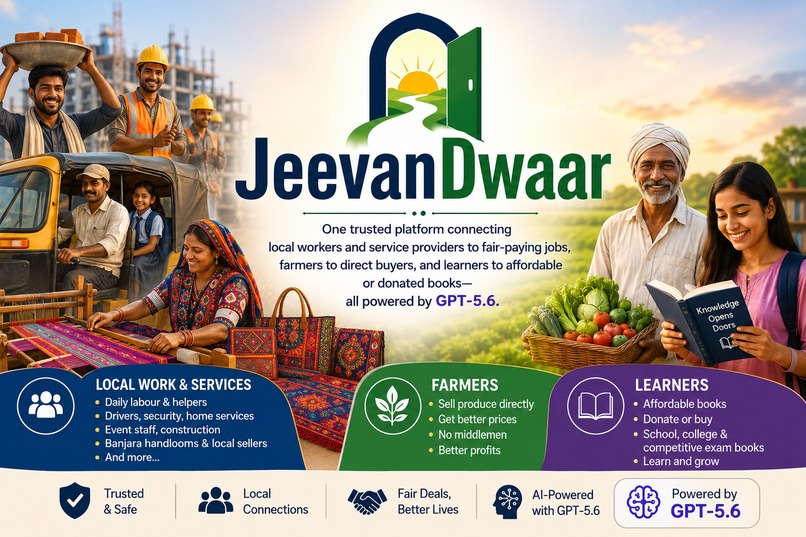
JeevanDwaar Project
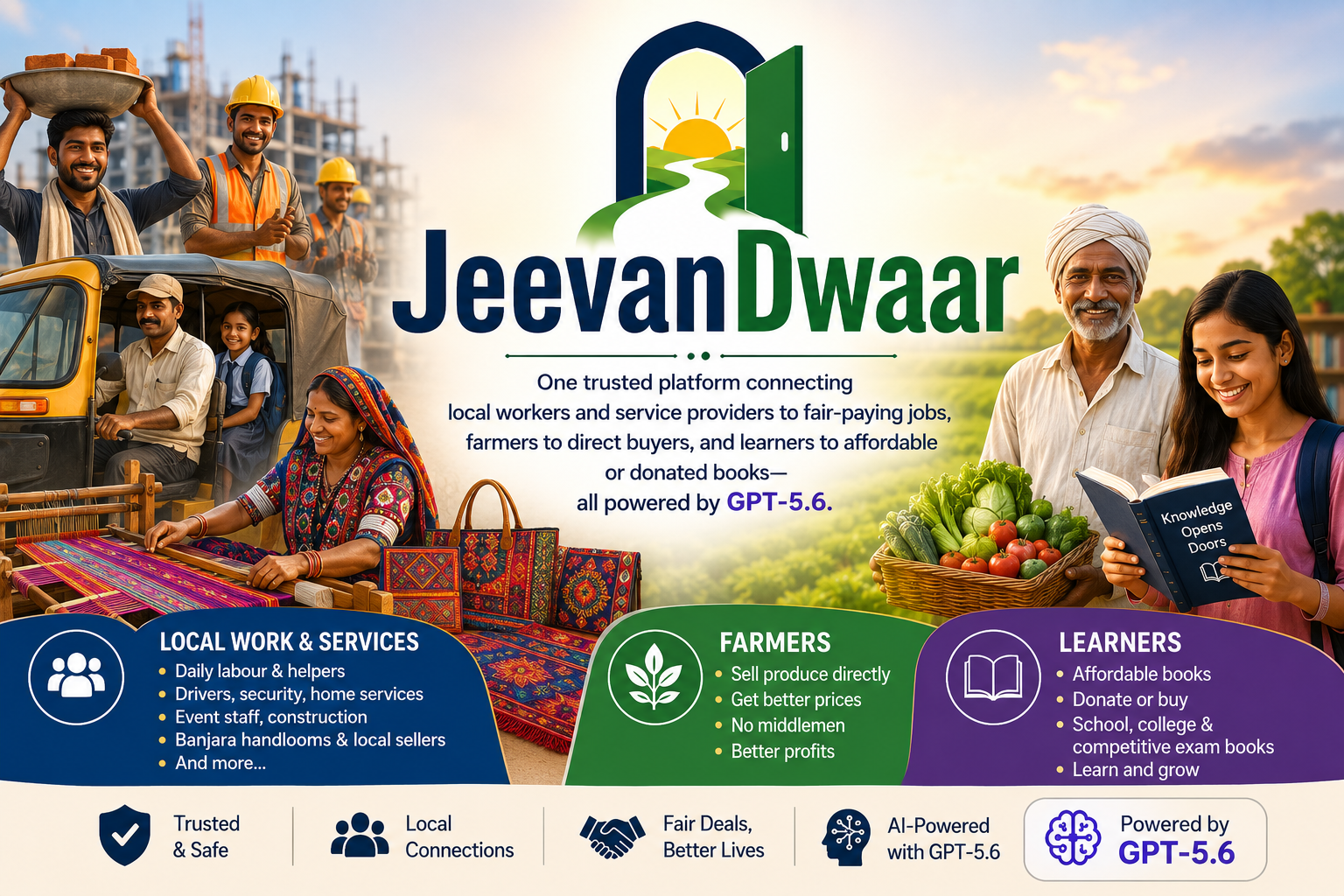
About JeevanDwaar
Inspiration
Many everyday opportunities already exist within local communities, but they are often difficult to discover or compare.
Local workers depend on informal contacts to find their next job. Farmers may receive unclear offers without understanding the total value or pickup conditions. Meanwhile, useful school and competitive-exam books often remain unused instead of reaching another learner.
Although these problems appear different, they share one underlying need: a direct, understandable, and trustworthy way for people to connect.
That inspired JeevanDwaar—meaning a doorway to life and opportunity. It is one multilingual platform connecting people to local work, direct agricultural markets, and affordable or donated books.
What JeevanDwaar does
JeevanDwaar contains three connected marketplaces:
Local Work and Services
Employers can publish opportunities for event helpers, construction workers, drivers, security staff, home-service providers, agricultural workers, and other local roles.
Workers can review transparent information about:
- Payment
- Location
- Schedule
- Required skills
- Number of workers needed
Skill-match scores are calculated deterministically. If (m) represents matching skills and (n) represents job requirements, the score is calculated as:
[ \text{Match Score} = \min\left(100,\operatorname{round}\left(55 + 45\frac{m}{n}\right)\right) ]
GPT-5.6 explains the score using permitted factors, but it never selects the worker.
Farmer Direct Market
Farmers can list produce and compare buyer offers using:
- Unit price
- Requested quantity
- Total offer value
- Pickup date
- Loading and transportation conditions
- Clearly labeled demonstration benchmarks
The total value is calculated in application code:
[ \text{Offer Total} = \text{Quantity} \times \text{Price per Unit} ]
GPT-5.6 explains the tradeoffs between offers without automatically choosing a buyer or inventing market prices.
Used Books and Donations
People can sell affordable second-hand books or donate them directly to learners and community groups.
Book owners can review requests, select a recipient, and complete the handover. The platform distinguishes clearly between paid sales and free donations.
How GPT-5.6 is used
GPT-5.6 acts as an assistance layer rather than a decision-maker.
It helps users:
- Convert natural English or Telugu descriptions into editable listings
- Explain deterministic worker-match scores
- Explain produce-bid tradeoffs
- Present complex information in simpler language
All AI input and structured output is validated with Zod. AI suggestions are never published automatically—the user must review and confirm every field.
If the model or credentials are unavailable, JeevanDwaar displays a clearly labeled Safe fallback instead of pretending that a live AI request succeeded.
How we built it
JeevanDwaar was built using:
- Next.js 16
- React 19
- TypeScript
- Tailwind CSS
- OpenAI Responses API with GPT-5.6
- Zod structured validation
- Supabase Auth, PostgreSQL, Row Level Security, and guarded database functions
- Vitest unit testing
- Playwright desktop and mobile testing
- GitHub Actions continuous integration
The submission includes a browser-persisted interactive demo, allowing judges to test complete workflows without creating accounts or configuring a database.
The architecture also supports authenticated Supabase persistence for production use.
How Codex accelerated development
Codex assisted throughout the engineering process, including:
- Converting the initial idea into a focused product architecture
- Designing the three marketplace workflows
- Creating database tables, authorization policies, and guarded lifecycle functions
- Implementing GPT-5.6 structured-output integration
- Debugging TypeScript, UI, and workflow problems
- Adding accessibility improvements
- Creating unit and end-to-end tests
- Preparing documentation and submission materials
Important product decisions remained human-directed, including the three-marketplace scope, deterministic calculations, truthful benchmark labeling, human confirmation, and avoiding unsupported claims such as escrow or government verification.
Challenges we faced
Keeping three marketplaces coherent
Work, agricultural produce, and books have different workflows. The challenge was making them feel like one product without making each experience overly complicated.
We solved this by using a shared pattern:
- Create a clear listing
- Receive transparent responses
- Compare relevant information
- Let the human choose
- Record completed activity
Preventing AI from controlling important decisions
Hiring workers, selecting buyers, and choosing donation recipients can affect real lives. These decisions should not be hidden inside a model.
We therefore kept scores, totals, authorization, and lifecycle transitions outside GPT-5.6. The model explains structured information but does not make the final decision.
Building a testable demo without external credentials
Judges may not have time to configure Supabase or create multiple accounts. We created a browser demo mode using localStorage while preserving the same visible workflows.
The interface explicitly identifies whether it is using Browser demo, Live Supabase, Safe fallback, or Live GPT-5.6.
Designing trustworthy signals
We did not want to display invented verification badges. Trust signals are based on completed platform activity, fulfilled donations, and community reviews.
What we learned
We learned that AI creates the most value when it reduces communication and comprehension barriers instead of replacing human judgment.
We also learned that deterministic calculations and structured model outputs make AI-assisted products easier to test, explain, and trust.
Finally, building for accessibility and multilingual use must influence the architecture from the beginning. It cannot be treated as a final visual enhancement.
What’s next
Future improvements include:
- Voice input and audio responses
- Additional Indian languages
- Verified external mandi-price integrations
- Privacy-preserving communication between participants
- Location-aware opportunity discovery
- Moderation and dispute-resolution tools
- Safety-document workflows for sensitive roles
- Partnerships with schools, libraries, farmer groups, and local employers
JeevanDwaar’s goal is simple: open one trusted doorway through which earning, fairer markets, and learning opportunities can reach more people.
Built With
- actions
- api
- codex
- css
- github
- gpt-5.6
- localstorage
- next.js
- node.js
- openai
- playwright
- postgresql
- react
- responses
- supabase
- tailwind
- typescript
- vitest
- zod


Log in or sign up for Devpost to join the conversation.