-
-
Kevaro OS: The Executive Operating System for founders.
-
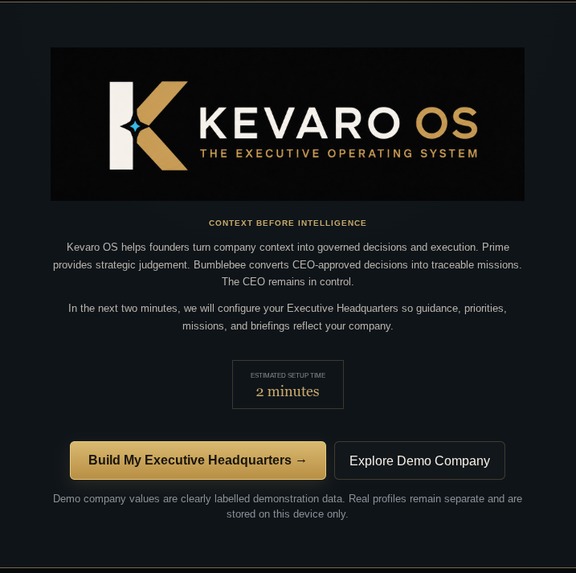
Welcome to a governed AI executive team that keeps the human CEO in control.
-
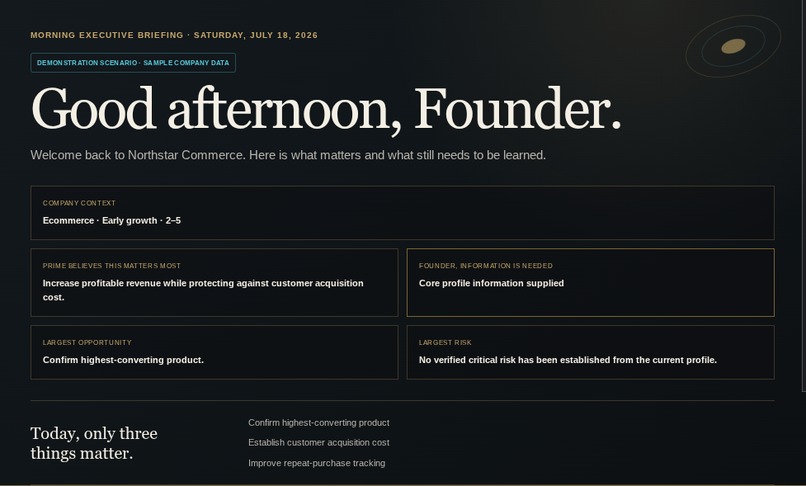
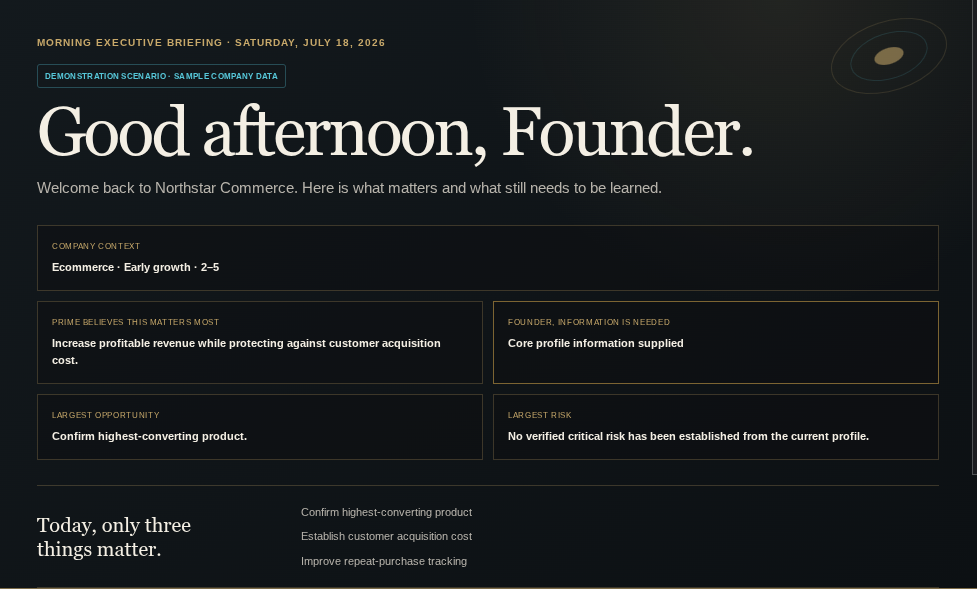
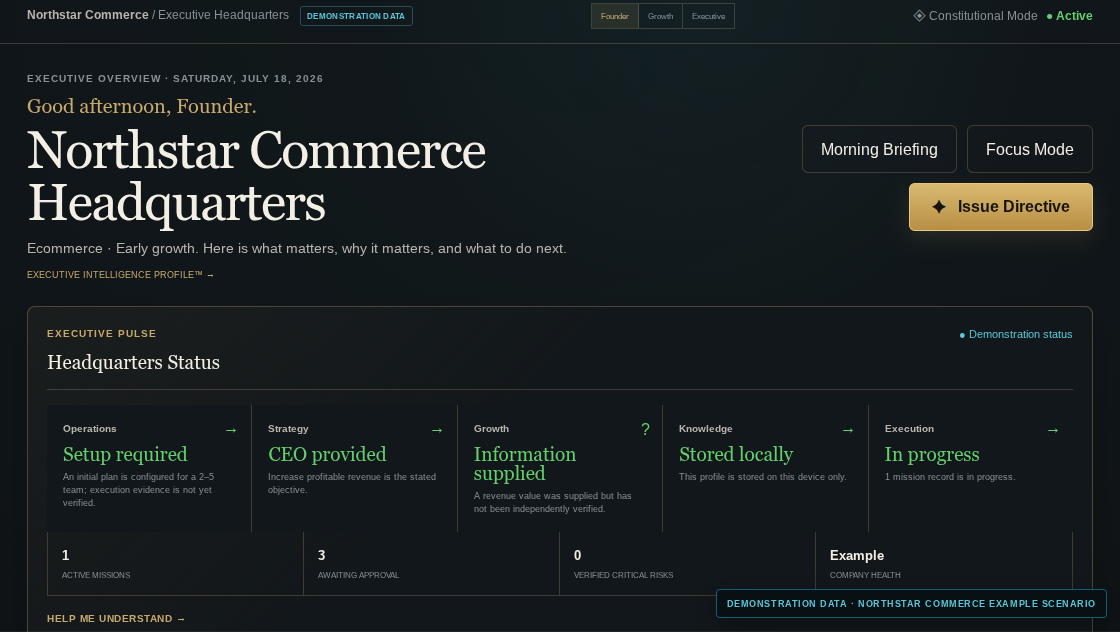
The Morning Executive Briefing identifies priorities, missing information and the three actions that matter most.
-
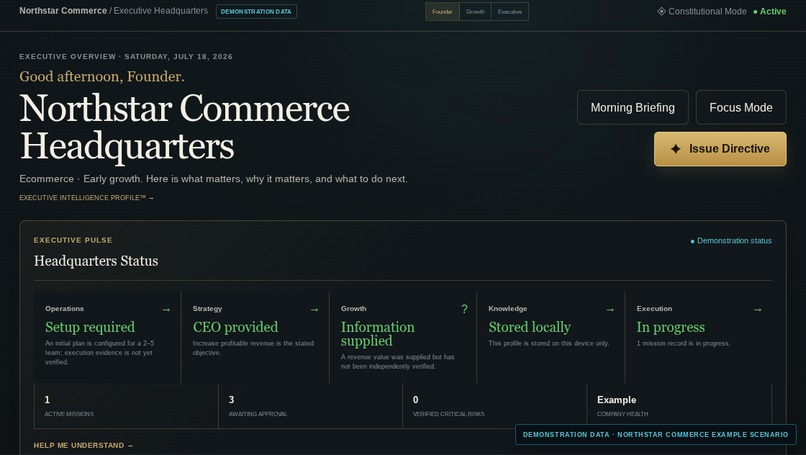
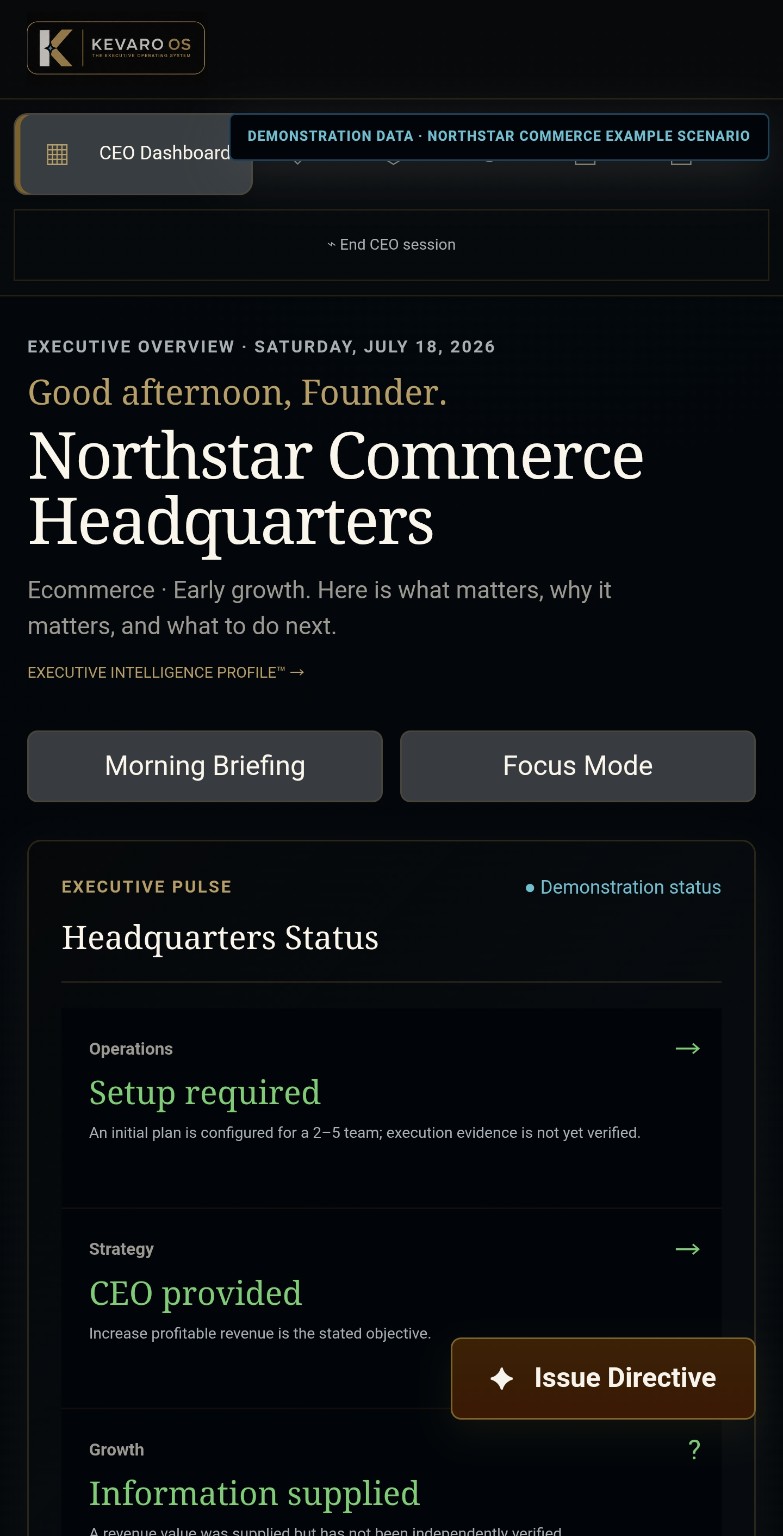
The CEO Dashboard brings company context, priorities, risks and pending decisions into one Executive Headquarters.
-
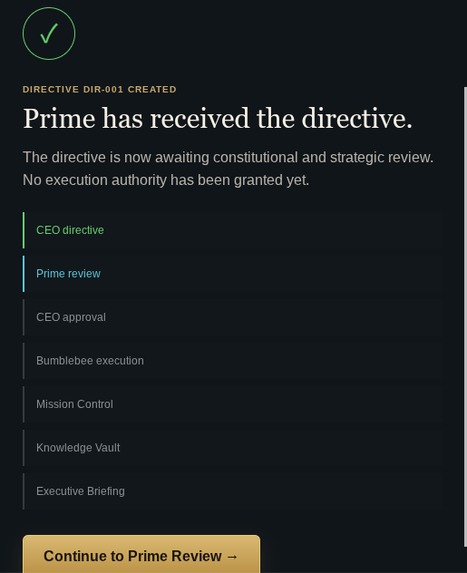
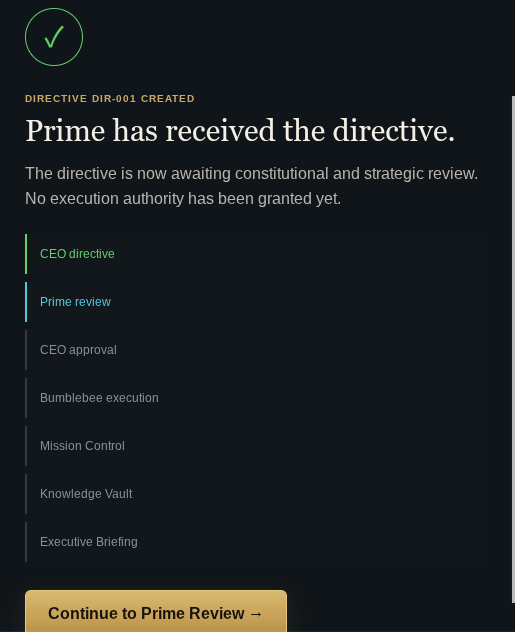
Every directive follows a governed path from Prime’s strategic review to preserved institutional knowledge.
-
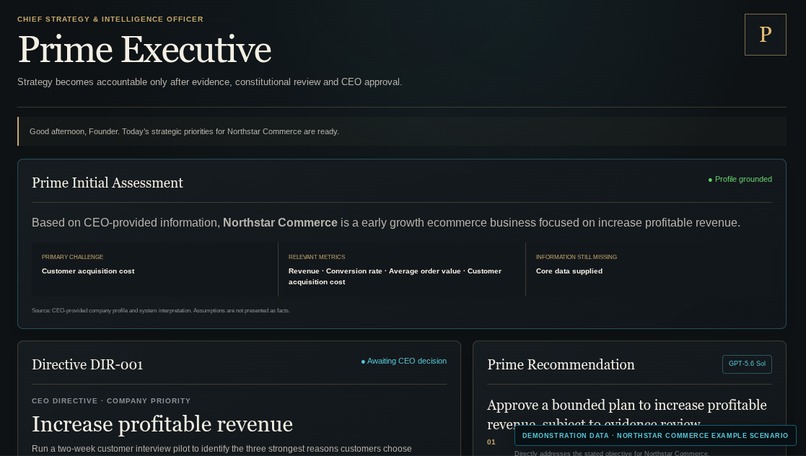
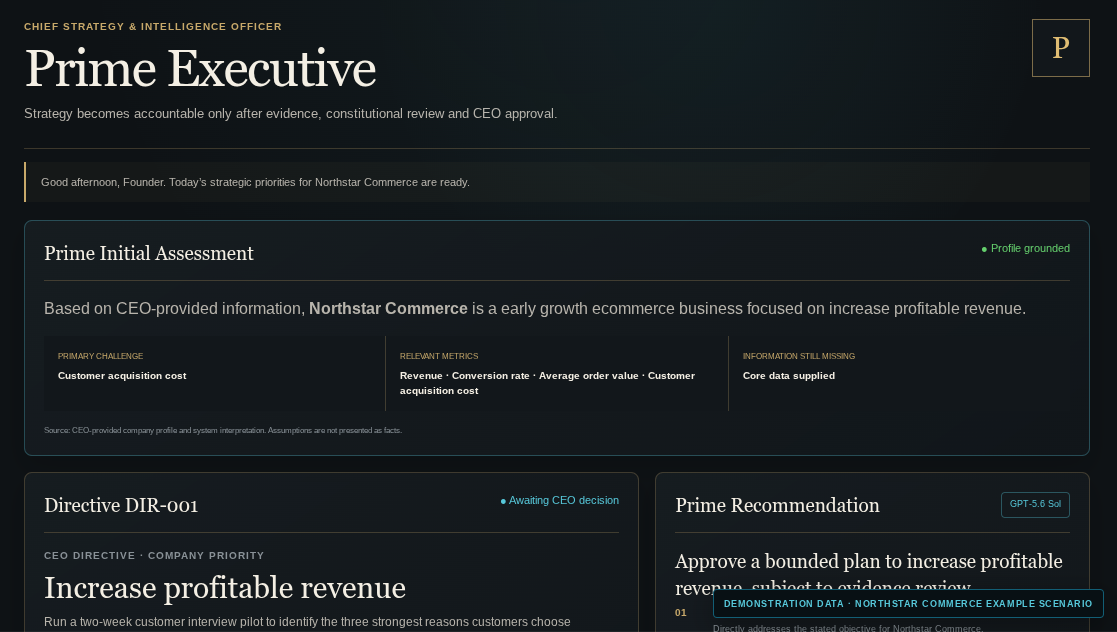
Prime uses live GPT-5.6 analysis to assess strategic fit, evidence, uncertainty and risk.
-
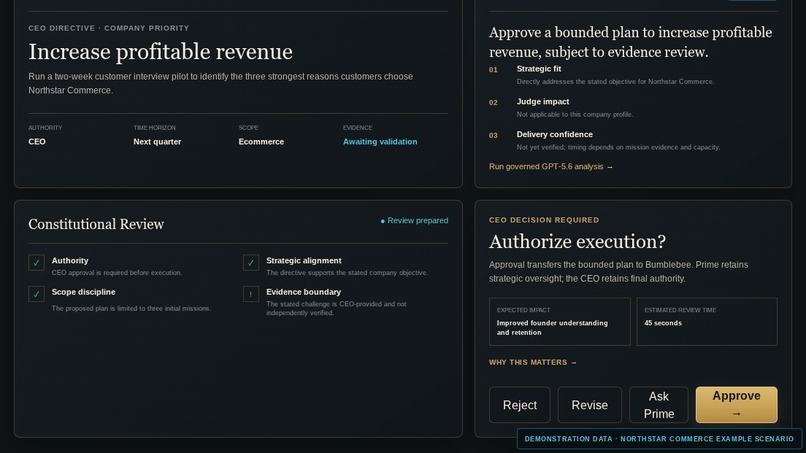
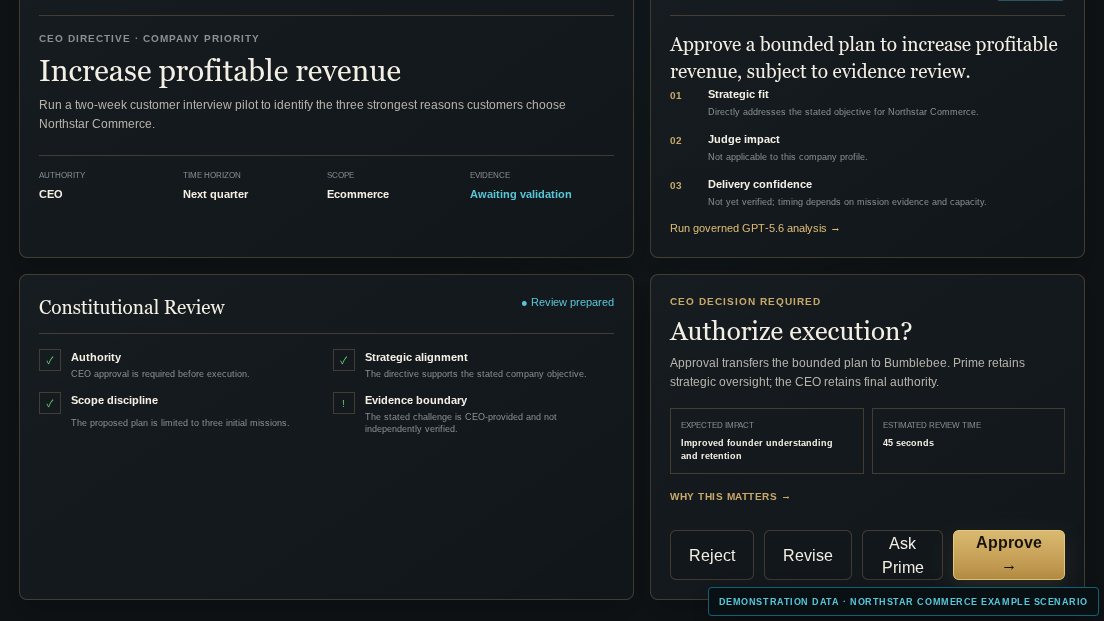
The CEO can reject, revise, ask Prime or approve. Consequential execution remains locked until authorization.
-
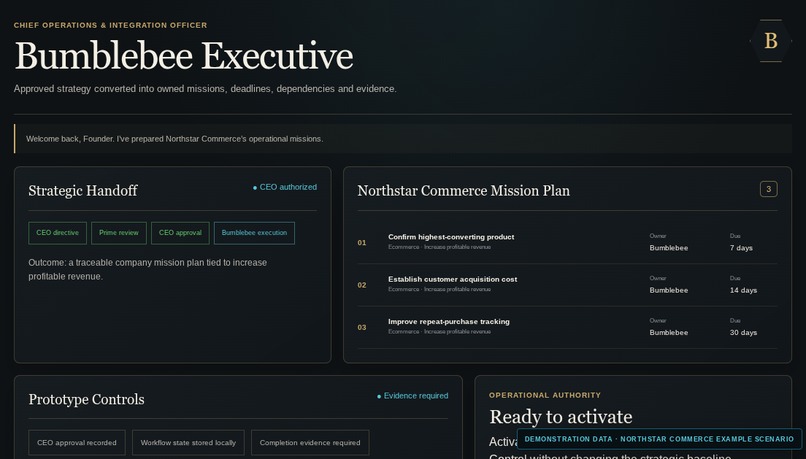
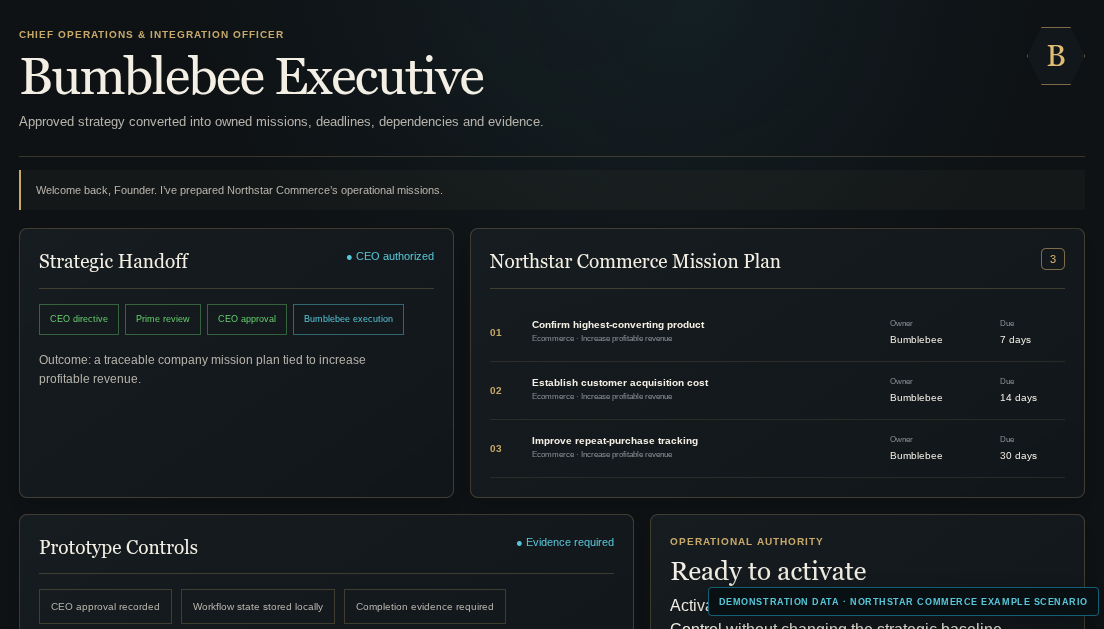
Bumblebee converts the CEO-approved recommendation into an owned, measurable mission plan.
-
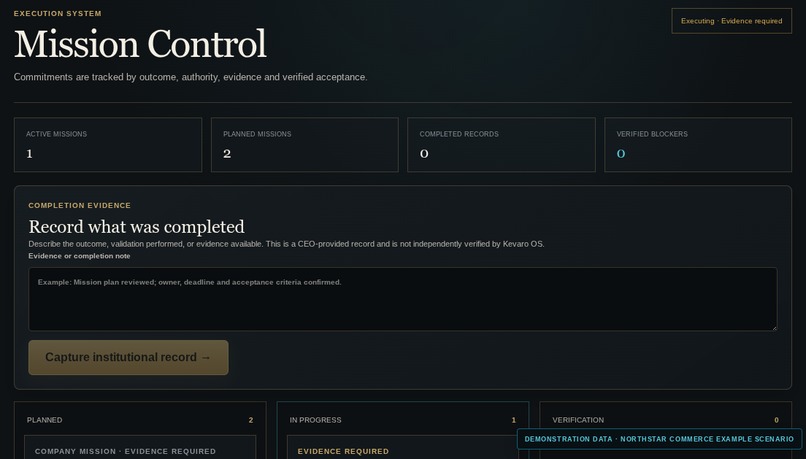
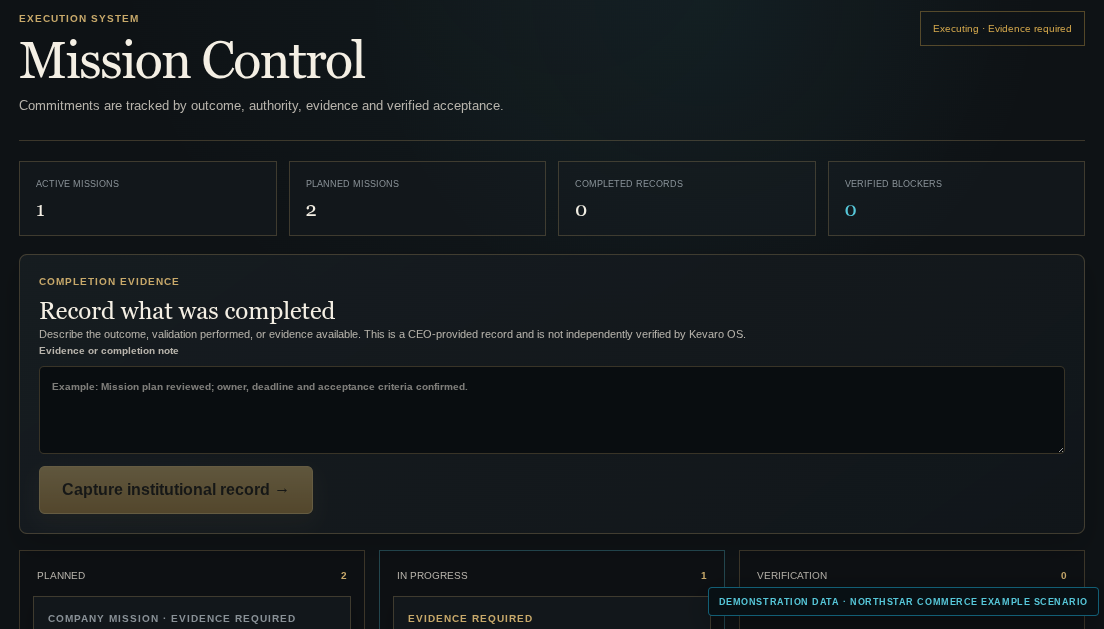
Mission Control tracks active work, planned missions and the evidence required for completion.
-
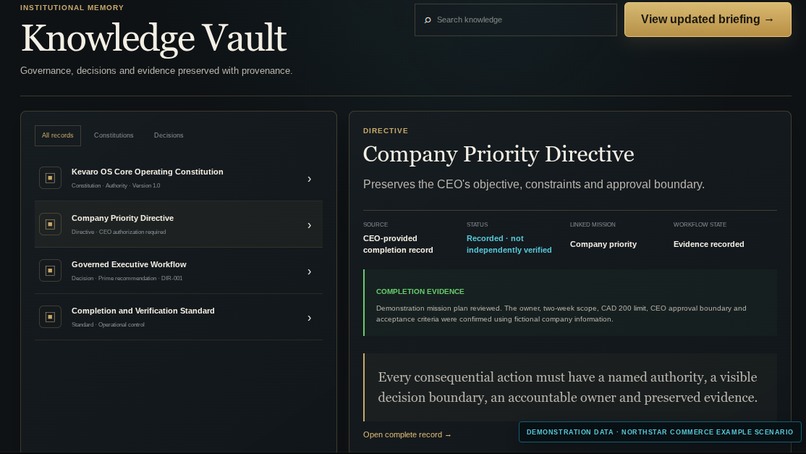
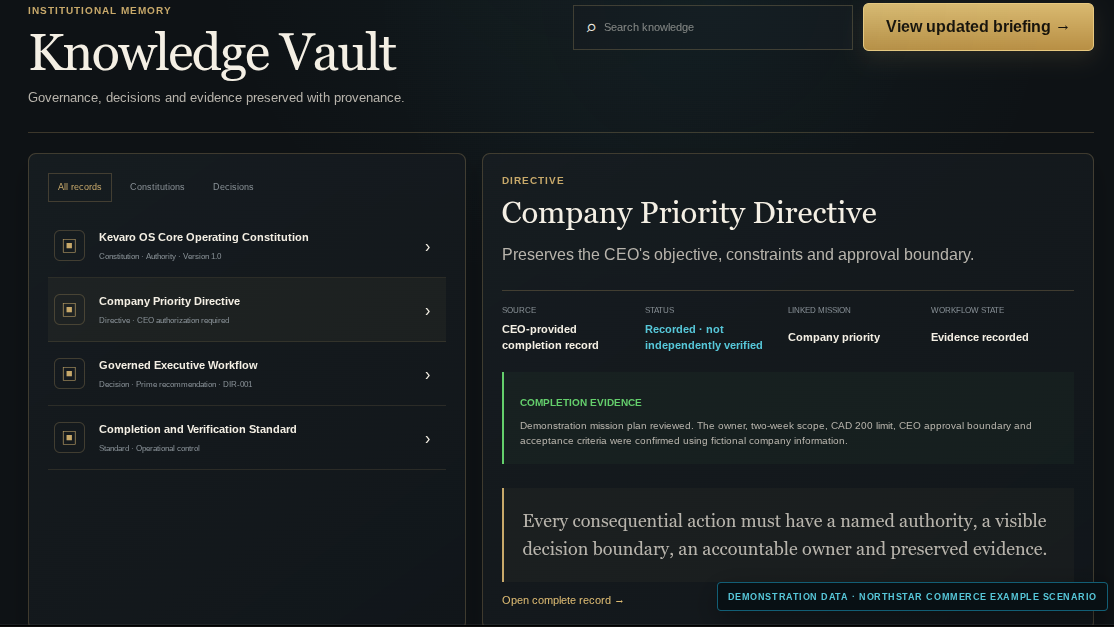
The Knowledge Vault preserves each directive, its authority, outcome and verification status.
-
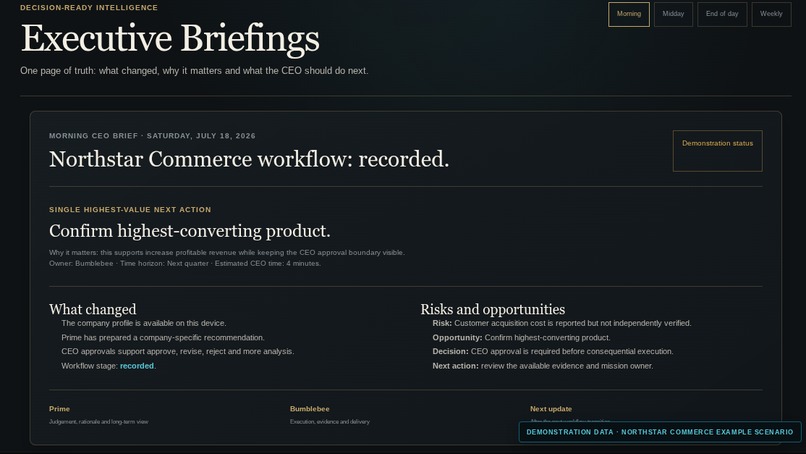
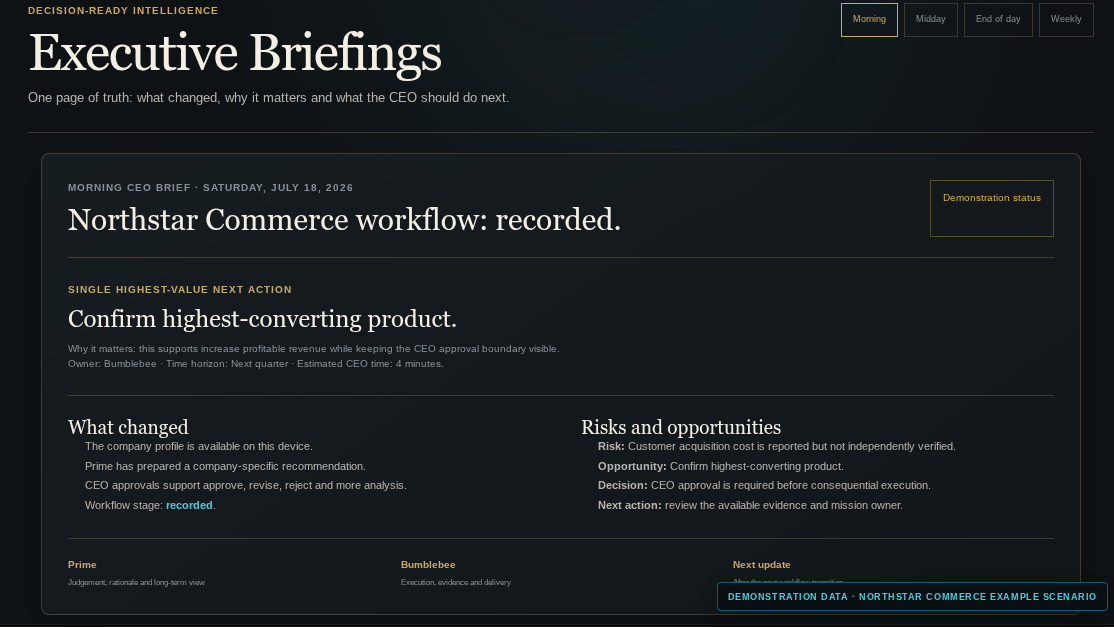
Executive Briefings explain what changed, what was learned and what should happen next.
-
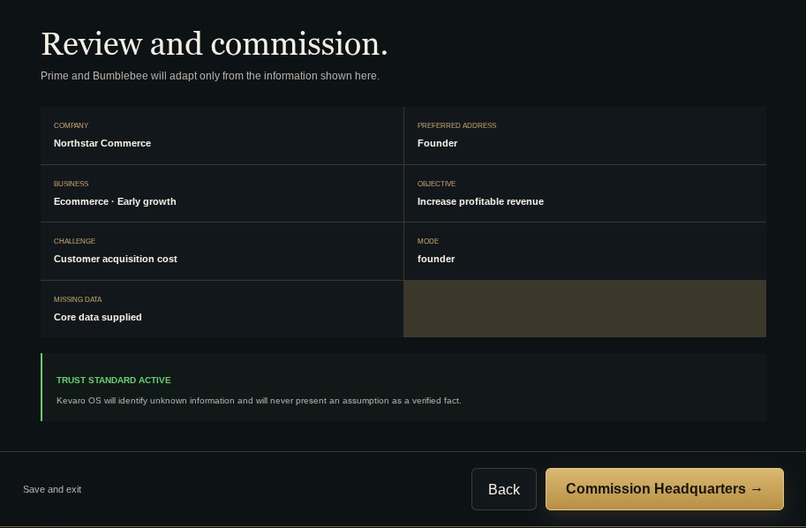
The Executive Intelligence Profile gives Prime and Bumblebee the company context needed to avoid generic advice.
-
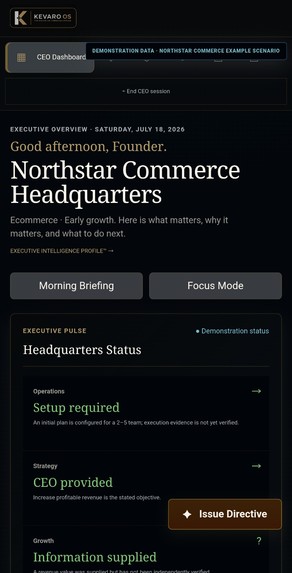
Kevaro OS remains clear and usable on mobile, giving founders access to Executive Headquarters anywhere.

Inspiration
I did not enter Build Week as a software developer.
I entered as a founder who understood the problem personally.
Running several early-stage projects taught me how quickly important decisions become scattered across conversations, documents, dashboards and unfinished task lists. Strategy gets mixed with execution. Good ideas lose their reasoning. Work moves forward without clear approval, and valuable lessons disappear when the next priority arrives.
I kept thinking about one question:
What would it feel like to run a company with the clarity of an executive team, even if you were still a team of one?
That question became Kevaro OS.
I wanted something more disciplined than another AI chatbot. I wanted a system where strategy, authority, execution and institutional knowledge each had a defined place. Most importantly, I wanted the human CEO to remain visibly in control.
What makes this project personal is that I had no previous software-development experience. I brought the vision, operating principles, product decisions and real founder problems. Codex helped me translate those ideas into a functioning product.
Build Week did not simply help me create an application. It changed what I believed I was capable of building.
What it does
Kevaro OS is The Executive Operating System for founders.
It helps a founder move from company context to governed intelligence, human-approved execution and preserved institutional knowledge.
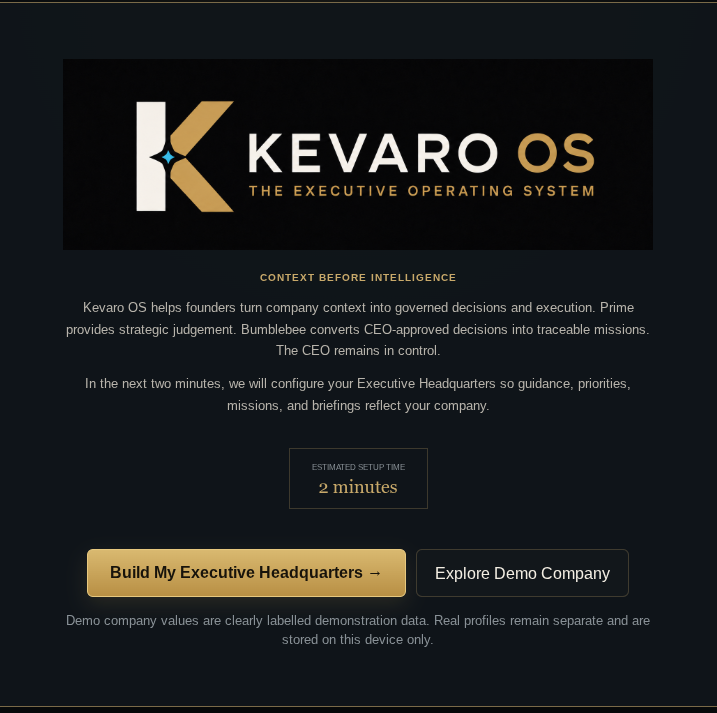
The experience begins with an Executive Intelligence Profile. The founder enters the company’s business model, stage, objectives, challenges, priorities and recent changes. Kevaro OS uses that context to avoid generic recommendations and clearly identifies information that remains unknown.
The system then coordinates two defined AI executive roles:
- Prime, Chief Strategy & Intelligence Officer, reviews directives, strategic fit, risks, evidence and uncertainty using GPT-5.6.
- Bumblebee, Chief Operations & Integration Officer, converts CEO-approved decisions into bounded missions, ownership, dependencies and completion records.
The complete governed workflow is:
CEO Directive → Prime Review → CEO Approval → Bumblebee Execution → Mission Control → Knowledge Vault → Executive Briefing
The CEO can approve, revise, reject or ask Prime for additional analysis. Consequential execution remains locked until the CEO authorizes it.
Mission Control tracks approved work. Completion evidence records what happened while clearly identifying whether the information was independently verified. The Knowledge Vault preserves the decision, authority, evidence and outcome. Executive Briefings then explain what changed and what should happen next.
Kevaro OS also includes:
- A guided Morning Executive Briefing
- CEO Focus Mode
- A plain-language Executive Mentor
- Adaptive company profiles
- Missing-information controls
- Demonstration and real-profile separation
- Responsive desktop and mobile experiences
- Labelled fallback behaviour when live model analysis is unavailable
The goal is not to replace the founder.
The goal is to help the founder think, decide and execute with greater clarity while remaining fully in command.
How we built it
I began with the operating model before thinking about screens.
I defined the roles of the CEO, Prime and Bumblebee, including what each role could recommend, approve or execute. I then worked with Codex to translate those authority boundaries into product architecture, workflow states, interface components and validation controls.
Kevaro OS was built using:
- Codex
- GPT-5.6
- OpenAI Responses API
- OpenAI Sites
- React
- TypeScript
- Responsive CSS
- Cloudflare Workers
- Browser local storage
Codex helped convert plain-language product direction into working code, diagnose defects, improve responsive behaviour, strengthen accessibility and test the governed workflow.
The production OpenAI route sends selected company context and the CEO directive to GPT-5.6 through a protected server-side configuration. Prime returns structured analysis covering the recommendation, strategic rationale, evidence supplied, important unknowns, principal risk, reversibility and proposed next action.
If live analysis becomes unavailable, Kevaro OS returns a clearly labelled fallback rather than pretending simulated output came from the model.
Throughout development, I tested the product manually on a Chromebook and phone. Every time I found friction, unclear language or a broken authority boundary, I worked with Codex to repair the system and test it again.
Challenges we ran into
The greatest challenge was not writing code.
It was turning an ambitious idea into a product that remained understandable, trustworthy and usable.
Early versions looked impressive but contained demonstration values that could be mistaken for real company data. We rebuilt the truth controls so examples, CEO-provided information, unknowns and verified evidence remained visibly distinct.
We also discovered that editing the demonstration company could accidentally convert it into a real profile. That was a serious trust problem. We separated the storage records, preserved demonstration identity and added migration controls.
Other challenges included:
- Mobile controls becoming hidden or overlapping
- Focus Mode not scrolling correctly
- Approval controls being covered by interface elements
- Completion records appearing more verified than they were
- Dashboard counts becoming inconsistent
- Making profile editing easy to discover
- Preserving workflow state after ending a CEO session
- Activating live GPT-5.6 analysis without exposing credentials
- Keeping Prime’s intelligence contextual without transmitting unnecessary company information
Each problem improved more than one screen. It strengthened the underlying operating system.
Accomplishments that we're proud of
I am proud that Kevaro OS became a complete working experience rather than a collection of attractive mockups.
The final build includes:
- A functioning seven-step company onboarding process
- Live context-aware GPT-5.6 strategic analysis
- Visible CEO approval boundaries
- A complete Prime-to-Bumblebee executive handoff
- Mission activation and evidence capture
- Institutional knowledge preservation
- Adaptive executive briefings
- Separate demonstration and real-company profiles
- Responsive Chromebook and mobile presentation
- Keyboard and accessibility controls
- Truth labels for evidence, uncertainty and unverified information
- A polished visual identity created during Build Week
I am especially proud that someone without previous software-development experience could begin with a founder’s problem and finish with a deployed AI product, a governed technical architecture and a complete submission package.
Kevaro OS is proof that domain experience, persistence and clear thinking can become working software when paired thoughtfully with Codex.
What we learned
I learned that not knowing how to code is different from not knowing what should be built.
The founder still needs to define the problem, make decisions, protect the product’s purpose and recognize when something is not good enough. Codex dramatically expanded what I could execute, but it did not remove the need for judgement.
I also learned that responsible AI design is not something added after the product works. Authority, privacy, evidence and uncertainty must be designed into the workflow from the beginning.
Most importantly, I learned that building is an iterative conversation.
We did not reach the final product through one perfect prompt. We reached it by testing, noticing friction, asking better questions, correcting weaknesses and improving the system repeatedly.
What's next for Kevaro OS
The Build Week version proves the central idea: founder intent can become contextual strategy, human-approved execution and preserved institutional knowledge within one governed system.
The next stage would develop Kevaro OS into a secure, persistent platform with:
- Authenticated company workspaces
- Encrypted cloud records
- Multi-user executive collaboration
- Configurable governance policies
- Permission-controlled business integrations
- Evidence connections for commerce, accounting, CRM and analytics systems
- Automated executive reporting
- Expanded institutional knowledge management
- Additional specialized executive capabilities
Those capabilities are intentionally presented as the future roadmap, not as features of the current prototype.
What began as a question from a non-developer became a functioning executive operating system.
Kevaro OS demonstrates what becomes possible when lived experience provides the vision, human judgement protects the purpose, and Codex makes building accessible.
Built With
- codex
- css3
- gpt-5.6
- html5
- openai-sites
- react
- responses
- responses-api
- typescript
- vite


Log in or sign up for Devpost to join the conversation.