In one line
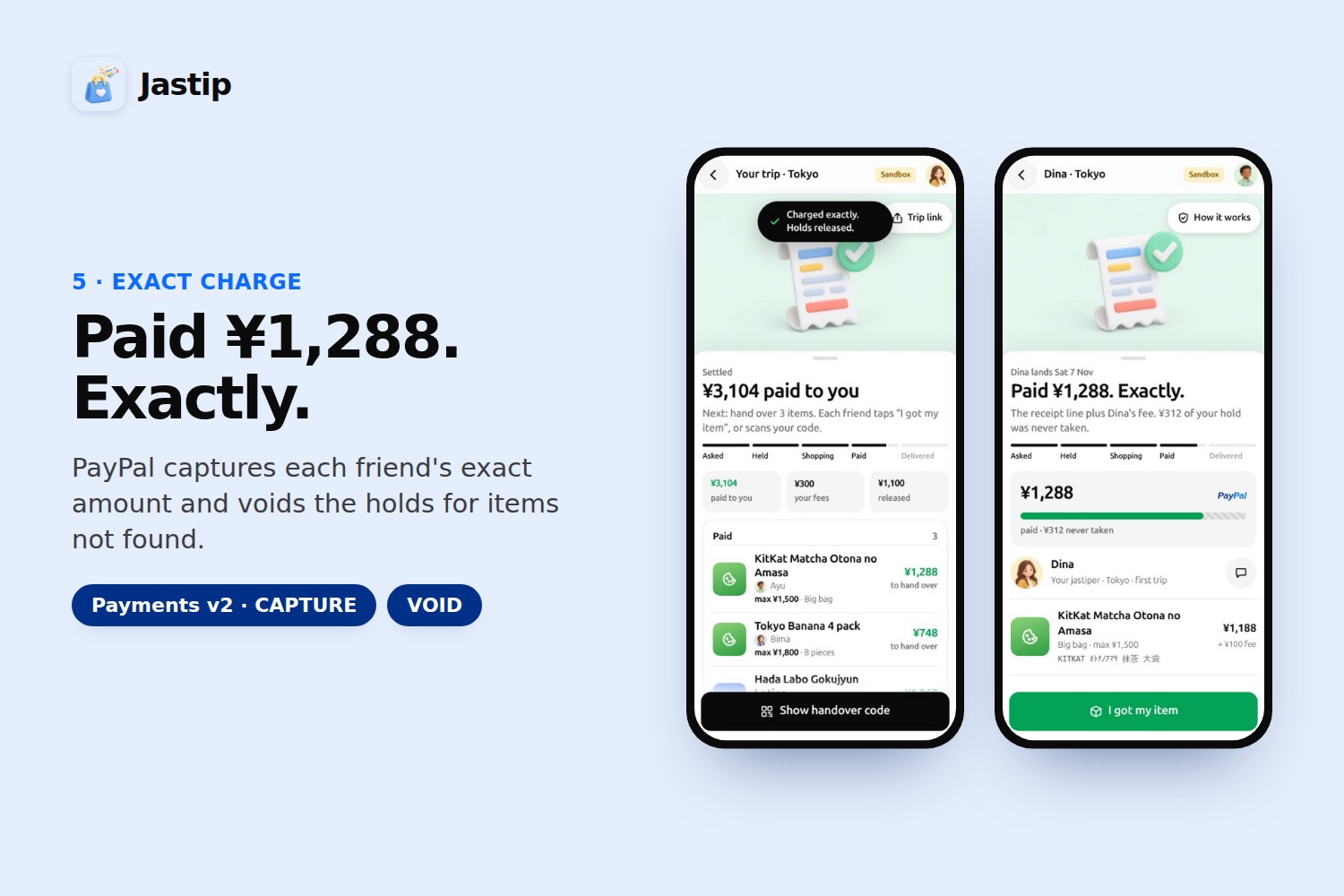
A friend approves a PayPal hold for a max price before anything is bought. One receipt sets their exact charge, and every unused yen goes back. In our sandbox test, a ¥1,500 hold became a ¥1,188 charge, and ¥312 was never taken.
How Jastip meets the judging criteria
- Technological implementation. Four PayPal calls work together: Orders v2 with
intent: AUTHORIZE, Authorize Order, partial Capture withfinal_captureand a PayPal-Request-Id per hold, and Void. AI does two jobs: Gemma 4 vision reads the receipt, and it turns a pasted link or slang into a product and shelf price. Code, never the AI, sets every amount. 29 of 29 end-to-end checks pass against the real sandbox, locally and on the live site. - Design. It's a complete product for a traveller and several friends at once, on phone, tablet and desktop. Each friend follows their order like a food delivery: Asked, Held, Shopping, Paid, Delivered. Sold-out items, swaps, late approvals and failed payments all have a screen and a next step.
- Potential impact. Jastip is how many Indonesians get things from abroad. By 2019, #jastip already had 3.7 million Instagram posts (Katadata). The Philippines has the same habit (pasabuy), and so does China (daigou, estimated at US$40bn to US$100bn of trade by QUT researchers). The pain is the same everywhere: someone fronts the money.
- Innovation. Jastip apps we found take full payment upfront, and pasabuy apps such as yayhop protect the buyer's money in their own in-app eWallet until delivery. Jastip never touches the money. PayPal holds it, and only the exact amount moves.
- Presentation. The video shows the full flow on the real sandbox, with PayPal's own approval page, in 2 minutes 5 seconds.
Approve a limit, not a cart
At AI Engineer World's Fair 2026, PayPal engineers showed an approval where the user confirms an amount, an expiry and a permitted merchant before an AI agent has found anything to buy. Jastip already works this way on PayPal's public APIs. The friend approves a max price, for one traveller, for one shopping day, before the item is on a shelf. Today a person does the shopping, and code holds them to the limit. The same hold could let a shopping agent fill an ask, with the same rules still capping every charge.
Inspiration
In Indonesia, when a friend flies to Tokyo, the group chat fills up: "bring me the matcha KitKat", "the big Hada Labo, please". This is jastip (from jasa titip, "carry-for-me service"), between friends and as small side businesses.
The money is the hard part. Either friends pay upfront for things that might be sold out or cheaper on the shelf, and then wait for refunds. Or the traveller pays for everything and chases friends for weeks.
PayPal already has the right tool: an authorization (a hold) that can later be captured for less than it was authorized for, or voided. Jastip is built around that.
What it does
- The traveller opens a trip (Tokyo, dates, a fee per item) and shares one link.
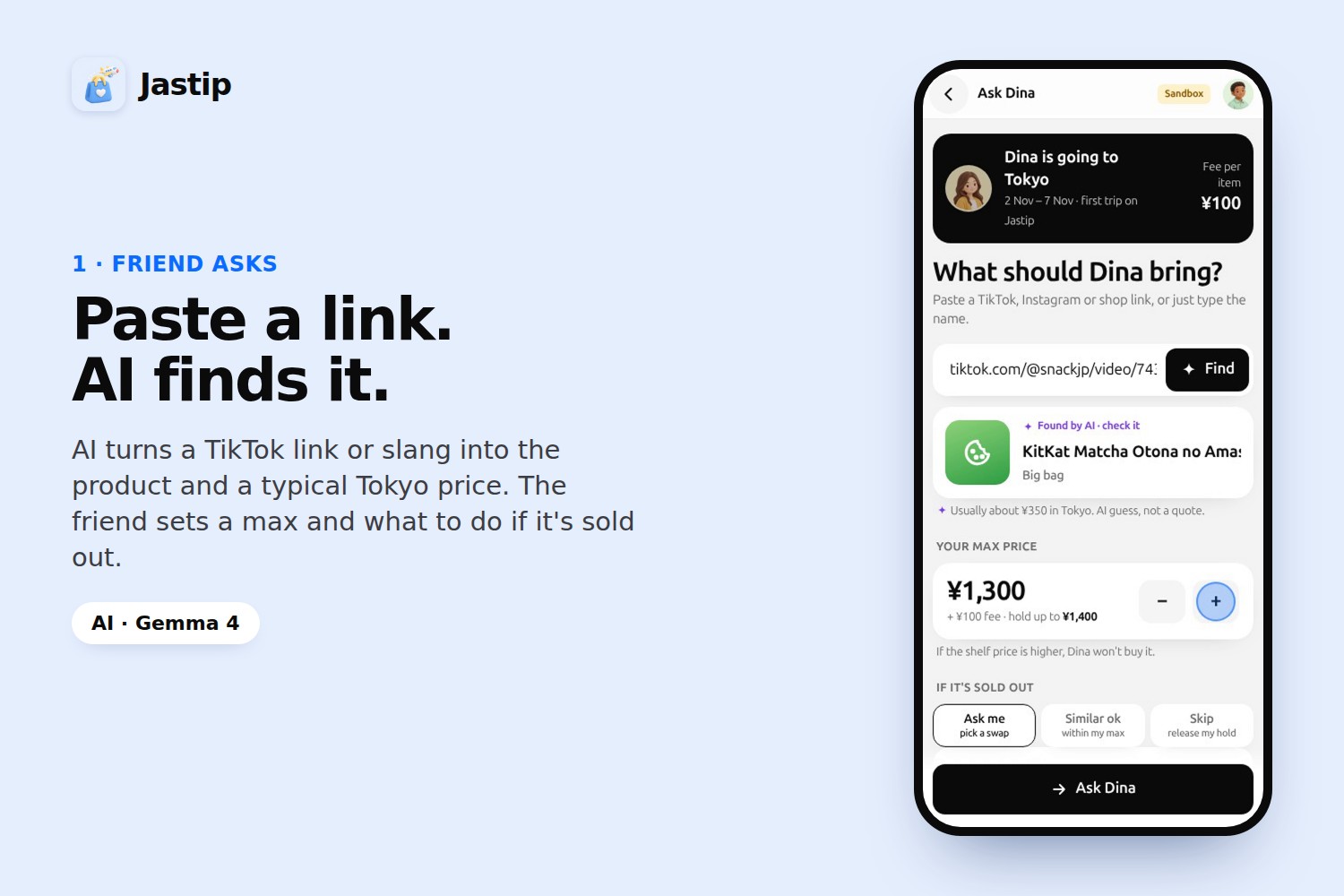
- A friend asks for an item. They paste a TikTok or shop link, or just type "matcha kitkat". AI turns it into the product, the variant and a typical Tokyo shelf price, so they can set a max price. They also choose what happens if it's sold out: ask me, similar is fine, or skip.
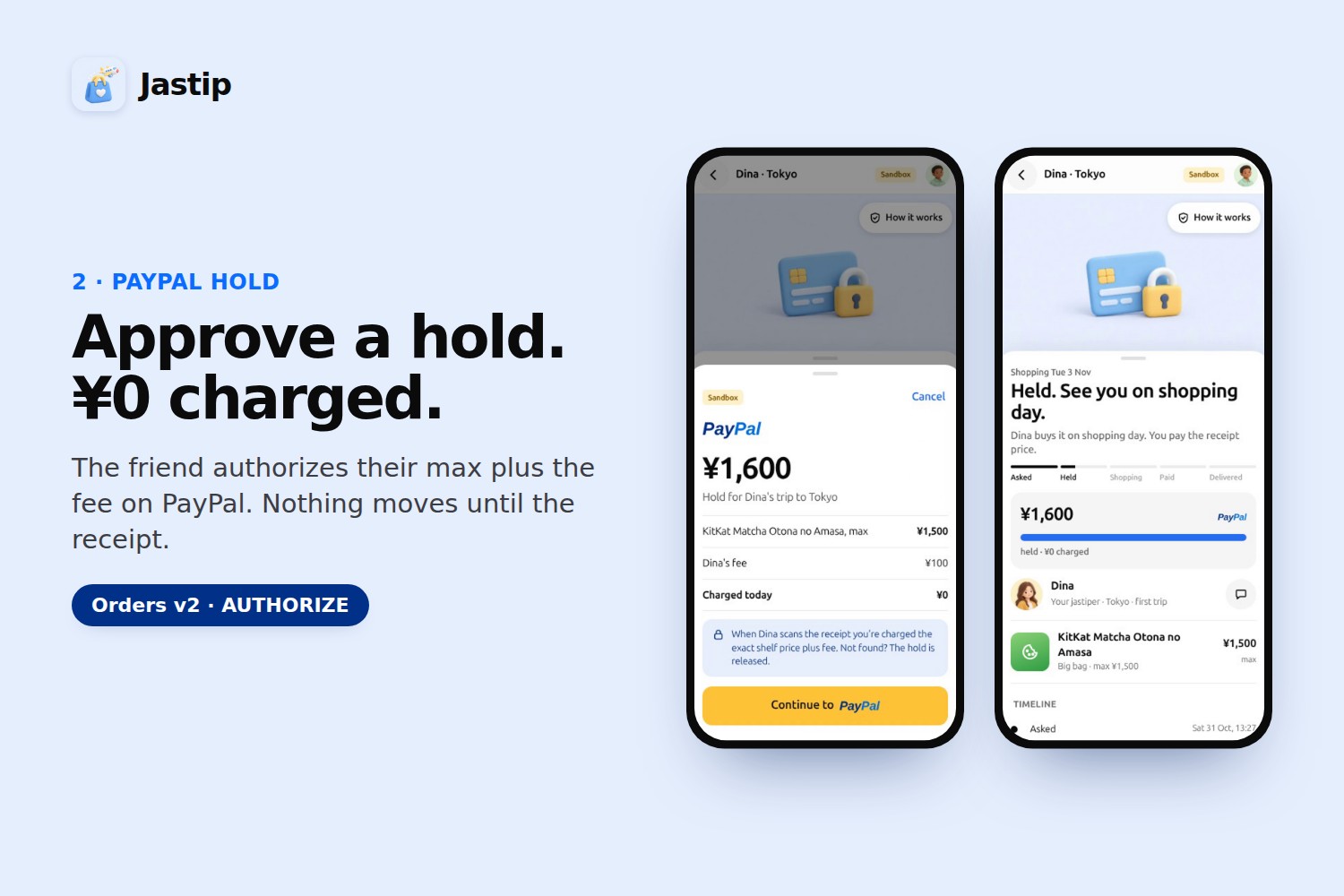
- The traveller accepts, picks a shopping day, and each friend approves a PayPal hold for their max plus the fee. Nothing is charged.
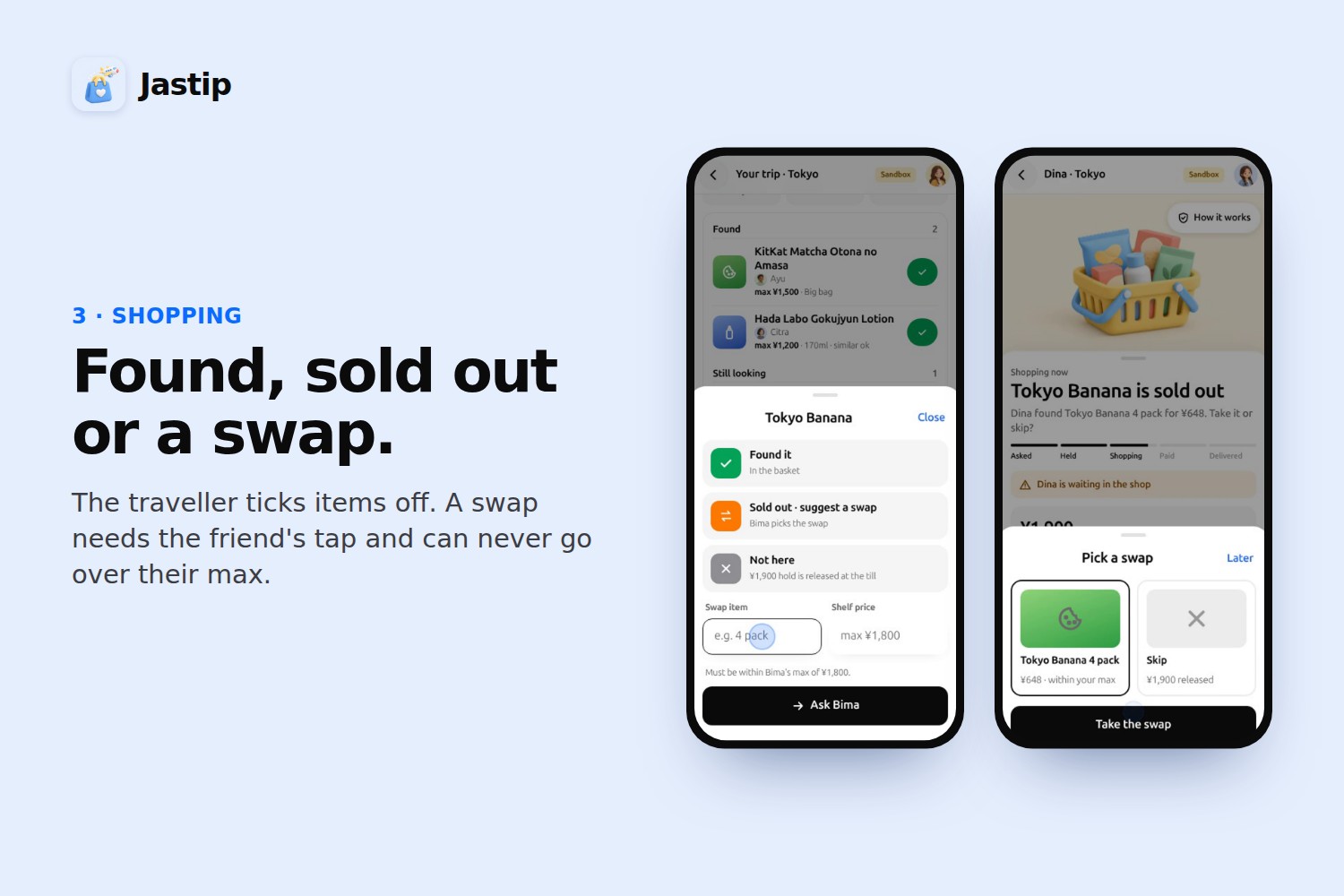
- In the shop, the traveller ticks items off. If something is sold out, they offer a swap and the friend accepts or skips it from their phone. A swap can never go over the friend's max.
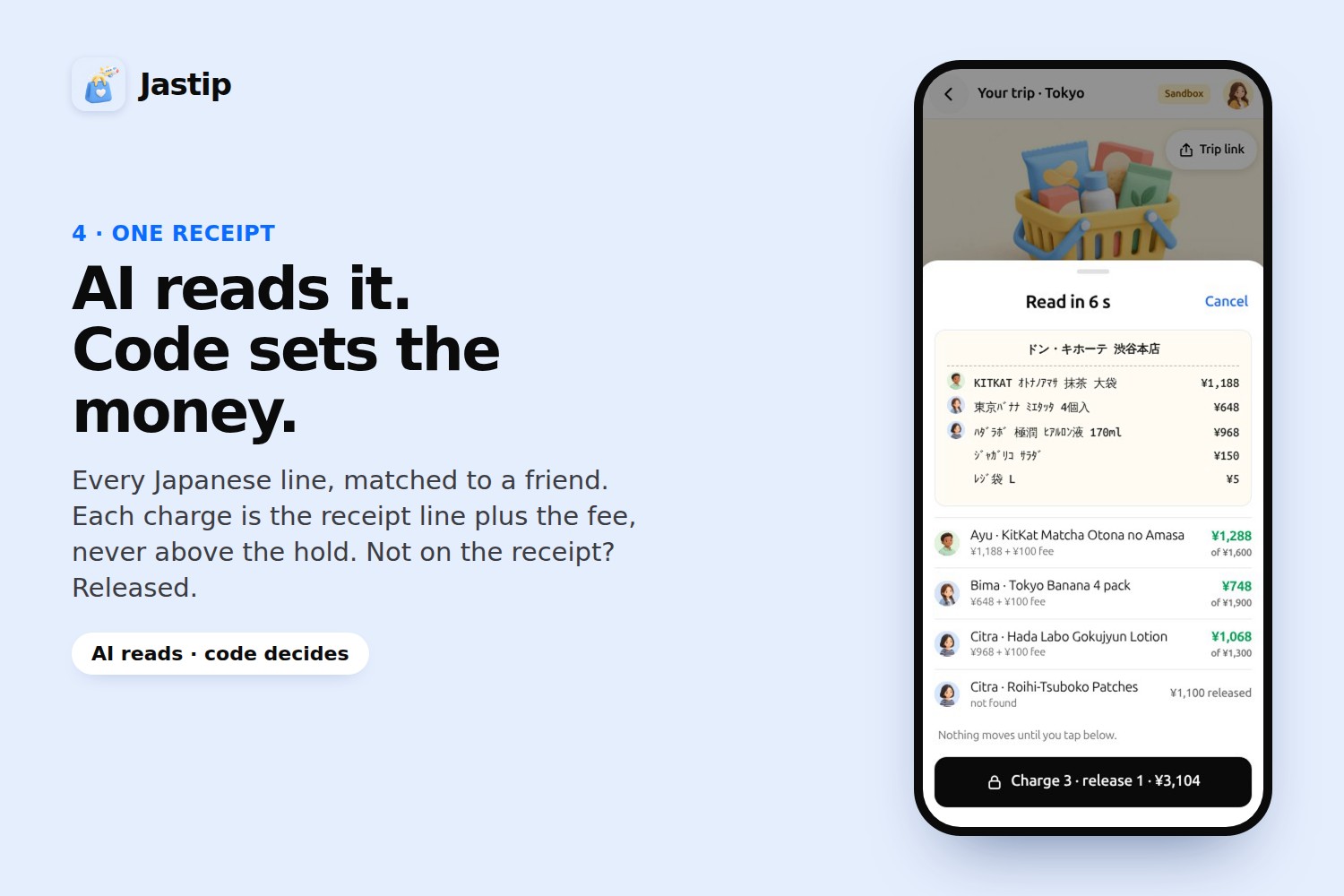
- At the till, the traveller photographs one receipt. AI reads every line (Japanese, Indonesian or English, with discounts and coupons) and matches lines to friends. Code, not AI, works out the money: each charge is that receipt line plus the fee, never above the hold.
- One tap. PayPal captures each friend's exact amount from their hold and voids the holds for items that weren't found. Each friend sees "Paid ¥1,288. Exactly." and how much of their hold was never taken.
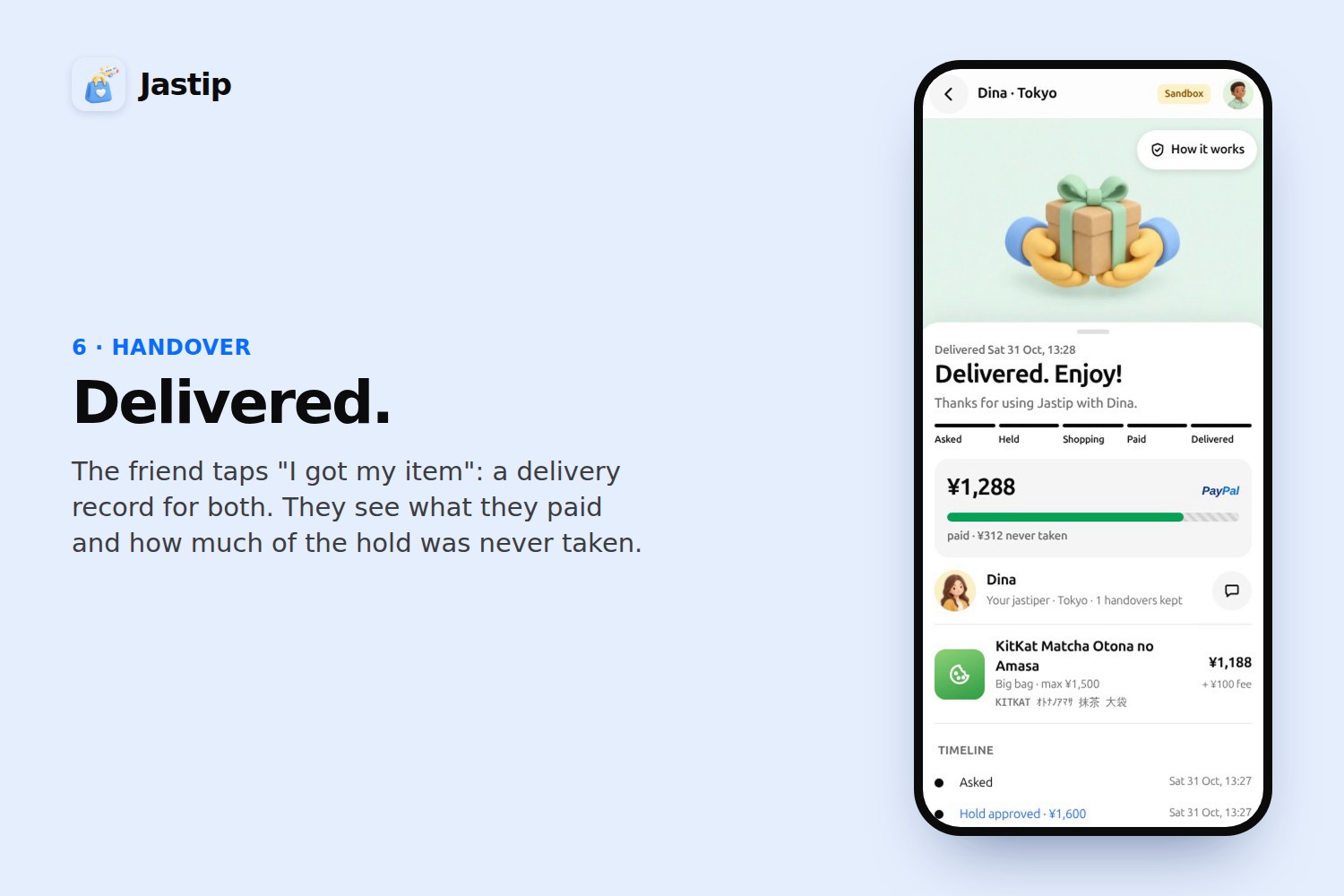
- Handover. The friend taps "I got my item", which is the delivery record for both of them.
How we built it
- PayPal Orders v2 creates each hold (
intent: AUTHORIZE, the traveller as payee) and authorizes it after the friend approves on PayPal's page. - PayPal Payments v2 captures the exact amount from each authorization (
final_capture, an idempotency key per hold) or voids it. - Cloudflare Workers AI (Gemma 4 26B, vision) reads the receipt photo and turns pasted links or slang into a product and a typical price.
- Cloudflare Workers + D1 run the app and store trips, asks and every PayPal and AI event. The same code runs locally on Node with SQLite.
- Plain JavaScript with no framework and no runtime dependencies. The interface is our own design, tested at seven screen sizes.
What we measured on the PayPal sandbox first
Before writing the app, we tested the riskiest part on the sandbox with an Indonesian buyer account, in yen:
- A ¥1,500 hold captured at exactly ¥1,188, and another hold voided.
- Reauthorizing is allowed once, from day 4 to day 29. The API returned
REAUTHORIZATION_TOO_SOONon day 1 with that rule. The docs say a hold can be reauthorized more than once. This one rule shaped the design: holds open on the shopping day, not at booking, and are charged inside PayPal's 3-day honor period. - PayPal's fee was ¥80 on ¥1,188 and ¥73 on ¥968 (about 7%), so the traveller's fee has to cover it.
- PayPal lets a merchant capture up to 115% of a hold (or $75 more, whichever is less). Jastip deliberately caps every charge at the friend's own max.
We then compared eight vision models on test receipts before choosing one.
Safety rules, enforced in code
- No hold, no shopping: only asks with an approved hold go on the list.
- A charge is never above the hold, and never above the receipt line plus the fee.
- No matching receipt line means no charge, and the hold is voided.
- One capture per hold. If PayPal fails halfway, each friend's charge or release is saved first, and Retry repeats only the steps that didn't go through, with the same amounts.
- A swap needs the friend's tap and can't go over their max.
- A new friend can hold at most $50 until their first handover, unless the traveller confirms they know them.
Challenges we ran into
- Real receipt photos. Coupon lines, quantity notes ("3点 X ¥485"), totals, cash and change all look like prices. The model reads the lines. Code folds each coupon into the item above it and drops totals, tax, cash and change, so they can never become a charge. On a real drugstore receipt with seven items and six coupons, every coupon landed on the right item and the lines added up to the printed total.
- Payment failures in the middle. An independent reviewer went through seven rounds of trying to break the payment flow: a PayPal approval that arrives after shopping started, a retry after a partial failure, a receipt plan built before the list changed. Each case is now handled and covered by a test.
- Staying on free tiers. Identical AI requests are cached, each person has an hourly limit, and if the daily AI allowance runs out the app keeps working. Item lookup falls back to plain text, and holds are never affected.
Accomplishments that we're proud of
- It runs end to end on the real PayPal sandbox: an Indonesian buyer account approving holds in yen, partial captures to the exact receipt amount, and voids.
- The AI never decides an amount. Every number a friend pays comes from a receipt line, the friend's own max and the traveller's fee.
What we learned
PayPal authorizations fit shared shopping well. The friend sees a real hold, nothing is charged, and the final amount can be lower. The timing rules decide the whole flow, so we measured them before building anything.
What's next for Jastip
- A shopping agent that fills an ask inside the friend's approved hold, with the same code rules capping every charge.
- Payouts and multi-party flows for travellers who run jastip as a small business.
- Using PayPal's dispute tools with the handover record and receipt as evidence.
- Testing with real jastip groups in Indonesia, starting with Tokyo and Singapore trips.
AI tools we used
- Gemma 4 26B (
@cf/google/gemma-4-26b-a4b-iton Cloudflare Workers AI), in the product: reads receipt photos and turns pasted links or slang into a product and a typical price. - Gemini 3.8 Flash, in the product when it runs locally (any OpenAI-compatible vision endpoint works).
- Model comparison during testing (receipt reading only, not in the product): Gemini 3 Flash, Claude Sonnet 4.6, and on Workers AI Llama 4 Scout, Mistral Small 3.1, Qwen 3.8 and Kimi K2.6.
- OpenAI image generation (through the Codex CLI): every illustration, avatar, the app icon and the hero image. All images are AI-generated.
- Kokoro TTS (open model, Apache 2.0), run locally: the narration in the demo video.
- AI coding agents (Claude through the pi coding agent, and GPT through pi for independent review rounds): used to write and review code, tests and documentation. The idea, the PayPal flow, the safety rules and every design decision were made and checked by the author.
Sources
- #jastip posts: Katadata, "Marak Bisnis Jasa Titip, dari Instagram hingga Aplikasi Tersendiri" (2019)
- Pasabuy: DHL Express Philippines, "How Pasabuy Works for Filipino SMEs"
- Daigou trade estimate: QUT research via Scimex, "Chinese Daigou shoppers a new type of entrepreneur"
- Approval before item selection: "Your Agent Just Authorized What?!", PayPal at AI Engineer World's Fair 2026
- Holds, honor period and 115% capture: PayPal Developer, "Authorization and honor period"
Try it
Live demo: https://jastip.feryyp-work.workers.dev (PayPal sandbox, nothing real is charged). Code: https://github.com/daefery/jastip. The sandbox login is in the testing instructions for judges.
