-
-
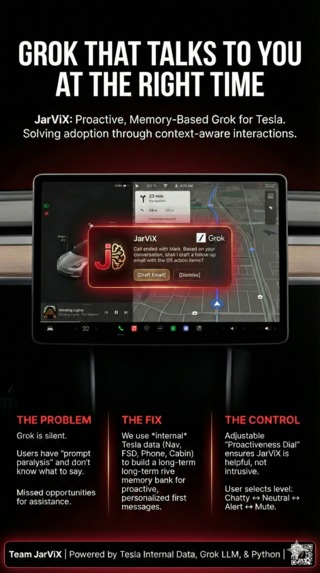
Proactive AI, JarVix
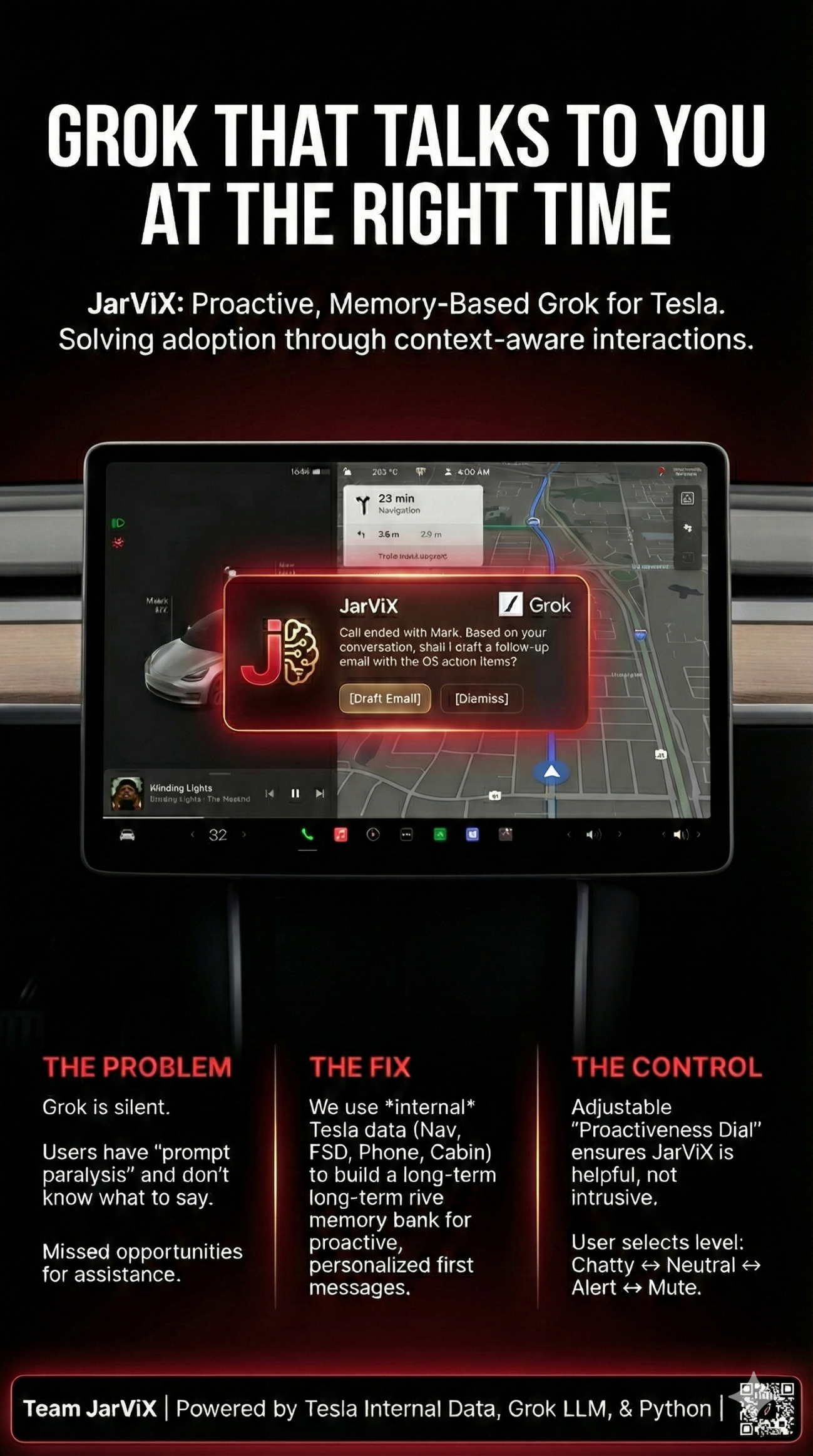
Inspiration
Inside every Tesla sits a powerful AI, Grok. Yet most drivers barely use it, even though Americans spend 300 hours a year driving alone.
The reason is simple: Grok is reactive. It waits. It never speaks first. And an assistant that never initiates cannot become part of your daily life.
We built JarVix, a proactive AI layer, to solve this. Grok already understands a lot about you, but it never knew when to talk. We changed that. Now it knows the right moment.
What it does
JarVix adds a proactive AI layer on top of Grok: Trigger-based initiation — Grok speaks exactly when it should, not randomly Long-term memory — remembers your habits, schedule, relationships Continuous understanding — listens to real-time context in the car
| Trigger | What Happens |
|---|---|
| 🎯 Destination Set | You enter a destination → “Heading to Starbucks? Want me to order your oat-milk latte?” |
| 📞 Phone Call Ends | Call with girlfriend ends → “Want me to add Saturday dinner to your calendar?” |
| 🤫 Conversation Gap | 10 minutes of silence → “By the way, your mom's birthday is next week.” |
| 👋 Passenger Exits | Friend gets out → “Now that you're alone, you’ve got 2 emails.” |
| 🚘 FSD Activates | FSD on → “Hands free. Want me to read your messages?” |
Why TESLA?
The most personal time in daily life,
Due to FSD, driving became highly opportune time to engage
While driving, sensors are always on actively capturing most of important parts of people's lives.
How we built it
• Defined trigger moments: Mapped concrete situations where AI interaction is genuinely helpful: destination set, call ends, silence gap, passenger exits, FSD on.
• Built long-term personal memory: Ingested calendar events, Tesla in-car voice conversations, and gallery images (receipts, notes, screenshots) through Grok Vision and STT into a mem0 based memory store.
• Implemented a proactive trigger engine: Real-time detection of trigger events, retrieval of relevant personal context, and prompt construction that decides if Grok should speak or stay quiet.
• Simulated realistic driving sessions: Created multiple driving scenarios and refined the trigger logic until the assistant consistently felt natural and helpful.
Challenges we ran into
Tuning the level of proactiveness Latency and instability in Grok API responses Limited access to vehicle-control interfaces Selective, lossy compression of raw multimodal data into a concise and actionable memory bank.
Accomplishments that we're proud of
Enabled Grok to speak first in meaningful moments, turning it from a reactive bot into a proactive copilot. Designed five reliable trigger events that consistently surface the right information at the right time. Built a long-term memory layer that lets Grok recall personal context naturally during a drive. Created a seamless interaction flow where trigger detection, context retrieval, and Grok responses feel unified. Validated the system across realistic driving scenarios to ensure the assistant helps rather than annoys.
What we learned
- We realized that as AI becomes a constant companion in daily life, defining the appropriate level of proactiveness is not trivial. Designing when an assistant should speak up versus step back is a nuanced behavioral decision, and this exercise forced us to think about it more deeply than ever before.
- True personalization does not require constant user interaction. With the right memory structure and triggers, the AI can understand the user without asking for input.
What's next
More integrations/connectors/mcps for wide range of actions Incorporate/capture data external to Tesla Reduce latency for voice agent (voice-to-voice ideally) Improve the long-term memory and retrieval system
Built With
- grok
- mem0
- python
- typescript


Log in or sign up for Devpost to join the conversation.