-
-
Jarvis-Multi Orchestration Agent
Jarvis: A Multi-Agent Orchestrated System
Inspiration
In the healthcare industry, Advanced Practice Clinicians (APCs) often spend a significant portion of their time on repetitive, administrative tasks—chart reviews, documentation, scheduling coordination, and data entry. These tasks, while necessary, take time away from direct patient care and contribute to burnout.
We were inspired to build Jarvis to address this challenge. Our goal was to create a system where intelligent agents could collaborate to automate these mundane workflows, allowing APCs to focus on what truly matters: patient outcomes
What it does
Jarvis is a multi-agent orchestrated system that automates and streamlines routine healthcare operations. Here's what it can do:
🔍 Summarize Patient Charts Automatically extracts and condenses relevant clinical information from patient records to assist with pre-visit planning.
📅 Coordinate Scheduling Identifies follow-up needs and automates appointment scheduling workflows across systems.
📊 Extract Insights from Notes and convert to json Uses NLP agents to analyze unstructured clinical notes and surface key trends or red flags.
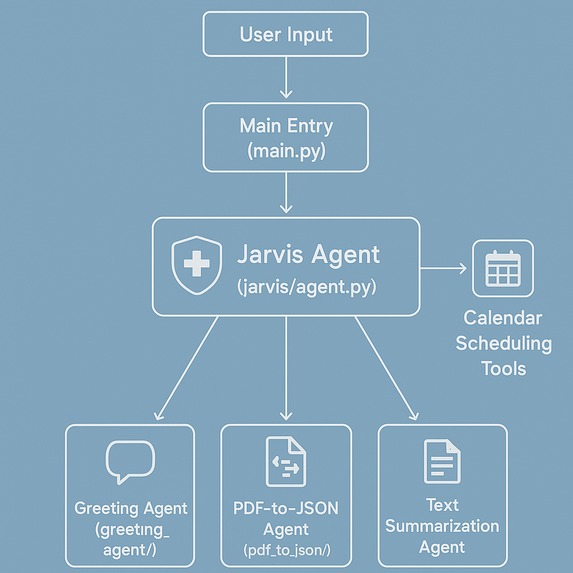
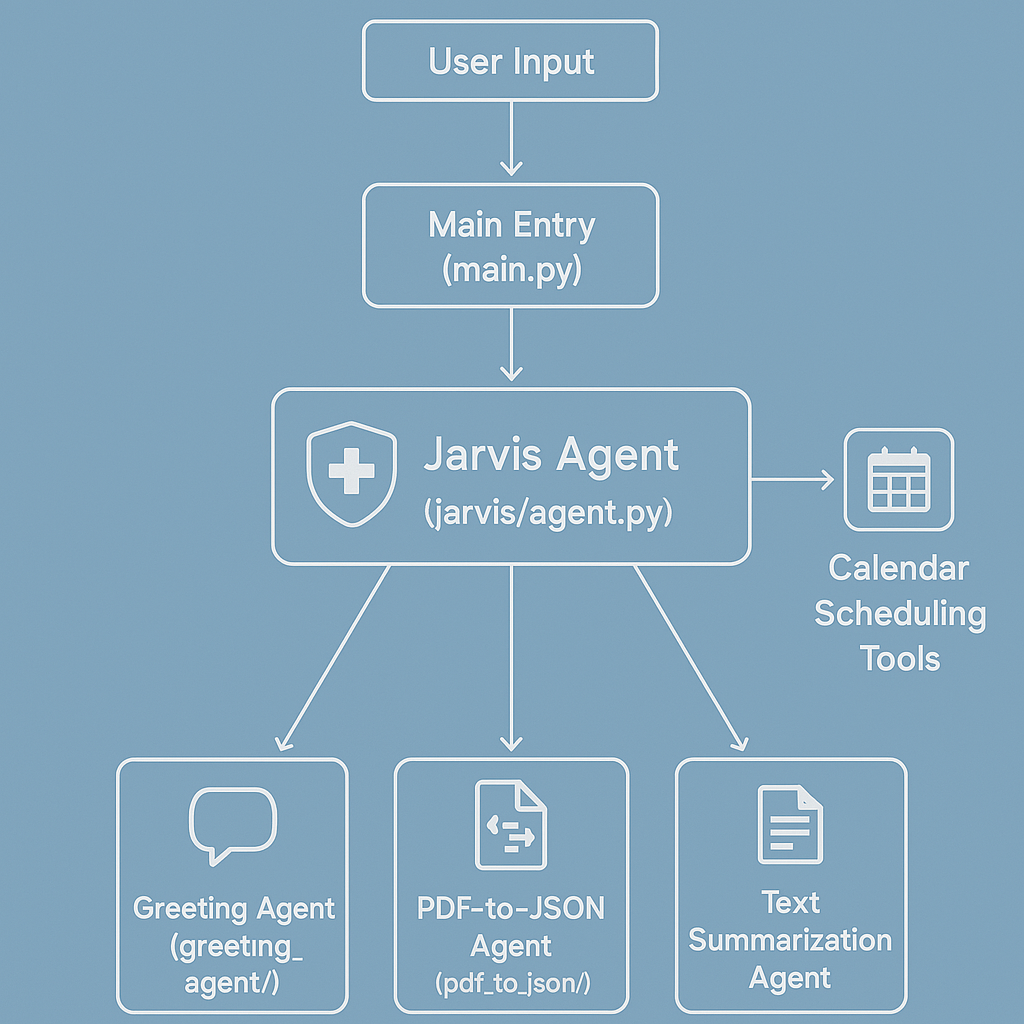
🔄 Agent Collaboration Agents communicate and delegate tasks through a central orchestrator, enabling parallel execution and intelligent fallback handling.
How we built it
Architecture A central orchestrator delegates tasks to specialized agents (e.g., document summarizer, appointment scheduler, greeting). Each agent is independently deployable and communicates via a message bus.
Healthcare Use Cases We focused on real-world scenarios such as:
Automating patient chart summarization Coordinating follow-up scheduling Extracting insights from clinical notes Tech Stack Python · FastAPI · Docker ·ADK
Challenges we ran into
Data Privacy: Ensuring HIPAA-compliant handling of synthetic patient data during the hackathon was a top priority. Agent Coordination: Designing a robust task routing mechanism that could adapt to agent availability and task complexity was non-trivial. Time Constraints: As with any hackathon, we had to prioritize core functionality over polish.
Accomplishments that we're proud of
Business Impact By automating repetitive workflows, Jarvis delivers measurable cost savings and operational efficiency: | Impact Area |Before Jarvis |After Jarvis | Estimated Savings | | ----------- | ----------- |----------- | ----------- | | Chart Review Time | ~15 minutes per patient |~3 minutes per patient | 80% time saved | | Documentation Completion | Manual, time-consuming |Auto-filled templates | 60% faster | |Scheduling Coordination| Manual follow-ups and phone calls| Automated agent-driven scheduling| 70% fewer delays| |APC Productivity| 10–12 patients/day| 14–16 patients/day| +30% throughput |Annual Cost Savings (est.)| Manual, time-consuming |~$250K per 10 APCs|Based on time ROI
These improvements not only reduce operational costs but also improve clinician satisfaction and patient experience.
What we learned
Domain-Specific Complexity: Healthcare data is messy, sensitive, and highly contextual. We learned to design agents that are both intelligent and compliant. Orchestration Patterns: We explored various coordination strategies—sequential, parallel, fallback—to optimize agent collaboration. Observability: Centralized logging and tracing were essential for debugging and understanding agent behavior.
What's next for JarvisFlow - Multi-Agent System
The next phase for Jarvis focuses on enhancing usability and accessibility. We're integrating voice interaction to allow clinicians to engage with agents hands-free—ideal for high-paced clinical environments. Additionally, we're building a secure upload feature that enables users to submit PDFs (like patient records or lab reports), which Jarvis can parse and process using document intelligence agents. These enhancements will make Jarvis even more intuitive and powerful, further reducing administrative burden and unlocking new automation opportunities in healthcare.
Built With
- docker
- fastapi
- github
- google-adk
- google-gemini
- javascript
- pydantic
- python


Log in or sign up for Devpost to join the conversation.