-
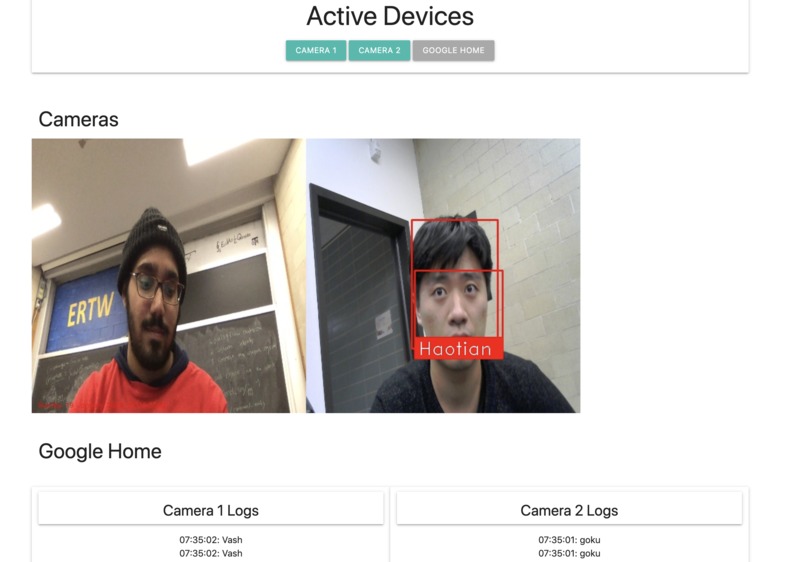
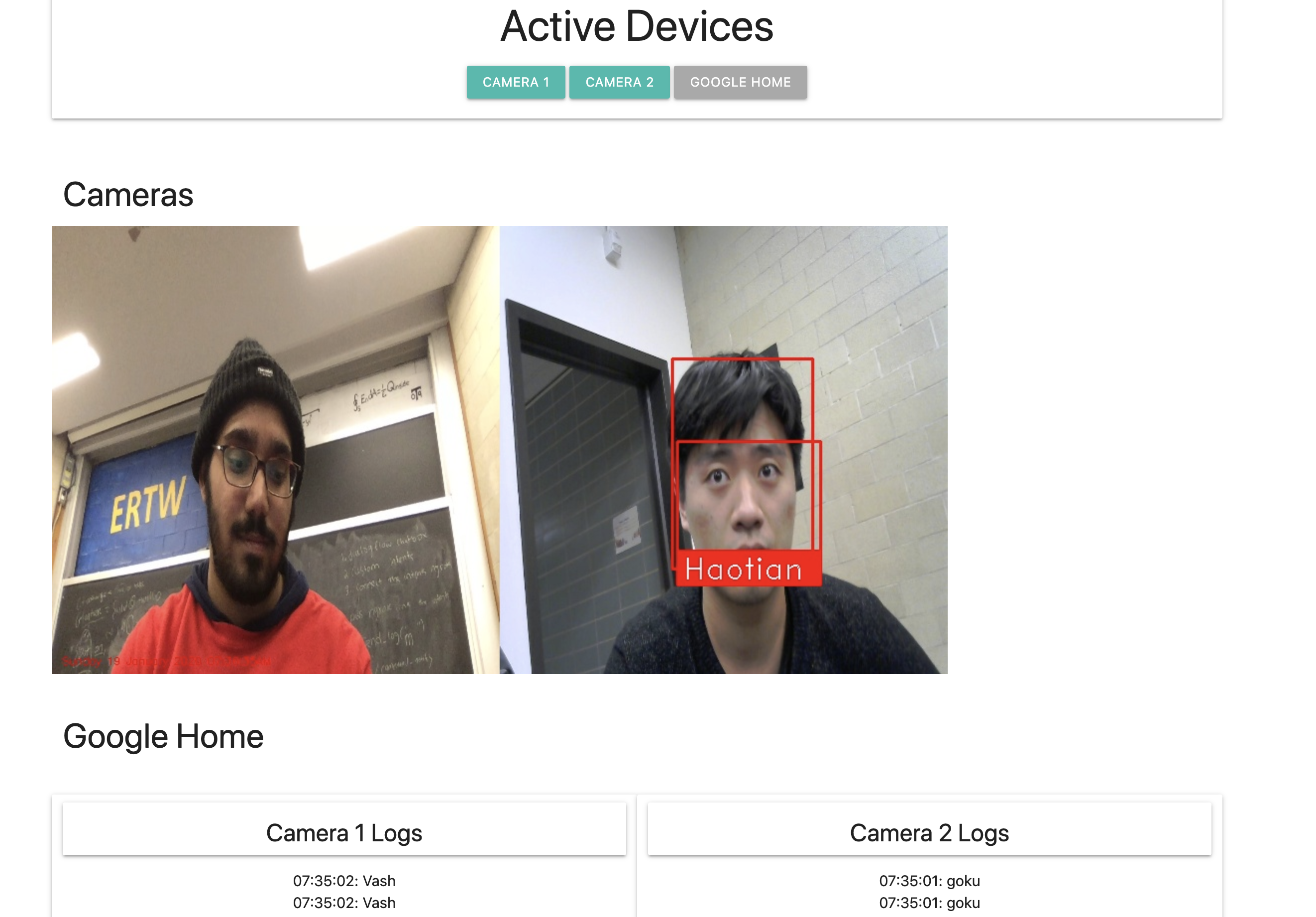
Site of people Getting Recognized
Inspiration
A lot of the technology that we use today will become obsolete in future ( as it has been in the past ). However; with the current advancements in the field of cloud technology and AI, old hardware can now be transformed into their intelligent form. Which is what inspired us to build Jarvis as it would allow us to not only avoid a national waste crisis but to also to provide intelligent systems for the betterment of the world.
What it does
Jarvis allows us to use a combination of existing hardware which may be obsolete (or soon to be) such as webcams, speakers, microphones, security systems and transform them into intelligent hardware. The platform uses the groundbreaking Google-Cloud-Vision APIs as the underlying engine which is then used to intelligently make use of the incoming input from the connected hardware. We also had to use a custom Natural - Language model in order to make accurate predictions. Further on, we are also making use of the Blockchain Technology to keep the data secure.
How we built it
The underlying Google-Cloud engine was built entirely with Python 3, whereas the front-end was built with the standard web-development tools ( HTML, JS, CSS). Google Firebase was the only API that was used on both sides of the platform which improved the flow of data significantly. Since Python and JavaScript execute under different systems, we had to use the Flask API to make a connection between the two. The platform primarily focuses on connecting system video hardware (webcam, security systems) so we also had to use OpenCV and other streaming pythons libraries to configure a multi-camera stream. Further on, we also used GETH and Web3 APIs to spin up a private blockchain network, which is being used to secure the data produced by the engine.
Challenges we ran into
One of the biggest challenges we ran into was in making the connection between the Python and Js portion of the project, which was mostly because our team had little knowledge on how the API worked (As it hosted its own server in-order to talk with the JS side of the project). Secondly, we also had trouble configuring multiple camera streams as the Linux OS is very specific on the default of the system. Thirdly, we also had trouble figuring out how exactly did the Google-Cloud-Vision works as some of the results were generalized.
Accomplishments that we are proud of
Our major accomplishment is that we were able to produce a working version of the platform that would allow different camera streams to be combined and be accurately analyzed with the Google-Cloud Engine. Along with it, we also have an object analyzer that uses the Google-Cloud-Vision and Natural-Language Engine to spot specific items.
What we learned
The most valuable that thing we learned is that an image can produce different sets of information, which if used correctly can predict its environment. Google-Cloud-Vision happens to be one of those tools that provided us with that technology and services.
What's next for Jarvis - Scalable Platform
Jarvis has an infinite number of use cases, which is why the team will continue to build modules that will provide the user with useful usage of Google-Cloud services. We plan on integrating the compatibility of other hardware(s) that might become obsolete in the foreseeable future.
Built With
- blockchain
- developement
- flask
- google-cloud
- google-cloud-vision
- google-home
- html5
- javascript
- materialize
- ngrok
- platform
- python
- react
- rpc
- twilio
- webcam

Log in or sign up for Devpost to join the conversation.