-
-
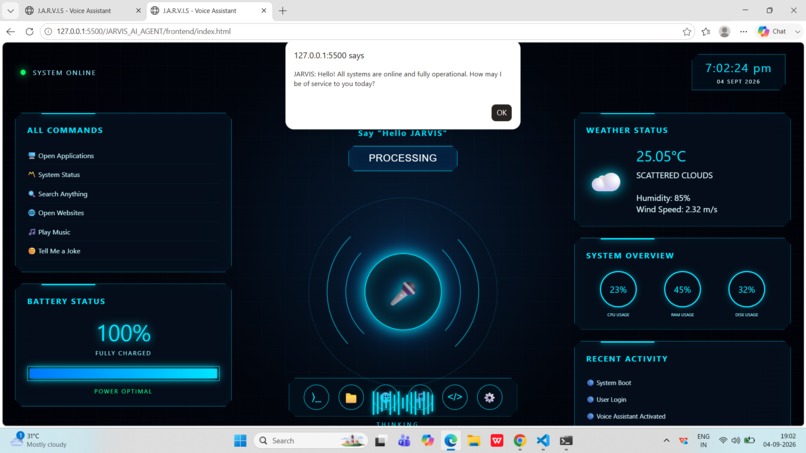
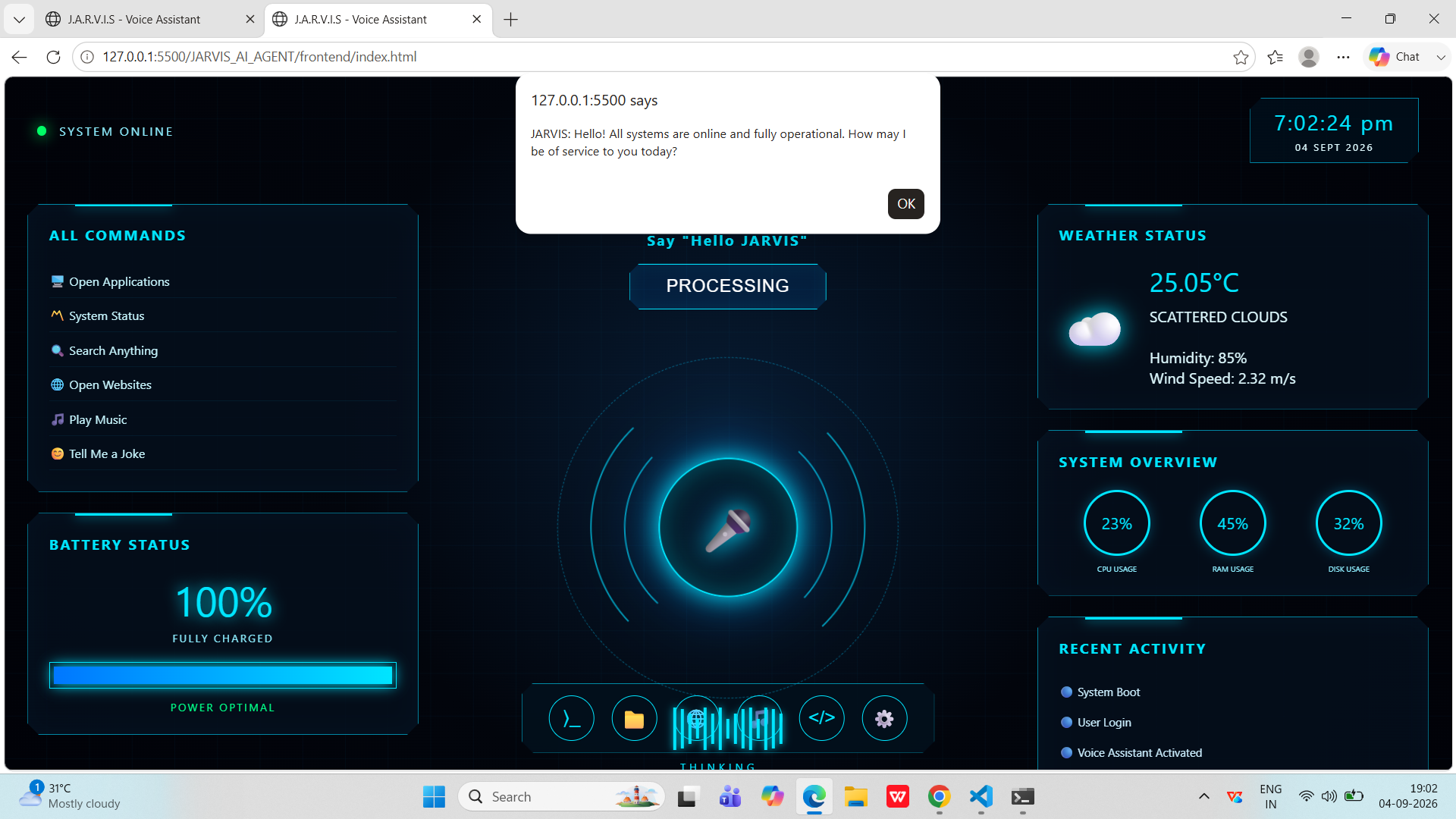
JARVIS — a voice-powered AI assistant that listens, understands, thinks, and acts to make everyday digital interactions smarter.
Inspiration
The inspiration behind "JARVIS Personal Assistant"came from the idea of having a personal AI that feels more natural and interactive than a traditional chatbot. I wanted to build an assistant that I could "talk to", ask questions, and eventually rely on for everyday digital tasks.
Inspired by futuristic AI assistants, I wanted to explore what it would take to turn that idea into a real working application using modern AI and voice technologies.
What it does
JARVIS Personal Assistant is a voice-enabled AI assistant that allows users to interact with AI using natural language.
Instead of typing every request, users can communicate with JARVIS through voice. It processes the user's request using an LLM, generates an intelligent response, and provides the response back to the user.
The goal is to make interaction with AI feel more natural, conversational, and human-friendly.
How we built it
JARVIS was built primarily using Python, with a modular structure that separates different parts of the application.
The main components include:
- Voice interaction for natural communication.
- LLM integration for understanding queries and generating intelligent responses.
- Python modules to organize the assistant's functionality.
- FastAPI for creating an API layer between the AI backend and the application.
- Environment variables for securely managing API credentials.
The basic workflow is:
Voice Input → Speech Processing → LLM → Response Generation → Voice Output
We started with a simple text-based prototype and gradually developed it into a voice-enabled assistant. This iterative approach helped us understand each component before integrating everything into one system.
Challenges we ran into
One of our biggest challenges was connecting all the individual components into a smooth end-to-end system.
Getting voice input, AI processing, API communication, and voice output to work together reliably required a lot of debugging. We also faced issues with Python dependencies, environment configuration, API integration, and communication between the frontend and backend.
Another challenge was designing the system in a way that would allow us to add more capabilities later without rewriting the entire application.
Each problem pushed us to understand the underlying technology instead of simply relying on pre-built solutions.
Accomplishments that we're proud of
We are proud that we were able to turn an initial idea into a "working AI assistant".
Some of the achievements we are particularly proud of include:
- Building a functional voice-based AI interaction system.
- Successfully integrating an LLM into a custom application.
- Creating a modular Python architecture.
- Connecting the AI backend through FastAPI.
- Moving from a basic text assistant toward a more interactive voice assistant.
- Learning and implementing multiple technologies together to create one complete project.
Most importantly, JARVIS gave us hands-on experience building an AI application from the ground up.
What we learned
Building JARVIS taught us that creating an AI product involves much more than simply calling an AI API.
We learned how LLMs, voice interfaces, APIs, Python modules, environment variables, and application architecture work together to create a complete AI system.
We also learned the importance of debugging, modular design, and iterative development. Many features did not work perfectly on the first attempt, but solving those problems helped us understand the technology much more deeply.
The biggest lesson was that building with AI is a continuous process of experimenting, testing, learning, and improving.
What's next for JARVIS Personal Assistant
JARVIS is only the beginning.
Our next goal is to transform JARVIS from a voice-enabled AI assistant into a more capable personal AI agent.
Future improvements include:
- Better conversational memory and context awareness.
- More natural and reliable voice conversations.
- Ability to interact with applications and perform computer tasks.
- Automation of repetitive digital tasks.
- Integration with useful external services and tools.
- Personalized responses based on user preferences.
- Multi-step task execution using AI agents.
Ultimately, we want JARVIS to move beyond simply "answering questions"and become an AI that can "understand, plan, and act".
"JARVIS — Listen. Understand. Think. Act."


Log in or sign up for Devpost to join the conversation.