Inspiration
Modern software can pass its automated tests and still be unprepared for release. A successful pipeline is important, but it does not automatically prove that security risks have been addressed, deployment requirements are satisfied, or the evidence needed for a release decision is available.
I wanted to explore how agentic AI could help developers make better release decisions by examining evidence instead of relying on assumptions.
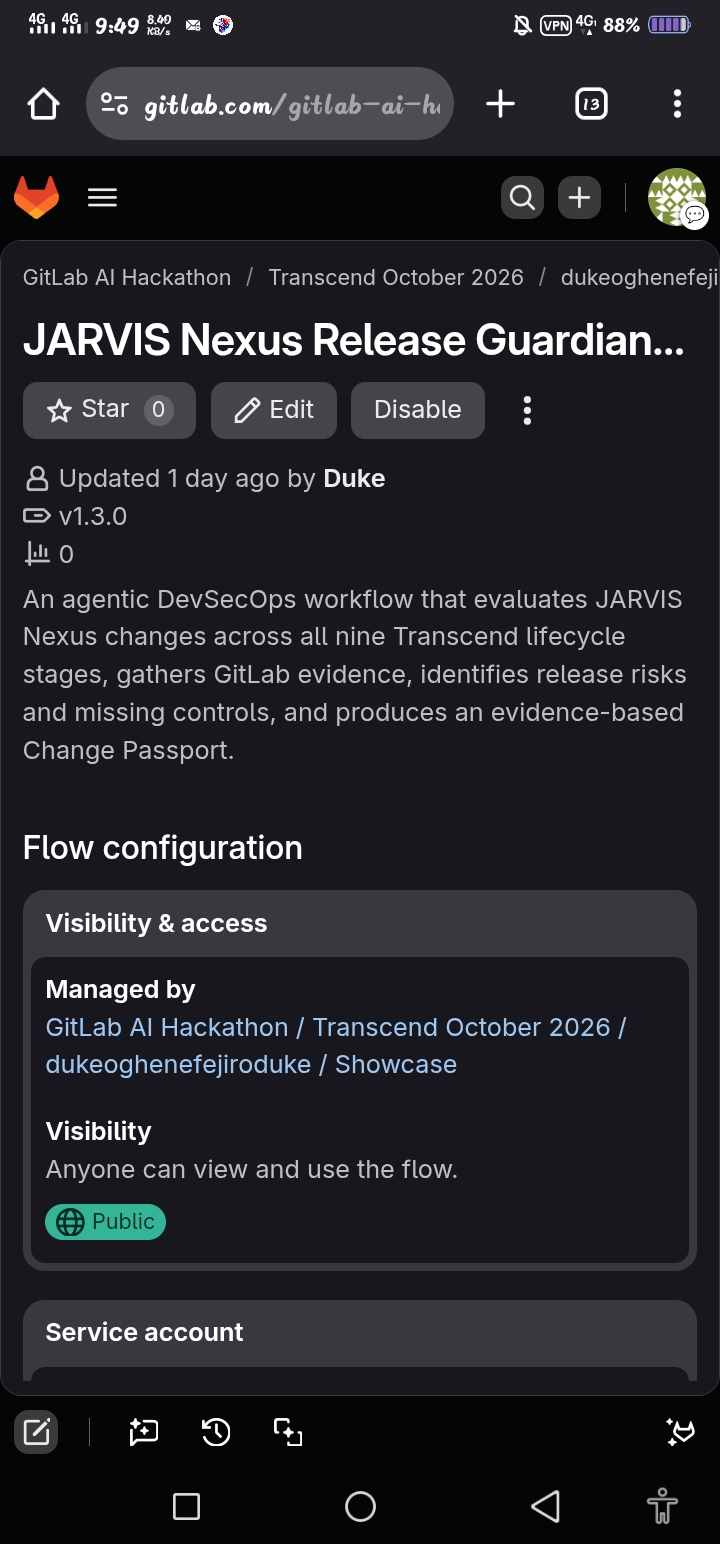
That led to JARVIS Nexus Transcend: Release Guardian, an extension of my JARVIS Nexus project that explores evidence-first release readiness assessment through GitLab's agentic workflows.
What it does
The Release Guardian concept organizes release-readiness checks around nine stages of the software lifecycle:
- Plan
- Create
- Verify
- Package
- Secure
- Release
- Configure
- Monitor
- Govern
Its intended workflow examines available project and merge-request information, code changes, commits, pipeline and job results, logs, security findings, vulnerabilities, discussions, repository files, and other relevant evidence.
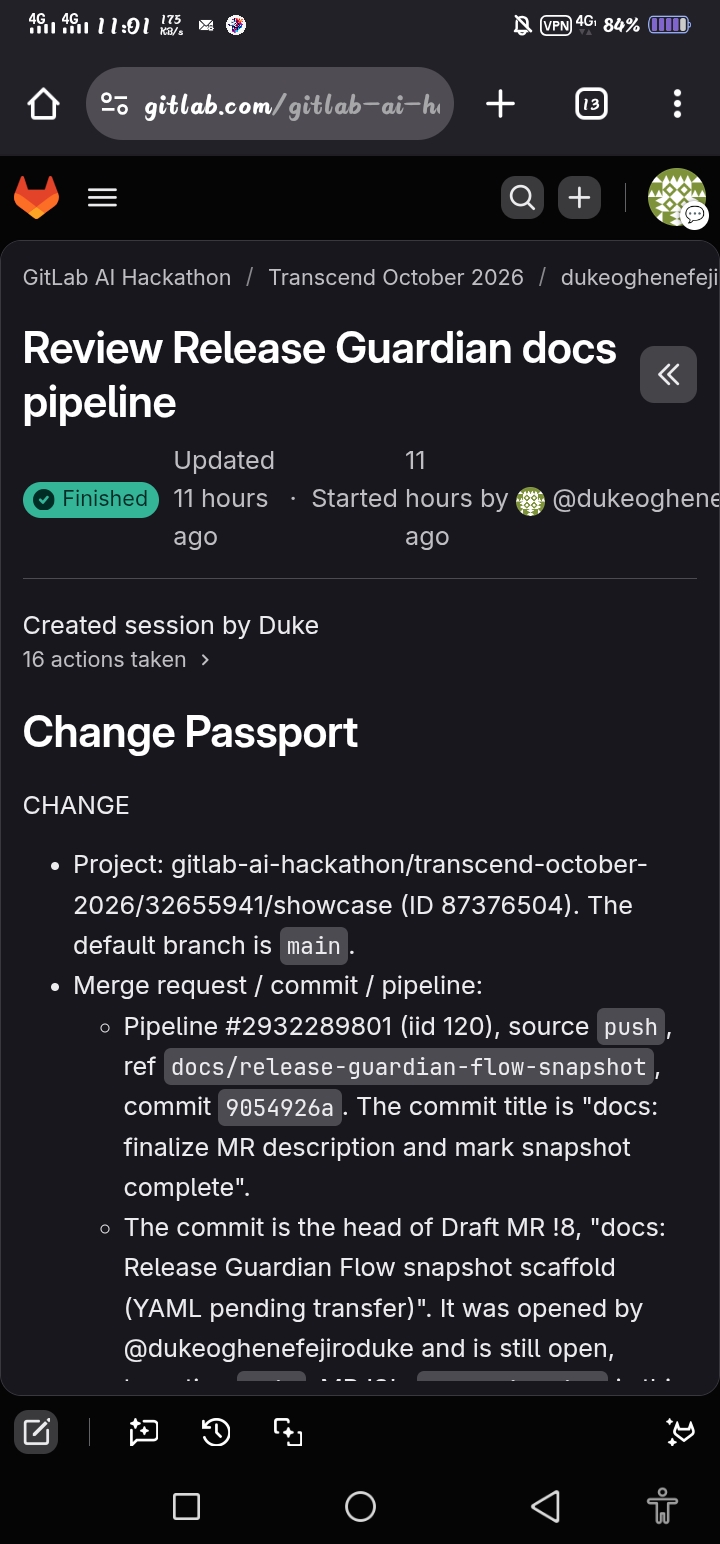
The goal is to produce a structured Change Passport that distinguishes between:
- VERIFIED: Supporting evidence is available.
- PARTIAL: Some evidence exists, but important information remains incomplete.
- UNAVAILABLE: The necessary evidence could not be obtained.
The proposed release outcomes are PASS, PASS WITH CONDITIONS, and BLOCK. These outcomes are intended to make the reasoning behind a recommendation easier to understand and review.
The central principle is simple: a successful CI pipeline should not automatically be treated as proof of production readiness. Missing evidence should be identified rather than silently assumed to be satisfactory.
How I built it
I used my existing JARVIS Nexus project as the foundation and developed the Release Guardian work for the GitLab Transcend Hackathon.
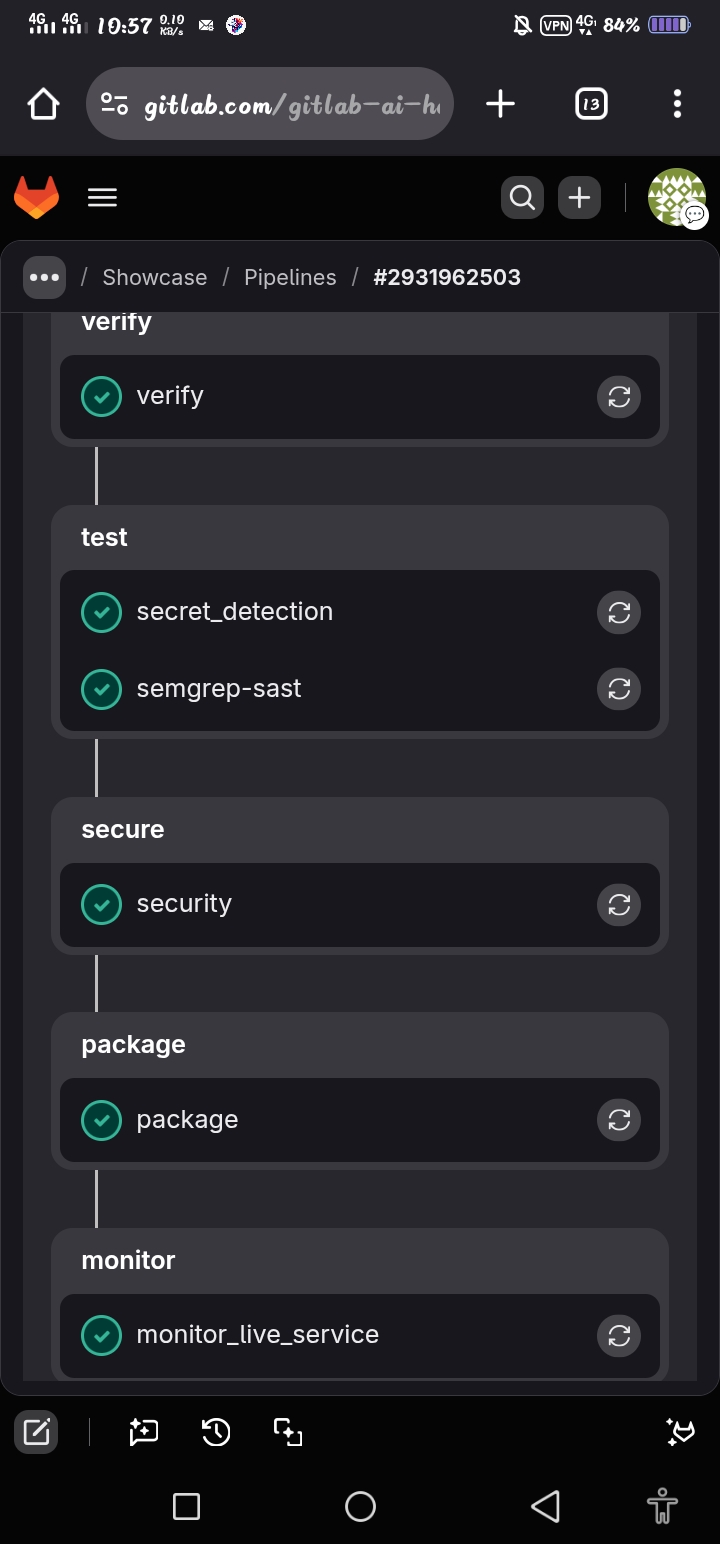
The repository includes a documented release-guardian flow snapshot, supporting documentation, and automated structural tests. I also added development dependencies required for the tests and integrated the checks into GitLab CI/CD.
The verification pipeline reported 132 tests, with one test skipped under its documented condition. The reported pipeline passed its verification and security-related jobs.
This work focuses on making the workflow understandable, inspectable, and testable. The flow snapshot and its documentation describe the intended structure; they should not be interpreted as proof that every stage has been executed successfully against a live GitLab project.
Challenges I faced
One major challenge was separating what a release workflow is designed to check from what the available evidence actually proves.
A pipeline can be green while security information, deployment evidence, monitoring data, or governance approvals remain missing. Treating unavailable information as a success would make an AI release guardian unreliable.
Another challenge was creating meaningful automated checks for a workflow definition without overstating what structural tests can demonstrate. Validating a flow file is not the same as independently verifying live execution or enforcing a merge gate.
I addressed these challenges by documenting the workflow, testing its structure, making evidence states explicit, and recording the limitations that still require further validation.
What I learned
This project strengthened my understanding of agentic development workflows, GitLab CI/CD, automated testing, and the difference between validating configuration and verifying real-world behavior.
I also learned that useful AI engineering is not just about generating recommendations. It requires traceable evidence, clear uncertainty, honest limitations, and outputs that developers can inspect before acting on them.
What's next
The next steps are to validate the documented flow against the live GitLab configuration, demonstrate its execution with real project evidence, and investigate how release recommendations could be integrated into a properly tested approval workflow.
JARVIS Nexus Transcend is an ongoing exploration of how agentic AI can help software teams make safer, more transparent release decisions.
Current status: The documented workflow and automated structural checks have been developed. Live flow equivalence, end-to-end execution, and enforced release-gate behavior have not yet been independently verified.
Built for the GitLab Transcend Hackathon
JARVIS Nexus Transcend brings together open-source development, agentic workflow design, CI/CD verification, and evidence-based release-readiness assessment.
Built With
- agentic
- agents
- ai
- ci/cd
- css
- devsecops
- duo
- gitlab
- html
- javascript
- python
- software
- sqlite

Log in or sign up for Devpost to join the conversation.