Inspiration
Most AI systems today exist inside simple chat windows. I wanted to explore what an Artificial Intelligence operating environment would look and feel like if it behaved more like a centralized digital system instead of a standard chatbot. Inspired by futuristic interfaces such as JARVIS from science fiction films, the goal was to create an immersive AI-powered desktop experience that combines voice interaction, persistent memory, visual intelligence feedback, and system monitoring into one unified platform.
What it does
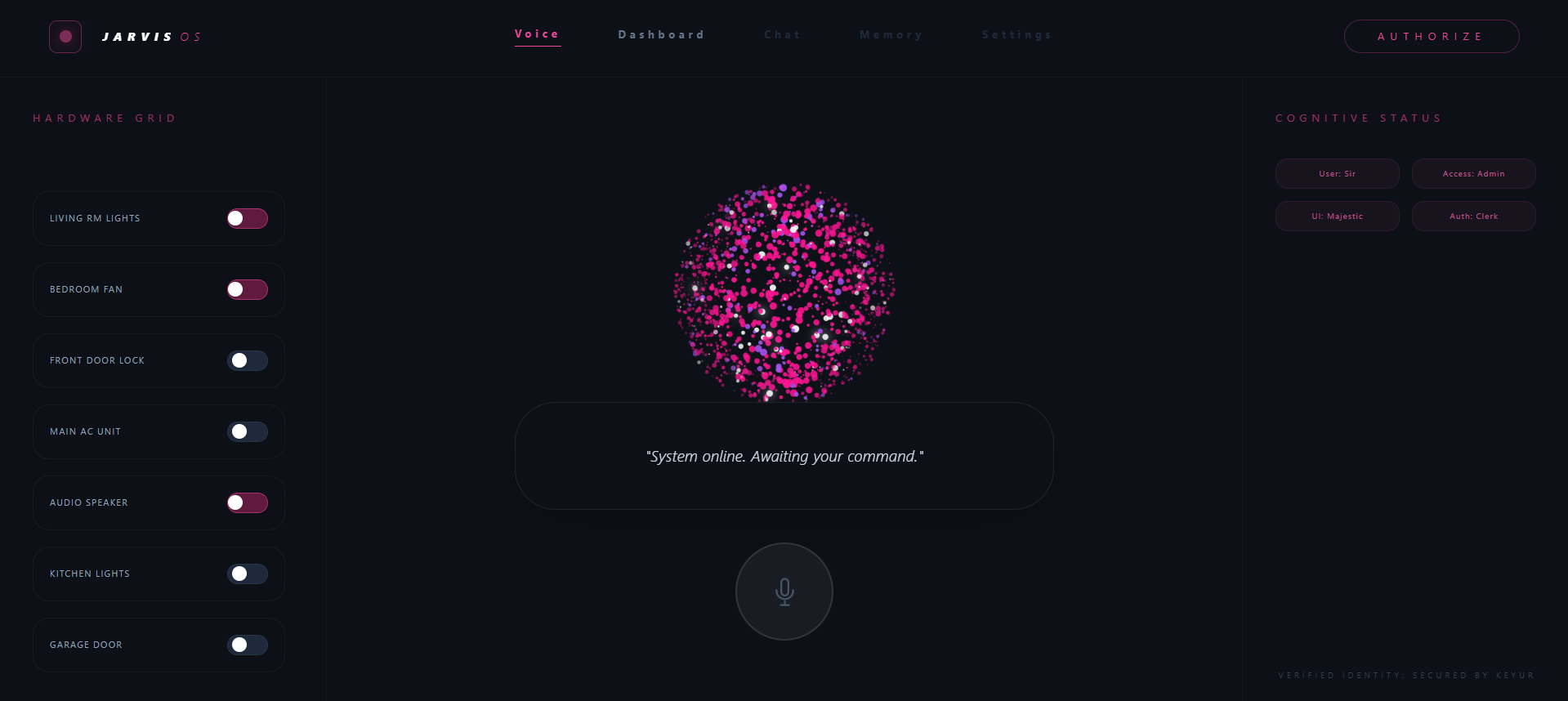
JarvisOS is a full-stack AI operating environment that supports both voice and text interaction while maintaining persistent contextual memory. The platform simulates a futuristic AI control center through animated system states, live telemetry logs, and a mathematical particle engine containing over 2,200 independently animated particles.
The application includes:
- Voice and terminal interaction modes
- Persistent cloud memory synchronization
- AI lifecycle states (IDLE, LISTENING, THINKING, SPEAKING)
- A simulated smart-device hardware control grid
- Hidden encrypted vault functionality
- Real-time system logs and monitoring panels
The overall experience is designed to feel like an intelligent operating system rather than a traditional web application.
How we built it
JarvisOS was engineered as a modern full-stack web application using React and Next.js. The frontend architecture uses Tailwind CSS, Framer Motion, and a custom HTML5 Canvas rendering engine to create smooth cinematic animations and responsive UI transitions.
Voice interaction was implemented using browser-native Speech Recognition APIs, while cloud database synchronization manages persistent user memories and system configurations. Clerk authentication was integrated to securely handle user sessions and route protection.
The particle system was developed from scratch using trigonometric motion equations and independent rotational calculations to create a responsive “cognitive core” visualization.
Challenges we ran into
One of the biggest challenges was maintaining smooth performance while rendering thousands of animated particles in real time alongside interactive UI components.
Another challenge involved synchronizing voice recognition, animation states, and cloud memory updates without creating delays or breaking immersion. Designing an interface that felt cinematic while still remaining functional also required multiple iterations and optimization passes.
Accomplishments that we're proud of
- Building a fully immersive AI operating environment instead of a standard chatbot
- Engineering a custom 2,200-particle mathematical rendering engine
- Successfully integrating voice interaction, cloud memory, and animated system states
- Creating a multi-modal interface with dashboard and terminal experiences
- Designing a futuristic UI system that feels responsive and intentional
What we learned
This project strengthened our understanding of full-stack engineering, real-time rendering systems, state-driven UI architecture, authentication security, and browser-based speech processing.
We also learned how important user experience design is when creating intelligent systems. Small details such as animation timing, state transitions, and system feedback significantly impact how believable and immersive an AI platform feels.
What's next for JarvisOS
Future plans for JarvisOS include:
- Streaming AI responses
- Adaptive long-term memory systems
- Real smart-device integrations
- Personalized daily briefing systems
- Modular AI tool execution
- Multi-user architecture
- Expanded AI reasoning pipelines
The long-term vision is to evolve JarvisOS into a centralized personal intelligence system capable of managing memory, automation, productivity, and contextual interaction inside a unified operating environment.

Log in or sign up for Devpost to join the conversation.