JARVIS-IV: A Real-Time Multimodal AI for Life Automation and Task Execution
Project Overview
Problem
Modern computing still requires users to manually operate systems:
- switching between applications
- structuring prompts for AI tools
- executing tasks step-by-step
Even with advanced AI, users remain responsible for translating ideas into actions. This creates friction between thinking and execution, reducing productivity and limiting the real-world usefulness of AI systems.
Solution
JARVIS-IV is a real-time multimodal AI system designed for life automation.
It acts as an intelligent execution layer over a computer system—capable of understanding user intent and performing tasks across applications in real time.
Instead of asking AI what to do, users can rely on JARVIS-IV to:
- interpret intent
- plan actions
- execute tasks
- deliver results
Working Prototype
JARVIS-IV is a functional system with the following working capabilities:
- Voice interaction (speech-to-text and text-to-speech)
- Screen and camera understanding (vision-based analysis)
- System automation (opening apps, performing workflows)
- Real-time web search and summarization
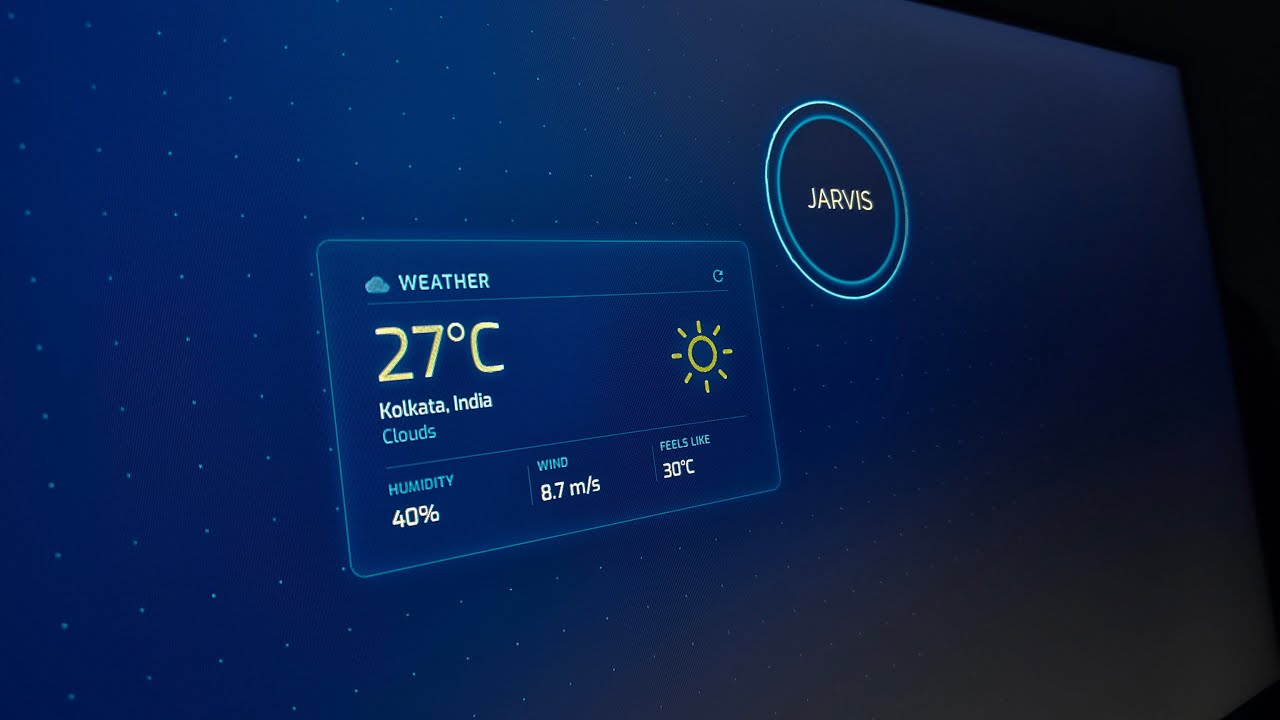
- Interactive UI with dynamic widgets
The system runs locally and provides real-time responses and actions.
How It Works
JARVIS-IV uses a multi-agent architecture, where specialized agents collaborate:
- AI Expert — reasoning and structured responses
- System Automator — executes system-level tasks
- Web Crawler — gathers and summarizes real-time information
- Vision Agent — analyzes screen and visual input
These agents are connected through a tool execution layer, allowing the system to move beyond responses and perform actual tasks.
Workflow:
- User provides input (voice, text, or screen)
- System interprets intent
- Appropriate agent is selected
- Tools are executed
- Results are delivered through UI
Innovation and Creativity
JARVIS-IV introduces a shift from:
Command-based interaction → Intent-driven life automation
Key innovations:
- Multimodal interaction (voice + vision + system control)
- Multi-agent coordination instead of single-model AI
- Real-time execution instead of passive responses
- Integration of automation, reasoning, and UI in one system
Technical Execution
- Python-based backend orchestration
- Eel framework for UI integration
- Google Gemini API for reasoning and vision
- Speech recognition and text-to-speech systems
- Automation tools (Selenium, PyAutoGUI)
- OpenCV for vision processing
The system is designed to balance responsiveness, modularity, and real-time interaction.
Real-World Usability
JARVIS-IV can be used for:
- Automating repetitive digital tasks
- Assisting with research and information retrieval
- Understanding on-screen content
- Enhancing productivity through hands-free interaction
It reduces the effort required to interact with software systems and improves workflow efficiency.
Impact
JARVIS-IV represents a step toward AI systems that:
- understand context
- adapt to user intent
- execute real-world tasks
This moves computing closer to intelligence-driven interaction, where systems actively assist rather than passively respond.
Future Scope
- Fully autonomous task execution pipelines
- Deeper OS-level integration
- Personalized life automation workflows
- Cross-device synchronization
Conclusion
JARVIS-IV is not just an assistant.
It is a system designed to automate how users interact with their digital environment—bringing us closer to true AI-powered life automation.
Built With
- api
- apis
- css
- eel
- gemini
- html
- javascript
- particle-js
- python


Log in or sign up for Devpost to join the conversation.