-
-
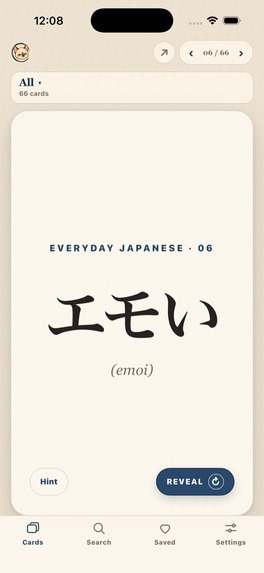
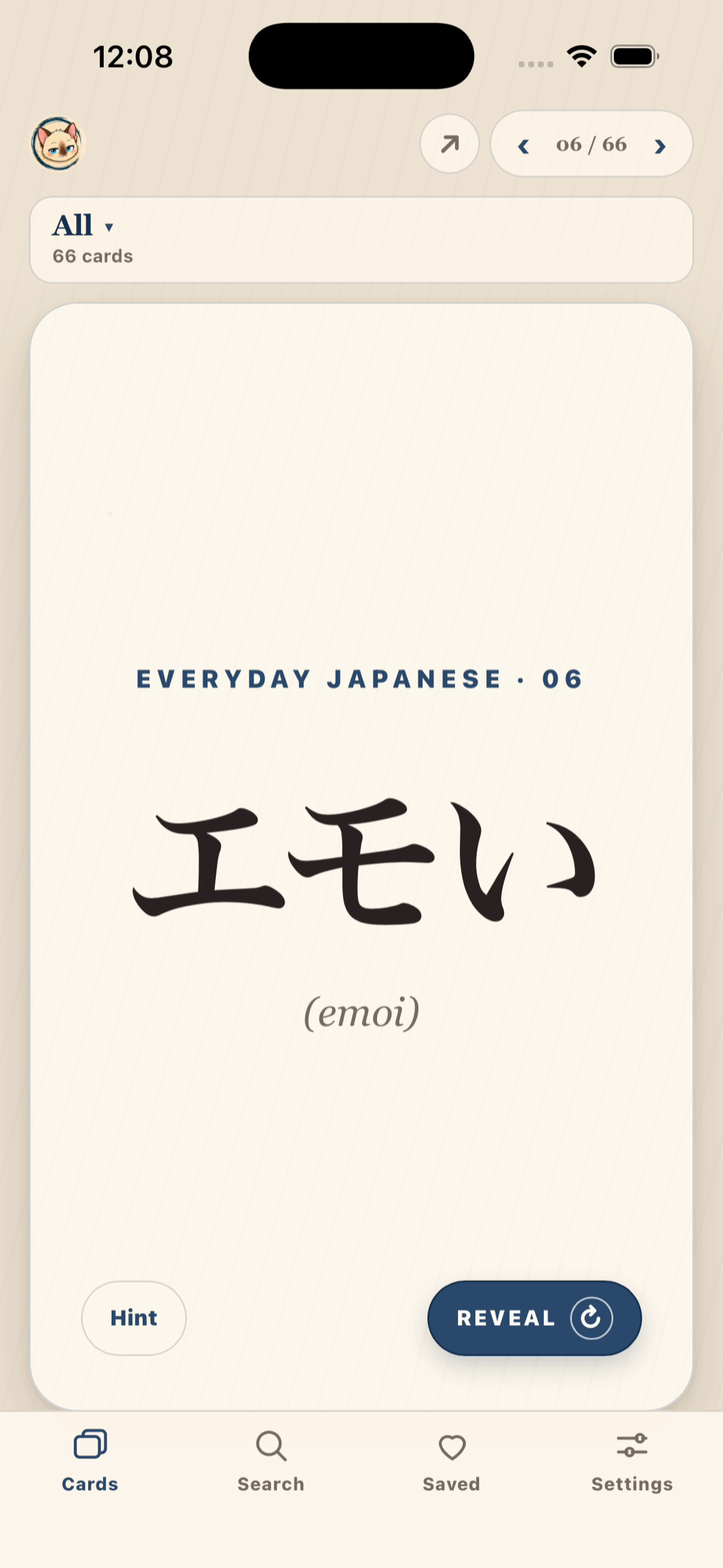
Card front (Pre-reveal): Guess modern Japanese slang with tactile prompts. Tap REVEAL to flip through all 66 cards.
-
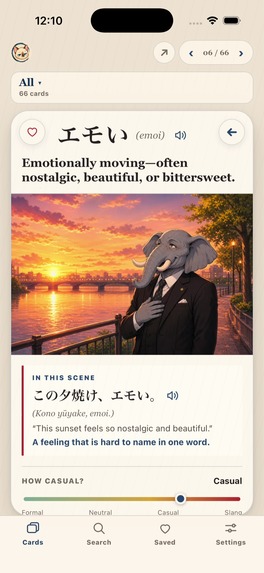
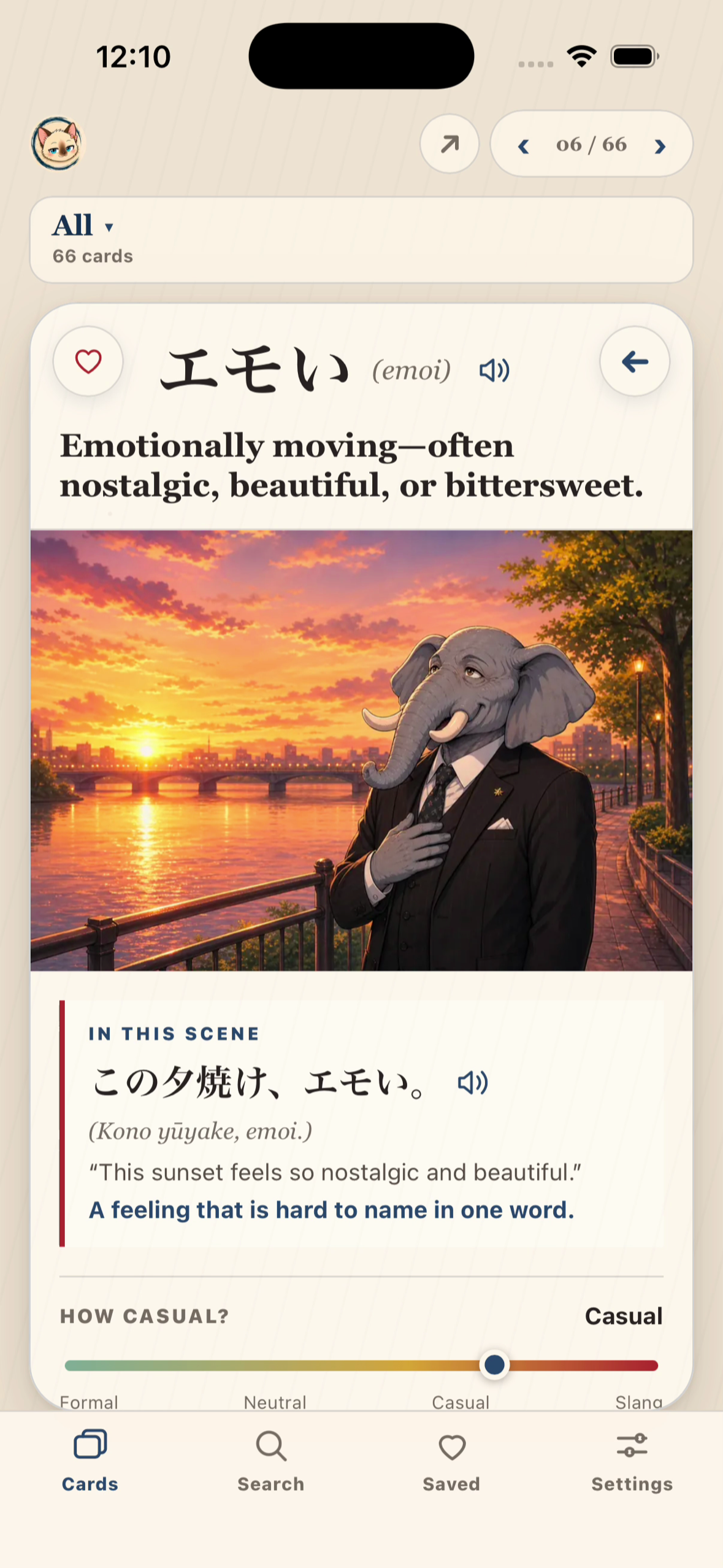
Card back (Revealed): Full-color manga scene with separate Japanese TTS controls for words & examples, plus a slang safety meter.
-
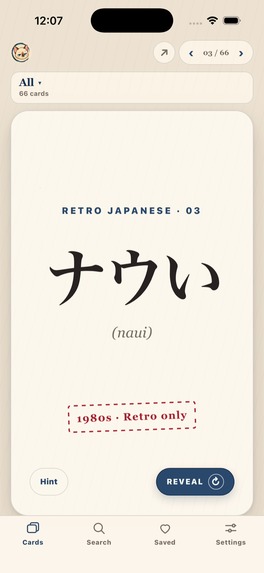
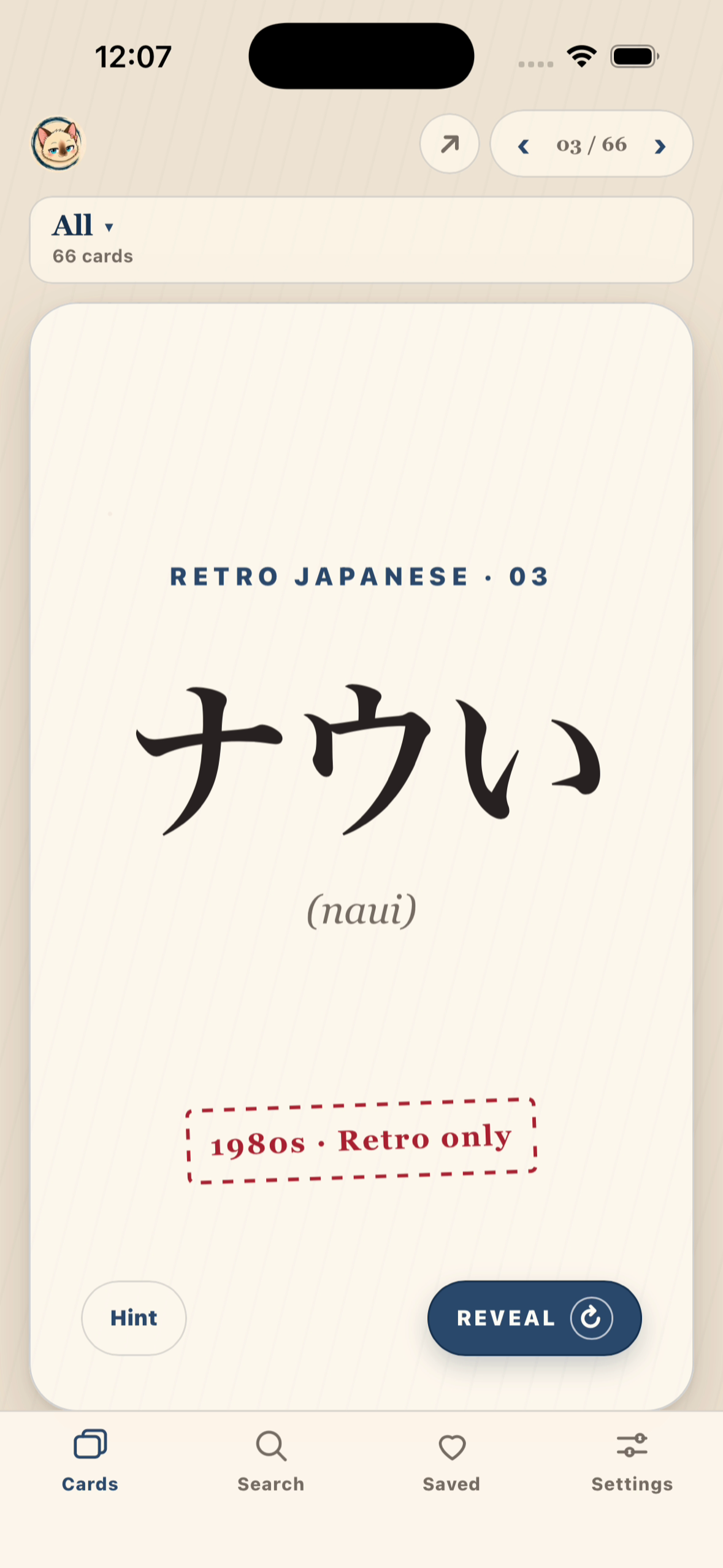
Diverse slang categories: From modern viral words to 1980s retro classics, curated with culture notes and nuances.
-
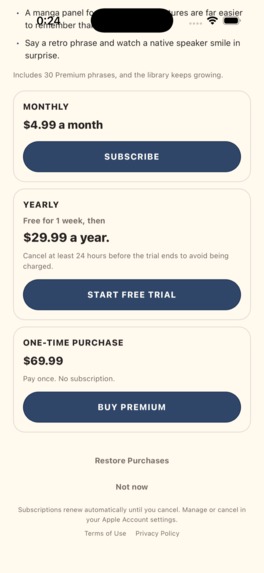
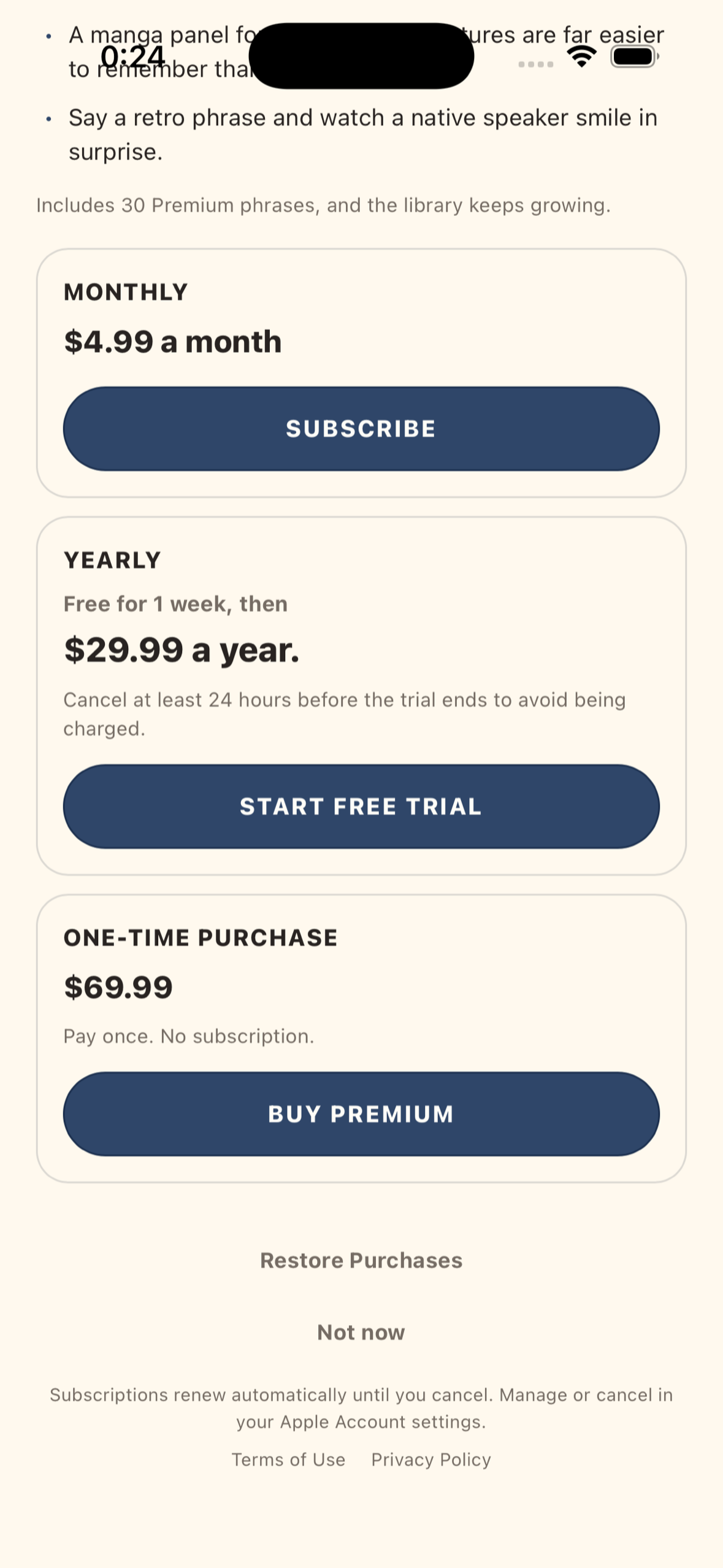
RevenueCat Paywall: 7-day free trial on annual plan ($29.99/yr), monthly ($4.99/mo), and lifetime ($69.99) with full restore support.
Inspiration
Standard Japanese textbooks like Genki or Minna no Nihongo do an excellent job teaching formal grammar and polite speech. But the moment learners dive into anime, manga, VTuber streams, Japanese social media (X, TikTok), or casual chats with native friends, they hit an invisible linguistic wall: real-world slang.
Phrases like Oshi (推し), Sorena (それな), Yabai (やばい), or Pien (ぴえん) permeate modern everyday culture. Yet when learners look them up in typical dictionaries, they encounter three critical roadblocks:
- Lack of Social Context: Conventional dictionaries explain literal definitions, but rarely tell you who you can say it to. Can you say this to a coworker? Only close friends? Is it insulting?
- Outdated Slang ("Freshness"): Slang evolves at lightning speed. Foreign learners often embarrass themselves by using slang that went obsolete a decade ago without knowing it.
- Absence of Visual & Vocal Nuance: Slang is 90% facial expression, tone, and comedic timing. A wall of plain text cannot convey why a word is hilarious, sarcastic, or affectionate.
We built Jargon Japan to solve this: an iOS dictionary crafted specifically for international anime and culture enthusiasts, bridging the gap with single-panel manga illustrations, context-aware safety ratings, and natural spoken audio.
What it does
Jargon Japan turns slang learning into an engaging, tactile card-based learning experience:
- Single-Panel Manga Cards: Every single slang phrase features custom manga artwork showcasing the exact emotional situation, facial expression, and character dynamics where the word comes alive.
- Tactile Card Interaction: Users tap to flip smoothly between visual immersion and clear English definitions, breakdowns, and cultural notes.
- Safety Register & Usage Guidance:
- Safety Meter: A tactile "How casual?" gauge paired with concrete "Best fit" social guidance (e.g. Friends · casual settings vs Friends and peers · avoid bosses and clients).
- Deck & Era Labels: Cards are tagged Trending Japanese, Everyday Japanese, Retro Japanese, and Japanese Jargon—clearly signaling nostalgic or era-bound phrases that are past their peak.
- Dual-Track Japanese TTS Audio:
- Word Audio: Clear standard pronunciation for headwords synthesized via Google Cloud TTS Neural2.
- Conversational Example Audio: Spoken dialogue lines generated via Gemini 2.5 Flash TTS with emotional cadence and natural pauses.
- Seamless Freemium Experience (Powered by RevenueCat):
- Free Core Dictionary: 36 essential slang cards with full audio, available immediately with zero ads and zero sign-up friction.
- Premium Collection (All 66 Cards): Unlocks the remaining 30 additional cards via an annual plan (with a 7-day free trial), monthly subscription, or lifetime purchase.
- Offline Content: All 66 cards, illustrations, and audio files ship in the iOS bundle. The free 36-card dictionary is fully usable offline; purchases, restores, current pricing, and Premium entitlement refreshes require connectivity.
How we built it
Jargon Japan was built by a solo indie creator with an AI-native pair-programming workflow. From the July product decision to the v1.1 release, the app evolved from a free 36-card iOS dictionary into a 66-card freemium product in roughly ten weeks.
Technical Architecture:
- Frontend & App Shell: Built with React and TypeScript bundled with Vite, packaged into a native iOS application using Capacitor.
- Subscription Architecture: We use RevenueCat’s Capacitor SDK (
@revenuecat/purchases-capacitor) to retrieve offerings, process purchases and restores, and read CustomerInfo-based Premium entitlement status. Our own customPaywallSheetand access layer render the resulting product and entitlement state. - Hybrid Japanese TTS Pipeline:
- Headwords (66 tracks): Synthesized with Google Cloud TTS (Neural2). Where slang readings needed correction, we used custom SSML phoneme and kana overrides.
- Conversational Examples (66 tracks): Primarily generated with Gemini 2.5 Flash TTS (
gemini-2.5-flash-preview-tts) using delivery prompts. Seven edge-case phrases that still produced unreliable readings use hand-tuned Neural2 SSML fallbacks.
- Visual Design & Assets: Manga illustrations designed with a cohesive pop aesthetic, curated into an artisanal palette celebrating modern Japanese print culture.
Challenges we ran into
- The Pronunciation Trap of Japanese Slang: Off-the-shelf TTS engines can struggle with modern slang—for example, reading Emoi (エモい) as Kimoi (キモい), or flattening the dynamic accent of Oshi (推し). We built an automated phonetic review pipeline that generated multiple accent variants, tuned SSML pitches, and implemented custom kana override dictionaries to achieve natural spoken delivery.
- Balancing Rich Visuals with Lightweight Performance: Displaying dozens of high-resolution manga cards with instant audio response without bloating app memory required meticulous asset compression (optimized WebP/PNG) and disciplined DOM management in Capacitor.
- Designing a Respectful Paywall UX: We refused to implement deceptive dark patterns or aggressive lockouts. Ensuring the free tier remains a complete, delightful 36-word product while making the 30-word premium tier compelling required careful state machine modeling and RevenueCat offering orchestration.
Accomplishments that we're proud of
- Solo Zero-to-One Launch: Designed, built, and shipped the app directly to the App Store as an indie solo developer in roughly ten weeks.
- Production RevenueCat Integration in v1.1: Shipped a fully functioning in-app purchase and subscription system featuring an annual plan with a 7-day free trial, plus monthly and lifetime options, backed by RevenueCat's resilient infrastructure.
- Live in 9 Global Storefronts: Successfully published and available on the App Store in the United States, Japan, Great Britain, Canada, Australia, New Zealand, Singapore, Hong Kong, and Taiwan.
- Built in Public: Transparently documented the engineering journey, architectural challenges, and marketing lessons on note and social media.
What we learned
- Ship Small, Iterate Live: Releasing the free core dictionary first allowed us to test real-world device responsiveness and store performance before adding the subscription layer.
- Subtractive UI Craft: In educational apps, what you leave out is as important as what you put in. Stripping away heavy toolbars, complex gamification badges, and intrusive ads allowed the joy of the manga cards to shine.
- Audio Authenticity is Paramount: For language learners, robotic audio breaks immersion. Combining rule-based phonetics for words with LLM-steered emotive audio for dialogue created a uniquely delightful learning tool.
What's next for Jargon Japan
- Seasonal Slang Packs: Introducing monthly themed slang drops (e.g., Gaming & Otaku culture, Workplace irony, TikTok-viral terms).
- Interactive Quiz & Daily Review Decks: Adding lightweight spaced-repetition swiping to help users test their slang mastery.
- Community Slang Submissions: Allowing users to propose trending slang from their favorite anime or streamers, with community voting and monthly curation.
Built With
- capacitor
- edtech
- gemini
- google-cloud
- ios
- react
- revenuecat
- typescript
- vite

Log in or sign up for Devpost to join the conversation.