-
-
Logo for more interaction with people
-
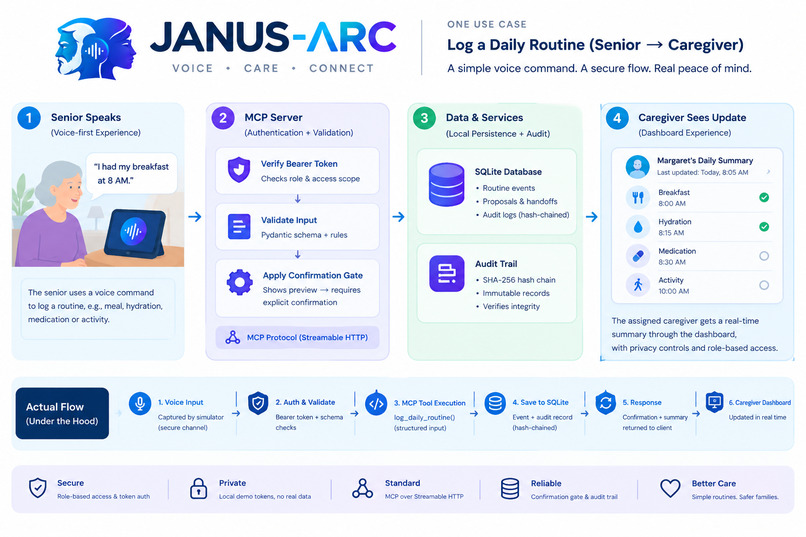
Usecase
-
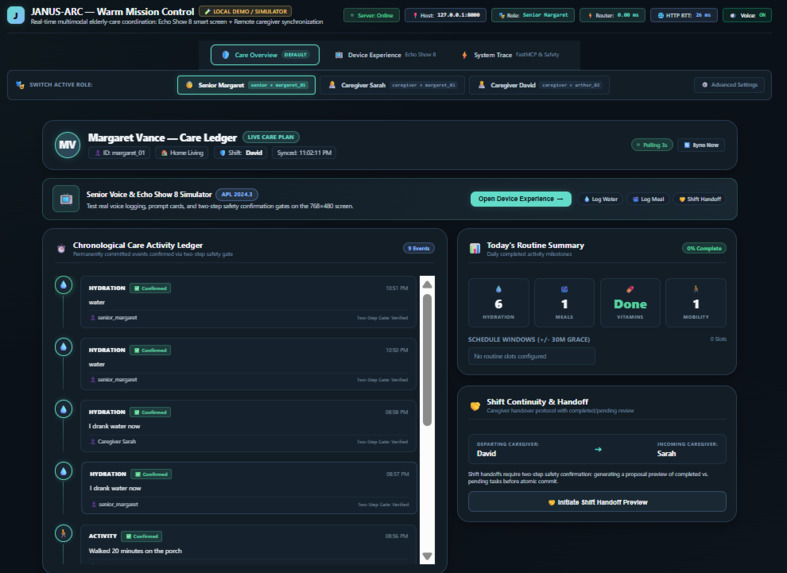
DEMO UI
-
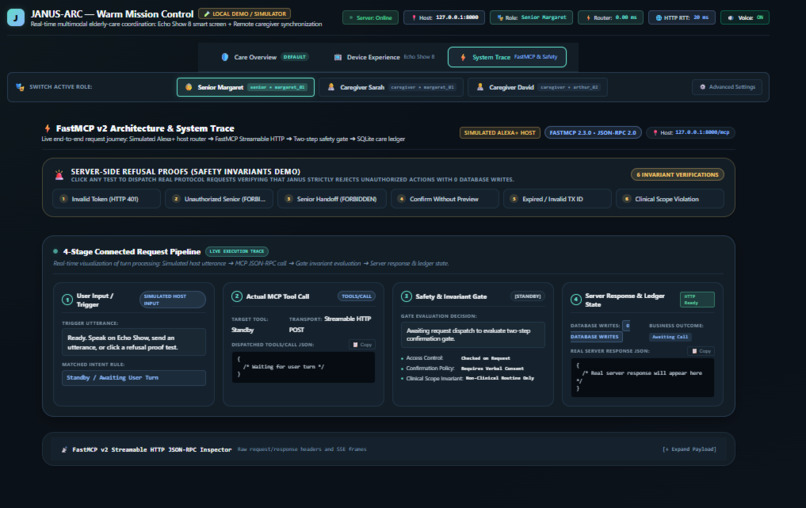
DEMO UI
-
DEMO UI
Inspiration
JANUS-ARC started with a simple question: What if an older adult could record everyday routines just by speaking, while their family could stay informed without relying on constant calls and messages?
Many older adults find it frustrating to navigate small touchscreens, remember app logins, or enter routine information manually. Meanwhile, family members who live elsewhere may have difficulty keeping track of everyday activities such as meals, hydration, vitamins, and physical activity.
We wanted to explore how voice-first technology could make this experience more natural, while giving families useful visibility without compromising privacy or turning everyday care into constant monitoring.
What it does
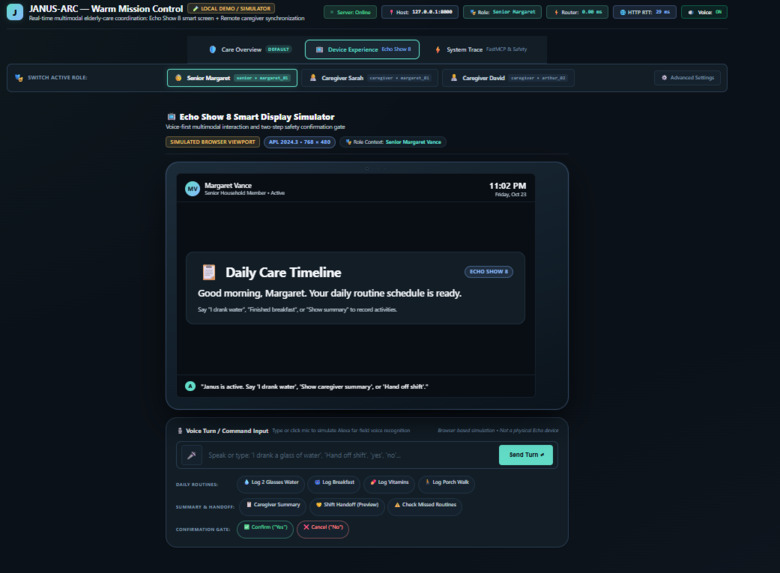
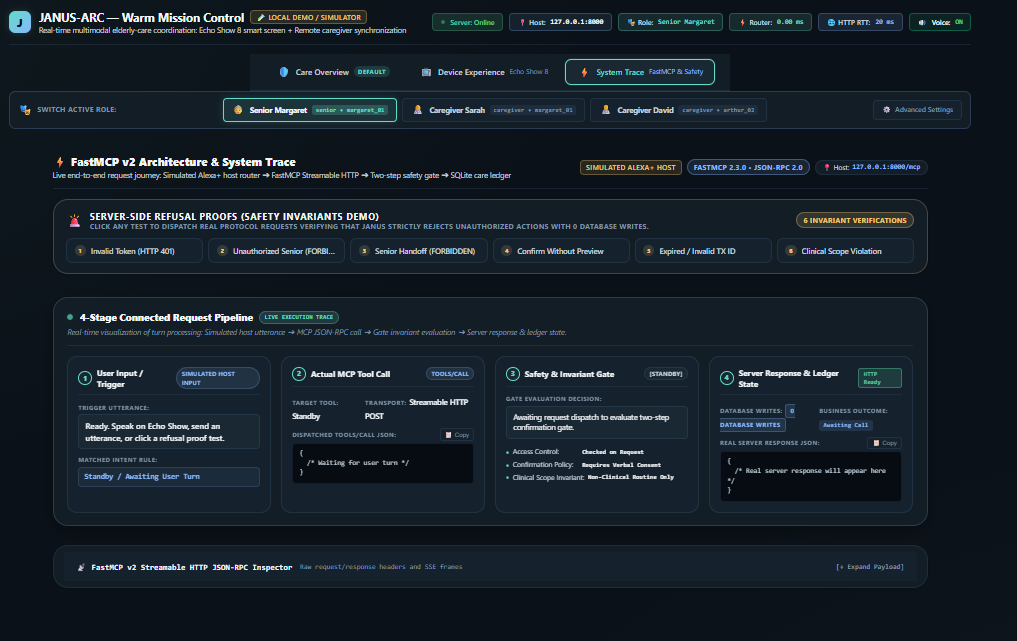
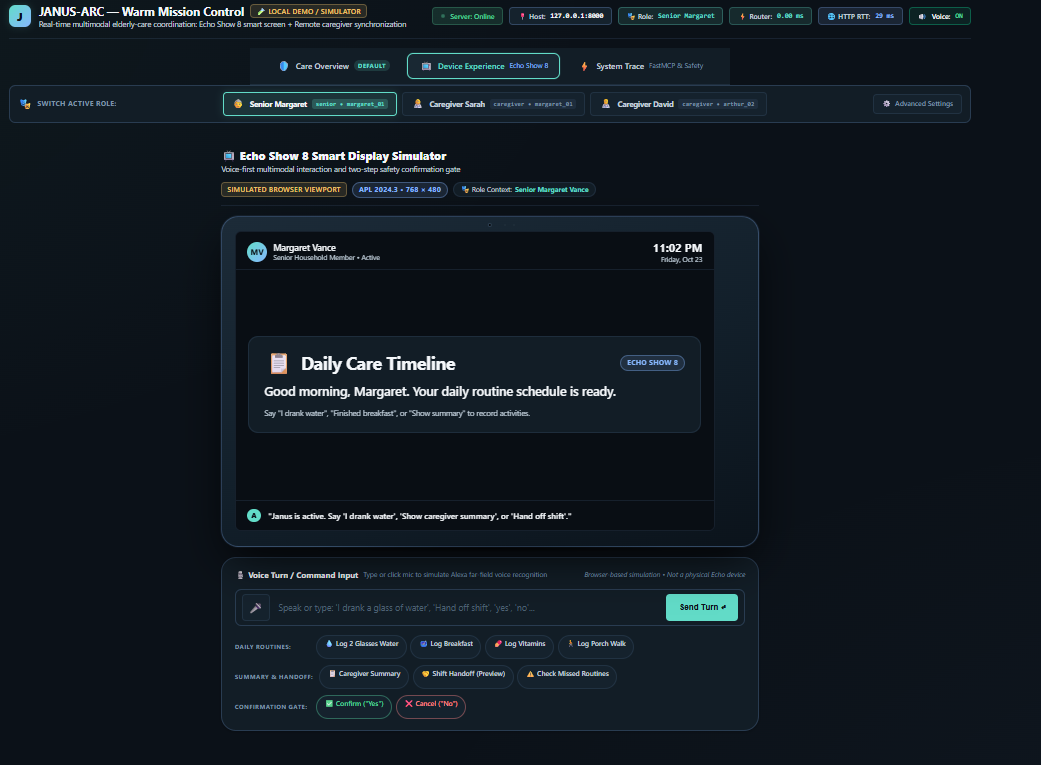
JANUS-ARC is a self-hosted Model Context Protocol (MCP) server and an Alexa+-style dual-screen simulator for non-clinical eldercare coordination.
- Senior experience: a voice-oriented interface (Echo Show 8 viewport) for recording everyday routines through structured actions.
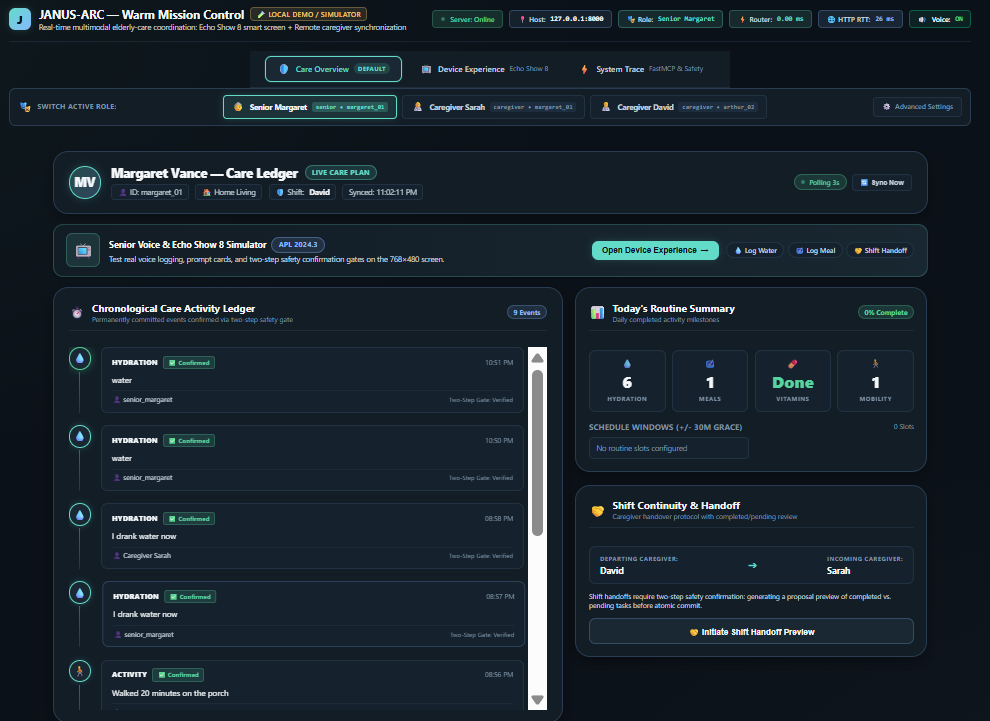
- Caregiver experience: a separate dashboard that polls every 3 seconds to show routine summaries and recorded events.
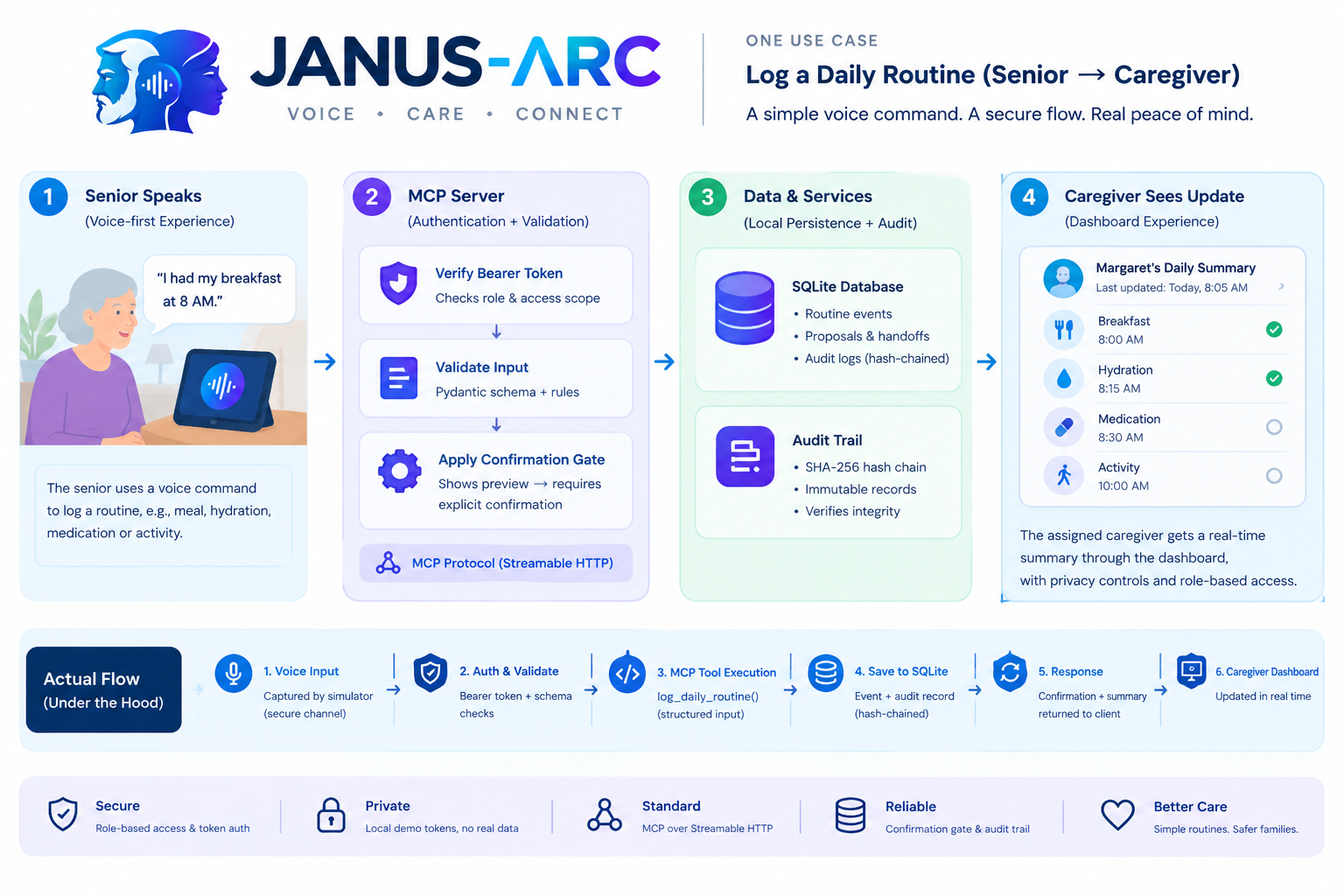
The server exposes four core MCP tools:
log_daily_routine: proposes a routine log (meal, hydration, vitamins, activity, wellness). Writes nothing yet.verify_routine_state: commits a proposal only after explicit confirmation.get_caregiver_summary: read-only daily summary for caregivers.flag_missed_routine: flags overdue routines.
Role-based Bearer token authentication restricts access by role. A two-step confirmation workflow means a request first produces a preview, and the change is committed only after explicit confirmation. A SHA-256 hash-chained audit trail makes tampering with recorded data detectable.
JANUS-ARC is intentionally limited to routine coordination. It is not designed to diagnose conditions or replace professional care.
How we built it
We built JANUS-ARC iteratively, using Antigravity as a coding assistant and working through the server, simulator, authentication, storage and testing as separate parts.
- Backend: the official Python MCP SDK over Streamable HTTP, a Starlette-based server, Pydantic v2 schemas, and SQLite for local persistence.
- Simulator: a browser-based dual-screen demo, so the senior and caregiver experiences can be explored without a physical Echo device.
- Testing: we focused on making the core workflow testable rather than relying only on a polished interface. Automated tests cover authentication, access boundaries, confirmation gates, audit behaviour and MCP interactions.
Challenges we ran into
Authentication and client-server communication. A request can reach the server and still fail because the Bearer token is missing, invalid, or unavailable in the active demo configuration. Debugging these cases taught us that a successful server startup doesn't mean the complete user journey works.
Making updates safe. A voice-driven system shouldn't silently turn an uncertain request into a persistent change. We addressed this with a proposal-and-confirmation workflow and tests intended to verify that unconfirmed actions don't write data.
Balancing convenience with privacy. The senior and caregiver experiences need to communicate, but one user's credentials must not grant access to another senior's information.
Accomplishments that we're proud of
- 58 passing tests, with 97% coverage on the auth, gate and audit modules.
- A real-network benchmark (50 calls per tool against a live server), with p95 latency under 45 ms over loopback.
- Output schemas validated against live server responses.
- A one-command smoke test so reviewers can verify the project quickly.
What we learned
Building JANUS-ARC helped us understand how an MCP server connects an agent-facing interface to structured tools, how HTTP authentication and role-based access control protect those tools, and how database transactions and audit records support accountability.
It also reinforced a lesson about AI-assisted development: generating code is only one part of building a reliable application. The resulting behaviour still needs to be tested, edge cases investigated, and security assumptions verified.
Known limitations
- Not tested on a physical Alexa device (validated against the APL spec and the simulator).
- Demo-mode authentication tokens only. Login with Amazon / OAuth 2.0 isn't implemented.
- Single-node local SQLite, built for local use.
What's next for JANUS-ARC
JANUS-ARC is a working development prototype. Next, we want to validate the full experience with real users, improve the clarity of error and confirmation messages, and evaluate integration paths beyond the simulator.
Our goal is to make everyday routine coordination feel less like filling out forms and more like a simple conversation, while making sure convenience never comes at the expense of consent, privacy, or control.


Log in or sign up for Devpost to join the conversation.